
Failure to Appear Warrant: Fastest Way to Resolve
Jason Goldsmith, Esq
You just missed court, or you think you did, and now every ring of your phone feels like trouble. In Broward, Miami-Dade, or Palm Beach, that kind of mistake can turn a routine case into a failure to appear warrant before you've even had time to call the clerk, check the mailbox, or ask your lawyer what happened. The hard truth is simple, the warrant is usually the bigger emergency than the original charge, because once it exists, any stop, any jail intake, or any courthouse check can turn into an arrest.
The good news is that this does not have to snowball. Courts issue and serve failure-to-appear warrants in large numbers, and the system is built to move people back into compliance, not just punish them forever. What matters now is speed, documentation, and choosing the right move before the system chooses one for you.
Table of Contents
When a Missed Court Date Turns Into a Bigger Problem Than the Original Case
What Actually Happens When You Get Arrested on an FTA Warrant
Defenses and Mitigation Strategies That Actually Work in Florida
Why Acting Quickly With a South Florida Defense Attorney Changes the Outcome
Frequently Asked Questions About Florida Failure to Appear Warrants
When a Missed Court Date Turns Into a Bigger Problem Than the Original Case
A Broward County client misses a routine hearing because the notice went to an old address, or because a child got sick and the morning went sideways. At first, it looks manageable, maybe a reschedule, maybe a warning, maybe a fine on the original case. Then the warrant lands in the system, and now a traffic stop on I-95 can turn into handcuffs.
That's why I tell clients to stop thinking about the missed date and start thinking about the warrant clock. A failure-to-appear warrant sits in law enforcement databases, and once it's active, it changes how every deputy, city officer, and jail intake deputy sees you. A minor court problem can become a custody problem fast.
The best recent numbers from Connecticut's Sentencing Commission show why this issue is not some rare courtroom mistake. As of 9/30/2025, Connecticut had 37,947 active failure-to-appear warrants, and 81% were for misdemeanor second-degree FTA warrants rather than felonies, which tells you these are often lower-level cases, not violent ones (Connecticut Sentencing Commission report). That same report said warrants were issued at about 5,000 per quarter and served at about 3,500 per quarter, so the backlog keeps growing.
Practical rule: If you discover a missed date, the first 48 hours matter more than the next 48 days.
For Florida clients, that means the smart move is not to wait and hope the system cools off. It's to confirm whether the court already entered a warrant, whether bond changed, and whether any probation issue got triggered at the same time. If your missed date was on a traffic matter, this court-appearance guide shows how quickly a simple appearance problem can become a warrant problem.
Six things matter right now, your notice, the exact court date, whether the warrant is already active, whether bond exists, whether probation is involved, and whether a lawyer can push a recall before arrest becomes unavoidable.
What a Failure to Appear Warrant Actually Is in Florida
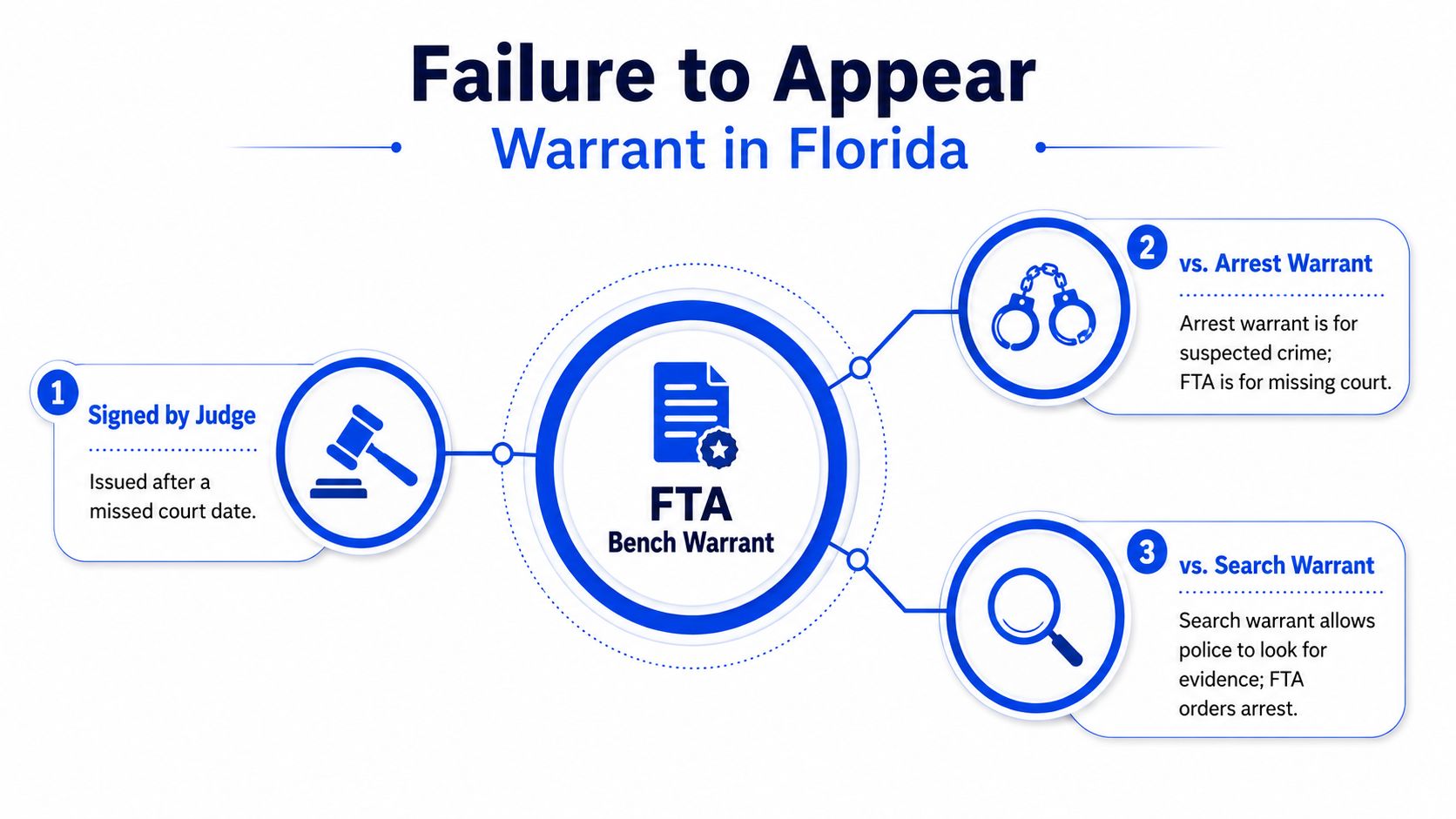
A failure to appear warrant is usually a bench warrant, which means a judge signed it because a person missed a required court date. It is not a search warrant, and it is not the same thing as an arrest warrant issued because police think you committed a new offense. The difference matters because the legal problem here is nonappearance, not necessarily a new act of wrongdoing.
Who issues it and what gets entered
In Florida, the judge signs the warrant after the missed court date, and the clerk's office then enters it into the systems law enforcement checks. That means the warrant can show up in a county jail, during a roadside stop, or when an officer runs your name for some unrelated reason.
The paper usually ties directly back to the original case, so the warrant does not replace the old charge. It sits on top of it and makes the original case harder to manage until it's addressed.
That's why many clients are confused when they hear “bench warrant” and assume it means a brand-new crime. Sometimes it does lead to a separate charge, but the first event is procedural, a missed court appearance that triggered the court's enforcement power.
What makes it different from other warrants
A search warrant lets police look for evidence. An arrest warrant usually comes from suspected criminal conduct. A bench warrant tells police to bring the person back because the court ordered them to appear and they didn't.
The safest assumption is this, once the warrant is entered, every law-enforcement encounter becomes a possible arrest point until counsel gets it recalled or you surrender under control.
That's the reason this is more than a calendar problem. It is a court-order problem, and court-order problems move faster than many expect. If you need a related example of how missing court gets handled in traffic matters, this FTA traffic court page is useful background.
Real Consequences Floridians Face After an FTA Warrant
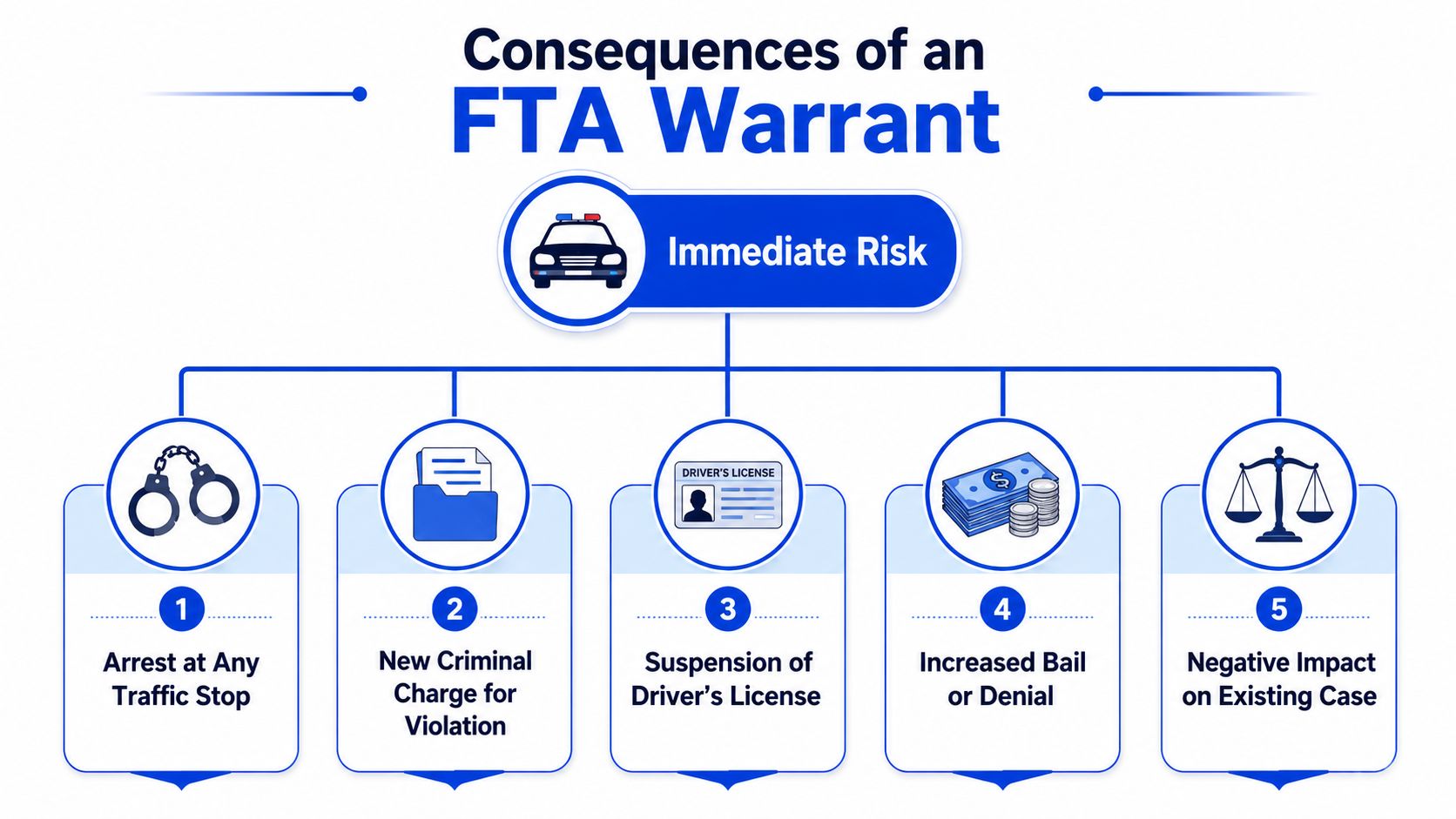
The first consequence is the one people feel in their stomachs, arrest risk. A warrant can be used at a traffic stop, at booking, or during any police contact, and once it's hit in the system, the officer usually isn't going to debate the reason you missed court on the side of the road. You're getting taken in first, and explaining later.
What changes once the warrant exists
If there was a bond before, it can become less useful or harder to use. Some clients who thought they were safely on release learn that the judge wants them back in custody or wants a new bond review. That can mean a no-bond hold or a higher bond setting after the court sees the missed appearance.
The second consequence is the possible license problem. In Florida, missed court dates in some criminal and traffic matters can spill into driver-license issues, which is a nightmare if you commute through Fort Lauderdale, Coral Springs, Miami, or West Palm Beach every day. A warrant plus a license hold can leave you boxed in, unable to drive legally and at risk if you get stopped again.
The third consequence is probation or community control exposure. If you're on any kind of supervised case, an FTA can be treated as a technical violation, which means the missed date does not just affect the old case, it can drag your probation officer and the judge into the picture too.
Why a missed date can become a new case
Some jurisdictions treat FTA as a separate offense. Washington's law, for example, makes it a gross misdemeanor when the underlying matter is a felony, and a misdemeanor when the underlying matter is itself a misdemeanor or gross misdemeanor, which shows how the underlying case can control the exposure (Washington RCW 9A.76.190). Texas also shows how a missed date can lead to a separate charge and a fine of not more than $500 in at least one county court guidance page (Harris County Criminal Court FTA guidance).
The point is not that every Florida case turns into a new charge. The point is that a missed appearance can create multiple problems at once, warrant, bond, license, and probation, and you need to treat it like a legal emergency, not a clerical one. National jail data reinforce how serious that can get, with a 2026 analysis of 562 jails finding 13% of bookings related to failure to appear and more than half of those being FTA-only bookings (Prison Policy Initiative and Jail Data Initiative analysis).
How to Clear or Recall a Florida Failure to Appear Warrant
The fastest fix is usually not dramatic. It's controlled, documented, and done through counsel. In some cases, an attorney can call the clerk or the prosecutor's office, confirm the warrant, and ask the court to set a recall or new hearing date without forcing a surprise arrest.
The usual paths back into compliance
A written motion to recall or quash the warrant is common when the missed date has a clean explanation and the judge is willing to hear it. The motion should explain the reason for the nonappearance, attach proof if you have it, and ask for a reset or a recall instead of waiting for arrest.
Sometimes voluntary surrender is the safer choice, especially if the court is unlikely to recall the warrant on paper alone. If the judge has already set bond, counsel can often ask for a bond review or a new hearing so you're not stuck with a number that was set while you were absent.
Best move: get the warrant verified first, then decide whether the next step is a recall, a bond hearing, or a controlled surrender.
You need documents ready before anyone files anything. Bring the original citation or case number, any mailed notice, the last court paperwork you received, proof of hospitalization or travel disruption if that applies, and your current contact information. If a traffic matter is involved, this article on failure-to-appear traffic court is a helpful reference for how these cases are handled in practice.
There's a hard line here. Don't call law enforcement and ask them to “just check” whether there's a warrant. That can create unnecessary exposure without solving the problem. A defense attorney can contact the right office, preserve the paper trail, and push the court toward the least damaging path.
What Actually Happens When You Get Arrested on an FTA Warrant
If the warrant is hit during a stop in Broward or Miami-Dade, you'll usually be taken into custody first and given details later. The deputy or officer runs your information, the warrant pops, and the rest of the encounter changes immediately. Your car may be left behind, or someone else may have to arrange pickup.
At the jail, the process is standard, fingerprinting, booking, and waiting for the next court step. That wait can feel short or miserable depending on the county, the hour, and whether the jail can confirm your release conditions quickly. If you're on a weekend arrest, it can drag longer than people expect.
Voluntary surrender usually plays better
When a lawyer arranges the surrender in advance, the process is often cleaner. The court already knows who you are, why you're coming in, and what you're asking for, so the first appearance can focus on recall and bond instead of a fresh arrest record. That's exactly why a planned surrender is better than getting scooped up during a traffic stop.
The first appearance matters because it sets the tone. Judges notice whether you came in with counsel, whether you're taking responsibility, and whether there's a real explanation for the missed date. The goal is to make the judge see a compliance problem, not a person trying to dodge the court.
If you're dealing with the bond side of this, this pretrial release guide helps explain why getting out under the right terms matters so much. A bad first night in jail can be the difference between a manageable fix and a messy one.
Defenses and Mitigation Strategies That Actually Work in Florida
The strongest defense is often lack of notice. If the summons went to the wrong address, the notice never arrived, or the paperwork was defective, the court may not be looking at a true willful failure to appear. Texas law is a good example of why notice matters, because it requires specific notice content before an initial warrant may issue in some situations and also allows recall when a person appears voluntarily and makes a good-faith effort to resolve the issue (Texas Code of Criminal Procedure Article 45A.104).
The facts that help, and the facts that hurt
Identity mistakes happen too. Wrong names, wrong dates of birth, and mixed-up case numbers can put the wrong person in the warrant system, and that's not something you want to assume the clerk will catch on its own. If the case file does not line up with you, counsel should force that review immediately.
Real emergencies also matter. Hospitalization, incarceration in another county, and transportation failures are all the kind of documented reasons that can support a motion to recall or an affirmative defense in the right jurisdiction. Research summarized by the Civil Justice Institute says missed court dates often come from ordinary barriers like forgetting, not knowing about the appearance, work or caregiving pressures, mental health, transportation, and housing instability (Civil Justice Institute summary of nonappearance barriers).
One thing matters more than excuses, documentation. Medical records, discharge papers, jail records from another county, bus or car trouble records, text messages, and court notices all matter because they let the judge see the difference between avoidance and a real problem.
Why early accountability helps
If the court sees you appear quickly, with counsel and proof, the judge is more likely to treat the event as a solvable failure rather than a pattern. That doesn't guarantee a perfect result, but it changes the frame. A person who runs from the warrant looks worse than a person who moves fast, admits the problem, and fixes it.
The goal is not to tell a story that sounds good. The goal is to prove the reason you missed court with records the judge can trust.
Why Acting Quickly With a South Florida Defense Attorney Changes the Outcome
A former prosecutor knows exactly what makes a judge skeptical and what makes a clerk move a case faster. That matters when you're staring at an active warrant in Broward, Miami-Dade, or Palm Beach, because the first week is usually the difference between a controlled recall and an arrest-driven mess.
What a lawyer can do immediately
A defense lawyer can verify the warrant, contact the state attorney or clerk, and file the right motion if the facts support it. If a surrender is unavoidable, counsel can usually arrange it in a way that avoids unnecessary surprises and helps preserve your chances at a better bond posture.
Local practice matters more than people think. South Florida courts move a lot of cases, and the way one courtroom handles an FTA may not match the next courtroom over. That is why a lawyer who practices in the area can protect both the arrest issue and any open probation or license problem at the same time.
Ticket Shield, PLLC handles warrant review, motion practice, and controlled surrender planning for Florida clients who need a fast response. That's the kind of help you want when the warrant is live and the clock is already running.
Your first week should look like this
Confirm the case number and the warrant status.
Gather every notice, ticket, and court paper you have.
Let counsel contact the court, not the other way around.
Avoid making random calls to police or showing up alone without a plan.
Decide whether recall, bond review, or surrender is the smartest path.
This Broward criminal defense resource is a good reminder that local representation is not a luxury when the court is already moving against you.
Frequently Asked Questions About Florida Failure to Appear Warrants
How do I find out if I have a warrant without getting arrested
A lawyer can check the case status and contact the court discreetly. If you call law enforcement yourself, you may be walking into an arrest instead of a solution, so get counsel involved first.
Does an out-of-state warrant follow me into Florida
Yes, it can. Warrants can be entered into systems that officers use across state lines, and a Florida stop can still expose you to arrest on a warrant from another jurisdiction.
How long does a failure to appear warrant stay active
It stays active until the court recalls it or law enforcement executes it. It does not just disappear because time passed.
Can I handle it before the court date gets worse
Yes, and that is usually the right move. Fast action gives your lawyer a better shot at recall, bond review, or a controlled surrender before the problem compounds.
Will this affect my driver license
It can. Florida courts can tie missed court problems to license consequences in some criminal and traffic matters, so you should check that issue right away if you drive for work.
Can a first failure to appear be fixed without a permanent mess
Often, yes, if you act quickly and document the reason. The more clearly you show that the missed date was a notice problem, emergency, or honest mistake, the better your odds of limiting the damage.
If you just discovered a failure to appear warrant, Ticket Shield, PLLC can check the case, contact the court, and move fast on a recall, bond review, or controlled surrender plan. Visit Ticket Shield, PLLC for a confidential consultation and get a real strategy before the warrant turns into an arrest.