Plea Bargaining Cases in Florida: A Practical Guide
Jason Goldsmith, Esq
The prosecutor's offer arrives while you're trying to understand the charging document, the next court date, and whether your job or family will survive the case. You may hear that accepting a plea will “make it go away,” while another person warns that pleading guilty will follow you permanently. Both statements can be incomplete. In Florida, the right decision depends on the evidence, the charge, the proposed resolution, the sentencing exposure, and the consequences the courtroom conversation may not fully reveal.
Plea bargaining cases usually turn on a practical question: what are you giving up, and what are you receiving in return? A careful defense lawyer should make that exchange understandable before you enter a plea, not after the judge asks whether you're sure.
Table of Contents
What a Plea Bargain Really Means for a Florida Defendant
You're in a Broward County misdemeanor courtroom. The State Attorney offers to reduce the charge if you plead guilty, or to recommend probation instead of asking for a harsher sentence. The offer may sound simple, but it changes the case in several separate ways. You're deciding whether to accept the proposed outcome instead of requiring the State to prove every element at trial.
A plea bargain is an agreement involving the prosecutor and the defendant, followed by a plea that must be accepted through the court's procedure. It isn't merely a private promise between lawyers. The judge must confirm that you understand the charge, the consequences, and the rights you're waiving before accepting a guilty or nolo contendere plea.
Florida negotiations generally take three forms:
Charge bargaining: The State reduces the offense, such as offering a lesser charge instead of the original accusation.
Count bargaining: The State dismisses some counts while you plead to another count.
Sentence bargaining: You plead to the existing charge in exchange for a sentencing recommendation, cap, or other agreed term.
A reduced charge may protect you from some consequences, but it can still create a conviction and affect employment, licensing, immigration, housing, or future sentencing. Before treating an offer as a victory, ask what the final judgment will say and what obligations will remain. The difference between pleading guilty and pleading no contest also matters, as does whether adjudication is withheld or guilt is formally entered. A plain-language explanation of that distinction appears in this guide to adjudication of guilt.
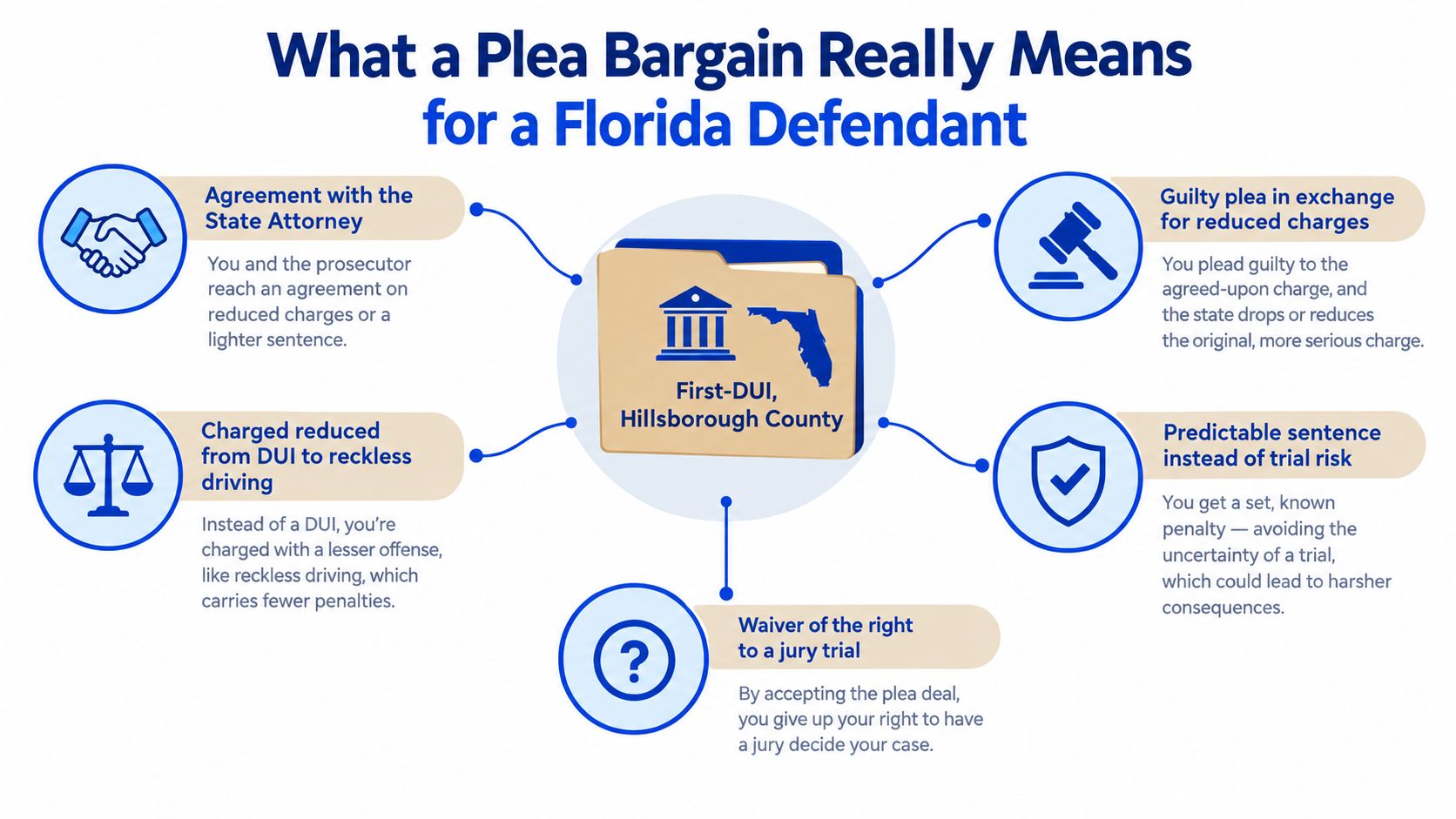
The core trade-off: A plea can provide predictability and reduce exposure, but it normally means giving up the right to a jury trial and the possibility of an acquittal.
The State benefits from finality, and you may benefit from a known result. But certainty isn't the same as a favorable result. Your lawyer should first examine whether the State's evidence is admissible, whether witnesses are reliable, whether the charge fits the facts, and whether a motion could shift your position. A frightened defendant shouldn't accept a deal just because the uncertainty of trial feels unbearable.
How Plea Bargaining Became the Default Way Cases End
Plea bargaining is now built into the ordinary operation of criminal courts. The modern constitutional foundation developed through Supreme Court decisions including Boykin v. Alabama, Brady v. United States, North Carolina v. Alford, and Santobello v. New York, decided in a cluster between 1969 and 1971. In Santobello, the Court described plea bargaining as an “essential component of the administration of justice,” while the surrounding decisions established safeguards for voluntary pleas, recognized an Alford plea, and addressed pressure associated with severe potential penalties. The historical framework is summarized in this Supreme Court overview of plea bargaining.
The numbers explain why a Florida defendant often spends more time negotiating than preparing for a trial. In the U.S. federal system, 97.4% of federal criminal convictions in 2018 came through guilty pleas, the highest percentage recorded by the U.S. Sentencing Commission when it began tracking that figure, according to the George Mason Law Review analysis. The same source describes international expansion, with a 2025 comparative study finding that 101 of 174 surveyed jurisdictions permit plea bargaining and measurable rates available for 52 jurisdictions.
Jurisdiction | Resolved by Plea (%) | Resolved at Trial (%) |
|---|---|---|
U.S. federal system, 2018 | 97.4% | 2.6% |
Large urban state courts | 97% | 3% |
U.S. federal and state cases, empirical summaries | About 90% to 95% | About 5% to 10% |
The large-urban and broader federal and state figures come from the Vera Institute's analysis of plea bargaining. They illustrate a system where trial is the exception, not the standard endpoint. Florida prosecutors exercise charging and negotiating authority, and court dockets rely on standardized forms, calendars, and routine plea hearings to process cases.
That reliance creates a practical consequence. A lawyer's assessment of discovery, suppression issues, charge structure, restitution, and sentencing exposure can matter more than a defendant's abstract belief that the truth will eventually prevail at trial. Understanding prosecutorial discretion helps explain why two cases with similar accusations can receive different offers.
How Plea Bargaining Actually Works in Florida Courts
The negotiation usually begins outside the courtroom. Defense counsel reviews discovery, identifies weaknesses, contacts the prosecutor, and discusses possible reductions, dismissals, diversion, sentencing terms, or conditions. The first conversation may be informal, but it can shape the entire case, which is why a lawyer shouldn't make casual admissions or accept an oral proposal without confirming its terms.
Florida Rule of Criminal Procedure 3.171 places the defendant at the center of the agreement. Defense counsel may not conclude a plea agreement without the client's full and complete consent. That means the prosecutor and lawyer can negotiate, but the client decides whether to authorize the final plea.
The written offer and the court's review
A proposed agreement may appear in a written plea form or another written document. Review it line by line. Look for the exact charge, dismissed counts, adjudication language, sentence, probation terms, restitution, court costs, credit for time served, and any waiver of rights. A verbal summary may omit a condition that becomes important later.
Rule 3.172 requires the judge to make specific inquiries before accepting a guilty or nolo contendere plea. The defendant is placed under oath, and the court confirms understanding of the charge, possible penalties, trial rights, and the consequences of the plea. The judge must determine on the record that the plea is voluntary and supported by a factual basis.

The hearing is called a plea colloquy. Answer the judge truthfully. If you don't understand a term, stop and ask your lawyer to explain it. A signature on a written form doesn't cure confusion, undisclosed pressure, or a material misunderstanding.
A nolo contendere plea, commonly called no contest, generally allows the defendant to accept criminal consequences without making a factual admission in the same manner as a guilty plea. It still results in a conviction or other court disposition and still waives important trial rights. The effect on later proceedings depends on the specific facts and governing law, so “no contest” shouldn't be treated as consequence-free.
This explanation of the Florida pretrial conference may help place negotiations within the larger case timeline.
No offer or negotiation becomes binding until the trial judge formally accepts it after completing the required inquiries. Until acceptance, either side may withdraw the offer without explaining why. If the judge rejects an agreed sentence, the defendant should receive advice about whether the plea can be withdrawn and whether the case returns to its prior posture. Special sentencing rules, including Florida's 10-20-Life framework in qualifying weapons cases, can sharply limit the available terms.
Benefits and Risks of Accepting a Plea Offer in Florida
A negotiated plea can cap exposure and create a predictable outcome where trial cannot. The State may dismiss counts, reduce the accusation, recommend probation, set restitution terms, or offer diversion where legally available. A defined resolution can also limit disruption to work, family, education, licensing, or housing.
Florida procedure makes the paperwork and courtroom inquiry important, but the negotiation itself is rarely documented. Before accepting, counsel should compare the written plea form and the judge's Rule 3.172 warnings with the terms discussed by the parties. For a noncitizen, a deportation warning under Rule 3.172 changes the risk calculation. A withhold of adjudication may differ from an adjudication of guilt for some purposes, yet neither should be treated as automatically safe for immigration, licensing, driver-license, registration, or housing consequences.
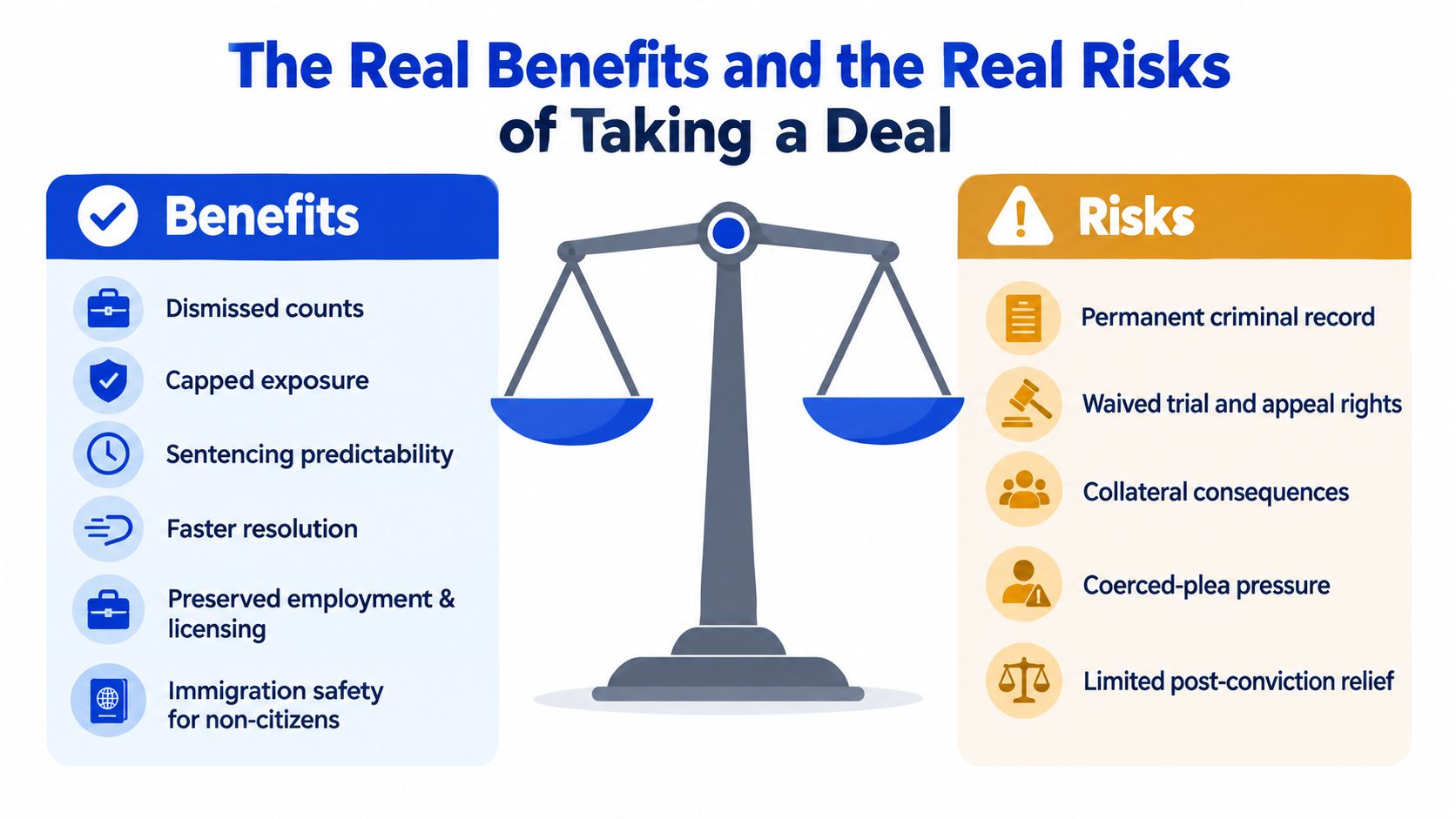
The trade-off remains substantial. By pleading, you generally give up the opportunity to require the State to prove the case at trial, cross-examine witnesses before a jury, challenge evidence through that trial, and seek an acquittal. Depending on the plea language and the issue, you may also lose the ability to preserve objections to pretrial rulings. The written form records the result. It may not capture why a particular concession was offered or which risk counsel evaluated.
The trial penalty is part of the decision
The pressure to accept can be significant. The National Institute of Justice discussion of criminal case processing summarizes studies reporting trial-versus-plea sentencing differentials ranging from 13% to 461% across five guideline states. One empirical analysis reported a 64% longer federal sentence for trial convictions, while NACDL-cited data described an average trial sentence approximately three times longer than the plea sentence.
Another economic analysis reported jury-trial convictions producing sentences about 11 years longer than plea bargains or bench-trial convictions in that dataset. Those findings do not predict a Florida sentence or establish that a particular offer is fair. They show why the comparison must include the proposed disposition, sentencing exposure after trial, admissible evidence, and collateral consequences.
A useful decision test: Ask what evidence the State can use, what evidence the defense can exclude, and what result is realistically available under each path.
Accepting may make sense when the offer materially reduces danger or preserves a lawful opportunity for rehabilitation. Rejecting may be reasonable when the evidence is weak, the consequences are unacceptable, or the proposed plea gives too little in exchange for giving up trial. Counsel should make those trade-offs clear without steering the client through pressure.
Plea Bargaining Across Different Case Types
The negotiation changes with the charge. A violent-crime case may not produce a dramatic reduction in the top-line accusation, but the parties may negotiate a lesser-included offense, a scoresheet position, a prison recommendation, or credit for time served. A weapons case can be dominated by mandatory sentencing exposure, while a theft case may turn on repayment and record consequences.
Case Type | Key Leverage Point | Common Concession | Strategic Consideration |
|---|---|---|---|
Violent offenses | Witness credibility, injuries, intent, lesser-included offenses | Reduced count or sentencing recommendation | Test whether the evidence proves intent and every element |
Drug offenses | Substance identity, quantity, possession theory, trafficking exposure | Possession resolution, treatment, or early disposition | Examine the search, testing, weight, and chain of custody |
Theft and fraud | Value, ownership, intent, documentation, restitution | Reduced charge, restitution terms, or diversion | Determine whether the disposition creates a lasting conviction |
Weapons offenses | Firearm facts, possession, enhancement allegations, 10-20-Life exposure | Charge or sentencing concession where legally available | Confirm whether mandatory provisions control the judge |
Probation violations | Alleged violation, notice, admissions, mitigation | Capped jail, reinstatement, or modified conditions | Require a concrete benefit before admitting a violation |
Drug cases in Broward, Miami-Dade, and Palm Beach may involve treatment-oriented or early-disposition options, but eligibility depends on the charge, record, facts, and local program rules. A lawyer should verify the actual program terms instead of promising that enrollment will erase the case. The distinction between possession and trafficking allegations can be more important than the label used in an initial conversation. Florida defendants can review related treatment-court concepts in this discussion of drug court in Florida.
Theft cases often turn on restitution, but paying money doesn't automatically erase criminal exposure. Counsel should identify the alleged value, the legal theory of ownership, the evidence of intent, and whether the proposed disposition includes adjudication, a withhold, diversion, or dismissal.
Probation violations require special discipline. The State may offer little beyond avoiding a worse sanction, particularly when it alleges a new law violation. A defense lawyer should ask what the defendant receives for any admission, whether the violation can be contested, and whether a technical allegation can be resolved through modified conditions instead of incarceration.
The Part Nobody Sees, Why Plea Negotiations Are Rarely Recorded
The courtroom record usually captures the final plea colloquy, not the negotiation that produced it. A transcript may show that you understood the charge and waived trial rights, but it often won't show the earlier calls, hallway conversations, emails, rejected offers, factual disputes, or pressure surrounding the decision.
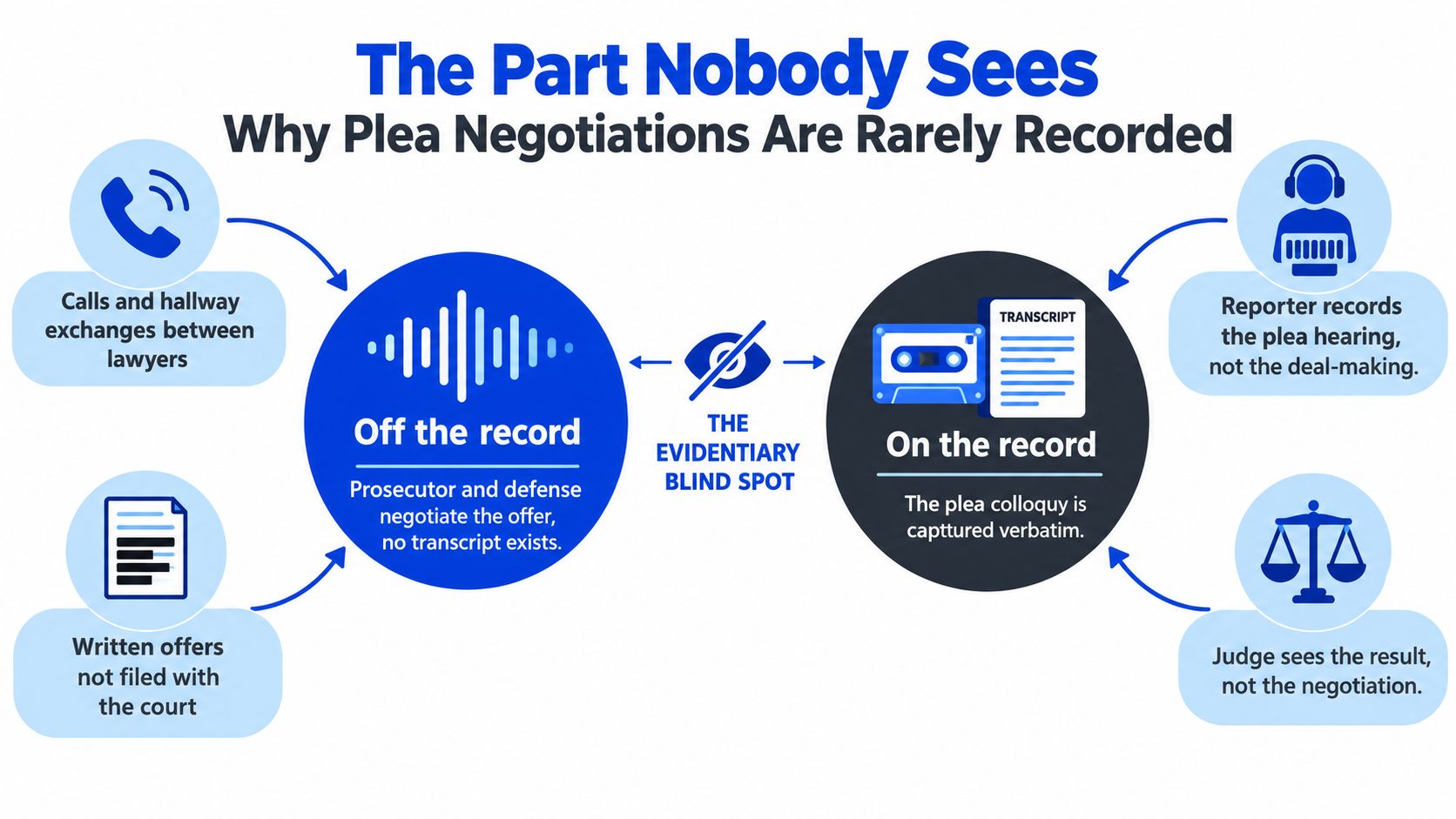
That gap creates accountability problems. If the negotiation isn't documented, it becomes harder to prove what the prosecutor offered, whether counsel communicated it accurately, whether an inducement was improper, or whether a client misunderstood a material term. Concerns about coercion, inaccuracy, and insufficient procedural protection remain central to scholarship on plea bargaining, as discussed in the Vera Institute's detailed report.
The absence of records can also hide differences between jurisdictions, prosecutors, charge categories, and defendants. Discussions about racial disparities in negotiated pleas remain mixed and underexplained, which makes the bargaining conditions themselves important. A public discussion that looks only at convictions can miss who received a meaningful offer and who faced an extreme trial penalty.
Better documentation protects both sides
Reform proposals and practices discussed in legal commentary include open-file discovery, standing written offer letters, sentence-offer data dashboards, and judicial review of charge stipulations. Each approach addresses a different problem. Open files help the defense evaluate proof, written offers reduce disputes about terms, data can reveal patterns, and judicial review can add oversight without turning every negotiation into a trial.
A defense lawyer's minimum safeguard: Confirm every material offer in writing, preserve discovery and communications, record the client's instructions, and place disputed terms on the record before the plea is accepted.
Florida's law governing recorded communications can be complicated. Counsel should understand the limits before recording a call, as explained in this discussion of Florida Statute 934.03. Documentation doesn't guarantee a favorable result, but undocumented bargaining leaves too much of the case's most important history outside meaningful review.
What to Do Before You Accept or Reject a Plea Offer
Don't decide at the podium with incomplete information. Use the time before the hearing to convert the offer into a written, testable decision.
Request the complete written offer. Ask for every page, attachment, sentencing term, dismissal provision, waiver, probation condition, restitution requirement, and deadline. If the offer is verbal, ask counsel to confirm it in writing before you rely on it.
Map the exposure count by count. Confirm the statutory maximum, mandatory minimum, sentencing enhancement, scoresheet effect, and whether sentences could run consecutively. The prosecutor's recommendation may not control the judge.
Compare the plea with a not-guilty strategy. Ask what evidence the State has, which witnesses must appear, what motions could suppress evidence, and what facts support each defense. A verdict assessment can't be reduced to a guaranteed percentage, but your lawyer should explain the strengths and weaknesses plainly.
Review the scoresheet and probation terms. If sentencing guidelines or a scoresheet apply, check the points and factual assumptions. Read every proposed condition, including reporting, testing, treatment, contact restrictions, restitution, community service, and travel limits.
Identify collateral consequences. Rule 3.172 addresses subjects that can extend beyond the sentence, including deportation consequences, sexually violent predator civil-commitment exposure, driver-license suspension or revocation, and use of plea statements in a perjury prosecution. Florida plea materials can also require a signed written form. Ask how the disposition affects employment, licensing, housing, firearms, and immigration.
Clarify the type of plea. Determine whether the agreement is open or closed, whether the State is bound to a sentence, whether the judge can reject the recommendation, and whether adjudication is entered or withheld. Ask what happens if the judge rejects the proposed term.
Separate restitution from other costs. Confirm the amount, recipient, payment schedule, court costs, supervision fees, and whether payment is a condition of probation. Never assume a payment resolves the criminal case unless the written agreement says so.
Discuss pressure privately. Tell your lawyer about threats, promises, medication issues, language barriers, family pressure, or anything you don't understand. You must be able to make the decision voluntarily and with a meaningful opportunity to confer with counsel.
If you accept in open court without preparation, the colloquy may later be used to show that you understood the rights you waived. That doesn't mean every plea is immune from challenge, but it makes prevention and accurate advice far more important than trying to undo the decision afterward.
Key Takeaways and Questions Florida Defendants Ask Most
Four points should guide the decision. Plea bargaining resolves most criminal cases, including felony and misdemeanor matters. Rules 3.171 and 3.172 control important parts of Florida's negotiation and acceptance framework. The trial penalty is measurable, although national studies don't determine the result in an individual Florida case. Finally, the negotiation itself is often poorly documented, so written offers, careful advice, and a clear record matter.
Can a defendant withdraw a plea after sentencing?
Sometimes, but the answer depends on the procedural posture, the reason for withdrawal, and the applicable Florida rule. A claim that the plea wasn't voluntary, knowing, or intelligent may be treated differently from regret about the sentence. Speak with counsel immediately, preserve the written offer and plea form, and don't assume a difficult outcome alone permits withdrawal.
How long must a State Attorney honor a verbal offer?
There isn't a universal answer based only on the fact that a prosecutor said it. Under Florida Rule 3.172, an offer or negotiation isn't binding until the judge accepts it after the required inquiry. Confirm expiration dates and conditions in writing.
What happens during a violation of probation plea?
The court addresses the alleged violation, your admission or denial, the factual basis, and the proposed consequence. An admission can surrender the opportunity to contest whether the violation occurred, so counsel should identify the concrete benefit before recommending that course.
Are cooperation agreements enforceable?
They depend on their wording and the parties' compliance. A cooperation promise should identify what the defendant must do, what the State will do, what remains discretionary, and what happens if the prosecutor claims the cooperation was incomplete or untruthful. Get the terms in writing.
How is juvenile plea practice different in Florida?
Juvenile court has different purposes, procedures, confidentiality rules, and possible dispositions from adult criminal court. A juvenile case may focus more heavily on rehabilitation and supervision, but a plea can still affect the child's liberty, school, family, and future record. A lawyer should assess the child's age, allegations, detention status, and available juvenile dispositions before any admission.
If you're facing a Florida criminal charge, Ticket Shield, PLLC can review the proposed plea, investigate the evidence, and explain whether negotiation, litigation, or trial better protects your rights. Visit Ticket Shield, PLLC to request a consultation about your case in Broward County, Fort Lauderdale, Miami-Dade, Palm Beach, or another Florida jurisdiction.