Florida Statute 934.03: All-Party Consent Law
Jason Goldsmith, Esq
A recorded call can turn a normal Florida case into a different kind of problem fast. One minute you're dealing with an argument, a breakup, a business dispute, or a DUI stop in Broward County. The next, a prosecutor is treating the recording like a clean piece of evidence and building around it.
That's where Florida Statute 934.03 matters. It's the Florida wiretap law that controls whether a call, conversation, or electronic communication was intercepted lawfully, and whether the contents can be used against you at all. For clients in Fort Lauderdale, Miami-Dade, Palm Beach, and throughout South Florida, the question is often simple: was this recording legal, and if not, what can be done about it?
Table of Contents
What Florida Statute 934.03 Actually Covers
A Broward County client usually doesn't learn about Florida Statute 934.03 from a textbook. They learn about it when a detective, prosecutor, or probation officer produces a recording and says, in effect, this is what you said. That happens in domestic cases, drug cases, DUI stops, and white collar investigations, because Chapter 934 reaches wire, oral, and electronic communication, not just classic “wiretaps” in the old movie sense. The Legislature placed the statute inside the Florida Security of Communications Act, which was enacted to protect privacy in communications, and it treats unlawful interception as both a criminal offense and a civil wrong. If the recording was obtained through a search or seizure problem as well, the defense often has to compare the wiretap issue with the broader suppression issues discussed in our illegal search and seizure analysis. Florida Statute 934.03 in Chapter 934
Why the statute shows up in ordinary cases
The practical point is simple. The statute reaches far beyond a technician attaching a device to a phone line. It can come up when a person secretly records a call on a smartphone, saves an audio clip from an app, or forwards a recording to law enforcement after the fact. The same statute can matter in a family fight, a workplace dispute, a probation issue, or a fraud case because the recording itself may be the evidence the State wants most. In practice, prosecutors use that recording to anchor a DUI, drug, or probation case long before they get to the rest of the proof.
The two-track structure matters
Chapter 934 does more than define a crime. It also gives an aggrieved person civil remedies under Section 934.10, including actual damages, punitive damages, attorney's fees, and statutory liquidated damages. That two-track design matters because Florida treated unauthorized recording as conduct serious enough to support both prosecution and private civil litigation. In practice, the same recording can trigger a suppression fight in the criminal case and a separate damages issue in civil court. A defense lawyer has to think about both tracks early, because the criminal case and the civil exposure can move together even when the State treats them as separate problems.
If the State's evidence depends on a recording, the first question is legality, not reliability.
Breaking Down the Statutory Elements
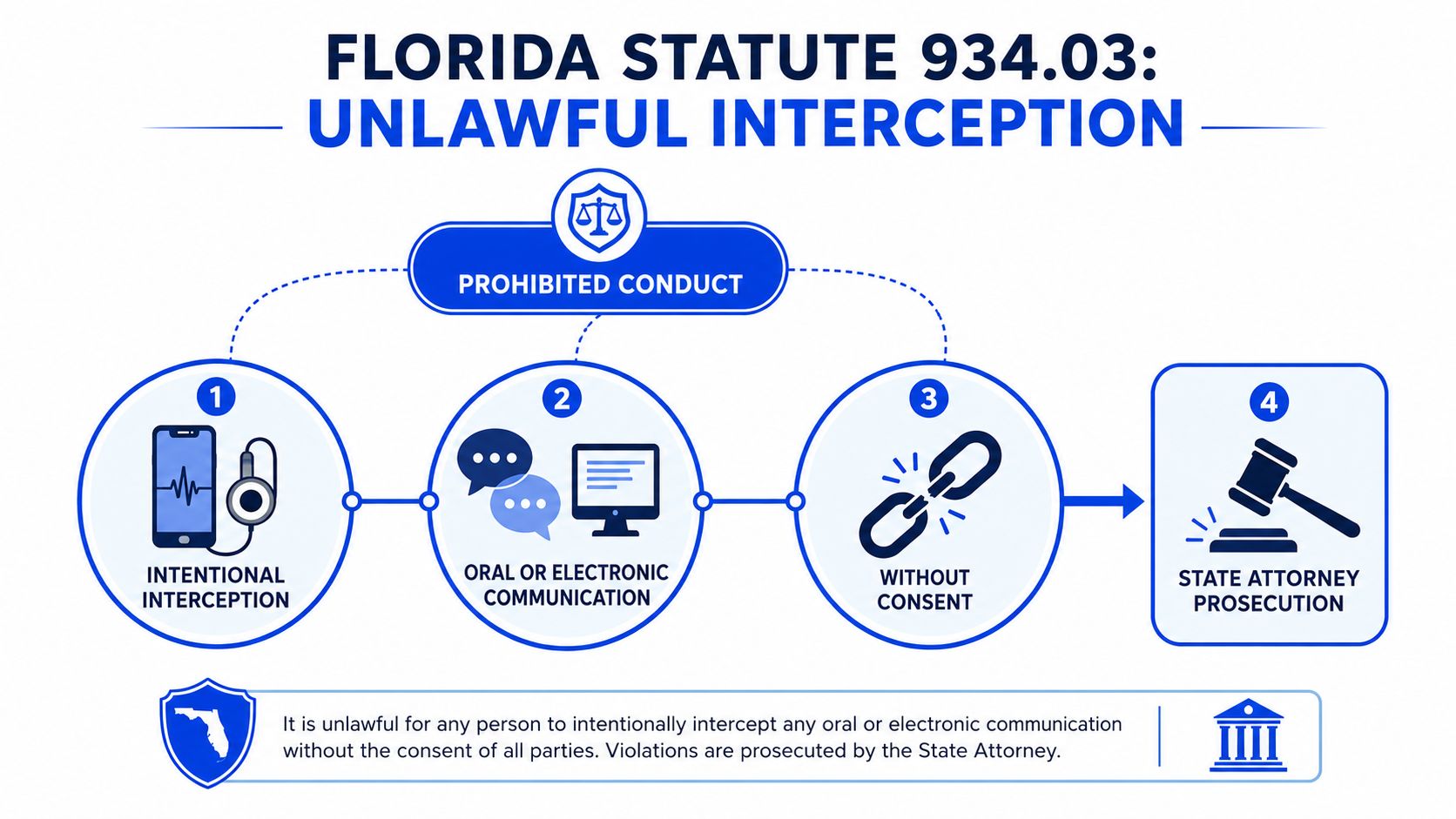
The State cannot just say, “there's a recording.” It has to show the recording fits the statute. Under Florida Statute 934.03, the offense is built around several different acts, and each one can create exposure depending on what happened. The core categories are interception, attempted interception, procurement of interception by another person, and later disclosure or use of the contents when the person knew, or had reason to know, the information came from an unlawful interception. Florida Statute 934.03 text
The prongs a charging document may rely on
A lawyer reading the discovery packet should identify which theory the State is using.
Intentional interception: someone captured the communication in real time.
Attempted interception: the recording failed or was incomplete, but the State says the person tried.
Procurement: a person induced someone else to do the recording.
Disclosure or use: the recording was later shared, played, forwarded, or used after the person knew it was unlawfully obtained.
That matters because the defense strategy changes depending on the prong. A case involving a hidden recorder in a car is different from a case involving a text thread where someone forwards a file they never recorded themselves. The statutory language is broad enough to reach the whole communications lifecycle, collection, transmission, disclosure, and downstream use.
Privacy still drives the analysis
Florida appellate guidance ties the definition of an oral communication to an expectation of privacy that society recognizes as reasonable. That means the law does not cover every conversation everywhere. A loud exchange in a public place can fall outside the statute if there was no legally protected expectation of privacy. A defense attorney looks hard at location, volume, bystanders, and whether the conversation was exposed to the public. See also the practical evidence issues that often overlap with chain of custody problems.
The charging theory matters. If the State can't identify the exact prong, the case is often weaker than it looks.
Why Florida Is an All-Party Consent State
Florida is an all-party consent state. Under § 934.03(2)(d), interception is lawful only when all parties to the communication have given prior consent. That is the trap. Many people think one person can always record a call if they're on it. That assumption may work in some states, but it does not describe Florida law. All-party consent explanation
Where people get caught
A Miami-Dade resident can get in trouble recording a call with a relative in New York. A Fort Lauderdale business owner can create risk by recording a meeting without telling the other side. A caller from the Panhandle can make the mistake of assuming their home-state rule controls a conversation that touches Florida. The consent question becomes even more complicated when the people on the call are in different places, because the location of each participant and the recording device may both matter in the litigation.
The defense angle is usually straightforward. If all parties did not consent, the recording is vulnerable. If the State cannot prove consent, the argument for suppression gets much stronger. Prosecutors know this, which is why consent is often the first issue they try to establish through texts, call logs, witness statements, or device data.
Why this hits criminal cases so hard
Florida's rule changes the advice people should get before they record anything. Secretly recording a phone call, a face-to-face argument, or an electronic exchange can create criminal exposure even if the person doing the recording is one of the participants. That's why the statute shows up so often in domestic violence disputes, probation matters, and drug cases, where one side tries to memorialize a conversation and later learns the recording created its own legal problem.
In Florida, being part of the conversation doesn't automatically give you the right to record it.
Statutory Exceptions That Create a Defense
The statute is strict, but it is not absolute. The defense should always test whether one of the statutory exceptions applies before assuming the recording is illegal. The main categories are express consent, certain lawful law enforcement interceptions, emergency situations where a party reasonably believes there is an immediate threat to life, and the provider-of-service carve-out for telecommunications carriers acting in the normal course of business. The details matter because prosecutors sometimes overread the statute and ignore the actual exception that fits the facts. For a related criminal-defense concept, see the practical limits of probable cause.
What a defense lawyer looks for
The question is not just whether an exception exists. It's whether the State can prove the facts that make the exception disappear.
Consent proof: written, recorded, or clearly documented agreement.
Court-authorized interception: the underlying order, scope, and execution.
Emergency rationale: what the person reasonably believed at the time.
Provider conduct: whether the service provider acted in the normal course of business.
If the State cannot support the exception with real evidence, the defense has room to attack the recording's admissibility. That often means subpoenaing call metadata, device logs, recordings of the consent conversation, and any paperwork tied to authorization.
The disclosure prong can surprise people
One less obvious part of the statute separately criminalizes disclosure intended to obstruct a criminal investigation, even in situations where the interception itself might otherwise look authorized under certain provisions. That's a problem in cases where a person records something, then passes it around in a way that changes the legal exposure. The defense has to look at the entire chain, not just the first recording moment. If the State overstates what the statute covers, suppression or dismissal arguments can become very strong.
Criminal Penalties and Civil Exposure
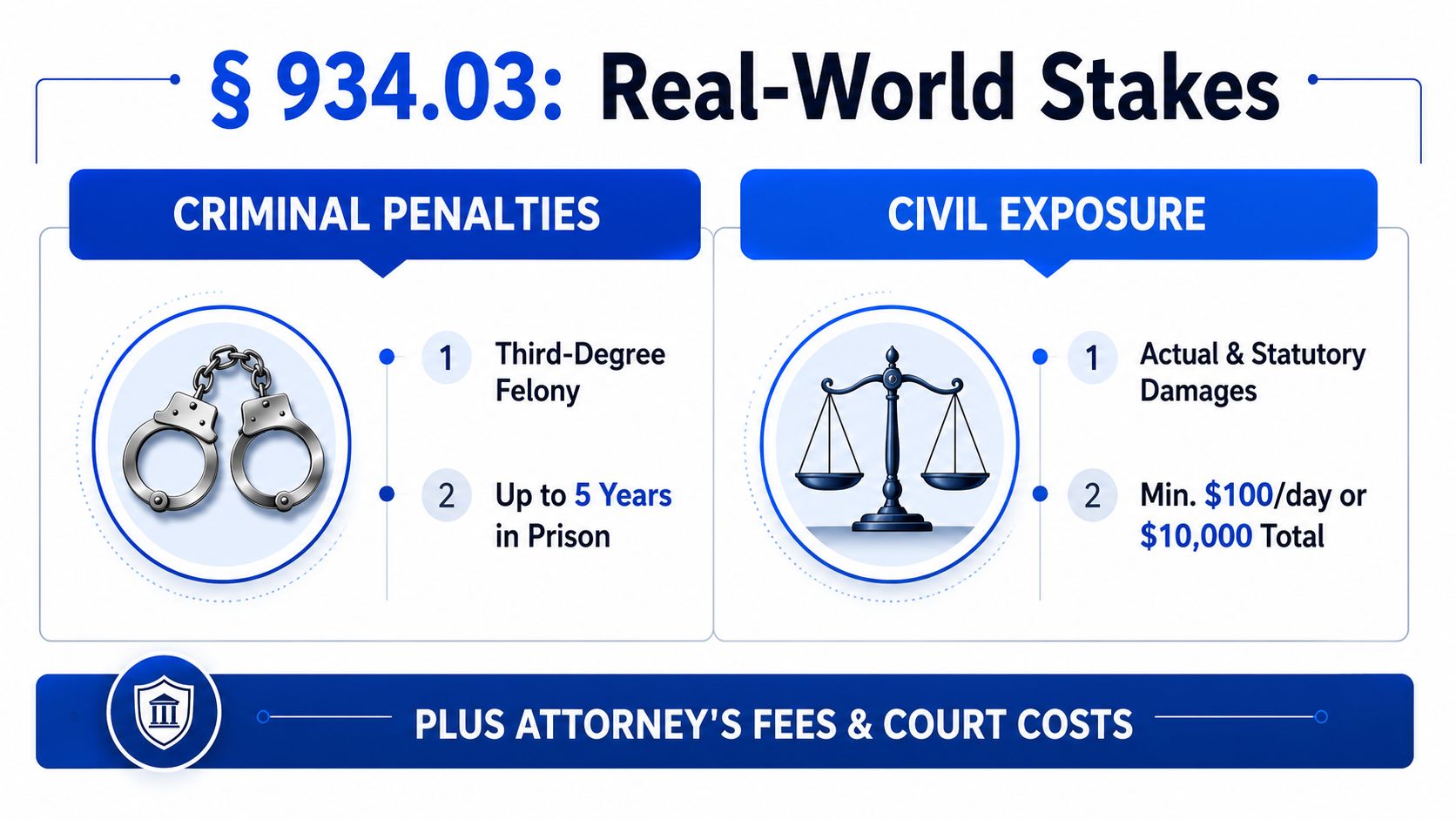
The stakes are real. A violation of § 934.03 can be charged as a third-degree felony, which Florida sources describe as punishable by up to 5 years in prison and a $5,000 fine. That alone changes plea negotiations in a South Florida courtroom, because a recording case is no longer just about evidence, it can become a standalone criminal charge. Criminal and civil consequences under Chapter 934
The civil case runs beside the criminal case
Section 934.10 gives an aggrieved person a private remedy that can include actual damages, punitive damages, attorney's fees, and statutory liquidated damages of at least $1,000, or $100 per day of violation if higher. That means a person who was recorded may have two separate paths, one in criminal court and one in civil court. The financial pressure can be significant even when no prison sentence is imposed, because the recording itself may give rise to a damages claim.
Time matters
The civil limitations period is short. A civil action under Section 934.10 generally must be filed within 2 years after the claimant first has a reasonable opportunity to discover the violation. That makes early investigation critical. If you wait too long, a civil claim may lose force even if the recording itself looks unlawful. In practice, that deadline can shape settlement negotiations, document preservation, and the timing of a defense response.
The two tracks also interact in a very practical way. Evidence gathered in the criminal case can affect a civil demand, and civil discovery can expose facts that help the defense attack consent, intent, or authenticity. A quick review of the recording device, the app used, and the chain of transmission often pays dividends much earlier than people expect.
The sooner the recording is examined, the more likely you are to preserve both suppression issues and civil defenses.
How 934.03 Shows Up in Real Cases
This statute usually appears in ordinary cases with messy facts. In drug investigations, a confidential informant may record a conversation that the State later wants to use to prove a sale, a conspiracy, or a statement against interest. In probation cases, jail calls or recorded conversations can become the basis for an alleged violation if the content suggests new criminal conduct or prohibited contact. In DUI cases, a passenger or ride-share driver may secretly record a driver's speech, coordination, or conduct, then hand the file to law enforcement. And in domestic cases, one person often records the other during a heated argument and later sends the clip to the police.
What changes from case to case
The legal question is the same, but the fact pattern drives the answer.
Drug cases: Was the informant acting with the right authorization, and was the recording lawfully obtained?
Probation cases: Was the jail call recorded by the jail system, and was the content lawfully collected and disclosed?
DUI cases: Did the passenger or driver have consent from all parties, or was it a secret recording?
Domestic cases: Was the conversation private enough to qualify as an oral communication, and who made the recording?
What to check in discovery
The discovery packet should be read with a cold eye. Look for consent forms, the exact device or app, timestamps, and how the file moved from one person to another. Chain of custody matters because recordings can be edited, clipped, mislabeled, or copied without context. Even when the State has a usable recording, it still has to prove what the file is, where it came from, and whether the statute allows it to be used.
The practical defense lesson is simple. Don't assume the State's recording is automatically admissible just because it exists. In many South Florida cases, the fight is not about whether the words were spoken. It's about whether the recording was lawfully captured and whether the court should hear it at all.
Defense Motions and Case Law to Know
The main defense tool is a motion to suppress under Florida Rule of Criminal Procedure 3.190(j). That motion asks the judge to keep unlawfully obtained evidence out of the case. In a 934.03 case, the defense usually argues that the recording was obtained in violation of the statute, that the client has standing to challenge it, and that the recording should not be admitted because the State's evidence was built on an unlawful interception. If you're looking at the mechanics of that filing, a motion to suppress evidence is often where the pressure shifts back to the prosecution.
The legal issues that matter most
Florida courts have also recognized an important privacy principle. An oral communication depends on an expectation of privacy that society is prepared to recognize as reasonable. That standard is one reason the statute does not reach every conversation in a public place or every casual remark overheard by others. The defense can use that framework to argue that the recording never fit the statute in the first place.
The Florida Supreme Court has also dealt with the cross-border problem. The court record in a notable dispute states that the statute can apply even when the recording was made outside Florida, but the court rejected personal jurisdiction over a nonresident based only on that out-of-state call recording. That distinction matters in modern cases, because people often record from another state while speaking with someone in Florida. The recording may still raise Chapter 934 issues, but the lawsuit or prosecution has to clear constitutional jurisdictional limits too.
Where cases are won
Motion practice is where this statute is usually won or lost. If the recording was made without consent, if no exception fits, or if the privacy facts support suppression, the judge may keep it out. If the recording was lawfully obtained, the defense may still attack authenticity, context, completeness, or downstream use. The point is that the statute gives the defense multiple ways to challenge the State's proof, and those arguments need to be made early.
Next Steps and When to Call a Defense Attorney
If you think a call or conversation was recorded unlawfully, stop discussing the facts on recorded lines. Save the device, app, or phone that captured the audio, and do not delete messages or files that may show who consented, who recorded, and when the file was shared. Ask for the State's discovery as early as possible, because the consent issue, the recording method, and the chain of custody often decide how much damage the file can do. If a civil claim is possible, calendar the 2-year window right away.
When a recording shows up in a Florida criminal case, the details matter more than people expect. A careful review of Florida Statute 934.03 can uncover suppression issues, civil exposure, and defenses the State would rather not confront.
If you're facing a recording issue tied to Florida Statute 934.03, Ticket Shield, PLLC can review the facts, challenge unlawful evidence, and explain your options in plain English. Visit Ticket Shield, PLLC to request a confidential consultation and get a defense strategy built around your case, not a generic script.