Jury Trial vs Bench Trial in Florida Explained
Jason Goldsmith, Esq
You're sitting in a Florida courtroom with a criminal charge hanging over you, and someone has asked whether you want a jury trial or a bench trial. The question sounds simple. It isn't. Your answer determines who will decide whether the State proved its case, how your evidence should be presented, and whether the trial focuses more on legal analysis or human credibility.
I spent years looking at cases from the prosecution's side. As a defense lawyer, I look at the same decision differently: Which decision-maker gives this particular defense its fairest hearing? That's the crux of the issue. A jury isn't automatically safer, and a judge isn't automatically more rational. Florida defendants need a forum-selection strategy based on the evidence, the judge, the witnesses, the charge, and the risks that matter in the individual case.
Table of Contents
What a Jury Trial and a Bench Trial Actually Are
A jury trial places the factual decision in the hands of citizens selected from the community. In Florida, the jury listens to testimony, reviews exhibits, evaluates credibility, and decides whether the prosecution proved guilt beyond a reasonable doubt. The judge controls the courtroom, rules on legal objections, and explains the governing law through jury instructions.
A bench trial removes the jury from that decision. The judge hears the same witnesses, considers the same admissible evidence, and determines both what facts are proven and what the law requires. The judge still acts as the courtroom referee, but also becomes the fact-finder.
The underlying contest doesn't disappear. The State still has the burden of proof. Defense counsel can still cross-examine witnesses, challenge unlawful searches, object to improper evidence, present defenses, and argue that the prosecution failed to establish an element of the offense. The major change is the person, or people, who decide what the evidence proves.
Element | Jury Trial | Bench Trial |
|---|---|---|
Fact-finder | Citizens selected for jury service | Trial judge |
Legal rulings | Judge | Judge |
Credibility decisions | Jurors | Judge |
Evidence rules | Apply | Apply |
Verdict | Jury concurrence requirements apply | Judge decides |
Main strategic question | How will ordinary citizens understand the case? | How will this judge analyze the law and record? |
That distinction affects far more than courtroom atmosphere. It affects voir dire, opening statements, visual evidence, witness examinations, motion practice, scheduling, verdict mechanics, and appeal strategy. It can also affect whether a client feels heard by a group of community members or by a judge accustomed to deciding legal disputes.
A trial decision also connects to other constitutional protections. For example, understanding how double jeopardy works after a trial begins helps explain why the election of a forum deserves careful attention before proceedings start.
A jury trial vs bench trial decision isn't a procedural footnote. It's a choice about who gets to interpret the story of the case.
Who Decides What in Each Trial Format
In a jury trial, jurors decide the disputed facts. They determine whether a witness is believable, whether an identification is reliable, whether an officer's account makes sense, and whether the evidence supports each element of the charge. The judge doesn't tell jurors which testimony to believe. The judge explains the legal rules they must apply.
The judge handles courtroom administration and legal questions. That includes deciding whether evidence is admissible, ruling on objections, deciding certain motions, managing jury instructions, and determining the sentence after a conviction in ordinary criminal cases. A Florida jury trial therefore divides responsibility between citizens and the court.
A judge-only trial changes the argument
In a bench trial, legal and factual arguments blend together. Defense counsel isn't just asking the judge to find a witness unreliable. Counsel is showing how the testimony conflicts with the physical evidence, the timeline, prior statements, or the legal elements the State must prove.
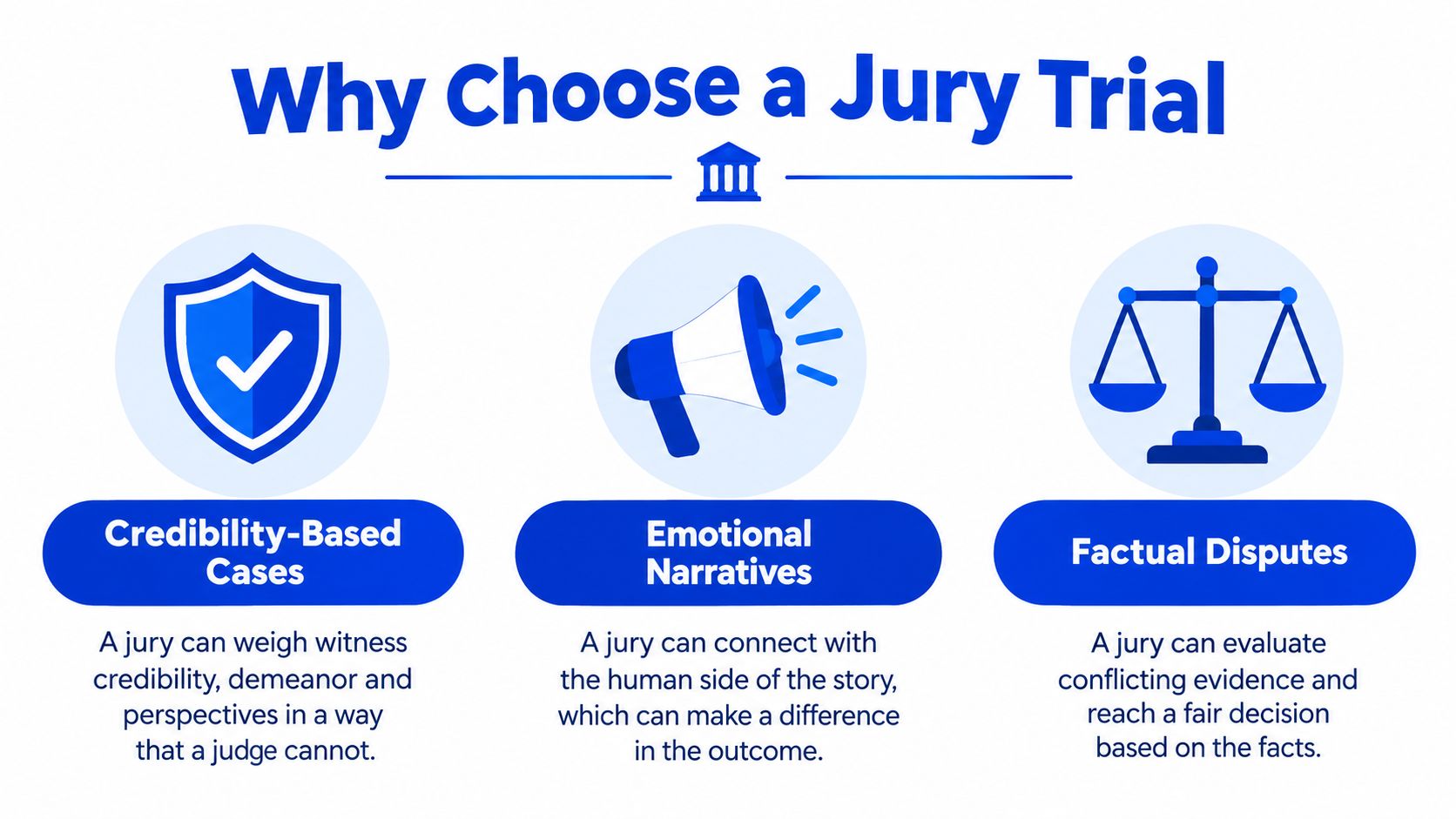
That can make a judge-only trial attractive when the defense depends on a narrow legal issue. A judge may be better positioned to work through statutory language, a search-and-seizure question, a Miranda issue, or a complicated evidentiary record without the same need to translate every point for a lay audience. But the defense also loses the possibility that one or more jurors will react favorably to the human story.
A Florida motion hearing can provide an early look at how the assigned judge handles legal disputes, witness credibility, and contested facts. It doesn't guarantee a trial result, but it gives counsel information that matters.
Sentencing usually remains with the judge
A common misunderstanding is that choosing a jury means jurors control every consequence. In most Florida felony cases, jurors decide guilt or innocence, but the judge determines punishment after a conviction. The Florida Criminal Punishment Code scoresheet, mandatory minimums, offense level, prior record, and other sentencing rules can control the range regardless of whether the verdict came from a jury or a judge.
That doesn't make the forum irrelevant to sentencing. The trial format can affect which facts the decision-maker accepts, which can influence later sentencing arguments. Still, counsel must analyze the sentencing exposure separately rather than treating a jury election as a sentencing strategy by itself.
Speed, Evidence, and How Each Trial Feels in Court
Bench trials generally move more efficiently because the courtroom doesn't need to select, instruct, manage, and accommodate a jury. Federal civil data illustrates the broader historical pattern. The Bureau of Justice Statistics reported that jury trials averaged almost four days, while bench trials averaged about two days, and jury cases took roughly 26 months from filing to verdict compared with about 20 months for bench cases. The same study reported about 26,950 general civil cases disposed of through jury or bench trial in 2005, while about 1% of federal civil cases were resolved by trial, including a jury-trial disposition rate around 0.7%. See the Bureau of Justice Statistics civil bench and jury trial study.
Those figures aren't a Florida criminal forecast. They do show why trial format matters to court administration. A jury trial adds jury selection, juror instructions, sidebars outside the jury's presence, and the need to explain technical evidence in accessible language. A bench trial often permits tighter presentation and quicker rulings.
Evidence has a different audience
Jurors need a coherent narrative. Demonstrative exhibits, timelines, photographs, diagrams, and plain-language explanations can help them organize conflicting testimony. A judge may focus more heavily on the legal significance of a particular fact, the wording of a statute, or whether the evidence meets a required element.
That doesn't mean judges ignore credibility or jurors ignore law. It means counsel must present the same defense differently. A complicated suppression argument may benefit from a judge-centered presentation. A case built around mistaken identification, inconsistent witnesses, or a sympathetic defendant may benefit from community fact-finders who can evaluate demeanor and ordinary human experience.
Factor | Jury Trial | Bench Trial |
|---|---|---|
Scheduling | Requires coordination with jury availability | Usually easier to place on the court's calendar |
Presentation | Narrative, accessible, and visually organized | More focused on legal and evidentiary detail |
Pretrial rulings | Jurors may hear only admissible trial evidence | The judge who ruled may later decide the merits |
Credibility | Multiple citizens assess witnesses | One judge evaluates the entire record |
Courtroom pace | More pauses and procedural steps | Usually more streamlined |
Suppression and credibility fights can shift
A judge who hears a suppression motion may form views about the officer's account, the defendant's testimony, or the reliability of the evidence. In a bench trial, that same judge later evaluates the merits. A jury doesn't participate in the suppression hearing and may approach the trial testimony without knowing every pretrial dispute.
That cuts both ways. A favorable suppression ruling can strengthen a bench-trial posture because the judge has already recognized a legal defect. An unfavorable ruling can make a jury more attractive if counsel can still present the remaining evidence as unreliable or incomplete. A careful defense lawyer won't choose the forum based on speed alone.
For an explanation of how counsel can challenge unlawfully obtained evidence, review Florida motions to suppress evidence.
Florida Rules on Jury Size, Verdict Math, and Waiver
Florida treats the trial forum as a real procedural choice. In most criminal cases, the defendant faces a six-person jury. Capital cases use twelve jurors. That difference affects the number of jurors who must agree before the State secures a verdict.
For a six-person jury, five jurors must concur. A twelve-person jury requires ten jurors to concur. A capital case follows a separate rule: every trial juror must agree on guilt before a death sentence may be imposed. The charge and procedural posture determine which requirement applies, so counsel must verify the rule rather than assume the ordinary six-person standard controls.
Trial Type | Jury Size | Verdict Required | Authority |
|---|---|---|---|
Most Florida criminal trials | 6 | 5 jurors must concur | |
Capital case | 12 | Unanimity for a guilty verdict before death may be imposed | Florida criminal procedure rules |
Bench trial | No jury | Judge decides guilt or innocence |
Waiving a jury isn't automatic
A Florida defendant who wants a bench trial must waive the jury right in writing. The State must consent, and the judge must accept the procedure. A defendant cannot merely announce a preference and require the court to proceed with a judge-only trial.
That consent requirement makes forum selection part of the case strategy. The prosecutor may oppose waiver because the State prefers a jury, sees public-interest concerns, or expects jurors to respond favorably to its evidence. The court must also approve the arrangement before the trial can proceed on that basis.
Procedural rule: Treat a bench trial as a proposed forum, not an entitlement. It requires a written waiver, State consent, and court approval.
Counsel should also confirm whether the charged offense carries a constitutional jury-trial right. Some non-jailable misdemeanors may not carry the same right as offenses punishable by incarceration. The charging document, governing rule, and court's scheduling order control the details, including any filing deadline. Do not guess at those requirements.
Case Postures That Favor a Judge or a Jury
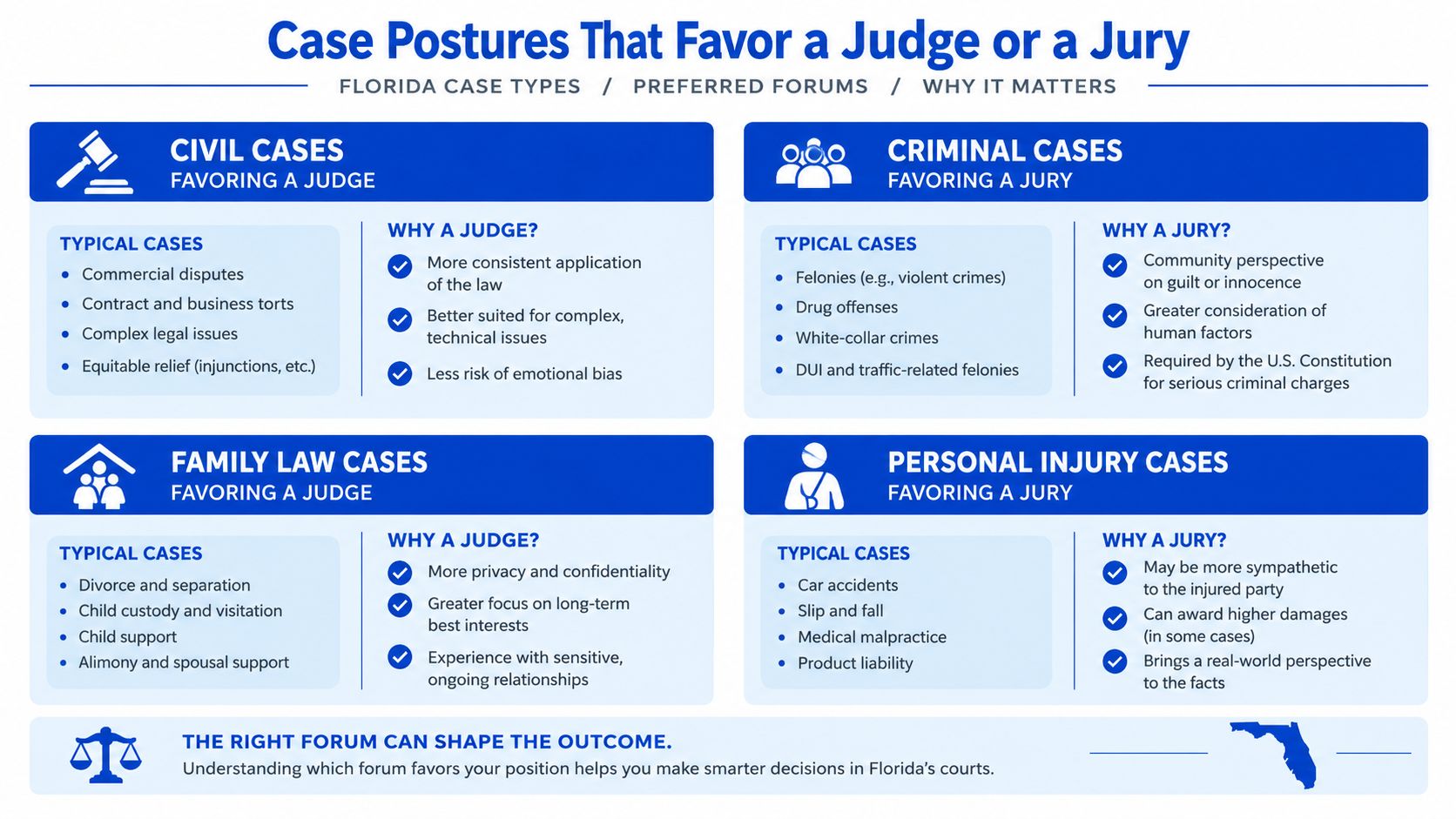
The best forum depends on what the defense must prove and what the prosecution must overcome. I don't recommend a jury automatically, and I don't recommend a bench trial just because a judge understands the law. The right question is whether the case turns on legal analysis, credibility, emotion, or prior-record risk.
Federal criminal data show why bench trials deserve serious consideration in the right case. In fiscal year 2018, about 2% of federal criminal defendants went to trial. Among those defendants, 12% had bench trials and 88% had jury trials. Acquittals occurred for around 38% of defendants facing a bench trial, compared with 14% facing a jury trial, a 24-point absolute difference. Those figures come from federal trial data discussed by Pew Research Center and the Duke Law Journal analysis of declining trials. They aren't a promise for any Florida defendant, but they establish that a judge-only trial can be a meaningful defense option.
A judge may fit a legal-issue case
A suppression challenge, search-warrant dispute, Miranda issue, or statutory-interpretation fight often benefits from concentrated legal argument. If the defense depends on showing that the State's evidence fails under a precise legal test, a judge may be the better audience.
A jury may fit a credibility contest
When the case comes down to two plausible witnesses, jurors can bring varied life experience to questions of motive, memory, demeanor, and reliability. That doesn't make jurors unpredictable in every case, but it gives the defense more than one person's assessment of the testimony.
Sympathetic proof often needs a jury
Mental-health evidence, trauma, good-character testimony, or a defendant's difficult circumstances may carry more emotional force with community members than with a judge who has seen similar explanations repeatedly. Counsel must present that evidence carefully. Sympathy can't replace a legal defense, and emotional material can backfire if it appears exaggerated.
Prior-record exposure changes the calculation
A significant criminal history can create risk if jurors hear admissible record evidence or interpret the defendant through the lens of prior conduct. A judge-only trial may reduce the risk of community reaction to that history, although judges also know how prior records affect sentencing and case evaluation.
Research from state-court datasets found conviction rates of 60% for bench trials and 64% for jury trials in one study of 13,214 criminal arrest cases. The same research reported higher average sentences after jury trials across the crime types examined. A separate DOJ analysis reported jail or prison sentences after 84% of jury convictions and 71% of bench-trial convictions, with mean jail sentences of 12 months after jury convictions, 10 months after bench convictions, and 9 months after guilty pleas. See the state-court criminal trial analysis. Those findings are jurisdiction-specific, so they support analysis, not guarantees.
How a Florida Defense Lawyer Walks You Through the Choice
A competent forum decision starts with the charge, not a slogan about juries being sympathetic or judges being predictable.
Start with the legal exposure
Counsel should review the information or indictment, the required elements, the defendant's record, and the Criminal Punishment Code scoresheet. The lawyer must identify mandatory minimums, offense-level consequences, potential enhancements, and sentencing facts the State may try to prove.
Next comes a written case audit. That review should address:
Search and seizure: Was the stop, detention, warrant, consent, or arrest lawful?
Identification reliability: Did the witness have a fair opportunity to observe the person accused?
Forensic evidence: Can the State establish collection, testing, chain of custody, and reliable interpretation?
Witness strength: Which witnesses have consistent accounts, and which have motives, contradictions, or credibility problems?
Defense evidence: Can the defense present records, experts, character testimony, or other proof without creating new risks?
The lawyer then compares the case to the assigned judge and venue. A judge's prior rulings, handling of evidentiary disputes, and approach to witness testimony can matter. So can the local jury pool and the likely reaction to the charge.
Confirm whether a bench trial is available
The defense must determine whether the State will consent to a written jury waiver. Counsel should also evaluate whether a plea offer depends on preserving or surrendering a jury right, and whether waiting to make the election could change the negotiation posture.
A Florida pretrial conference may be the setting where deadlines, trial readiness, motions, and plea discussions become concrete. Missing a deadline can turn a strategic choice into a procedural problem.
Before filing, counsel should explain the recommendation in plain English. The client should understand what the judge will decide, what jurors will decide, which evidence creates the greatest risk, and what cannot be undone after the forum is selected.
Finally, the lawyer drafts the written waiver under the applicable rule, files it by the required deadline, obtains State consent, and confirms that the assigned judge will accept the bench trial. No client should make that election based on convenience alone.
Appeals, Sentencing Exposure, and Next Steps
The trial forum remains important after the verdict. A jury acquittal and a bench acquittal both provide strong finality protections. A conviction in either format can lead to sentencing litigation and an appeal, but appellate counsel can argue only issues preserved in the trial record.
In a bench trial, Florida defense counsel must handle the motion for judgment of acquittal with precision. To challenge insufficient evidence, the defense must make the motion on time and state specific grounds. Raising a new theory for the first time on appeal can sharply limit the argument. Counsel should also identify whether an evidentiary ruling, jury instruction, or preserved objection supports appellate review.
Post-trial procedures differ by result and forum. After a jury conviction, a motion for new trial may target improper evidence, legal error, juror problems, or a verdict against the weight of the evidence. A bench-trial defendant may raise comparable legal errors, but the judge who heard the evidence will review the challenge to the court's own findings. An acquittal generally ends the prosecution's ability to seek a new trial, subject to narrow legal exceptions.
Sentencing remains a separate analysis
The Florida Criminal Punishment Code scoresheet can drive the sentencing range after conviction. Mandatory minimums, prior record, offense severity, and lawful sentencing findings may matter more than whether the judge or jury returned the verdict. The forum can affect which factual findings the defense must contest, but it does not remove scoresheet calculations or statutory requirements.
Before choosing a forum, make these points concrete:
Review the case file: Read every report, recording, photograph, exhibit, and prior statement.
Audit the witness list: Identify credibility conflicts, unavailable witnesses, and testimony that may harm the defense.
Plan the proof: Decide what the judge or jury must see, hear, and understand.
Calculate sentencing exposure: Prepare the scoresheet analysis and identify mandatory consequences.
Protect the deadline: File the written jury waiver only after confirming State consent and court approval.
Preserve objections: Make timely, specific motions and objections so appellate counsel has a usable record.
A plea changes the forum analysis. Before accepting or rejecting an offer, review how a Florida plea bargain affects trial risk, sentencing, immigration consequences where applicable, and the client's long-term record.
Ticket Shield, PLLC can review charging documents and evidence, analyze sentencing exposure, and handle the procedural steps for selecting a trial forum. Make the decision before the court's deadline, not in the hallway outside the courtroom.
If you are facing a Florida criminal charge, contact Ticket Shield, PLLC for a confidential consultation about the evidence, sentencing exposure, witness issues, and jury-waiver options in your case.