Drug Court Florida Guide What to Expect and How Lawyers Help
Jason Goldsmith, Esq
A Broward County arrest for possession can leave you staring at the paperwork and wondering whether drug court is your escape hatch or just another maze. The judge wants answers, the prosecutor wants movement, and you want to know whether treatment is a possibility or whether jail is still the likely path. For people in Fort Lauderdale, Miami-Dade, Palm Beach, and the rest of South Florida, that question comes up fast, because drug court Florida is not a side program, it's a structured part of the state's criminal justice system.
Florida's drug courts are built to handle more than one kind of case, and they don't all work the same way. Some people enter through pretrial diversion, some through post-adjudicatory tracks, and families sometimes encounter dependency drug court when child welfare concerns are involved. The key is knowing where your case fits, what the judge can require, and how local circuit rules can change the path ahead. A clear understanding of the process can help you protect your rights, avoid preventable mistakes, and make smarter decisions before the next hearing. If you're already searching for help with a Broward County drug charge, start with a focused overview of drug crimes defense in Florida.
Table of Contents
Introduction to Florida Drug Court
A first-time arrest can make every option feel urgent. One client may be sitting in a Broward jail cell after a possession charge, while another is home on bond but terrified that one wrong move will cost them work, family stability, and their license. In that moment, drug court can sound like a lifeline, but it helps to know what it really is before you start making decisions.
Florida drug court is a court-supervised treatment system. Adult programs use frequent judicial review, random alcohol and drug testing, and coordinated sanctions and rewards to push compliance and sobriety instead of relying on a few probation check-ins. Florida courts describe adult drug court as a structured treatment process, not a casual referral, and that distinction matters if you're trying to keep a case from turning into a conviction or a jail sentence. The state's adult drug court page explains that the model uses court supervision, testing, and treatment coordination as the mechanism for compliance, not just promises made in open court. See the Florida courts' adult drug court overview for that framework, then compare it with your own charges and history before you decide how to proceed.
That's why the first conversation with counsel usually isn't just about guilt or innocence. It's about whether the charge, your prior record, and the local circuit's rules make you a realistic candidate for treatment court. If you're facing a South Florida drug case, the smartest next step is to understand the program before you agree to any plea, waiver, or screening interview.
Practical rule: drug court can help, but only if you know the entry rules, the compliance demands, and the financial obligations before you say yes.
Understanding Drug Court Florida and Its History
Florida's drug court network didn't appear overnight. The modern movement is often traced to Miami, where the first drug court launched in 1989. That matters because it shows Florida wasn't just following a trend, it was helping create the model that later spread nationwide. Today, the Florida courts report 48 adult drug courts, 14 juvenile drug courts, 13 dependency drug courts, and 4 DUI courts in operation as of July 2024, which makes this a mature statewide system rather than a one-off experiment. The Florida courts' statewide drug court page also reflects how embedded this model has become in the state's problem-solving court structure.

Why the history matters in a real case
If you're charged today, the history isn't just trivia. It tells you that Florida drug court is built on decades of courtroom practice, local rules, and appellate review, so judges and prosecutors are working inside a defined system. The fact that the network now spans adult, juvenile, dependency, and DUI tracks shows how differently courts can handle substance-related problems depending on age, offense type, and family context. That can be important for people searching for help after an arrest in Broward County or Miami-Dade, because the available track may depend on more than the offense name on the arrest affidavit.
The Miami-Dade Adult Drug Court has operated since 1989, and the Eleventh Judicial Circuit describes it as a volunteer diversion and treatment program that redirects eligible defendants through intensive judicial supervision and treatment for a minimum of one year. Broward's program began in 1991 and is described by the Seventeenth Judicial Circuit as the nation's third drug court, which shows how early South Florida embraced this model. If you're comparing local options, a related area to review is Florida mental health court practice, because courts often sort substance issues and behavioral health concerns through overlapping problem-solving tracks.
The big takeaway is simple. Drug court in Florida is no longer a novelty. It's an established pathway that can replace ordinary prosecution for eligible people, but the details still change by circuit and by case.
Eligibility Requirements and Entry Process
Entry starts with screening, and that's where many people get confused. Some assume any drug arrest makes them eligible. Others assume a prior case automatically bars them. Eligibility is more limited, and the path depends on the type of program and the local court's rules.
Who usually fits
Florida's Office of Program Policy Analysis and Government Accountability explains that pretrial diversion drug courts serve first-time nonviolent drug offenders, while post-adjudicatory tracks admit nonviolent defendants with prior convictions under formal screening standards (OPPAGA report). That split matters because it changes both the intake process and what the court expects from you after entry. A pretrial track usually asks whether the person is a first-time offender who would otherwise be headed toward county probation, while a post-adjudicatory program is built for people who already have prior convictions but still qualify for treatment-based supervision.
What the court usually looks at
The screening process often includes a review of the charge, prior record, treatment history, and whether the person is considered nonviolent. A defendant with a pending violent case, or a history that falls outside local standards, may be screened out before the court ever sets a treatment plan. In practice, that means documents matter, including your arrest paperwork, prior disposition records, and anything showing treatment need or amenability to supervision.
The question isn't only, “Do I have a drug case?” The question is, “Does this circuit allow my record, charge, and history to fit inside its program?”
A qualified defense lawyer can help identify the right track before a screening interview goes wrong. If you're trying to understand the difference between diversion and an ordinary plea bargain, review pretrial diversion in Florida before you sign anything. That extra clarity can keep you from accepting a path that closes off drug court entirely.
Program Phases and Participant Requirements
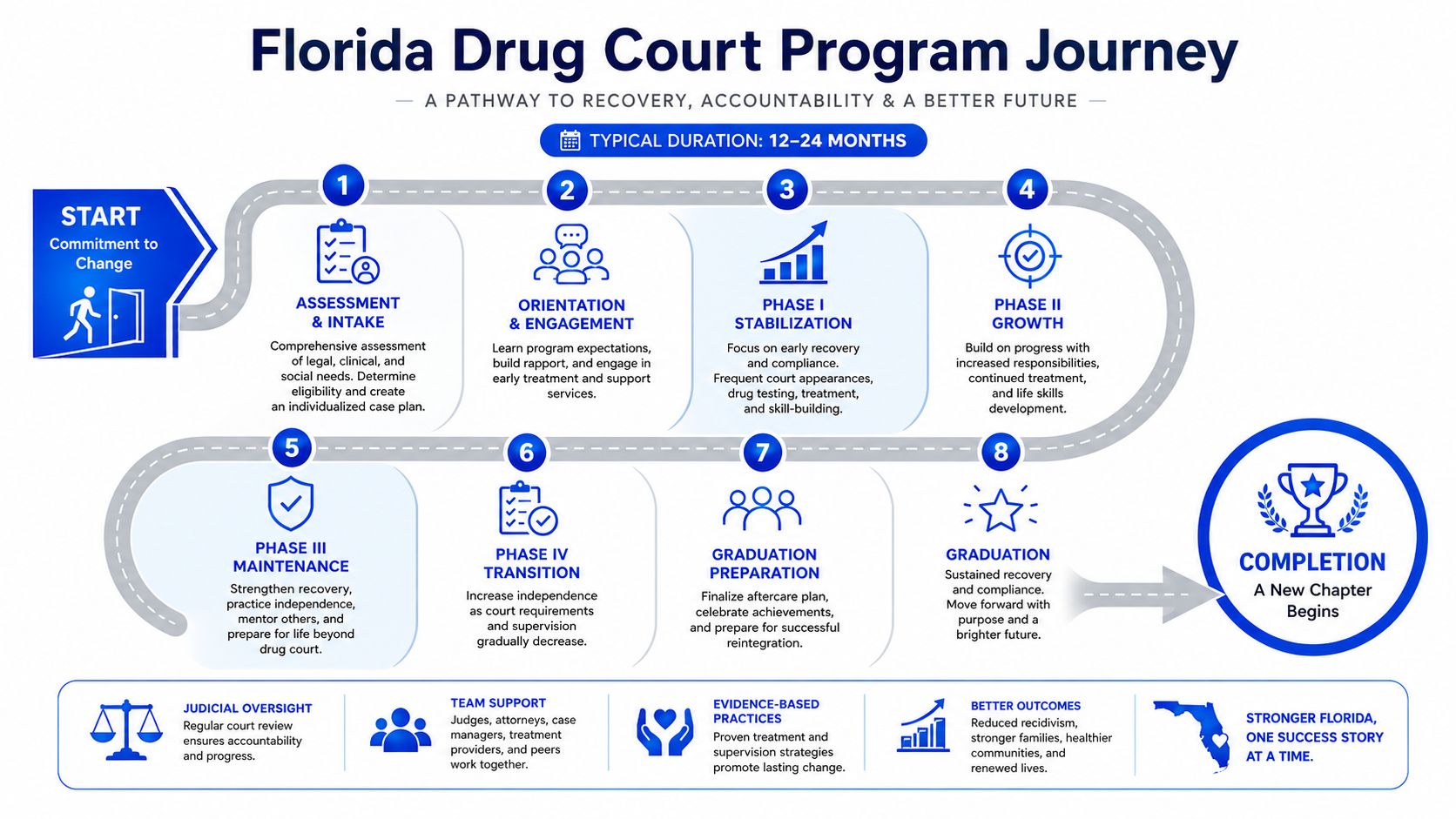
A person entering drug court often expects one meeting, one plan, and a quick answer. The reality is more structured. Florida programs usually move through 12 to 24 months of supervision, and the pace starts tight before easing only after the participant shows steady progress. A phased model lets the court watch compliance the way a coach watches practice, closely at first, then with less intensity once the basics are in place. The Florida Drug Court Program Journey infographic shows that step-by-step structure clearly.
What the early months usually look like
The first phase usually centers on stabilization. That means treatment referrals, frequent drug testing, close monitoring, and regular court contact. Early hearings can come quickly, because the court wants to see whether the participant is showing up, testing clean when possible, and keeping appointments. One Florida circuit explains that appearances may happen every 30 to 45 days, while statewide standards call for status hearings every four weeks until the final phase, with some local programs using weekly hearings at the start (Florida's Sixth Circuit drug court page). For someone in Broward or Palm Beach who is juggling work, childcare, and transportation, those dates are not abstract. They shape the week.
Local courts also vary in how they use those early months. A judge in one circuit may want a tighter reporting schedule, while another circuit may place more weight on treatment notes or testing results between hearings. That is why two people in South Florida can both be in drug court and still face different day-to-day obligations.
What participants are expected to do
The court is looking for more than a negative test. Judges want treatment attendance, honesty, stable contact information, and follow-through on counseling or assessments that have been ordered. The system uses sanctions and rewards to respond to behavior, so a missed test or skipped appointment can bring consequences even when the person is trying to stay on track. That is why defense lawyers often tell clients to treat every hearing like a deadline, not a routine check-in.
The practical standard is simple. Show up, stay in contact, and do what the treatment team and judge have ordered. If a participant misses a session because of transportation trouble, the court may still treat it as noncompliance unless the person communicates quickly and has a documented reason. Drug court works best when the participant understands that every small choice, from answering the phone to bringing proof of attendance, can affect the next review date.
Important: drug court rewards consistency. It does not excuse casual compliance.
The long-form nature of the program matters even more in dependency cases. Florida's 2023 dependency drug court report shows the median time for successful completion was 447.5 days, which is about 15 months, so this is not a quick fix. The same report counted 412 participants, with 214 still active as of December 31, 2023, 147 successful completions, 1,133 children involved, and 0 verified fatal overdose cases among the reported population (2023 Dependency Drug Court Data Summary). Those numbers show why family cases get such close supervision, and why missed obligations can affect both the case and the household around it.
Benefits Compared to Traditional Prosecution
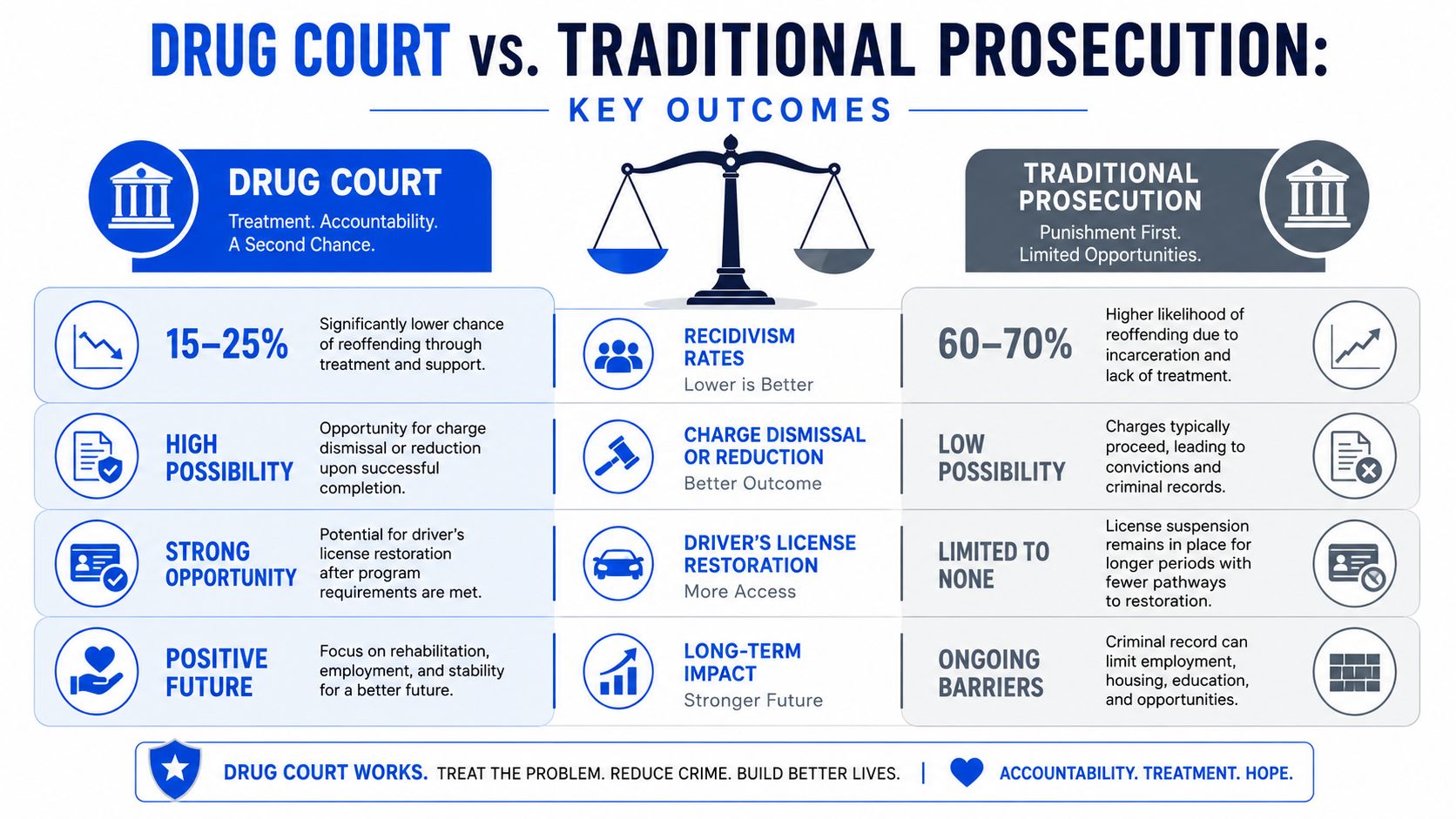
The biggest difference between drug court and ordinary prosecution is the goal. Traditional criminal court focuses on charging, proof, and sentencing. Drug court focuses on treatment, accountability, and whether the person can safely move through supervision toward a better outcome.
What changes when treatment comes first
In a standard case, the court may sentence a person without building in the same level of ongoing supervision. In drug court, the judge stays involved, treatment becomes part of the process, and the participant gets repeated chances to prove compliance. Florida statute section 397.334 authorizes adult drug court treatment for qualified defendants and allows courts to require substance abuse treatment as a condition of probation or community control, which is the legal backbone for using treatment instead of ordinary adversarial prosecution (Florida Statutes section 397.334).
That framework can matter for people who are worried about jail, a permanent criminal record, or the collateral damage of a conviction. It also creates space for the defense to focus on constitutional issues early, including whether the stop, search, or seizure that led to the arrest was lawful. A case that might look routine on paper can change quickly if the evidence came from an illegal search.
Why the choice matters
Drug court can preserve more stability for people who are trying to keep a job, support children, or avoid the disruption of a jail sentence. It also gives the defense more room to argue for a treatment-centered resolution rather than treating the case as just another conviction factory. For many clients in South Florida, that's the true value, not a slogan, but a structured chance to resolve the case with fewer long-term consequences.
County Variations and Participant Obligations
Florida drug court is statewide, but it's not identical from one circuit to the next. That's where a lot of public-facing guides fall short. They explain the general idea, then skip the practical details that matter most when you're trying to get through the program without missing a requirement.
Broward, Miami-Dade, and Palm Beach are not interchangeable
Broward County's Drug Court began in 1991 and is described as the nation's third drug court. The Seventeenth Judicial Circuit says it originally diverted first-time, nonviolent offenders from jail through pretrial intervention, then added a post-adjudicatory track in 2009 to divert nonviolent defendants facing prison into treatment (Broward County Drug Court). Miami-Dade's adult program, by contrast, has the longest historical footprint in Florida and uses a volunteer diversion model with a minimum one-year treatment structure. Palm Beach also operates within the statewide system, but local rules can differ on screening, transport, treatment providers, and courtroom expectations.
The obligations can hit harder than people expect
The overlooked issue is cost and logistics. The University of Miami review on Florida drug courts points out that steep court costs and financial obligations can destabilize participants, especially indigent people, even when the program is meant to support recovery (University of Miami review). That matters because someone can qualify on paper and still struggle with transportation, testing fees, work conflicts, or other compliance burdens.
Here's the practical reality many clients miss:
Broward cases: local history and post-adjudicatory options can help, but the participant still has to keep up with hearings and treatment demands.
Miami-Dade cases: longer treatment supervision can mean more calendar strain, even if the program is voluntary.
Palm Beach cases: transportation and scheduling often become make-or-break issues, especially when treatment providers and court dates don't line up neatly.
If you're worried about financial strain, ask early about indigency, waivers, and the actual day-to-day obligations before you accept admission. The state's Adult Drug Court Best Practice Standards also acknowledge that drug courts reach fewer than 10% of adults in the justice system who need services, which shows access is limited even before you add financial barriers. That makes local advice essential, especially in South Florida where county rules can feel different even within the same region.
How Attorneys Can Support Drug Court Participants and Next Steps
A person can qualify for drug court and still lose ground without the right legal help. Screening questions, treatment conditions, and compliance hearings all leave room for mistakes, and those mistakes can carry real consequences. A lawyer can help you get ready for the intake process, challenge unreliable evidence, and push for a treatment plan that fits your situation instead of forcing you into a one-size-fits-all track.
The work also continues after entry. Counsel can help at status hearings, raise issues about unlawful searches, and address problems before they turn into violations. If you want to understand how defense strategy fits into a drug case more broadly, review Florida criminal defense representation so you can see what a proactive defense looks like when your freedom and record are on the line.
The best time to get legal help is before the first screening interview, because that gives you a chance to prepare instead of reacting to a missed requirement on your calendar.
Drug court can be a second chance, but it works best when someone is guiding you through each step with an eye on both compliance and rights. That means knowing when to speak, what documents to bring, and how to avoid agreeing to a condition you cannot realistically meet. A confidential consultation can help you sort out those questions before the court sets the tone for the rest of the case.
Ticket Shield, PLLC helps people facing drug charges, DUI issues, probation problems, and other criminal cases across Florida understand whether drug court is a realistic option and how to protect their rights at every step. If you're in Broward County, Fort Lauderdale, Miami-Dade, Palm Beach, or nearby and need guidance on screening, compliance, or defense strategy, visit Ticket Shield, PLLC to request a confidential consultation today.