
Legal Blood Draw in Florida: What You Need to Know
Jason Goldsmith, Esq
In Florida, officers generally need a warrant for a non-consensual blood draw, unless exigent circumstances or specific crash injuries justify it under state law. A first refusal can trigger a 12-month license suspension, while a second or subsequent refusal can trigger an 18-month suspension.
You may be sitting in a South Florida hospital bed after a crash, confused by questions from an officer, a nurse, and an emergency-room physician. You may believe that cooperating with medical treatment means you've agreed to a DUI blood test. Or you may have refused, only to learn that officers obtained a warrant and still intend to use your blood as evidence.
That situation is frightening, but a warrant doesn't end the legal analysis. The State may still need to prove that officers had a lawful basis for the draw, that they followed the warrant, and that the sample was properly handled from collection through laboratory analysis. Consent, implied consent, a warrant, medical treatment, license consequences, and criminal evidence can involve separate legal questions.
Table of Contents
Understanding the Legal Blood Draw in Florida
A driver stopped for suspected DUI in Broward County may first encounter a request for roadside testing, followed by an arrest and transportation to a hospital. The officer may ask for a blood sample, present paperwork described as a warrant, or tell the driver that Florida law already requires chemical testing. Each statement may have legal significance, but none automatically answers whether the resulting evidence can be used in court.
The central question is how police obtained the blood. A voluntary sample, a sample collected under Florida's implied-consent framework, and a forced draw authorized by a judge can raise different constitutional and statutory issues. The location matters too. A hospital may be treating injuries, collecting blood for medical care, or holding a sample later sought by law enforcement. Those events shouldn't be treated as interchangeable.
Florida law recognizes implied consent for approved chemical or physical testing after a lawful DUI arrest, but the blood-testing provisions are narrower than the general concept often described to drivers. The State must connect the test to the legal circumstances identified by the statute. A person's confusion, pain, medication, language difficulty, or lack of meaningful choice may also matter when the prosecution claims the person consented.
Practical rule: A blood sample isn't automatically admissible simply because it came from a hospital or because an officer called the procedure “mandatory.”
If officers didn't have a warrant, the State may argue that the circumstances were urgent enough to justify a warrantless draw. If officers did have a warrant, the defense can still examine the affidavit, the judge's authorization, the scope of the order, and the way officers executed it. A warrant can authorize a search, but it doesn't give officers permission to ignore constitutional limits or statutory safeguards.
For a broader explanation of Florida DUI charges and the process after arrest, review this guide to DUI law in Florida. If you're facing a blood draw in Fort Lauderdale, Miami-Dade, Palm Beach, or another Florida court, preserve every document you received and avoid trying to explain the incident to investigators before speaking with counsel.
Key Case Law Shaping Blood Test Rights
The modern framework begins with Schmerber v. California, a foundational Supreme Court decision involving Armando Schmerber. In that case, the Court ruled by a 5–4 vote that a compelled blood draw could be constitutional when officers had probable cause and true exigent circumstances. The Court reasoned that alcohol dissipates over time, so delaying for a warrant could destroy evidence, and it held that blood-test results are physical evidence rather than testimonial communication under the Fifth Amendment. Schmerber v. California became the foundational modern precedent for legal blood draws in DUI investigations.
Schmerber didn't create an automatic exception for every DUI arrest. Its reasoning depended on the circumstances surrounding the particular draw, including probable cause and a genuine emergency. The constitutional analysis concerns the intrusion into the body, not merely the officer's suspicion that a driver was impaired.
McNeely rejects an automatic emergency
The Supreme Court later narrowed the shortcut many officers and prosecutors had tried to draw from Schmerber. In Missouri v. McNeely, decided in 2013, the Court rejected a blanket rule that alcohol dissipation alone always creates an emergency. Police must justify a warrantless blood draw case by case, considering the actual facts confronting officers.
That change is especially important in South Florida, where officers may have access to telephonic or electronic warrant procedures and where a hospital setting can create additional time and medical complications. The existence of time-sensitive evidence doesn't eliminate the warrant requirement whenever obtaining judicial approval is reasonably practical.
Later scholarship has described the modern approach as one in which officers should presumptively use warrants to obtain blood from DUI suspects. The evolution runs from Schmerber's limited exigency exception toward a more structured, warrant-centered model. Missouri v. McNeely and the warrant preference in DUI blood draws explains that development in greater depth.
What the cases mean for your defense
A DUI arrest doesn't automatically waive bodily privacy. The State may need to establish probable cause, a valid warrant or recognized exception, and a reasonable execution of the search. A defense lawyer can ask whether officers faced an emergency, whether they made reasonable efforts to obtain a warrant, and whether the warrant application accurately described the facts.
A suppression motion may seek to prevent unlawfully obtained blood evidence from reaching the jury. Learn more about the role of a motion to suppress evidence in challenging unconstitutional searches.
Florida Implied Consent and Mandatory Testing Laws
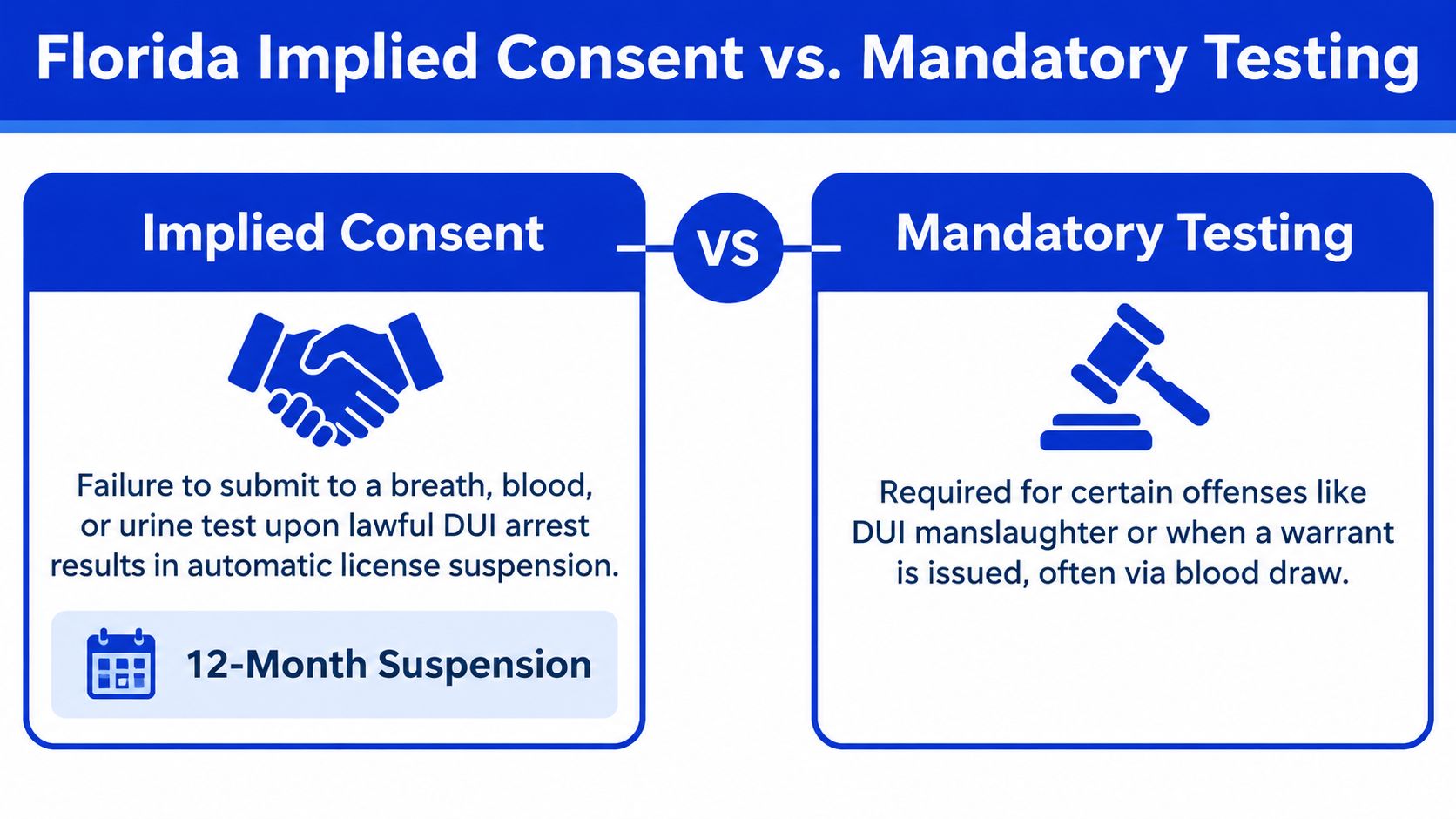
Florida's implied-consent law treats the privilege of driving in the state as consent to approved chemical or physical testing when a person is lawfully arrested for DUI. The statute includes breath testing and addresses blood testing for alcohol content or chemical substances in defined DUI circumstances. The details matter because implied consent isn't a universal license for officers to take blood whenever they want. Florida's implied-consent statute sets out the statutory framework.
A lawful arrest is an important threshold. So are the type of test requested, the reason for requesting it, and whether the facts fit the statute. A driver who doesn't understand the request may later face a dispute over what was communicated, what was refused, and whether the officer followed the required procedure.
Serious crashes create a separate statutory issue
Florida law requires a blood test when an officer has probable cause to believe a DUI-related crash caused death or serious bodily injury. In that setting, the officer shall require the driver to submit to a blood test for alcohol content or the presence of chemical substances. Florida's mandatory blood-testing statute governs this specific situation.
That requirement doesn't erase every constitutional question. A defense may still examine whether the officer had probable cause, whether the crash fit the statutory category, and whether the draw was performed in a reasonable manner. The medical setting can also raise questions about who requested the draw, who performed it, and whether the sample was collected for treatment, law enforcement, or both.
Refusal can affect the license separately
Florida imposes significant administrative consequences for refusal. A first refusal can cause a 12-month license suspension, and a second or subsequent refusal can cause an 18-month suspension. Refusing a lawful breath or urine test is also a second-degree misdemeanor under Florida law. Florida's refusal statute addresses those consequences.
A refusal doesn't necessarily prevent police from later seeking a warrant. Conversely, a warrant doesn't necessarily eliminate the administrative refusal issue. The criminal case and the license proceeding can involve different records, deadlines, and legal arguments.
Florida also recognizes a limited right to an independent blood test after a person submits to the officer-requested chemical or physical testing. Florida Supreme Court materials further note that a voluntary blood test may be admissible when the person was fully informed that implied consent required only breath and urine testing and blood was offered as an alternative. Florida Supreme Court materials on voluntary and independent blood testing help illustrate why the exact conversation matters.
For practical guidance about refusal issues, read whether you can refuse a breathalyzer in Florida, then obtain advice based on the actual arrest paperwork rather than relying on a general rule.
Challenging Blood Evidence and Chain of Custody
A warrant addresses the legality of obtaining evidence. It doesn't automatically prove that the evidence tested in the laboratory is the same sample drawn from you, or that the sample remained reliable during handling.
The prosecution must establish an unbroken chain of custody from collection through analysis. That record should identify where the sample was, who possessed it, how personnel labeled it, and how it was stored at each stage. A gap can support an argument that the State hasn't reliably connected the laboratory result to the defendant's blood.
The records deserve close examination
A defense review should compare the warrant, draw documentation, hospital records, evidence logs, laboratory submission forms, and testing records. The goal isn't to create confusion for its own sake. The goal is to identify a concrete break or inconsistency that affects identity, integrity, or reliability.
Questions can include:
Collector identity: Who drew the blood, and did that person follow the applicable procedure?
Time records: Do the collection, sealing, transfer, receipt, and testing times make sense together?
Labels and initials: Do the identifiers match across the medical and law-enforcement records?
Storage history: Was the sample stored as required before laboratory analysis?
Transfer documentation: Did every person who received the specimen document the handoff?
A missing signature may not automatically end the case, and a clerical error may not always justify exclusion. But the State must still prove that the error doesn't undermine the evidence. Chain-of-custody requirements for DUI blood evidence explains why these records are central to admissibility.
A warrant isn't a substitute for proof
Suppose a judge signed a warrant, a nurse collected the specimen, and a lab later reported a result. The defense can still ask whether the warrant described the correct person and circumstances, whether officers collected the sample within its terms, and whether the State can account for every transfer.
The challenge may be constitutional, evidentiary, scientific, or administrative. It may involve a request to suppress, an objection to foundation, cross-examination of the collector or analyst, or an expert review of the testing method. A chain-of-custody defense analysis can be especially important when the State's case depends heavily on one blood result.
A legal draw and a reliable sample are separate questions. Your lawyer should investigate both.
Biohazard Handling and Sample Integrity Risks
Blood evidence is treated as biohazard evidence, which means handling and documentation serve two purposes. Personnel must protect people who handle the specimen, and they must preserve the sample as evidence that can be trusted later in court.
The sample should be sealed, labeled, and signed or initialed at transfer points. Because it may move through a hospital, an officer's evidence system, a storage facility, and a testing laboratory, each handoff creates a point for error. The records should show who accepted the sample and how it was secured afterward. Medical-legal guidance on handling DUI blood evidence discusses the importance of sealing, labeling, and documenting transfers.
Contamination and mix-ups are practical issues
A blood result may appear scientific and precise, but laboratory analysis depends on the specimen presented to the analyst. Contamination, tampering, a mislabeled tube, an unsuitable container, or a storage problem can affect the defense evaluation. The issue isn't whether blood testing is generally useful. The issue is whether this sample was collected and preserved correctly.
A lawyer may seek:
The original collection kit and tube information.
Hospital and officer documentation showing who handled the specimen.
Laboratory receiving, storage, and testing records.
Information about preservatives, seals, and container condition.
Any quality-control or instrument records supporting the reported result.
A medical draw also deserves careful separation from a forensic draw. Hospital staff may collect blood to diagnose and treat injuries, while law enforcement may later seek access to that sample or request a separate specimen. The purpose, consent, timing, and authorization can affect the legal analysis.
Reliability can remain contested after a warrant
A warrant may resolve one Fourth Amendment issue, but it doesn't guarantee that officers followed its terms or that the laboratory result is beyond challenge. Consent can also be disputed. A person in pain, medicated, restrained, or surrounded by authority figures may not have made a free and informed choice, particularly if the officer presented an alternative as mandatory.
For a DUI defense lawyer in Fort Lauderdale or Broward County, the meaningful review often requires more than reading the arrest affidavit. It requires obtaining the medical records, evidence logs, warrant materials, and laboratory file, then comparing them for inconsistencies.
Taking Action to Protect Your Rights in Florida
The first practical step is to preserve information while it's fresh. Write down where the draw occurred, who was present, what the officer said, whether a warrant was shown, whether anyone explained your options, and whether medical staff were treating you. Don't guess or fill gaps. Record what you remember.
Request counsel before making detailed statements about the draw or the accident. A lawyer can examine the warrant, challenge an unsupported exigency claim, address consent and refusal issues, and investigate whether the sample survived the chain-of-custody and integrity review. The lawyer should also identify license deadlines, because an administrative suspension may proceed separately from the criminal DUI case.
What works: early preservation of records, focused constitutional review, and a forensic examination of the sample's handling.
What doesn't: assuming that a warrant ends the case, ignoring the license proceeding, or treating hospital blood as automatically available to police.
Ticket Shield, PLLC handles Florida criminal defense matters involving DUI, search and seizure, drug charges, violent crimes, weapons offenses, theft, and probation violations. Attorney Jason S. Goldsmith is a former prosecutor, and the firm serves clients in Broward County, Fort Lauderdale, Miami-Dade, Palm Beach, and courts throughout Florida. Learn more about working with a Florida criminal defense lawyer.

If police obtained a blood sample after a Florida DUI arrest, Ticket Shield, PLLC can review the warrant, consent language, hospital records, chain of custody, and license consequences affecting your case. Contact the firm for a confidential consultation so you can understand your options and take timely steps to protect your license, record, and freedom.