Organized Scheme to Defraud in Florida: Penalties & Defense
Jason Goldsmith, Esq
Under Florida Statute §817.034, an organized scheme to defraud is a systematic, ongoing course of conduct with intent to obtain property by false pretenses. The penalties escalate by the aggregate dollar value obtained, under $20,000 is a third-degree felony, $20,000 to under $50,000 is a second-degree felony, and $50,000 or more is a first-degree felony.
You may be dealing with this charge after a business dispute, a failed investment, a construction project that went wrong, or an accusation involving several customers. A Fort Lauderdale property manager, for example, might be accused of accepting rent deposits from multiple tenants for units he didn't own or have authority to rent. The State may view those transactions not as separate misunderstandings, but as one continuing plan.
That distinction matters. Florida's organized scheme to defraud statute focuses on a pattern of conduct, the defendant's intent, the property obtained, and the total value prosecutors attribute to the alleged scheme. This article explains the statute in plain English, the State's proof requirements, Florida's grading ladder, related theft and white-collar charges, common defenses, and how cases in Broward County, Miami-Dade, Palm Beach, and surrounding South Florida communities can develop.
Table of Contents
Sentencing Exposure, Restitution, and Collateral Consequences
Why a Former Prosecutor's Perspective Matters in These Cases
Frequently Asked Questions About Organized Scheme to Defraud
What an Organized Scheme to Defraud Means in Florida
Florida law treats an organized scheme to defraud as more than a single dishonest statement. The statute addresses a systematic, ongoing course of conduct carried out with intent to defraud or obtain property through false pretenses, representations, promises, or willful misrepresentations of a future act. The statutory definition appears in Florida Statute §817.034.
In the property-manager example, prosecutors might point to repeated lease agreements, deposits, text messages, advertisements, and bank deposits. Their theory would be that the manager followed a continuing method to obtain money from multiple tenants, not that one isolated conversation happened to contain an inaccurate statement.
The pattern matters
An organized scheme can involve different victims, transactions, documents, or communication methods. The alleged conduct doesn't have to look identical every time. The prosecution generally tries to connect the events through a common purpose, repeated representations, similar payment requests, or a consistent method of obtaining property.
That doesn't mean every failed business relationship becomes organized fraud. A contractor who misses a deadline, an investor whose project loses money, or a landlord who has a title dispute may face serious civil consequences without having criminal intent. The State still has to prove the required fraudulent purpose and the connection between the alleged conduct and property obtained.
Practical rule: A collection of unhappy customers isn't automatically proof of an organized scheme. The evidence must connect the transactions to a deliberate fraudulent plan.
Why the charge carries unusual risk
The statute allows prosecutors to view related transactions together when deciding the charged felony degree. That can transform what appears to be a modest individual complaint into a substantially more serious case once prosecutors aggregate the alleged value.
The charge may also appear alongside grand theft, fraudulent practices, worthless checks, money laundering, or licensing offenses. A defense attorney handling a South Florida white-collar case should examine the entire alleged course of conduct, not just the transaction that triggered the investigation.
How Florida Defines a Scheme to Defraud
Florida's statutory language supplies the starting point. A scheme to defraud means a systematic, ongoing course of conduct with intent to defraud one or more people or obtain property through false or fraudulent pretenses, representations, promises, or willful misrepresentations of a future act. A Florida legislative analysis also describes the definition as a continuing pattern rather than a single isolated lie. See the Florida legislative analysis of the organized-fraud definition.
The words do practical work.
Breaking down the statutory language
Systematic: The State claims the conduct followed an identifiable method, not merely an accidental error.
Ongoing: Prosecutors rely on multiple acts or a continuing course of conduct, rather than treating one statement as the entire offense.
Intent to defraud: The alleged actor must have acted with a purpose to deceive or obtain property improperly.
False pretenses or representations: The accusation may involve statements about existing facts, promises, contractual performance, or a future act the defendant allegedly never intended to perform.
Obtaining property: The alleged scheme must result in the defendant obtaining money, property, or another thing of value.
A single false statement can support another charge depending on the facts, but organized fraud requires the State to prove the broader course of conduct. For example, a person who misstates the condition of one used vehicle may face a theft or false-pretenses theory. A person who repeatedly creates similar listings, collects deposits, and never provides vehicles presents a stronger systematic-conduct theory.
“Organized” doesn't mean sophisticated
The prosecution doesn't need to show an elaborate corporate structure, coded communications, or a large network. A simple repeated method can be enough for the State to argue that the conduct was organized. On the other hand, repeated transactions may still reflect legitimate business activity if the evidence supports good faith, changing circumstances, or honest mistakes.
The defense should test whether the alleged acts form one plan. Differences in customers, promises, dates, payment purposes, and performance can weaken the State's attempt to combine everything into a single fraudulent course of conduct.
Elements the State Must Prove Beyond a Reasonable Doubt
Florida's standard jury instruction treats organized fraud as an element-by-element offense. The State must prove the charged elements beyond a reasonable doubt, including the scheme, fraudulent representations, knowledge, intent, and actual acquisition of property. Florida appellate decisions have emphasized the need to establish a systematic ongoing course of conduct and the required fraudulent intent, as reflected in this Florida appellate decision addressing organized fraud.
Element | What the State Must Prove | Common Defense Pressure Point |
|---|---|---|
Scheme to defraud | A systematic, ongoing course of conduct directed at defrauding one or more people | The transactions were isolated, unrelated, or part of legitimate business activity |
False representation | A false or fraudulent pretense, representation, or promise concerning a material fact | The statement was opinion, sales puffery, an estimate, or later corrected |
Knowledge | The defendant knew the representation was false when made | The defendant relied on incomplete information, misunderstood records, or believed the statement was accurate |
Intent | The representation was made to obtain money, property, or something of value | The purpose was performance, repayment, negotiation, or another lawful objective |
Obtaining property | The defendant actually obtained property through the alleged scheme | No causal connection exists between the statement and the payment, or the property went to another person |
Where cases commonly break down
A delayed project doesn't prove that the contractor intended to deceive at the beginning. A failed investment doesn't establish that the promoter knew the business would fail when funds were solicited. The State must connect the defendant's mental state at the time of the alleged representation to the property later obtained.
Materiality and causation also matter. A minor inaccuracy that didn't influence a payment may not explain how the defendant obtained property. Likewise, a customer who paid for independent reasons may complicate the State's effort to prove that the alleged misrepresentation caused the transfer.
The defense often builds this analysis through contracts, invoices, accounting records, text messages, emails, bank statements, delivery records, and witness timelines. The goal isn't to identify one inconsistency. It is to show that the State can't prove one or more required elements beyond a reasonable doubt.
Felony Grades and Penalties by Dollar Value
Florida grades organized fraud by the aggregate value obtained through the alleged scheme, not necessarily by looking at each transaction separately. Under §817.034, the statutory ladder is:
Aggregate Value Obtained | Felony Degree | Max Prison | Max Fine |
|---|---|---|---|
Less than $20,000 | Third-degree felony | Up to 5 years | $5,000 |
$20,000 to less than $50,000 | Second-degree felony | Up to 15 years | $10,000 |
$50,000 or more | First-degree felony | Up to 30 years | $10,000 |
These grades and maximums appear in the Florida Senate version of §817.034. The value question can become the central issue in charging and negotiation. A defense attorney should demand a transaction-by-transaction accounting, identify duplicate claims, separate civil damages from property obtained, and test whether every alleged payment belongs to the same scheme.
A person researching related theft allegations should also review the firm's explanation of grand theft in Florida, because prosecutors may file separate theft counts based on individual transactions.
Why aggregation changes the case
Suppose prosecutors identify several deposits from multiple alleged victims. They may argue that the deposits belong to one continuing plan and add them together. The defense may respond that some payments involved completed work, separate contracts, unrelated disputes, refunds, or transactions outside the charged scheme.
The felony grade affects bond arguments, plea negotiations, sentencing exposure, restitution discussions, and the long-term consequences of a conviction. A conviction can also appear as an economic or white-collar felony on a criminal record, creating problems with employment, licensing, housing, and immigration.
Related Florida Charges and How They Overlap
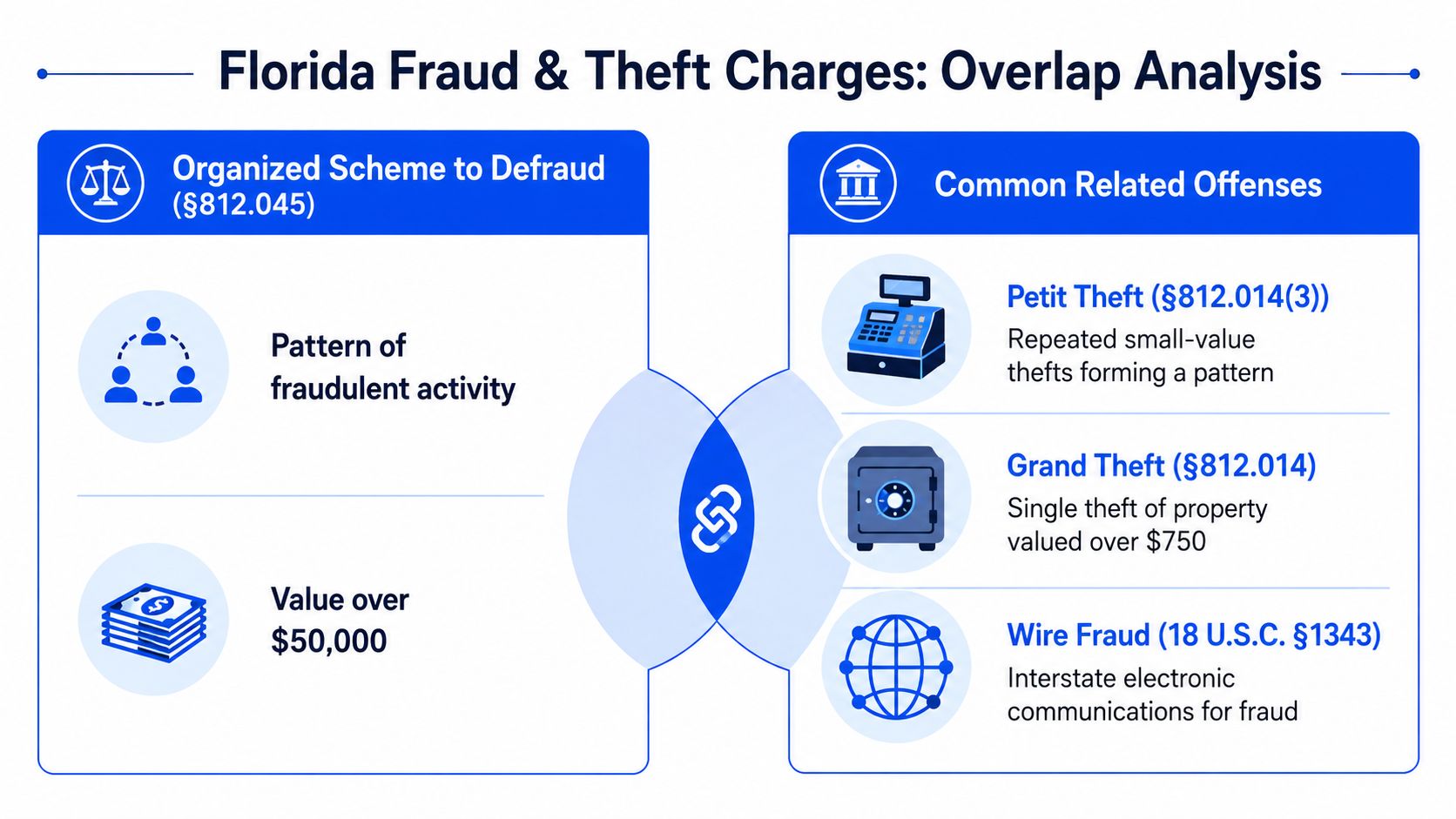
Organized scheme to defraud frequently overlaps with theft and financial-crime allegations, but the statutes don't require identical proof. Petit theft and grand theft generally focus on an unlawful taking, while §817.034 requires proof of a systematic, ongoing fraudulent course of conduct. A case may therefore contain both an overarching organized-fraud count and individual theft counts tied to particular victims.
Common companion charges include fraudulent practices under §817.02, obtaining property by false pretenses under §817.41, worthless checks under §832.05, money laundering under §896.101, and licensing or construction offenses in contractor cases. An allegation involving property transfers may also lead investigators to examine whether the defendant dealt in stolen property, which is addressed in Florida's dealing-in-stolen-property statute.
The charge-by-charge analysis
Petit theft: Usually concerns a lower-value taking or isolated conduct.
Grand theft: Concerns a qualifying taking based on property type or value.
Fraudulent practices: May focus on deceptive commercial or financial conduct.
Money laundering: Focuses on transactions involving proceeds of unlawful activity.
Home-improvement fraud: May arise when a contractor accepts money through prohibited conduct or performs unlicensed work.
The same facts can support multiple counts, but multiple counts don't automatically mean multiple punishments are lawful. Courts examine whether each offense requires proof of a fact the other doesn't, applying the constitutional double-jeopardy framework commonly associated with the Blockburger test. The charging documents, jury instructions, and factual basis for each count matter.
An attorney should compare the alleged acts, victims, property, and statutory elements before accepting the State's description of the case. Labels such as “fraud” or “theft” don't resolve whether counts merge, require separate proof, or expose the defendant to separate sentences.
Sentencing Exposure, Restitution, and Collateral Consequences
The statutory maximum is only one part of Florida sentencing analysis. The Criminal Punishment Code scoresheet may assign points for the primary offense, victim injury, and prior record. The resulting score can produce a guideline sentence that differs sharply from the maximum stated in the statute.
A lower-level case may be eligible for probation or a negotiated non-prison resolution, but eligibility doesn't guarantee that result. Multiple victims, prior convictions, a high scoresheet calculation, or disputed losses can make the prosecutor's sentencing position more severe.
Restitution requires careful review
Florida courts can order restitution for documented economic losses under §775.089. The defense should examine whether each claimed loss was caused by the offense, whether the amount reflects a real economic loss rather than a speculative expectation, and whether insurance, refunds, recovered property, or completed services reduce the claim.
Restitution can become a major part of plea negotiations. A written agreement should identify the victims, amounts, payment schedule, and consequences of disputed claims. A defendant shouldn't assume that agreeing to a broad restitution figure will resolve every future civil or criminal issue.
Collateral consequences can last
A felony conviction may affect professional licensing, immigration status, employment, housing, and firearm rights. Florida-licensed contractors, real-estate professionals, and financial workers may face reporting or disciplinary issues. Noncitizens should obtain immigration advice before entering a plea because a fraud-related conviction can carry consequences beyond the Florida sentence.
A defense lawyer can challenge improper scoresheet points, seek a mitigated sentence, narrow restitution, and negotiate charge reductions. For a broader explanation of negotiated resolutions, review how plea bargains work.
Common Defenses Florida Defense Attorneys Use
The strongest defense usually targets the elements rather than relying on a general claim that the situation was a misunderstanding. Counsel examines the timeline, communications, records, witness accounts, and the State's aggregation theory to determine whether the alleged scheme existed.
Challenging the alleged pattern
The State may group transactions together because they involve the same business, defendant, or type of complaint. The defense can separate them by showing different contracts, different explanations, different services, or unrelated financial circumstances. One failed transaction doesn't automatically prove a continuing plan.
Challenging intent and knowledge
Intent often becomes the most contested issue. Evidence that can support a good-faith defense may include work performed, partial delivery, efforts to obtain refunds, attempts to correct invoices, reliance on an accountant or partner, and communications showing an intention to complete the promised act.
The timing of the representation matters. Prosecutors must prove the defendant knew the statement was false when it was made. Later failure, poor judgment, insolvency, or an unexpected event may not establish that original knowledge.
Challenging causation and evidence
A defense can argue that the alleged statement wasn't material, the victim didn't rely on it, or the defendant didn't obtain the property. Counsel may also raise entrapment where law enforcement induced conduct the defendant wasn't predisposed to commit, seek suppression of unlawfully obtained business or bank records, and file a motion challenging legally insufficient proof.
The statute of limitations under §775.15 and applicable Florida Rules of Criminal Procedure must be reviewed early. Restitution calculations also deserve independent scrutiny. More examples of defense strategies appear in this guide to criminal defenses.
Example Fact Patterns and Case Law Illustrations
South Florida cases often arise from ordinary businesses that generate extensive records. The records can help the State, but they can also expose gaps in its theory.
A Broward contractor might accept deposits for several renovation projects, then fail to begin work. The prosecution may rely on similar proposals, repeated payment requests, and messages promising imminent performance. The defense would examine whether materials were purchased, subcontractors were hired, permits were sought, work began, or financial problems developed after the contracts were signed.
A Miami-Dade investment promoter might solicit funds for a real-estate flip that doesn't exist. The key questions include what the promoter represented, whether property documents were fabricated, where the funds went, and whether the promoter knew the project was nonexistent when money was requested.
Real-estate and online examples
A Palm Beach real-estate agent accused of double-staging closings on the same property presents a different evidentiary problem. Title records, closing statements, escrow instructions, and communications may reveal whether the conduct reflected deliberate duplication or an administrative error corrected before any property was obtained.
An online marketplace operator who posts recurring fake vehicle listings across county lines may face a stronger pattern argument if listings use similar photographs, descriptions, payment instructions, and nonexistent vehicle identification information. Even there, the State must prove the required intent and show that the defendant obtained property through the alleged representations.
Florida appellate decisions have shaped how courts distinguish a systematic course of conduct from a single fraudulent act and how they evaluate intent and property obtained. Juries may credit good-faith testimony when documents support it, but consistent documentary evidence can undermine an explanation that changes over time.
Why a Former Prosecutor's Perspective Matters in These Cases
A former prosecutor understands how an investigation moves from complaints and subpoenas to an arrest affidavit, information, or broader prosecution. That perspective helps identify what the State may be trying to prove before the charging theory becomes fixed.
In Broward, Miami-Dade, and Palm Beach cases, investigators may include local economic-crime units, FDLE, financial institutions, or the Florida Attorney General's Office of Statewide Prosecution. Counsel familiar with those charging patterns can anticipate how prosecutors may combine victims, value transactions, and present the case to increase the felony grade.
Finding leverage before trial
Complex financial cases often contain discovery weaknesses. Records may be incomplete, witnesses may disagree about promises, accountants may interpret transactions differently, and prosecutors may rely on summaries instead of underlying documents. A defense lawyer should test the original records and the method used to calculate the alleged amount.
The defense also has to compare plea negotiations with trial risk. Cooperation may help in some cases, but speaking without a negotiated protection can create new evidence. Restitution-driven resolutions, charge reductions, and possible dispositions under §948.01 require a careful assessment of the evidence and the client's goals.
Early intervention matters most before a grand jury presentation or formal charging decision. A defense lawyer may be able to provide records, explain legitimate transactions, narrow the alleged loss, or identify a missing element. Counsel should also investigate whether government conduct raises issues discussed in this overview of prosecutorial misconduct.
Quick Reference for Organized Scheme to Defraud
Use this summary to identify the core issues in a Florida §817.034 case.
Felony Grade | Aggregate Value | Max Prison | Key Element |
|---|---|---|---|
Third-degree felony | Less than $20,000 | Up to 5 years | Systematic course of conduct and property obtained |
Second-degree felony | $20,000 to less than $50,000 | Up to 15 years | Fraudulent representations plus required intent |
First-degree felony | $50,000 or more | Up to 30 years | Aggregate value tied to the alleged scheme |
Core elements: The State generally must prove a systematic, ongoing course of conduct, fraudulent pretenses or representations, knowledge of falsity, intent to obtain property, and actual acquisition of property.
Cross-references: Review §812.014 for grand theft, §817.02 for fraudulent practices, §896.101 for money laundering, and §775.084 for potential habitual-offender sentencing issues. The exact charge, alleged value, prior record, and proof determine the practical exposure.
Frequently Asked Questions About Organized Scheme to Defraud
Can an organized scheme to defraud conviction be sealed or expunged?
A felony conviction generally creates serious barriers to sealing or expungement under Florida law. Section 943.059 contains eligibility requirements and disqualifying offenses, so a person shouldn't assume that a dismissal, withheld adjudication, or reduced charge will produce the same record result. Eligibility depends on the final disposition, prior record, charge language, and statutory restrictions.
Can the same conduct lead to Florida and federal charges?
Yes, conduct involving interstate electronic communications may draw a federal wire-fraud theory under 18 U.S.C. §1343. Conduct involving the United States mail may implicate federal mail fraud under 18 U.S.C. §1341. The federal mail-fraud framework traces to the statute Congress enacted on June 8, 1872, which criminalized using the mail with intent to defraud, and Congress codified it as §1341 on June 25, 1948. Congress added §1346 in 1988 to address deprivation of the intangible right of honest services, as explained by the United States Postal Inspection Service history of mail fraud.
Federal and Florida cases can involve different elements, agencies, charging decisions, and sentencing systems. A state investigation doesn't guarantee federal prosecution, and a federal inquiry doesn't eliminate Florida exposure.
What does restitution require?
Restitution generally concerns documented economic losses caused by the offense. The defense should review each claimed amount, identify payments or recovered property, challenge unsupported losses, and negotiate a realistic schedule before entering a plea.
What should I do if law enforcement contacts me?
Don't try to explain the entire situation during an unexpected call or interview. Ask whether you're being detained, remain calm, and invoke your right to counsel before answering substantive questions. Contact a Florida criminal defense lawyer promptly if FDLE, the FBI, a state attorney's economic-crime unit, or a Fort Lauderdale police detective asks about your business, bank account, customers, or communications.
A lawyer can communicate with investigators, preserve records, assess subpoena or search-warrant issues, and determine whether early action can prevent avoidable statements from becoming evidence.
Ticket Shield, PLLC defends clients facing organized scheme to defraud, theft, white-collar, and related felony charges throughout Broward County, Fort Lauderdale, Miami-Dade, Palm Beach, and surrounding South Florida communities. Contact the firm for a confidential consultation, and visit Ticket Shield, PLLC to discuss the evidence, alleged dollar value, and defense options before speaking with investigators or entering a plea.