Dealing in Stolen Property Florida Statute: Elements
Jason Goldsmith, Esq
You bought a laptop through Facebook Marketplace because the seller seemed ordinary, the price looked attractive, and nothing about the exchange felt criminal. Weeks later, a Broward County detective tells you the laptop was reported stolen, asks how you got it, and suggests you may have been part of a resale operation. You never entered the burglary, but Florida law can still expose you to a serious felony investigation.
The phrase dealing in stolen property Florida statute refers primarily to Florida Statute §812.019. The law reaches people who traffic in, or attempt to traffic in, property they know or should know was stolen. That can include a reseller, a pawn-shop customer, an online seller, or someone who agrees to move property for a friend. If police contact you, don't explain the transaction informally before speaking with a criminal defense lawyer.
Table of Contents
Understanding Dealing in Stolen Property Charges in Florida
A Florida stolen-property case can begin with an ordinary resale, pawn, or online marketplace transaction. You may never have entered the property where the item was taken, yet investigators can still accuse you of dealing in stolen property. The central issue is the difference between theft and dealing: the State need not prove that you committed the original taking. Under Florida Statute §812.019, prosecutors must connect you to trafficking in property while proving that you understood, or had reason to suspect, its stolen origin.

Why an innocent purchase can become a felony case
Buying a tool, phone, laptop, vehicle part, or jewelry does not automatically prove criminal knowledge. The item's later identification as stolen is only part of the case. The State still must prove the required elements beyond a reasonable doubt, based on the transaction and surrounding circumstances.
Investigators may examine messages, listings, payment records, photographs, serial numbers, witness accounts, and the seller's explanation. They may also point to an unusually low price, an exchange location, missing records, or other details they say made the transaction suspicious. Pawn and online marketplace transactions create particular risks because ordinary records can later be presented as evidence of what you knew.
Practical rule: Do not explain a stolen-property investigation casually. Your words can become evidence about what you knew, when you learned it, and why you accepted or resold the item.
A felony accusation can affect employment, professional licensing, housing, immigration status, and firearm rights. The impact depends on the charge and outcome, so obtain legal advice before answering questions. Review the Florida theft and property crimes practice area for broader information about Florida property offenses.
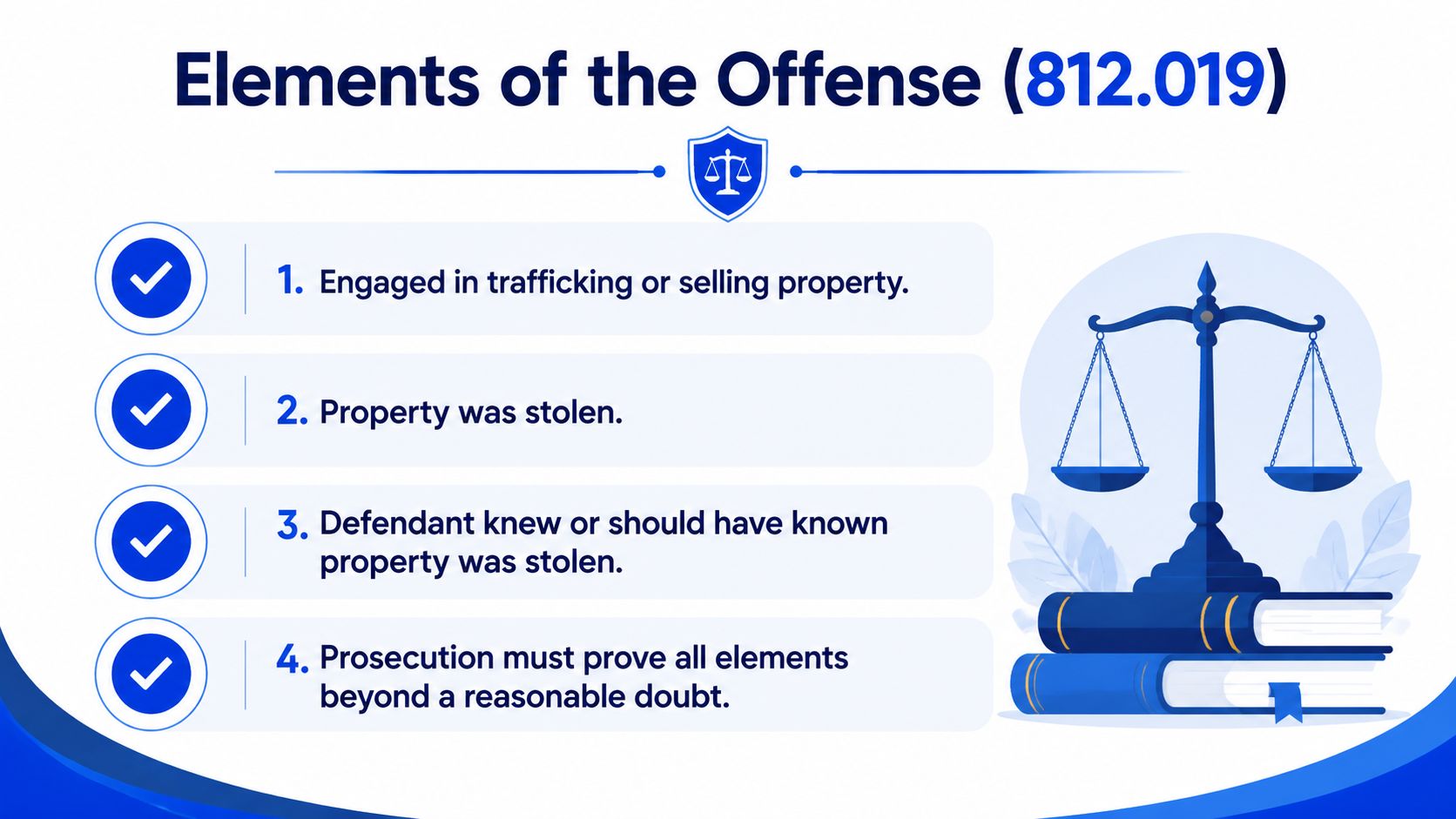
Elements of the Offense Under Florida Statute 812.019
The State must prove each required element beyond a reasonable doubt. A defense lawyer should test the evidence separately rather than treating the case as one broad accusation of suspicious conduct.
The trafficking element
Florida's statute covers trafficking in, or attempting to traffic in, stolen property. In practical terms, the State may focus on conduct such as selling, transferring, purchasing, receiving, possessing with an intent to sell, or disposing of the property. The alleged act doesn't require a large resale business. A single transaction can become the center of the prosecution's theory.
But possession and trafficking aren't automatically identical. If the evidence shows only that an item was found in your home or vehicle, the State may still need to prove the additional conduct or intent required for dealing.
The property must actually be stolen
The prosecution must connect the specific property to a theft. That may require an owner, an original theft report, identifying marks, serial-number evidence, photographs, purchase records, or testimony explaining ownership. If the item can't be reliably identified, or the ownership history is inconsistent, that gap can create reasonable doubt.
Knowledge or reason to know
The most disputed element is usually whether you knew, or should have known, the property was stolen when you dealt with it. Prosecutors can rely on circumstantial evidence, but suspicion isn't the same as proof. The defense should examine what information was available to you at the time, not merely what investigators discovered later.
The following video can provide general background, but it isn't a substitute for advice about your facts.
Felony Degrees and Penalty Exposure
Florida Statute §812.019 sets out two felony levels for dealing in stolen property. The ordinary charge applies when a person traffics in, or attempts to traffic in, property they knew or should have known was stolen. The first-degree charge requires more: the person must also initiate, organize, plan, finance, direct, manage, or supervise the theft before trafficking in the property.
Factor | Second-Degree Felony (812.019(1)) | First-Degree Felony (812.019(2)) |
|---|---|---|
Conduct alleged | Trafficking in, or attempting to traffic in, property known or reasonably suspected to be stolen | Organizing or supervising the theft and then trafficking in the stolen property |
Maximum prison exposure | Up to 15 years | Up to 30 years |
Maximum fine | Up to $10,000 | Up to $10,000 |
Central proof issue | Knowledge or reason to know, plus trafficking | The enhanced organizational role, the theft, and later trafficking |
The prison and fine exposure follows Florida's statutory penalty framework. A first-degree allegation is not a tougher version of an ordinary buyer charge. Prosecutors must connect you to a leadership or coordinating role in the theft itself.
The property's value does not determine the main difference between these dealing charges. The State must prove what role you played, that trafficking occurred or was attempted, and that you knew or should have known the property was stolen. Those issues often separate a dealing allegation from a separate theft charge.
Separate theft allegations can still increase the stakes. Florida law classifies property valued at $750 or more but less than $20,000 as grand theft of the third degree under the stated circumstances. That charge may arise from the same investigation, but theft and dealing require different elements and support different prosecution theories.
For a broader comparison of Florida theft classifications, review this guide to misdemeanor and felony theft. A defense lawyer should examine each count separately rather than assume that proof of a theft automatically proves dealing.
Common Factual Scenarios That Lead to Charges
A pawn-shop transaction often creates the first report. Someone brings in tools, electronics, jewelry, or other merchandise, and investigators later identify the property as stolen. Altered or removed serial numbers can draw particular attention because they may suggest an effort to hide ownership, although the condition of an item alone doesn't prove what the customer knew.
Online marketplaces create a different evidentiary record. A Facebook Marketplace, OfferUp, or Craigslist listing may preserve the seller's description, photographs, messages, payment arrangements, and meeting details. A prosecution may argue that a low price, a rushed exchange, or the absence of a receipt should have alerted the buyer. The defense must place those facts in context, including what the listing said and whether the buyer had a reasonable explanation.
Resale and business transactions
A thrift-store operator, flea-market vendor, or used-goods dealer may face scrutiny after acquiring inventory from an unfamiliar source. Bulk purchases of construction equipment, catalytic converters, copper wire, tools, jewelry, or electronics can attract investigation when the goods later match theft reports. The State may examine whether the seller had a credible business identity, whether the buyer kept records, and whether the transaction followed ordinary practices.
A legitimate resale business should preserve invoices, seller information, photographs, payment records, and messages. Those records don't guarantee a result, but they can help show how the inventory entered the business and what the buyer knew at the time.
Helping another person sell property
People also get pulled into cases by doing a favor. A friend may ask you to pawn an item, list it online, store it temporarily, or deliver it to another person. If the property later proves stolen, investigators may treat your participation as trafficking even if you didn't receive the original item through a burglary.
The relationship with the seller matters, but it isn't a complete defense. The question is whether the surrounding facts support the State's claim that you knew, or should have known, the property was stolen.
Theft Versus Dealing in Stolen Property Charging Issues
Prosecutors may charge theft and dealing in stolen property based on the same scheme or course of conduct. Florida law permits both offenses to appear in a single information, but the trier of fact may convict on one or the other, not both, when the charges arise from that same conduct under Florida Statute §812.025.
That rule creates a practical defense issue. Theft generally focuses on taking or exercising control over property with the required intent to deprive the owner. Dealing focuses on trafficking in property that the defendant knew, or should have known, was stolen. The State may describe a sequence involving both, but the defense should ask whether the evidence proves separate criminal acts or repackages one transaction.
Element | Theft (812.014) | Dealing (812.019) |
|---|---|---|
Core conduct | Taking or exercising control over another person's property | Trafficking in, or attempting to traffic in, property alleged to be stolen |
Intent focus | Intent to deprive the owner of the property or its benefits | Knowledge, or reason to know, that the property was stolen |
Required factual question | Did the defendant commit the taking with the required intent? | Did the defendant engage in trafficking and possess the required knowledge? |
Value relevance | Value can affect the degree of a theft charge | The dealing statute's felony degree turns primarily on conduct and role, not property value |
A person accused of stealing an item and later selling it may face two theories supported by different evidence. But if the State can't identify a distinct trafficking act, or can't prove the required knowledge, counsel can challenge the charging theory and jury instructions.
The issue is not merely technical. It can affect negotiations, trial strategy, verdict forms, and the possibility of a conviction under an offense the evidence does not support. A related explanation of Florida's stolen-property concepts appears in this guide to receiving stolen property.
Knowledge Inferences and Evidentiary Traps
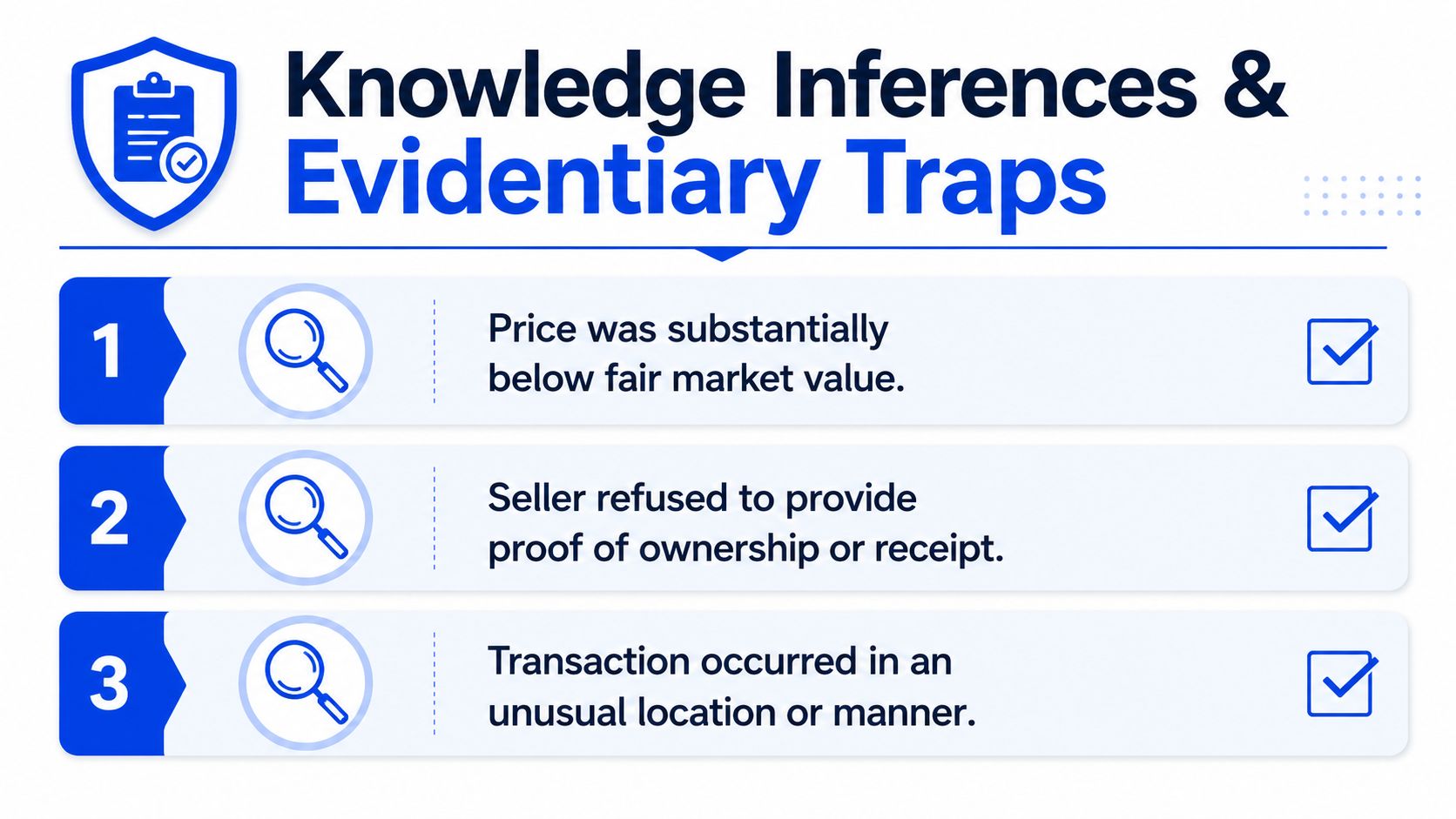
Florida's inference provisions can make an ordinary transaction look criminal after the fact. Under Florida Statute §812.022, circumstances such as an unusually low price or an out-of-course business transaction can create an evidentiary inference that the defendant knew the property was stolen.
That inference doesn't erase the State's burden. The prosecution still must prove the charge beyond a reasonable doubt, and the defense can challenge whether the facts support the inference and whether the transaction has an innocent explanation.
How the State builds the inference
A detective may focus on a price far below what similar goods normally command, a seller who refused to provide ownership documents, or an exchange arranged outside ordinary business practices. In a pawn, resale, or online-marketplace case, investigators may also emphasize missing receipts, inconsistent seller explanations, altered serial numbers, or multiple transactions with the same source.
The defense should not accept those labels without testing them. Was the item damaged? Was the seller liquidating an estate? Did the buyer have messages showing a normal discussion? Was the product commonly sold used at a wide range of prices? Did the buyer ask reasonable questions and receive a plausible answer?
A suspicious circumstance is evidence to examine, not a substitute for proof of criminal knowledge.
Possession of recently stolen property can create another problem when the defendant can't satisfactorily explain how the item was obtained. A lawyer should preserve the explanation early, compare it with the digital and financial records, and identify witnesses who can confirm the transaction. For related possession issues, review constructive possession in Florida.
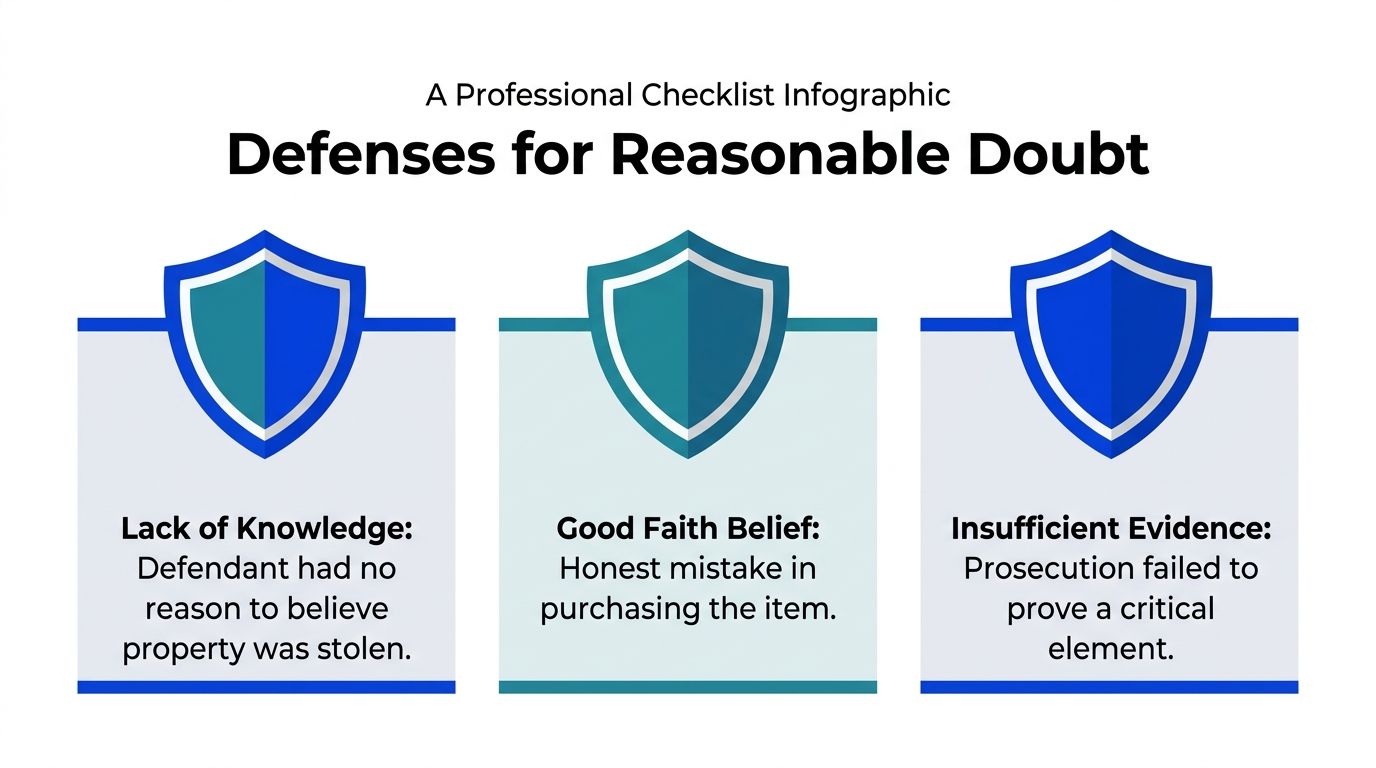
Defenses That Can Create Reasonable Doubt
The strongest defense usually targets knowledge. The State may prove that you handled, bought, sold, or transferred an item, but that doesn't answer whether you knew or should have known the item was stolen.
Lack of knowledge
Receipts, payment confirmations, marketplace messages, seller profiles, shipping records, and photographs can show a transaction that appeared legitimate. A buyer who paid through an ordinary method, received a consistent explanation, and had no obvious warning signs may have a credible argument that the State can't prove the mental element.
The defense should preserve the complete conversation, not just selected screenshots. A single message can look suspicious when separated from the negotiation that preceded it.
Good-faith purchase
A good-faith belief in the seller's ownership can undercut the prosecution's inference. Consider a person who buys a used laptop for personal use after receiving a serial number, a written receipt, and an explanation of where the seller obtained it. If the item later appears in a theft report, those facts may support an innocent explanation.
That doesn't make the defense automatic. The State can argue that other circumstances should have caused concern. The lawyer's job is to present the full context and expose assumptions that aren't supported by reliable evidence.
No trafficking or unreliable stolen-property proof
The State must prove more than possession if it alleges dealing. Counsel should examine whether there was an actual sale, transfer, attempted sale, or evidence of an intent to traffic. The defense should also test whether the alleged victim owned the item, whether the property was accurately identified, and whether the chain of custody supports the accusation.
An unlawful search, an improper seizure, a Miranda problem, or unreliable digital evidence may provide grounds for a motion to suppress or another pretrial challenge. In an undercover operation, the defense should also examine whether police induced conduct that the defendant wouldn't otherwise have committed.
Plea Options and Alternative Resolutions
A strong defense doesn't mean rejecting every offer. It means evaluating the evidence before deciding whether trial, negotiation, or another resolution protects your future.
Counsel may seek a reduction to a theft offense, a misdemeanor where the facts and charging authority permit it, dismissal after investigation, or a resolution that avoids a felony conviction. The available options depend on the evidence, criminal history, alleged conduct, victim's position, and the prosecutor's assessment of the case.
What negotiations should address
A lawyer should focus on the weak points that matter most:
Knowledge proof: Explain why the transaction appeared legitimate and present records that undermine the inference.
Trafficking proof: Challenge whether the State can establish a sale, transfer, attempted sale, or resale intent.
Role allegation: Separate an ordinary transaction from claims that the defendant organized, financed, directed, managed, or supervised a theft.
Collateral consequences: Evaluate how the proposed resolution may affect employment, licensing, immigration, firearm rights, housing, and record-sealing eligibility.
A withhold of adjudication may avoid a formal conviction in some circumstances, but it isn't the same as dismissal and doesn't eliminate every consequence. Diversion or restitution-based resolutions may be available in qualifying cases, yet no program should be assumed without reviewing the specific court and prosecutorial requirements.
Don't plead because the charge is frightening. Don't reject a resolution without understanding the trial risk. A defense lawyer should compare the evidence, the legal elements, and the long-term consequences before recommending a course of action. This overview of plea bargains in Florida provides related context.
Quick Reference Guide and Next Steps
A Facebook Marketplace sale, pawn transaction, or resale can become a dealing charge when prosecutors claim you knew the property was stolen. That differs from a theft allegation. The State must connect you to a sale, transfer, attempted sale, or resale intent and prove the required knowledge beyond a reasonable doubt.
Keep these points in view:
Charge theory: Review whether the evidence supports dealing, rather than only possession or theft, and identify the specific transaction the State relies on.
Knowledge issue: Preserve listings, messages, receipts, payment records, shipping information, photographs, and communications showing why the transaction appeared legitimate.
Inference risk: Do not delete account data or alter records. Pawn tickets, marketplace history, rapid resale activity, or inconsistent explanations may become evidence about what you knew.
Immediate action: Do not consent to a search or give an interview before speaking with counsel. Write down relevant dates, preserve devices in their current condition, and identify witnesses promptly.
If police contact you, refer questions to your lawyer. Counsel serving Fort Lauderdale, Broward County, Miami-Dade, Palm Beach, and nearby South Florida communities can assess the evidence, protect your rights, and address the case before records or witness recollections change.
Ticket Shield, PLLC handles Florida dealing-in-stolen-property defenses involving online sales, pawn transactions, alleged resales, and disputed knowledge. Visit Ticket Shield, PLLC for a confidential consultation about the charges, evidence, and next step.