
Open Container Laws Florida: What Drivers Need to Know
Jason Goldsmith, Esq
You're driving home through South Florida when blue lights appear behind you. An opened drink sits in the center console, a passenger has been holding it, or a half-finished bottle is tucked beside the seat. You may be worried that a traffic ticket is about to become a DUI investigation, a license problem, or something more serious.
Florida's open container laws are narrower and more technical than many drivers realize. The result depends on what the container is, where it was located, who possessed it, whether the vehicle was on a public road, and whether a statutory exception applies. The citation itself is generally a civil traffic matter, but the facts observed during the stop can become important evidence in a broader roadside investigation.
Table of Contents
Getting Pulled Over With an Open Container in Florida
On a Saturday night near Dania Beach, a Broward deputy approaches a late-model sedan after headlights flash behind it on A1A. A half-finished mojito is visible in the cupholder. The officer may notice the broken seal, see that the drink is capable of immediate consumption, and smell alcohol inside the cabin. The driver's instinct might be to finish it, pour it out, or toss it before the officer reaches the window.
Those reactions can create more questions rather than solve the problem. Once an officer has observed the container, the focus may shift from a traffic citation to who was drinking, whether the driver consumed alcohol, and whether impairment signs exist.
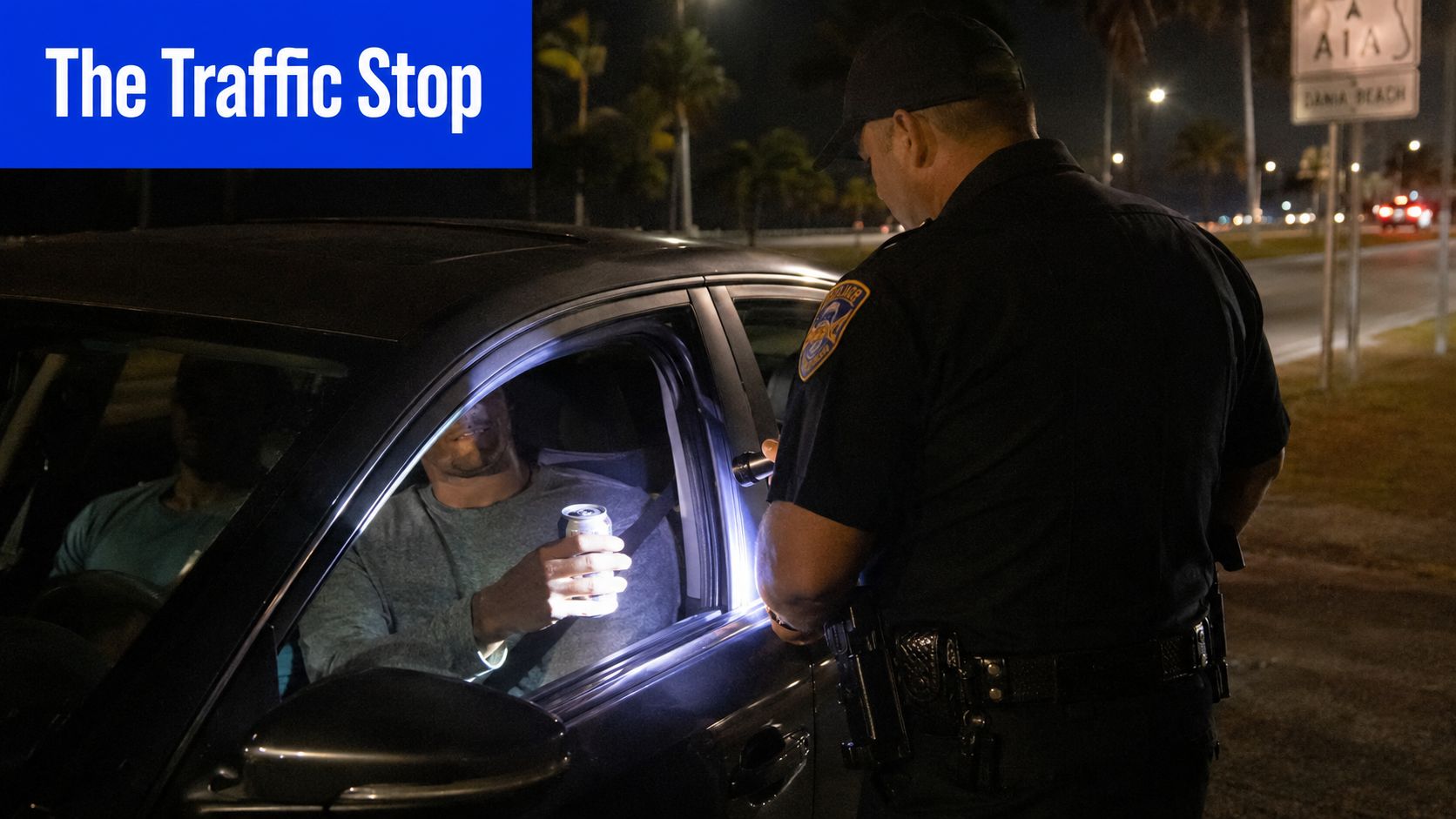
Florida Statute 316.1936 defines an open container as an alcoholic-beverage container that is immediately capable of being consumed from or whose seal has been broken. The statute prohibits possessing or consuming that container while operating a vehicle, while riding as a passenger, or while seated in a motor vehicle stopped or parked within a road. Florida's statutory text should be read carefully because small factual differences can change the analysis.
A traffic stop must also begin lawfully. If you believe the officer lacked a valid reason to stop the vehicle, review the circumstances with counsel, including the basis for the stop and any later search. A practical overview of this issue appears in Florida traffic-stop reasonable suspicion law.
The key steps are straightforward:
Stay calm: Don't reach for the container or make sudden movements.
Don't volunteer a narrative: Answer identification and registration questions, but avoid guessing about who drank what.
Don't consent automatically: You can respectfully decline consent to a vehicle search.
Preserve the details: Write down the location, passenger positions, container placement, officer statements, and what happened before any citation or arrest.
The important point is that the citation may be only the first document in a much larger investigation.
How Florida Statute 316.1936 Defines the Offense
A driver can receive a civil traffic citation even when no one claims the driver was impaired. Florida Statute 316.1936 separates the conduct of the vehicle operator from that of a passenger who possesses or consumes an open alcoholic-beverage container. The operator's violation is a noncriminal moving traffic violation. The passenger's violation is a nonmoving traffic violation. The statute's classification and possession language determines what the citation alleges and how it may affect the larger roadside investigation.
The container must qualify under the statute. A lawfully sealed alcoholic beverage is treated differently from a bottle, can, cup, or other container with a broken seal or one immediately capable of being consumed from. The rule addresses alcoholic beverages. Controlled substances fall under separate laws. An open cup can therefore become evidence even if the original bottle or can is elsewhere or no longer visible.
Driver and passenger treatment
The statute assigns responsibility according to possession, control, and location. A passenger may be cited for possessing the container. The operator may also face attribution if the container is not shown to be in a passenger's possession and is not secured in a permitted locked or non-passenger area.
Element | Driver, Section 1 | Passenger, Section 2 |
|---|---|---|
Conduct covered | Possessing or consuming an open alcoholic beverage container while operating the vehicle | Possessing or consuming an open alcoholic beverage container while riding in the vehicle |
Classification | Noncriminal moving traffic violation | Nonmoving traffic violation |
Important factual issue | Whether the container is attributed to the operator | Whether the passenger had possession or control |
Core evidence | Container condition, location, access, and vehicle status | Passenger's location, control, and any statutory exception |
The classification affects traffic-court handling, but it does not end the officer's inquiry. During a stop, an officer may record the container's condition and location, any odor, and statements from the occupants. Those details can later support questions about impairment, field-sobriety testing, an arrest, or a license-suspension case. The citation may be civil while its surrounding facts become part of a DUI investigation.
For broader context, this overview of Florida criminal laws and classifications explains how Florida categorizes offenses. The open-container violation generally remains within the civil traffic framework rather than the ordinary misdemeanor or felony framework. That classification matters, but the facts recorded during the stop often matter more when a separate DUI allegation follows.
Where the Rule Actually Applies on the Road
The statute applies when the vehicle is on a road, a term tied to a way open to public travel. That includes ordinary public streets and highways, so a stop on I-95 through Fort Lauderdale or US-1 through Miami falls within the practical setting most drivers have in mind. The rule can also apply when a vehicle is stopped or parked within a public road, because movement isn't the only issue.
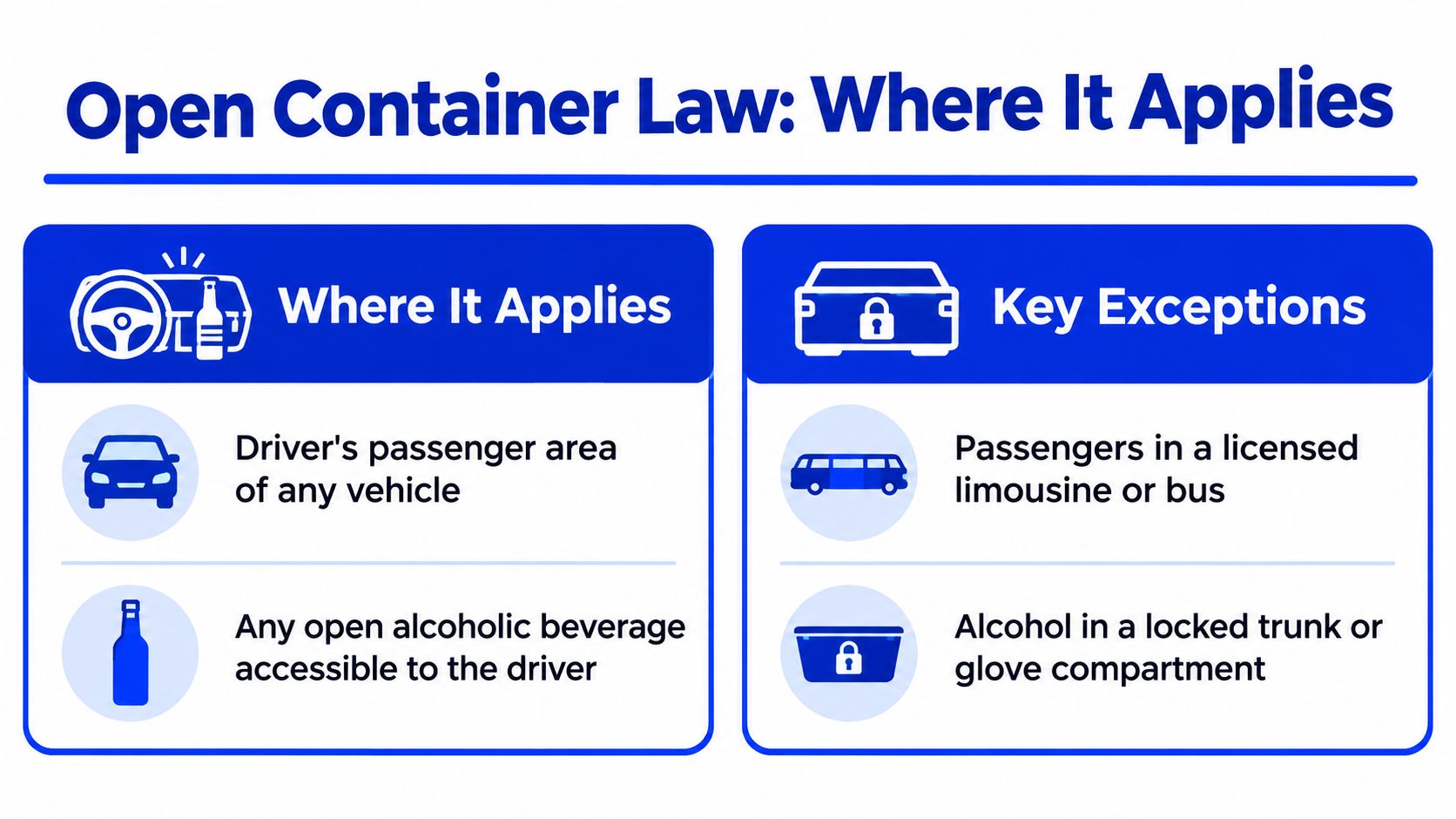
The passenger area is equally important. Florida's framework focuses on the compartment designed for the driver and passengers, while certain areas are treated differently, including a trunk, a locked glove compartment, the space behind the last upright seat in a station wagon or hatchback, and the living quarters of a qualifying motor home.
Location and possession can decide the citation
Florida's attribution rule is mechanical. If an open container isn't in a passenger's possession and isn't in a locked glove compartment, locked trunk, or another locked non-passenger area, the statute treats it as being in the operator's possession. That means the driver may be cited even when no one saw the driver physically hold the drink. A University of Tampa summary of Florida law also highlights why container placement deserves close attention.
Consider two different interiors:
A sealed bottle inside a locked trunk presents a different issue from an opened bottle in the center console.
A drink held by a passenger may create a passenger-possession question, but the surrounding facts still matter.
A container behind the last upright seat may be treated differently from one reachable from the front seats.
A vehicle stopped on private property may raise a different road-status question from one stopped on a public shoulder.
A paid parking lot or gated community may require separate analysis because the statutory road requirement may not fit the same way as a public highway. That doesn't guarantee dismissal, especially if another law or local rule applies, but it can be a meaningful defense fact.
If an officer opened a compartment or moved property to locate the container, examine the search separately. The Fourth Amendment issue may affect whether the evidence can be used, as discussed in this guide to illegal search and seizure in Florida.
Statutory Exceptions Drivers Often Miss
Florida's open-container rule isn't absolute. The exceptions are narrow, and they depend on the vehicle, the driver's licensing status, the passenger's position, and where the beverage is located.
A passenger may have protection in a vehicle where the driver is contracted to provide transportation and holds the required commercial driver license with a passenger endorsement. The statute also recognizes passengers on a bus driven by a properly licensed commercial driver. Those provisions can matter in charter transportation, tour buses, and similar settings, but a person shouldn't assume every paid ride qualifies.
A self-contained motor home can present another distinct situation. Florida recognizes an exception for a passenger in a self-contained motor home exceeding 21 feet in length. The relevant facts include the vehicle's configuration and whether the beverage is in the living quarters rather than the driving cab. Florida's exception framework illustrates why a vehicle's design can be more important than the drink's appearance.
Documents can make the exception usable
An exception is easier to establish when the evidence exists at the time of review. Preserve:
Commercial credentials: Driver licensing and passenger-endorsement information.
Transportation records: A contract, dispatch record, or trip documentation showing the transportation arrangement.
Vehicle details: Registration, dimensions, floor plan, and photographs of the interior.
Compartment proof: Photographs showing that a trunk or glove compartment was locked and outside the passenger area.
Passenger positioning: Where each person sat and who had immediate control of the container.
Do not treat a rideshare vehicle, taxi, limousine, bus, and motor home as interchangeable. The statutory language turns on specific conditions. If the facts fit an exception, counsel should present that evidence early rather than relying on a general argument that the situation “should” be allowed.
How an Open Container Citation Connects to DUI Stops
An open-container citation doesn't prove DUI. It can, however, become one fact in an officer's decision to investigate possible impairment. The officer may combine the visible container with an alcohol odor, slurred speech, balance problems, admissions, driving behavior, or other observations. The legal question then changes from whether an open container existed to whether the officer had sufficient grounds for additional investigative steps.
The container's evidentiary role
The container may be photographed, collected, described in a report, or used to support an inference that alcohol was recently available to someone in the vehicle. That inference doesn't identify who drank from it or establish impairment by itself. A defense lawyer should separate those questions rather than allowing the State to treat the container as proof of the entire DUI theory.
The investigation may expand to field sobriety exercises, questioning about consumption, and requests for breath or blood testing. What the driver says, how the driver performs, and whether the officer followed required procedures can all become contested issues. This guide to what happens after a DUI arrest explains why early review matters.
Practical rule: An open container may explain why an officer asked more questions, but it doesn't answer who consumed alcohol, when consumption occurred, or whether the driver's normal faculties were impaired.
The civil citation and an administrative license action can also exist alongside a DUI case. Florida's implied-consent law, section 316.1932, addresses consequences connected to an alleged refusal to submit to an authorized breath, blood, or urine test. A first refusal can lead to a six-month hard suspension, while a second refusal can lead to a twelve-month penalty, according to the statutory framework described in the Florida refusal and implied-consent law. The same framework includes a new ignition interlock requirement in the circumstances specified by law.
Those consequences are separate from the open-container classification. A noncriminal ticket doesn't automatically become a DUI, and it doesn't by itself establish a license suspension. But the stop may produce records that affect both proceedings. A lawyer should request and examine the citation, arrest affidavit if one exists, body-camera footage, dash-camera footage, test records, and license paperwork.
Common Misconceptions That Can Make Things Worse
An open-container citation may look minor because it is ordinarily a noncriminal violation. Treating it casually can still create problems. Missing the court date, overlooking a license issue, or discussing disputed facts with an officer or insurer may affect the larger roadside investigation. The violation's classification does not determine whether the stop also produced evidence for a DUI or another traffic proceeding.
Do not pour out the drink after the officer has seen it. That action does not erase the observation and may give the officer another movement or statement to describe. Keep your hands visible, follow lawful safety instructions, avoid argumentative explanations, and limit comments about facts you dispute.
Common assumptions that need a closer look
“The original bottle is hidden, so a cup is fine.” The question is whether the container holds alcohol and is open, has a broken seal, or is immediately capable of consumption. Hiding the original packaging does not resolve the cup's condition.
“The passenger can't be cited.” Florida law distinguishes passenger violations from operator violations. Who possessed or controlled the container remains a factual question.
“A parked car is outside the statute.” A vehicle stopped or parked within a road can still fall within the statutory language. The vehicle's position and the road involved need careful review.
“An officer can search anywhere after seeing a drink.” A visible container may affect probable-cause analysis, but the search still needs a lawful basis and appropriate scope. Evidence obtained beyond constitutional limits may be challenged.
“The ticket has nothing to do with a DUI.” The citation is not a DUI conviction. The officer's observations, questioning, and account of the container may nevertheless become part of the DUI investigation, including the later dispute over impairment.
Municipal rules can further complicate an allegation in Broward, Miami-Dade, and Palm Beach municipalities. Identify the exact authority listed on the citation. Assuming every open-container allegation relies on the same provision can lead to the wrong defense and obscure whether the citation is being used to support a broader roadside case.
Defense Strategies and When to Call an Attorney
A strong defense begins with the actual charge and the evidence supporting it, not with the label “open container.” The first task is to identify whether the alleged violation is tied to the driver, a passenger, the vehicle's location, or a separate DUI investigation.
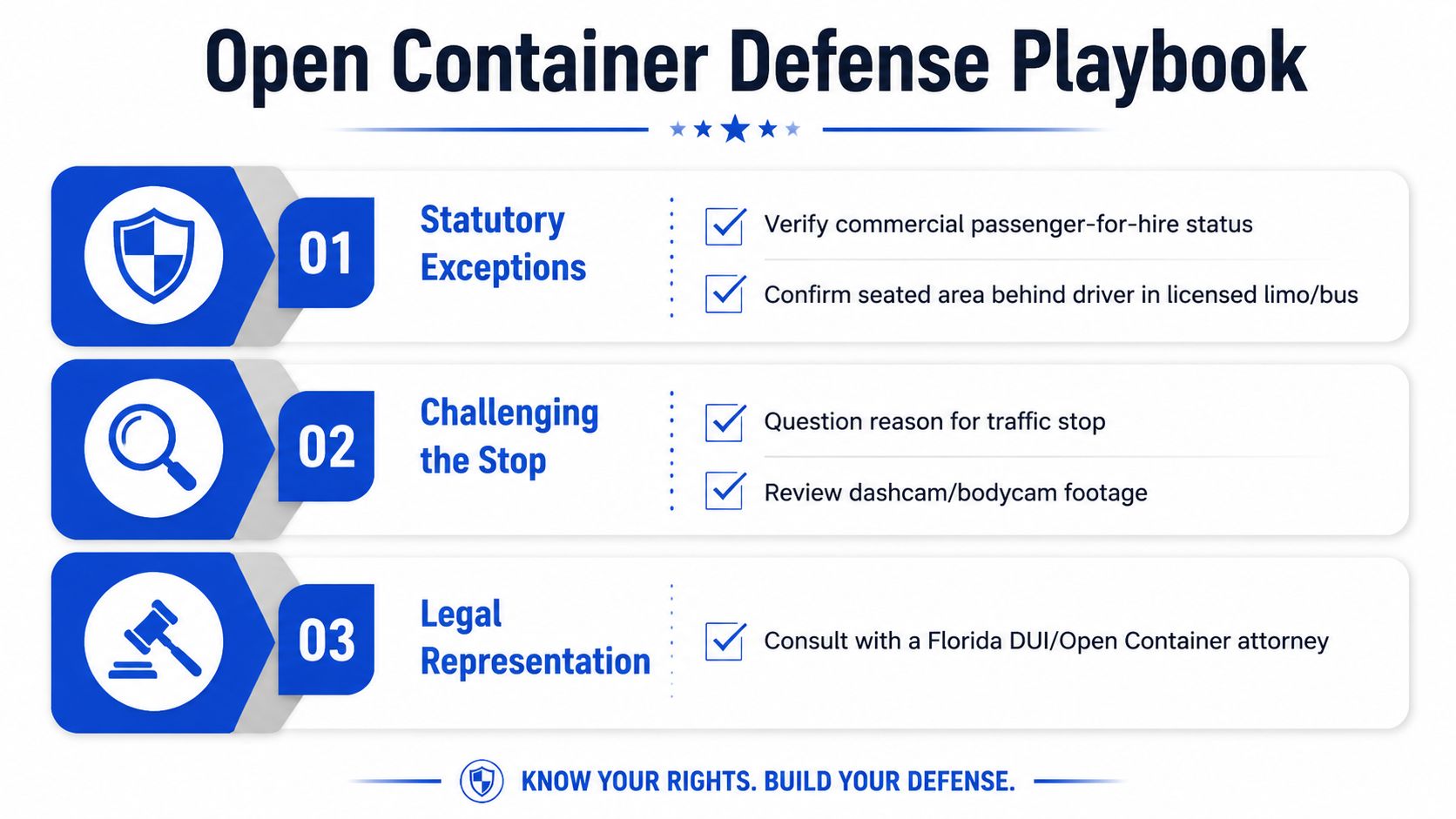
Start with statutory exceptions
Ask whether the facts fit one of Florida's specific exceptions. Counsel may investigate:
Commercial passenger transportation: Was the driver contracted to provide transportation, and did the driver hold the required commercial license and passenger endorsement?
Bus transportation: Was the passenger riding on a bus operated by a properly licensed commercial driver?
Self-contained motor home: Did the vehicle qualify under the statute, and was the beverage in the living quarters rather than the cab?
Locked storage: Was the container in a locked trunk, locked glove compartment, or another locked non-passenger area?
Documentation can determine whether an exception is merely arguable or clearly supported. Photograph the vehicle before making changes, preserve employment or trip records, and save the citation exactly as issued.
Test the State's factual assumptions
The State still must connect the alleged container to the statutory elements. Useful questions include:
Was the seal broken?
Was the container capable of immediate consumption?
Did the officer see alcohol, or only an unidentified liquid?
Was the drink in the driver's possession or a passenger's possession?
Was the vehicle on a public road as the statute uses that term?
Was the vehicle operating, stopped, or parked?
Did the officer move property or open a compartment to find the container?
Did the officer's report accurately describe the vehicle's layout?
A passenger's statement may help, but it can also create problems if given casually at the roadside. The defense should compare every account with body-camera footage, dash-camera video, photographs, dispatch records, and the citation's wording.
The question isn't whether the officer saw a drink. It's whether the evidence proves the statutory violation and whether the evidence was obtained lawfully.
Separate the ticket from any DUI case
If the stop led to field sobriety exercises, a breath request, blood draw, arrest, or license-suspension paperwork, treat those as related but separate issues. The defense may challenge the reason for the stop, the expansion of the detention, the request for testing, the officer's observations, or the admissibility of physical evidence. A defense strategy can also address common types of criminal defenses in Florida, while tailoring the arguments to a civil traffic citation and any accompanying DUI allegations.
Early legal review can help preserve video, identify deadlines, and prevent an apparently minor citation from being handled without regard to a pending DUI file. Traffic-school eligibility may be worth discussing in an appropriate case, but it shouldn't be accepted automatically if doing so affects a related defense or driving record. The right choice depends on the citation, the court, the client's record, and any companion investigation.
Frequently asked questions
Can I refuse an officer's request to search my car?
You can generally decline consent to a search, but don't physically resist or interfere. State clearly that you don't consent, then comply with lawful instructions. Whether officers had an independent legal basis for a search requires a fact-specific review.
Does an open-container citation require a bond?
A civil traffic violation ordinarily isn't handled like an arrestable criminal charge requiring a bond. If the stop also produced a DUI arrest or another criminal allegation, bond issues may arise from that separate case.
How long does resolution take?
The timeline depends on the issuing court, the citation, related license deadlines, and whether a DUI or other charge is pending. Don't assume that no immediate notice means no deadline exists. Have counsel review the paperwork promptly.
Should I call a lawyer if nobody was arrested?
Yes, especially if the officer mentioned DUI, requested testing, searched the vehicle, or issued license paperwork. An attorney can determine whether the matter is limited to a traffic citation or connected to a broader investigation.
If you're dealing with an open-container citation, DUI investigation, license suspension, or another South Florida criminal defense matter, Ticket Shield, PLLC offers confidential consultations and direct guidance on the evidence, deadlines, and defense options. Visit Ticket Shield, PLLC to discuss your situation with a Florida defense team serving Broward County, Fort Lauderdale, Miami-Dade, Palm Beach, and surrounding communities.