What Is Prosecutorial Misconduct and What Can You Do
Jason Goldsmith, Esq
You've asked for discovery, your lawyer has requested the body-camera video, and the prosecutor insists the file is complete. Months later, after a conviction, someone finds an email showing that a crime-lab analyst's competency was questioned before the analyst testified. You're left asking what happened, whether the State broke the law, and whether anything can still be done.
That situation raises the practical question behind what is prosecutorial misconduct. The term covers more than dramatic corruption or fabricated evidence. In Broward County, Fort Lauderdale, Miami-Dade, Palm Beach, and other Florida courts, the issue often involves withheld evidence, misleading arguments, unreliable witnesses, or discovery failures that affect an ordinary DUI, drug, weapons, violent-crime, or white-collar case.
Table of Contents
A Scenario That Shows Why This Question Matters
A Broward County defendant facing DUI and drug charges pleads not guilty. Before trial, the defense repeatedly requests body-camera footage, laboratory worksheets, and communications between the police department and the crime lab. The State provides police reports and some video, but nothing revealing a problem with the analyst who tested the substance.
The case proceeds. The analyst testifies that the testing followed accepted procedures, and the jury convicts. During post-conviction review, the defense obtains a previously undisclosed crime-lab email questioning whether the analyst remained competent to perform the work. The email doesn't automatically prove innocence, but it could have changed how the defense cross-examined the analyst, whether an expert was retained, and whether the jury trusted the laboratory result.
Practical rule: A discovery violation matters because of what the defense could have done with the information, not merely because the information existed.
This is why a person searching for an explanation of arraignment shouldn't think of prosecutorial misconduct as a headline-only problem. It can arise in a routine felony case involving a lab report, a cooperating witness, a plea offer, or a closing argument. The conduct may look ordinary until the defense compares the State's file with records held by police agencies, laboratories, informants, or other government offices.
The difficult truth is that many defendants never learn that evidence was withheld. Some discover the issue only after conviction, when memories have faded, trial counsel is no longer involved, and procedural deadlines have narrowed the available remedies. Early defense investigation gives a lawyer a better chance to identify the missing material, challenge it before trial, and preserve the objection for review.
Defining Prosecutorial Misconduct
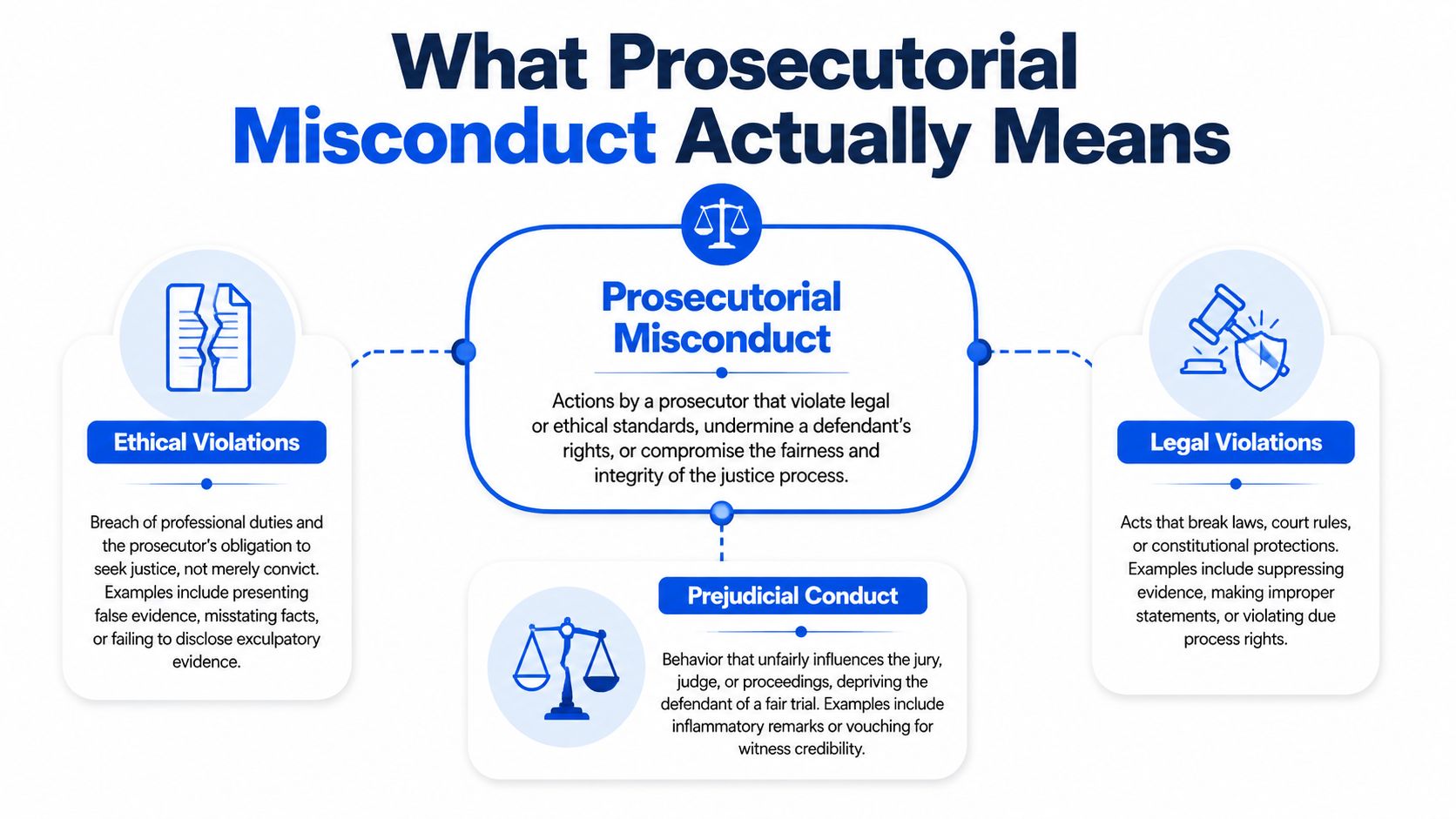
Prosecutorial misconduct is conduct by a state or federal prosecutor that violates a legal or ethical duty and undermines the fairness of a criminal proceeding. The label covers more than intentional deception. Courts may evaluate whether the conduct was a technical error, negligent handling of information, reckless behavior, or a deliberate attempt to mislead the judge or jury. That distinction often affects whether a defendant receives any remedy.
The main legal categories include:
Brady violations: The State suppresses material evidence favorable to the defense.
Giglio violations: The State withholds impeachment information, such as a witness benefit, promise, or credibility problem.
Improper argument: The prosecutor shifts the burden of proof, vouches for a witness, appeals to passion, or argues facts outside the evidence.
Discovery violations: The State fails to meet disclosure duties under applicable criminal procedure rules.
Ethical violations: The prosecutor breaches professional duties even when a court finds insufficient prejudice to reverse the conviction.
Florida's professional rules address fairness in trial conduct and communications with unrepresented people, including Rules 4-3.4 and 4-4.3 of the Florida Rules of Professional Conduct. Constitutional law reaches further. In Berger v. United States, the United States Supreme Court described the prosecutor's role as serving justice rather than pursuing a win. Strickler v. Greene sets out the familiar Brady framework: the evidence must favor the defendant, the State must have suppressed it, and the suppression must be material.
Why the problem can become institutional
Prosecutors control charging decisions, plea offers, witness agreements, and the presentation of government evidence. Their discretion operates inside offices where outside review may be limited. A prosecutor also may not know how a colleague's conduct affected an earlier conviction.
Research has described misconduct as an institutional problem involving vague ethics rules, broad discretion, limited transparency, and weak remedies. That creates a gap between the rule and the proof required in court. A judge may recognize improper conduct yet deny relief because the defendant cannot show that it affected the verdict. In practice, identifying misconduct does not guarantee a new trial, dismissal, or even an evidentiary hearing. The defense must connect the violation to a concrete loss of a fair opportunity to investigate, cross-examine, present evidence, or defend against the charge.
The Most Common Forms of Prosecutorial Misconduct
In Florida practice, the misconduct most often litigated involves disclosure failures, misleading arguments, or witness-integrity problems. These issues arise in ordinary felony and misdemeanor cases, not only in headline-making scandals.
Form of Misconduct | Typical Florida Case Setting |
|---|---|
Brady or Giglio disclosure failure | DUI laboratory cases, drug prosecutions, fraud cases, and cases involving cooperating witnesses |
Improper closing argument | Any jury trial, especially when the State comments on silence, credibility, or the burden of proof |
Discovery violation | Felony cases involving police reports, digital evidence, body-camera video, or expert testing |
Witness coaching or false testimony | Drug, gang, domestic violence, and violent-crime prosecutions |
Racial or inflammatory conduct | Jury selection and trials involving disputed identity or credibility |
Coercive charging or plea practices | Cases where prosecutors threaten additional charges or use multiple theories to pressure a plea |
Disclosure failures
A prosecutor may violate constitutional disclosure duties by withholding evidence that helps the defense or weakens a government witness. Examples include an undisclosed benefit for a cooperating witness, a laboratory quality-control concern, a prior inconsistent statement, or information showing that another person had a motive to accuse the defendant.
Late production alone does not establish a Brady violation. The defense must show that the evidence was favorable, that the State suppressed it, and that it was material under the governing legal standard. Reviewing the chain of custody in a criminal case may expose a reliability problem in a drug or weapons prosecution. A missing transfer record can support a challenge, but it does not automatically prove misconduct.
Arguments and trial presentation
Improper closing arguments may include telling jurors that an innocent person would testify, personally vouching for a witness, appealing to sympathy for a victim, or implying that the defense must prove something. Florida decisions, including Hertz v. State, show why courts examine the exact language, the surrounding context, any objection, and the likely effect on the jury.
The State can create additional problems by introducing inadmissible evidence or failing to comply with Florida Rule of Criminal Procedure 3.220. In a DUI case, the issue may involve undisclosed video or testing material. In a domestic violence case, it may involve statements the court previously excluded. The practical question is whether the error affected the defense, not whether the prosecutor violated a preferred trial procedure.
Charging discretion warrants separate scrutiny because overcharging can signal an attempt to create plea pressure rather than reflect the strength of the evidence. Dual charging, stacked charges, or threats of additional counts may be lawful in some circumstances. A defense lawyer should examine whether the State is using that authority to punish a defendant for exercising trial rights or to conceal weaknesses in the proof. Even conduct that appears unfair may produce no remedy unless the defense can connect it to a preserved legal violation and concrete prejudice.
Florida and Federal Case Examples in Practice
Case outcomes depend heavily on the setting in which the misconduct occurred. The practical question is what each decision teaches defense counsel about choosing the right challenge, preserving the record, and asking for a remedy a court can realistically grant.
Mordenti v. State illustrates the narrow circumstances in which grand-jury misconduct can end a prosecution at the charging stage. The Florida Supreme Court dismissed the indictment after finding that the State failed to present exculpatory evidence to the grand jury. For a defense lawyer, the decision matters because it separates a serious defect in the charging process from a disagreement over evidence that belongs at trial. A dismissal argument must attack the integrity of the grand-jury proceeding itself.
United States v. Bagley remains a useful reference point for evaluating suppressed evidence, but its practical value is often more concrete than the headline rule suggests. Counsel should ask how the missing material would have changed investigation, cross-examination, plea advice, or trial strategy. A document that could have supported an alternative suspect, exposed a weakness in testing, or changed the defense theory may matter even when the State characterizes it as cumulative.
Giglio v. United States is particularly important in cases built around a cooperating witness. In a Florida drug, fraud, or organized-crime prosecution, counsel should investigate promises, benefits, expectations of leniency, and internal concerns about credibility. Those details can change the order of cross-examination, support a motion to recall a witness, or affect whether the defense recommends trial rather than a negotiated resolution.
Improper closing arguments produce a different record. Florida appellate courts examine the precise language, the objection, the prosecutor's purpose, and the argument's effect in context. A preserved and harmful argument may justify a new trial, while an unobjected-to comment often leaves the defense facing a much steeper path. Courts usually correct the trial, not erase the charges. Institutional barriers can make relief uncommon, so the strongest case connects a specific error to a concrete strategic loss.
Legal Consequences and Remedies When Misconduct Happens
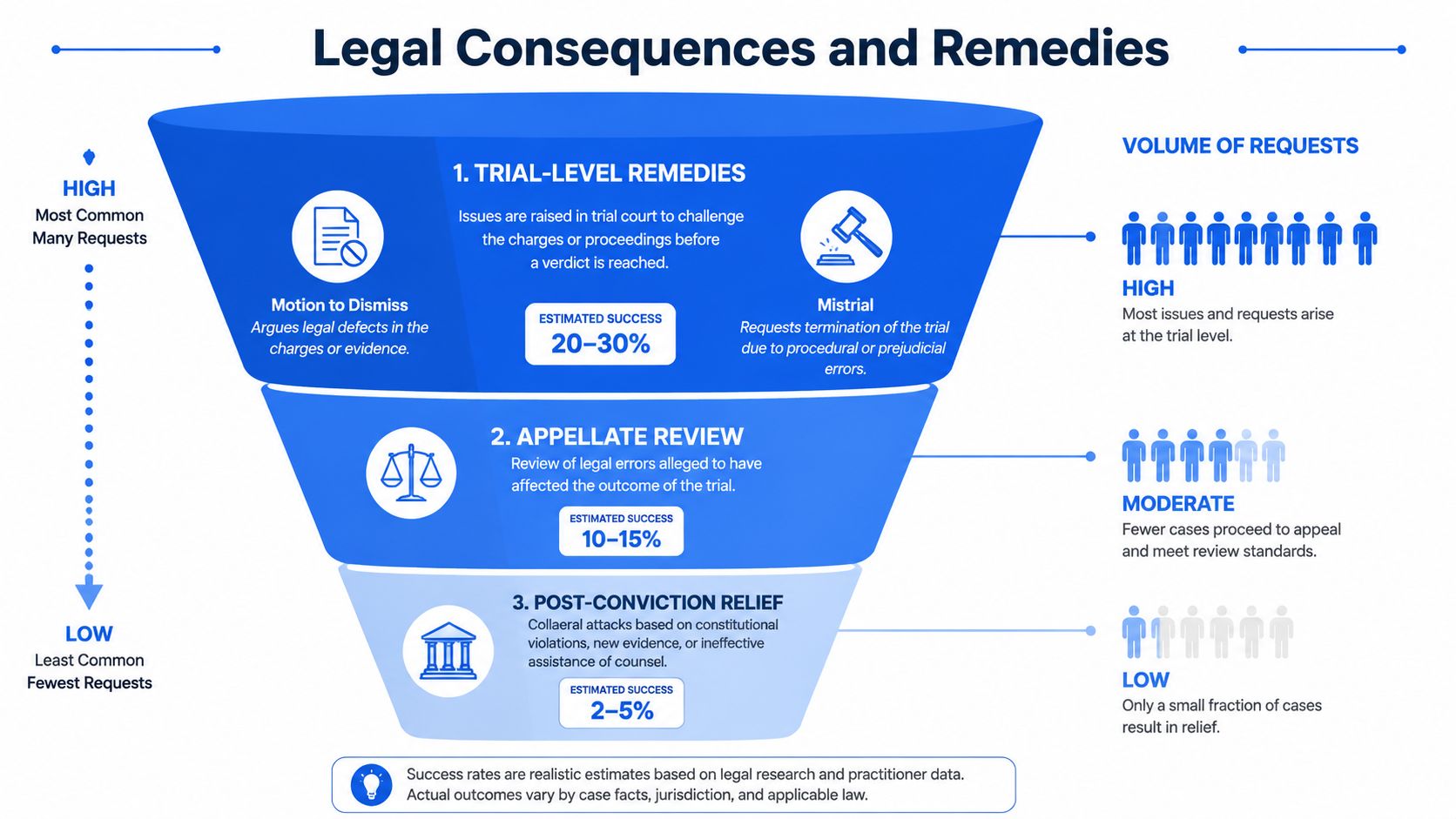
The available remedy depends on when the problem is discovered, whether the defense objected, and how strongly the misconduct affected the case. A judge may correct a problem at trial without overturning the prosecution, while an appellate court may order a new trial if the error made the verdict unreliable.
Trial-level remedies
Before or during trial, defense counsel may seek:
A motion to dismiss: Appropriate in unusual circumstances, such as a serious due-process violation or grand-jury abuse.
A motion for mistrial: Used when improper evidence or argument cannot be cured by an instruction.
A curative instruction: The judge tells jurors to disregard improper material or applies the correct burden of proof.
Discovery sanctions: The court may restrict evidence, postpone proceedings, or impose another remedy for a discovery violation.
Judges often prefer a targeted correction over ending the trial. A lawyer therefore has to explain why an instruction won't cure the harm, particularly when the jury has already heard inadmissible evidence or a prosecutor has made a highly prejudicial argument.
Appellate and post-conviction review
After conviction, Florida defendants may pursue relief through direct appeal and post-conviction procedures, including Florida Rules of Criminal Procedure 3.800 and 3.850. Federal prisoners and some state prisoners pursuing federal review may encounter 28 U.S.C. § 2254, procedural default rules, and the federal limitations period. The plan for a habeas corpus petition must account for those restrictions from the beginning.
A successful Brady claim can lead to a conviction being vacated or a new trial. An argument-based claim more commonly results in a new trial, not dismissal. A claim that trial counsel failed to investigate or object may proceed as ineffective assistance of counsel, but the defendant still must prove deficient performance and prejudice.
The gap between allegation and relief is substantial. A review cited by the Quattrone Center examined 7,207 misconduct claims in 4,644 opinions, with courts leaving 1,775 claims unaddressed and finding misconduct in only 204 of 5,432 claims they addressed. The Quattrone Center's review illustrates why a defendant needs a documented record, a specific legal theory, and proof of prejudice.
How a Defense Lawyer Identifies and Challenges Misconduct
A serious misconduct investigation starts with records, not accusations. Defense counsel reviews the charging document, police reports, witness statements, laboratory material, digital evidence, discovery notices, plea communications, and the trial transcript. The lawyer compares what the State produced with what police departments, laboratories, task forces, and other agencies may possess.
Florida Rule of Criminal Procedure 3.220 governs criminal discovery. Counsel may send a focused written request identifying the categories of favorable evidence that must be disclosed, then file a motion to compel if the State delays or provides an incomplete response. Subpoenas may be necessary for records held outside the State Attorney's office.
Building the factual record
A defense lawyer may interview witnesses independently rather than relying on the prosecutor's summaries. Law-enforcement interviews can reveal inconsistent reports, omitted statements, or differences between what an officer remembers and what the body camera shows. In a drug case, counsel may examine the informant's benefits and prior cooperation. In a DUI case, counsel may compare testing records with testimony and video.
The defense should also send a targeted Brady notice before trial. A letter doesn't prove a violation, but it identifies the information requested and makes it harder for the State to claim that the defense never raised the issue.
Preservation matters: An objection, request for a curative instruction, and motion for mistrial can give an appellate court a usable record. Silence may leave the court applying a much harder standard of review.
Challenging the evidence
Suppression litigation can expose how police obtained evidence, whether officers followed constitutional rules, and whether the State's version matches the underlying records. A lawyer evaluating a motion to suppress evidence may also uncover discovery problems that affect the credibility of the State's witnesses.
After conviction, the investigation usually requires trial transcripts, hearing exhibits, prosecutor disclosures, agency records, and affidavits from witnesses or experts. A Florida Bar complaint may be appropriate where the evidence supports professional misconduct, but a disciplinary complaint isn't a substitute for filing an appeal or post-conviction motion on time.
Who Polices Prosecutors and Why Discipline Stays Rare
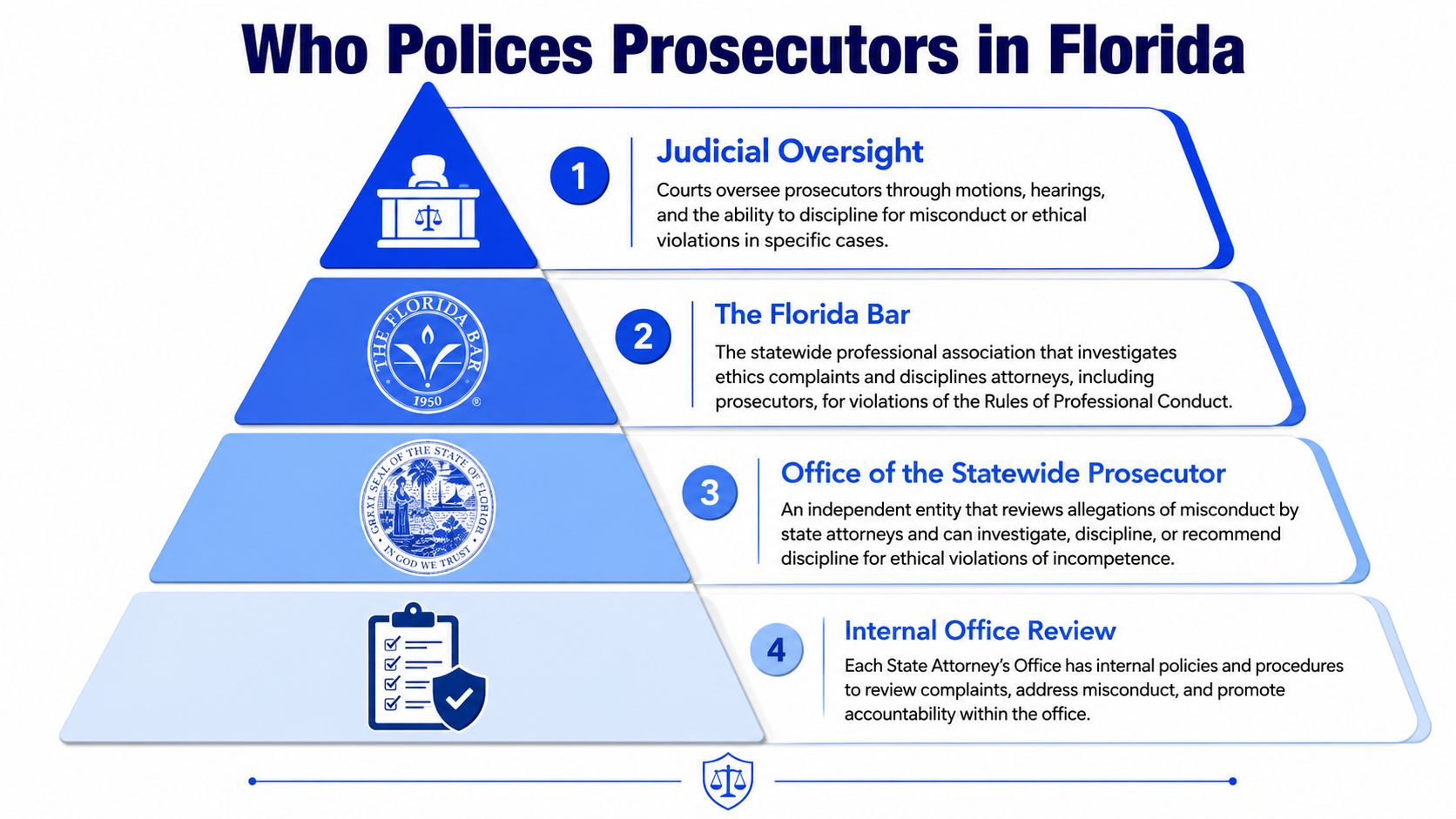
No single body guarantees meaningful discipline for prosecutorial misconduct, even though several oversight layers exist. Trial judges may exclude evidence, grant a mistrial, dismiss a charge in exceptional circumstances, or order a new trial. Appellate courts may reverse convictions. The Florida Bar can investigate professional complaints, while State Attorney offices may review their own lawyers' conduct.
The federal Office of Professional Responsibility offers a useful comparison. It received 1,666 new complaints in FY 2025, a 24% increase, completed 10 investigations, and found professional misconduct in 9 investigations, according to the FY 2025 report. Those figures do not measure Florida prosecutors. They do show why a high complaint count should not be confused with formal findings or discipline.
Internal review can identify a disclosure failure, improper argument, or repeated violation. The practical concern is whether the review produces a consequence beyond correcting the defendant's case. An office investigating its own attorneys may recognize a problem without imposing a meaningful career consequence.
Civil damages are also limited. Under Imbler v. Pachtman, prosecutors generally have immunity for conduct closely connected to their prosecutorial role. A person usually must pursue remedies in the criminal case, appellate review, post-conviction litigation, or professional discipline rather than expect damages from the prosecutor personally.
Reform proposals include independent review, stronger disclosure systems, recorded witness interviews, and clearer consequences for repeated violations. For a defendant, however, the immediate priority is protecting the case. A person evaluating prosecutorial discretion should treat discipline as a separate goal. It rarely replaces a timely objection, appeal, motion to vacate, or negotiated resolution.
Next Steps FAQs and When to Call a Defense Lawyer
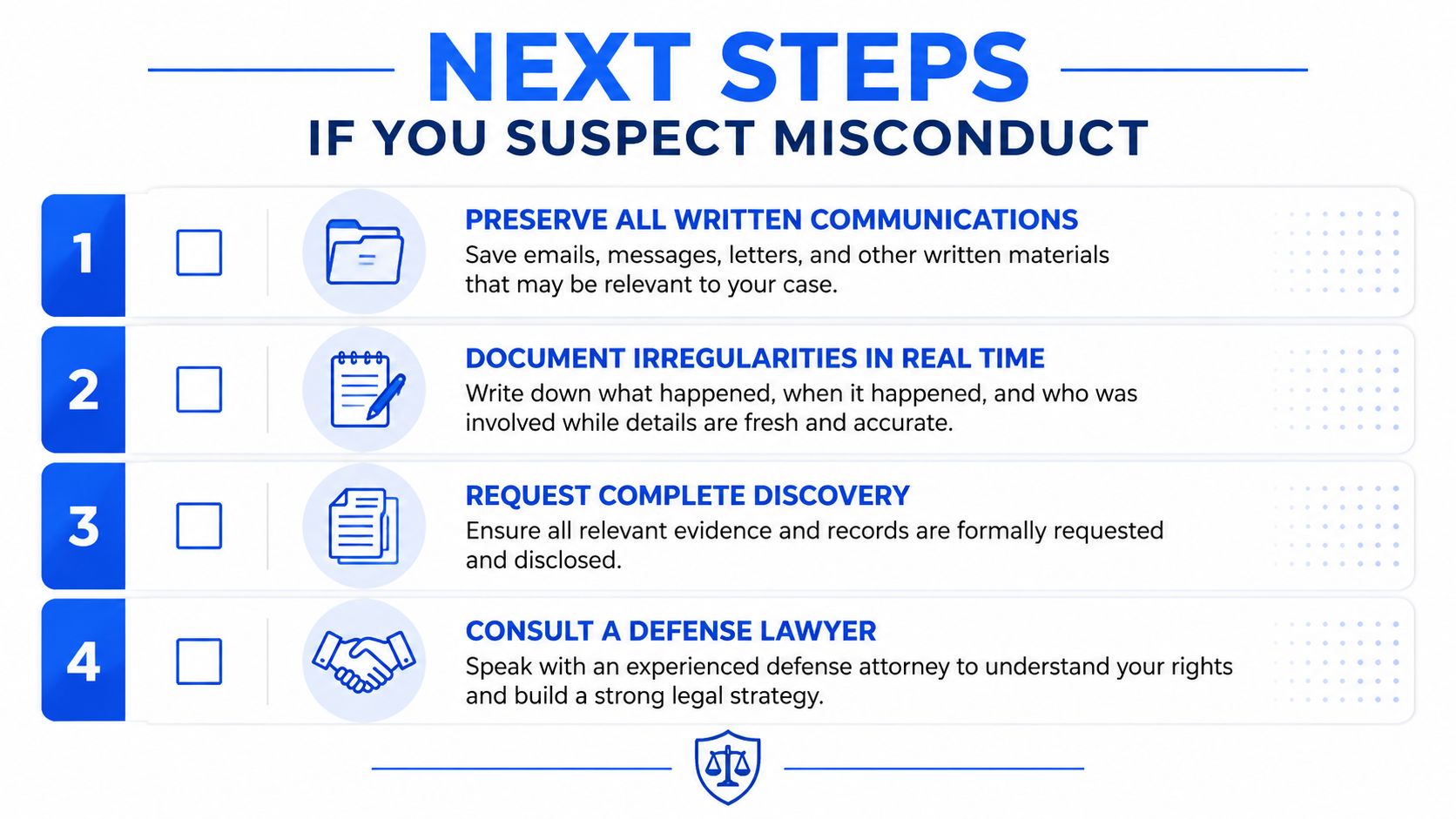
If you suspect misconduct, preserve every letter, email, discovery exchange, recording, screenshot, and court notice. Write down what happened at hearings while the memory is fresh, request complete discovery, ask for a bill of particulars when the charge is unclear, and avoid giving a recorded statement to the State Attorney's office before speaking with defense counsel.
Can misconduct alone overturn a conviction
No. The defendant generally must connect the violation to prejudice, materiality, or an unreliable verdict. A court may find improper conduct but deny relief if the error didn't affect the outcome under the governing standard.
What does Brady mean in plain English
Brady means the prosecution must disclose favorable material evidence in its possession, custody, or control. That can include evidence that supports innocence and evidence that weakens a prosecution witness.
Can the issue be raised for the first time on appeal
Sometimes, but failing to object at trial can make relief substantially harder. Preservation rules and harmless-error analysis may prevent an appellate court from granting a new trial even when the argument was improper.
How does a lawyer prove evidence was withheld
Counsel compares the State's production with agency files, subpoenas records, reviews transcripts, interviews witnesses, and shows how disclosure would have changed investigation, cross-examination, expert testimony, plea decisions, or trial strategy.
Does prosecutor immunity protect the prosecutor
Imbler provides broad civil immunity for core prosecutorial acts. It doesn't erase the defendant's ability to seek criminal-case relief or pursue a professional complaint, but those paths have different standards and deadlines.
If you're facing a DUI, drug, domestic violence, theft, violent-crime, gun, sex-crime, juvenile, federal, traffic, or probation case in Fort Lauderdale, Broward County, Miami-Dade, Palm Beach, or elsewhere in Florida, contact a defense lawyer quickly. Early review can preserve discovery objections, investigate missing evidence, and protect appellate or post-conviction claims before deadlines expire.
Ticket Shield, PLLC reviews suspected disclosure failures, improper arguments, search and seizure issues, and other weaknesses in Florida criminal cases with a practical, prosecutor-informed approach. Visit Ticket Shield, PLLC to request a confidential consultation and discuss the records, deadlines, and defense options specific to your case.