
DUI Reduced to Reckless Driving in Florida
Jason Goldsmith, Esq
You're sitting in a Broward County courtroom after a DUI arrest, hoping the prosecutor will “just make it reckless.” Your license may already be suspended, your insurance company may be asking questions, and someone may have told you that a reckless-driving plea solves everything. It doesn't. A DUI reduced to reckless driving in Florida can be a major improvement, but only when the criminal plea and the separate DMV consequences are analyzed together.
The decision also isn't automatic. Florida prosecutors negotiate reductions when the evidence creates trial risk and the law allows the disposition. A first-time record helps, but it won't overcome every statutory barrier. Before accepting a plea in Broward, Fort Lauderdale, Miami-Dade, Palm Beach, or elsewhere in South Florida, you need to know whether your case is reduction-eligible, whether the stop and testing evidence can be attacked, and what the plea will mean later.
Table of Contents
When a Florida DUI Becomes a Reckless Driving Plea
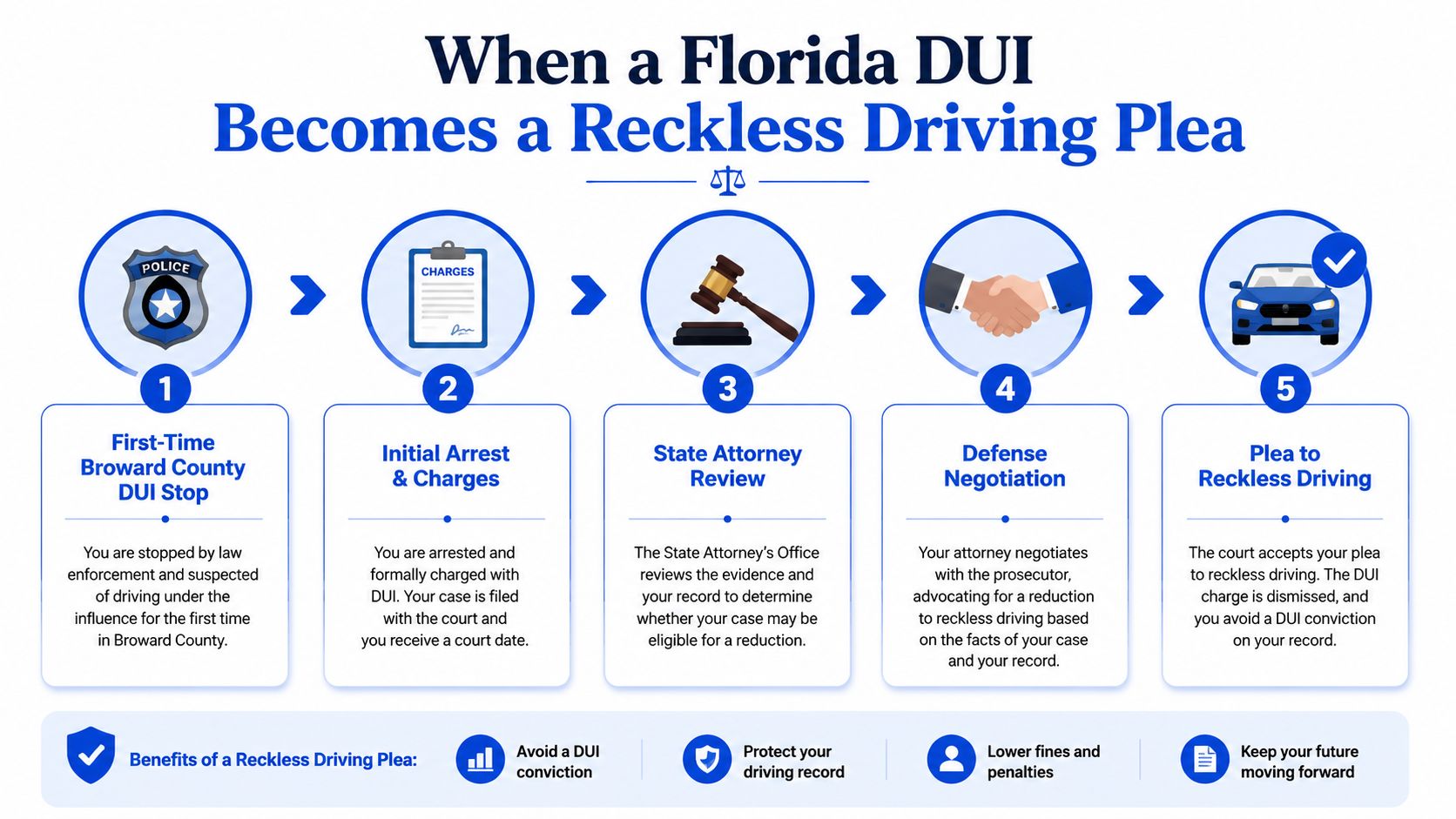
A typical case starts with a first-time DUI stop in Broward County. The officer makes an arrest, the State files or maintains a charge under Florida Statute 316.193, and the driver faces a criminal case plus a separate administrative license matter. A reduction means the State agrees to amend the criminal charge, and the defendant pleads guilty or no contest to reckless driving under Florida Statute 316.192.
That is a negotiated disposition, not a legal entitlement. The prosecutor and judge must still accept the proposed resolution, and the facts must not trigger statutory restrictions. The practical question isn't whether a DUI can theoretically become reckless driving. It's whether the State believes its DUI evidence is vulnerable enough, and whether the law permits the amendment.
What the plea changes
Under section 316.192, reckless driving is driving with willful or wanton disregard for the safety of persons or property. It remains a criminal offense, but it generally avoids the direct consequences of a DUI conviction. Florida assigns 4 license points for a reckless-driving conviction, although a withhold of adjudication can avoid those points, as explained in the Florida reckless-driving statute.
A properly negotiated outcome can also avoid DUI-specific criminal consequences, including mandatory DUI conviction consequences and ignition-interlock requirements that may accompany a DUI disposition. It can materially reduce the immediate damage to your record and driving privileges. But it won't necessarily erase the administrative suspension caused by the arrest.
The process usually looks like this:
Initial review: Counsel obtains the arrest report, videos, testing records, and driving-history information.
Legal screening: The defense checks for statutory bars, injury allegations, high alcohol readings, and prior qualifying convictions.
Evidence analysis: The lawyer identifies weaknesses in the stop, field sobriety exercises, officer observations, and chemical testing.
Negotiation: Counsel presents those weaknesses to the prosecutor and seeks an amendment to section 316.192.
Plea decision: You accept the reckless-driving resolution only after reviewing adjudication, conditions, licensing effects, and future-risk issues.
Broward, Miami-Dade, and Palm Beach prosecutors may apply different practical screening habits, even though the governing statutes are statewide. Don't rely on a friend's result from another county. The details of your evidence and the local courtroom matter more than a generic promise that a “wet reckless” is available.
For a plain-language comparison of the two charges, review this discussion of DUI versus reckless driving in Florida.
The Statutory Bars That Block a DUI Reduction
Some cases should be screened out before anyone treats a reduction as a realistic option. Florida Statute 316.656 restricts acceptance of a lesser plea in important DUI situations, including a breath or blood alcohol level of 0.15 or higher. The statute also addresses DUI cases involving specified injury, death, and vehicular-homicide-related circumstances. Those restrictions can remove the ordinary bargaining path.
A high reading isn't a minor negotiation problem. It can be a legal barrier. Likewise, an allegation involving serious bodily injury or death changes the case from a routine first-offense DUI discussion into a substantially more serious prosecution.
Factors that require immediate screening
Refusal cases need careful handling, but a refusal doesn't automatically answer the reduction question. The State may still pursue the DUI using officer observations, driving conduct, statements, and other evidence. The defense must review both the implied-consent consequences and the admissibility of the remaining proof.
Prior convictions, property damage, and allegations involving a child passenger can also make prosecutors unwilling to offer a reduction, even when the client has otherwise favorable mitigation. The relevant question is whether the specific allegation triggers a statutory restriction or creates a factual enhancement that the prosecutor will treat as disqualifying.
Disqualifying Factor | Florida Statute | Effect on Reduction |
|---|---|---|
Alcohol level of 0.15 or higher | Florida Statute 316.656 | Lesser-plea acceptance may be barred, subject to the statute's application to the specific case. |
Serious bodily injury allegation | Florida Statute 316.193(3)(a) | The injury-enhanced DUI requires a different defense and negotiation analysis. |
DUI manslaughter or death-related allegation | Florida Statute 316.193(3)(b)(3) | A routine DUI-to-reckless resolution isn't the expected pathway. |
Prior DUI history | Florida Statute 316.193 and related provisions | Prior-offense exposure can increase penalties and reduce prosecutorial flexibility. |
Property damage | Florida Statute 316.192 and related provisions | Reckless driving may carry enhanced consequences when damage results. |
Child-passenger allegation | Florida DUI provisions | Prosecutors may treat the allegation as a significant aggravating factor or veto reduction discussions. |
The governing DUI and lesser-plea restrictions appear in Florida's DUI statutes. Before paying a retainer based on a promised reduction, have counsel identify whether any statutory exclusion applies. If one does, the better strategy may be suppression or dismissal, not a weaker plea request.
How Defense Counsel Audits the Stop, the SFSTs, and the Breath Test
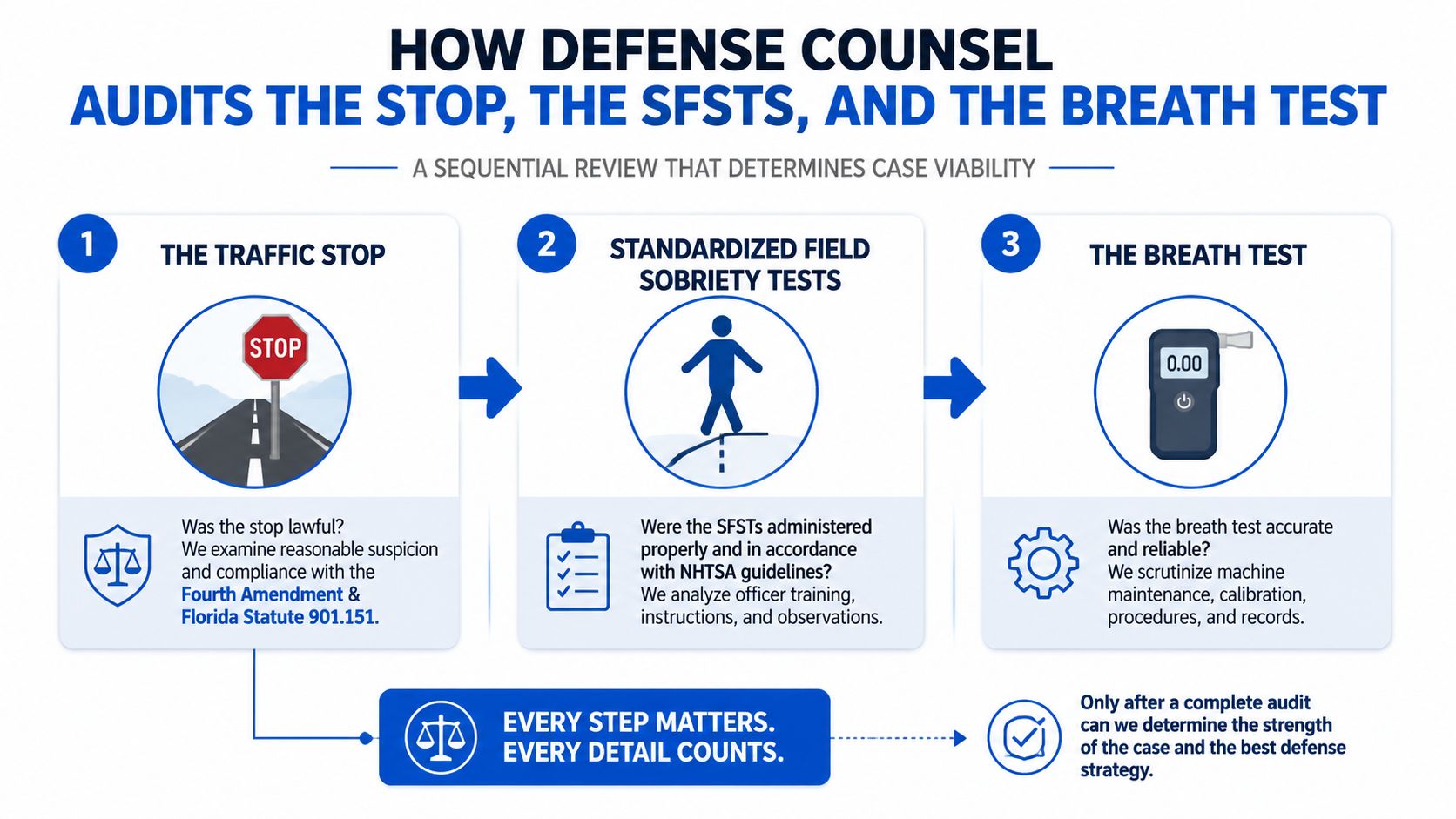
A serious DUI defense starts with evidence, not hardship arguments. Counsel should review the case in the order that determines whether the State can use its strongest proof.
The traffic stop comes first
The first question is whether the officer had a lawful basis to stop you. Counsel examines the claimed lane violation, speeding allegation, equipment issue, crash information, or other stated reason under the Fourth Amendment and Florida Statute 901.151. The lawyer then compares the report with dash-camera and body-camera footage.
A vague report, an inconsistent timeline, or video that contradicts the officer can create meaningful advantages. If the stop lacked reasonable suspicion or probable cause, counsel may pursue a suppression motion under Florida Rule of Criminal Procedure 3.190.
Field sobriety exercises need context
The walk-and-turn, one-leg stand, and horizontal gaze nystagmus exercise aren't magic truth machines. The defense reviews instructions, surface conditions, lighting, footwear, weather, medical limitations, balance issues, divided attention, and whether the officer followed the applicable NHTSA guidelines.
Counsel also checks the officer's training and certification history, including the claimed 18-month operator certification requirement for the officer administering the standardized exercises. The point isn't to find a technicality for its own sake. It's to determine whether the jury or prosecutor can reasonably trust the observations.
Chemical testing must survive scrutiny
For a breath case, counsel examines the testing procedure under Florida Statute 316.1932. That includes the 20-minute observation period, mouthpiece and ambient-air checks, Intoxilyzer 8000 software logs, maintenance and inspection records, and the required Florida Department of Law Enforcement inspection certificate.
A defect can support a suppression argument, an evidentiary challenge, or a reduced-charge negotiation. A valid-looking number doesn't end the analysis. The State still has to establish that the instrument, operator, procedure, and records satisfy the legal requirements.
Use this overview of the Florida field sobriety test process to understand why the exercise sequence and documentation matter. The defense goal is concrete: expose a defect that makes a DUI conviction less certain at trial.
DUI Versus Reckless Driving Penalties in Florida
The immediate criminal exposure is usually lighter after a reckless-driving disposition, but the two charges are not interchangeable. Florida Statute 316.192 sets a first reckless-driving conviction at up to 90 days in jail and a fine of $25 to $500. A second or subsequent conviction can carry up to 6 months in jail and a fine of $50 to $1,000, as stated in section 316.192.
A first DUI under section 316.193 can carry up to 6 months in jail and a fine of up to $1,000. DUI consequences also include offense-specific licensing and ignition-interlock issues that don't attach in the same way to an ordinary reckless-driving resolution.
Penalty or Consequence | DUI (316.193) | Reckless Driving (316.192) |
|---|---|---|
First-offense jail exposure | Up to 6 months | Up to 90 days |
Fine exposure | Up to $1,000 | $25 to $500 |
Second-offense jail exposure | Depends on the applicable DUI subsection and prior history | Up to 6 months |
Second-offense fine exposure | Depends on the applicable DUI subsection and prior history | $50 to $1,000 |
License points | Florida assigns DUI convictions 6 points | Florida assigns reckless-driving convictions 4 points, unless a withhold avoids points |
Ignition interlock | DUI-specific requirements may apply | Not automatically imposed as a standard reckless-driving penalty |
Administrative revocation | Florida DMV says a DUI conviction triggers at least a 180-day revocation | A reckless plea doesn't automatically erase an earlier DUI administrative suspension |
Alcohol-related conditions | DUI school and other conditions may apply | DUI school may still be required if the court orders it when alcohol or controlled substances contributed to the conviction |
The license track is separate from the criminal case. Florida's impaired-driving guidance explains the at-least-180-day revocation triggered by a DUI conviction, while the administrative suspension from the arrest may already be operating before the criminal plea. A reduction doesn't automatically restore your license, cancel hardship conditions, remove an ignition-interlock requirement, or complete reinstatement steps.
That distinction is why you shouldn't evaluate a plea only by asking whether the charge disappears. Read this explanation of Florida DUI penalties before making a decision.
How Plea Negotiations Work in South Florida Courtrooms
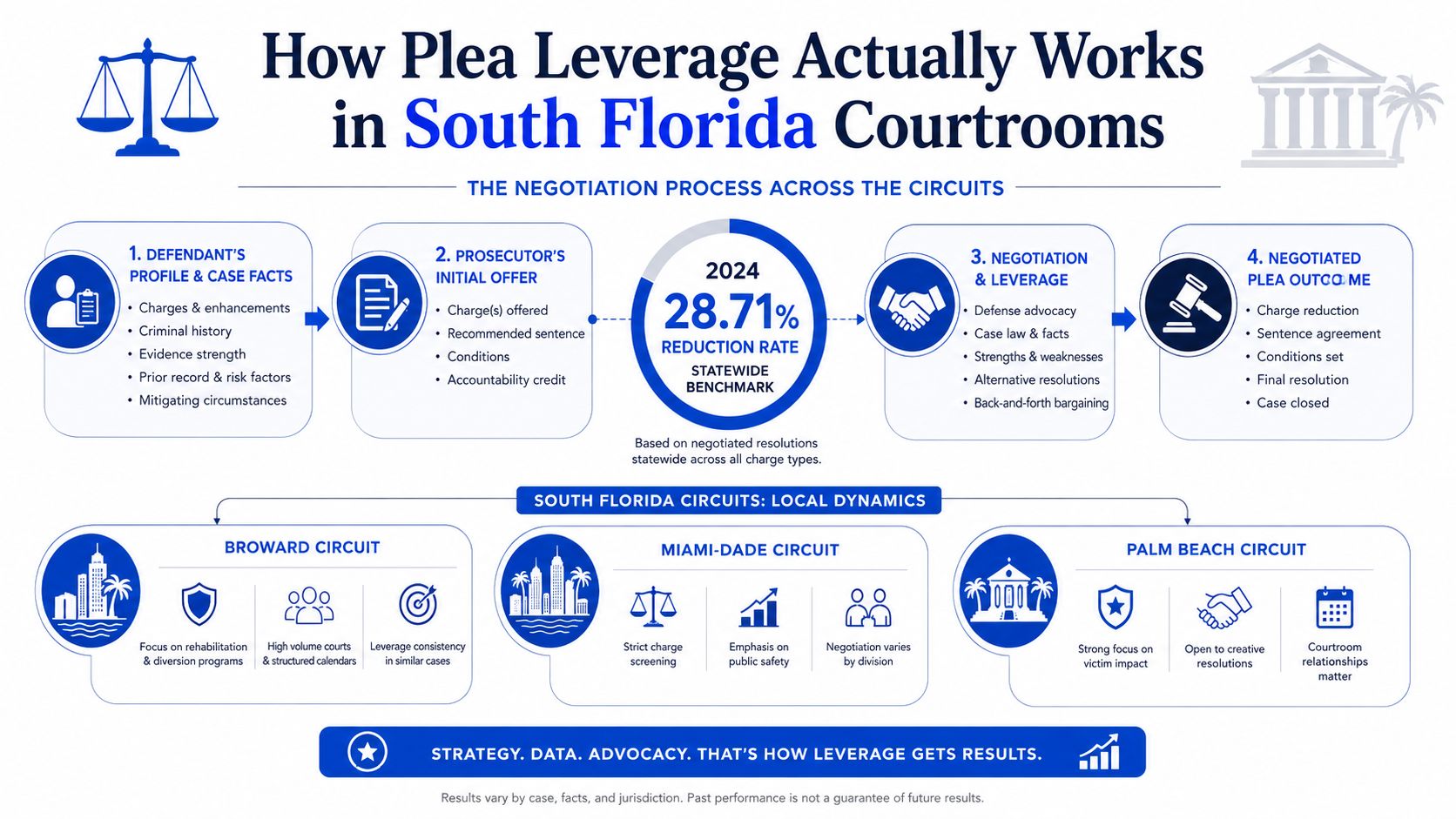
A prosecutor will not reduce a DUI charge because you are anxious, employed, or promise not to repeat the conduct. Those facts may support mitigation. The stronger position is a case the State may lose or struggle to prove.
Florida traffic-safety reporting recorded 3,375 DUI citations and 969 reductions to reckless driving in the 2024 reporting period, a reduction rate of 28.71%. The 2024 impaired-driving fact sheet provides a useful benchmark, not a prediction for Broward, Miami-Dade, or Palm Beach County. It also does not create a right to a negotiated result.
The State measures trial risk
An assistant state attorney will usually examine the same issues your defense lawyer should audit:
Can the officer justify the stop? A weak basis may support a suppression motion that threatens the case.
Does the video match the report? Contradictions can weaken credibility and reduce the State's settlement position.
Can the State prove impairment? A test result alone does not replace admissible evidence proving the required elements.
Are there statutory bars? A 0.15 reading or serious-injury allegation can block ordinary reduction discussions.
Is the defense ready for court? Counsel who has reviewed discovery, identified witnesses, and prepared motions has more negotiating credibility than someone asking for mercy.
Timing matters. Early action can preserve video, locate missing agency records, and challenge an incomplete State narrative. Do not accept the first offer before auditing the evidence. A well-supported suppression motion can improve negotiations. A weak motion filed only to delay can damage credibility.
Diversion requires its own review. The First Offender DUI Program and county-specific misdemeanor diversion may avoid a criminal conviction, subject to eligibility and conditions. A reckless-driving plea may be the right result in one case. Diversion, suppression, or dismissal may be better in another. Review how the plea bargain process works before treating the first offer as final.
When a Reduction Is a Trap Instead of a Win
A reckless-driving reduction is often a better immediate outcome than a DUI conviction. That doesn't mean it's always the best available outcome. You're still entering a criminal disposition, and the record may retain an alcohol-related notation that matters later.
Florida legal summaries explain that a wet reckless can appear on the record and may be treated as a prior DUI for sentencing enhancement in a later DUI case. That future exposure matters more for someone with professional licensing concerns, a commercial driving career, or a realistic risk of another alcohol-related arrest. The short-term relief must be weighed against the long-term consequences.
Ask what you're giving up
Before accepting, demand clear answers about:
Adjudication: Will the court enter a conviction or withhold adjudication?
Points: Does the proposed resolution trigger the 4 reckless-driving points, or can a withhold avoid them?
Record relief: Is sealing legally available after the exact disposition and conditions?
Insurance: Could the result cause non-renewal, higher premiums, or an SR-22 requirement?
Future exposure: Will the notation be treated as a prior impaired-driving event in a later case?
License status: What administrative suspension or reinstatement obligations remain?
If the stop was unlawful, the field exercises were improperly administered, or the breath instrument lacked a valid FDLE inspection certificate, settling for reckless driving may leave value on the table. The better fight may be suppression or outright dismissal.
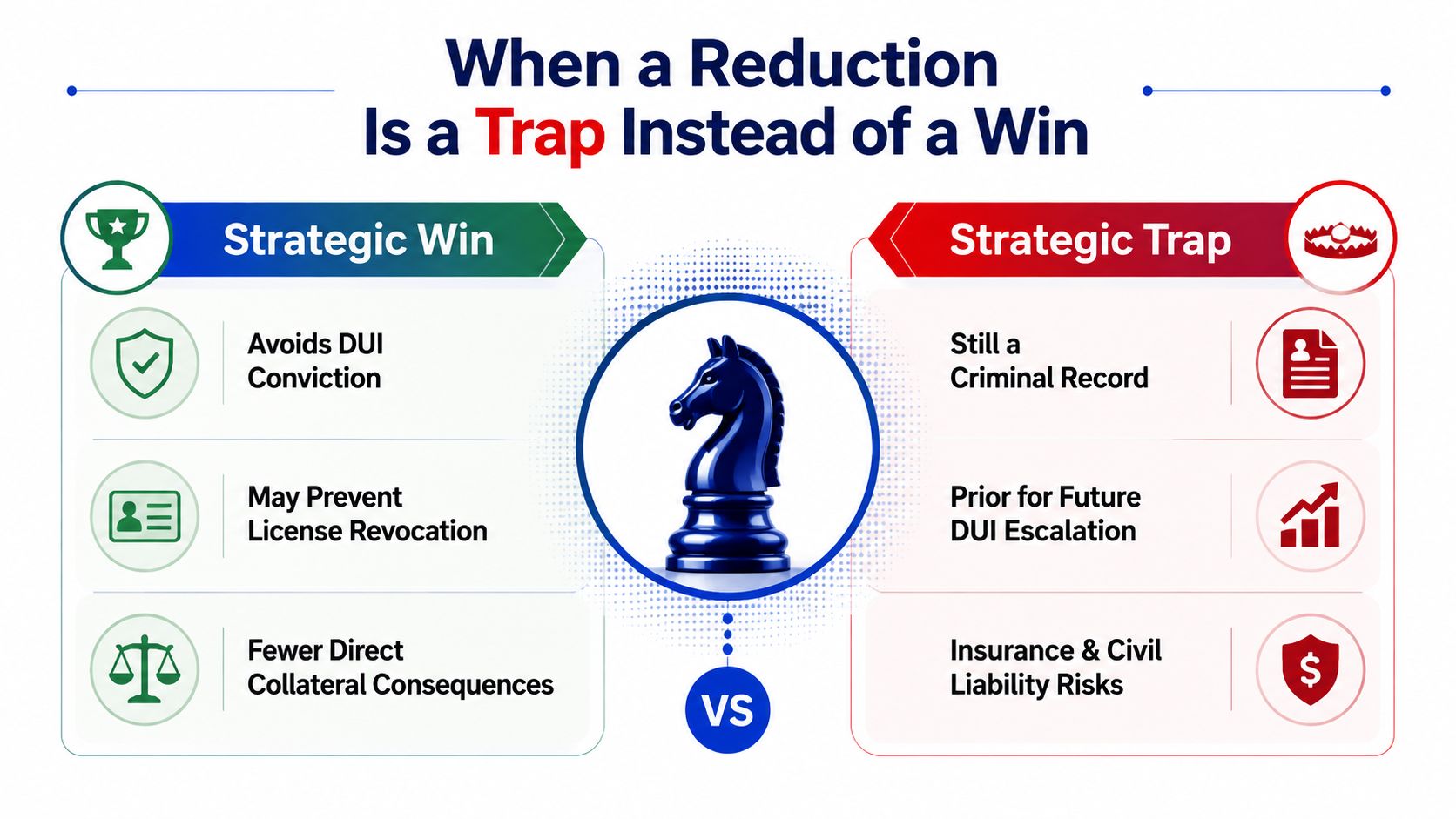
A withhold can make the outcome materially different from a conviction, particularly for licensing and points. But it isn't a universal shield. The precise plea language, alcohol notation, court conditions, and your prior history control the result.
The license issue deserves separate attention because Florida DMV consequences can survive the criminal reduction. The Florida Highway Safety and Motor Vehicles administrative guidance also explains that DUI school may still be required if alcohol or controlled substances contributed to a reckless-driving conviction and the court orders it.
What to Do Right Now If You Are Facing a DUI in Florida
A DUI arrest creates two separate problems: the criminal charge and your Florida driver's license. Handle both immediately. A reckless-driving plea may improve the criminal case while leaving administrative suspension issues unresolved.
Your immediate checklist
Secure the paperwork: Obtain the arrest affidavit, citation, charging document, release conditions, and every DMV notice.
Request recordings: Have counsel preserve and obtain dash-camera, body-camera, booking-area, and roadside video.
Collect testing records: Gather breath-test printouts, machine records, inspection materials, operator information, and blood or urine documentation, if applicable.
Write a private timeline: Record where you were, what happened before the stop, what the officer asked, and how the testing occurred.
Protect the administrative deadline: Florida's DMV process provides a short 10-day window after a DUI arrest to request a formal review hearing. Discuss it with counsel immediately.
Avoid public statements: Do not post about the arrest or give detailed accounts to an insurer or employer before getting legal advice.
Do not negotiate alone: An informal conversation can create evidence, and prosecutors are not required to identify weaknesses for an unrepresented defendant.
Your lawyer should review the stop, field sobriety exercises, breath or blood testing, and the license consequences separately. The case may call for a negotiated reckless-driving plea, a suppression motion, or continued litigation. The right choice depends on whether the evidence is reliable and whether a statutory bar, including a 0.15 BAC result, blocks the reduction.
Choose counsel based on local DUI courtroom experience, willingness to litigate suppression motions, and clear billing. A Fort Lauderdale DUI lawyer handling a Broward case should explain discovery, motion practice, courtroom procedure, and the prosecutor's evaluation process. The same standard applies in Miami-Dade, Palm Beach, and other Florida courts. A candid free DUI consultation should give you options and consequences, not a guarantee.
Ticket Shield, PLLC handles Florida DUI and reckless-driving defense, including evidence review, license-focused strategy, negotiations, and suppression litigation when the facts support it. To discuss whether your case calls for a reduction, diversion, suppression, or dismissal, visit Ticket Shield, PLLC for a confidential consultation.