
What Is a Motion Hearing in Court: Florida Guide
Jason Goldsmith, Esq
72,801 motion hearings were scheduled in one Ontario civil court dataset in 2019, and 54,521 were heard. In plain English, a motion hearing is a court proceeding where a judge decides a specific legal request before trial, and that ruling can shape whether the case moves forward, what evidence comes in, or whether the case ends early.
If you're sitting in Broward County, Miami-Dade, or Palm Beach and you've got a motion hearing coming up, that hearing may feel small on the calendar but huge in your life. A judge might hear argument about suppression, bond, discovery, continuance, or dismissal, and the outcome can change the pressure on you long before a jury ever gets involved.
Table of Contents
What a Motion Hearing Actually Is and Why It Matters
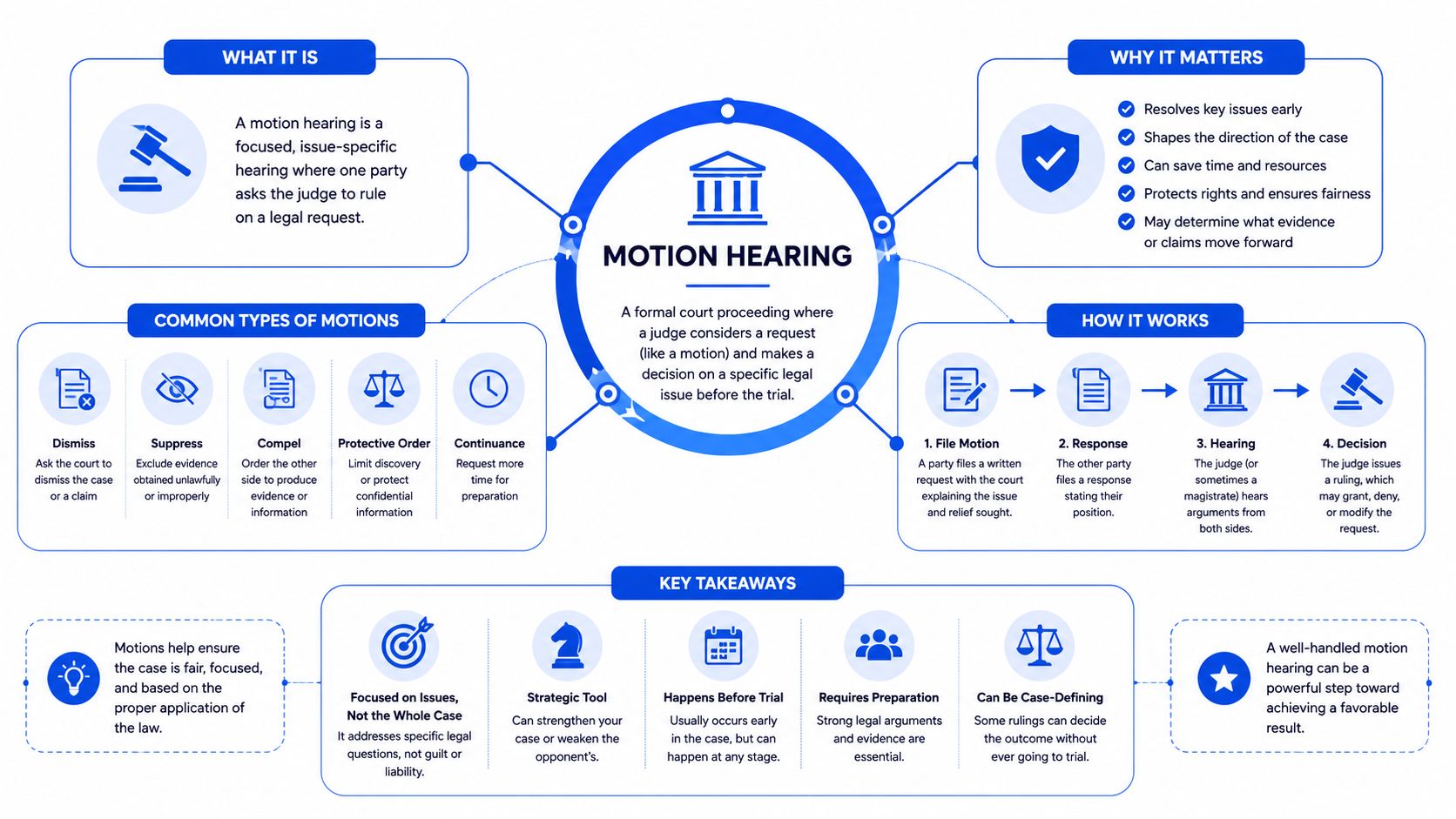
He got to the courthouse early, walked through security, and still wasn't sure what would happen next. That feeling is normal. A motion hearing is not the trial, it is the part of the case where the judge decides a specific request from the defense or the State before trial starts.
What the judge is actually deciding
A motion hearing is usually narrow. The judge is asked to rule on one legal or procedural issue, not to decide the whole case. That issue might be whether evidence should be suppressed, whether discovery must be turned over, whether bond should change, or whether the case should be dismissed. Some hearings involve only lawyers arguing the law. Others become evidentiary hearings, where witnesses testify under oath and the judge has to sort through facts as well as arguments. That is why a person can sit in the courtroom and hear one issue discussed in detail while the rest of the case stays on hold.
The idea becomes easier to follow once you separate the hearing from probable cause. Probable cause is the legal threshold that often appears at the beginning of a criminal case, and a motion hearing may later test whether the State still has enough to support what it is asking the court to do. If you want a plain-English explanation of that separate issue, see what probable cause means in a criminal case. The hearing itself still stays focused on the specific request in front of the judge.
Practical rule: if the judge is being asked to rule on one issue, you are probably in a motion hearing, not a trial.
Why the hearing can change the whole case
People care about motion hearings because they can change the direction of a case before trial. A ruling may keep key evidence out, allow the State to keep using it, or force the prosecution to change course. It can also affect how much work both sides must do, and that changes the pressure on plea discussions and trial preparation. Clio's discussion of motion practice explains how these hearings can shape what happens before trial motion hearing impact on litigation.
In the courtroom, that pressure feels real. If the defense is arguing to suppress a search, for example, the judge may spend time listening to how the stop happened, what officers saw, and whether the facts support the State's position. If the defense is arguing about discovery, the hearing may focus on whether the prosecutor has turned over what the law requires. A former prosecutor understands how those arguments sound from the other side, which matters because the State will usually frame the facts in the light most favorable to its case, while the defense has to show the judge why the issue should be decided differently.
Motion hearings are a regular part of court business. An Ontario motion hearing study found 72,801 scheduled civil motion hearings in 2019, with 54,521 heard, meaning about 25% did not go forward as planned, and roughly 280 hearings per workday across 260 workdays Ontario motion hearing study. That kind of volume shows that motion practice is part of how courts manage cases every day, not an unusual side event.
For someone facing DUI, drug charges, domestic violence allegations, theft, a probation violation, or a gun case in Florida, the hearing can be the first real test of the State's evidence. Sometimes it is the best chance to narrow the case before the pressure gets worse.
How a Motion Hearing Works in Florida Courts
A Florida motion hearing usually begins well before anyone stands in front of the judge. Defense counsel files the motion, the State has a chance to respond, and the court adds the matter to a docket so both sides can be heard. That process gives each side a fair chance to explain the issue before the judge decides it.

The courtroom rhythm
In many motion hearings, the defense speaks first because it filed the request. The State responds, the defense may get a brief reply, and then the judge rules from the bench or takes the matter under advisement. That basic flow matches the nature of a motion hearing, which is usually a focused proceeding built around one legal issue and often handled through oral argument alone.
The pace can change a lot from one hearing to the next. A narrow legal question may take only a few minutes, while a contested suppression issue with witnesses can take much longer. If the judge needs testimony, the hearing becomes evidentiary and starts to resemble a mini-trial on that single point. That is often where a defense lawyer with a former prosecutor's perspective matters, because the State will usually present the facts in the way that helps its case, and the defense has to show why the judge should see the same facts differently.
A judge can grant the motion, deny it, or reserve ruling after hearing both sides. That is why preparation matters so much.
What the hearing is for
The point is not to retry the whole case. The point is to isolate one problem and ask the judge to resolve it clearly. In a criminal case, that can mean arguing that a stop was unlawful, discovery is missing, bond is too high, or the case should not keep moving because of a legal defect.
That narrow focus is why motion hearings matter so much in Florida criminal practice. They let the court address problems early, while the record is still being built and before trial pressure starts to build. For a deeper look at one of the most common issues, see this discussion of motion to suppress evidence. If you are dealing with a Fort Lauderdale arrest or a Broward County prosecution, this hearing may be the moment when the defense begins to change the shape of the case.
Common Motions in Florida Criminal Cases
The motions that matter most in Florida criminal court tend to fall into a few familiar categories. Each one asks the judge to solve a different problem, but they all serve the same bigger purpose, to reduce risk before trial and force the State to prove what it says it can prove.
Motions that protect the defense case
A motion to suppress evidence asks the court to keep certain evidence out. That often comes up in search and seizure disputes, DUI stops, drug cases, weapons cases, and statements made to police. If the stop, search, or questioning was unlawful, the evidence may be attacked before trial. For a deeper look at that issue, see the firm's discussion of motion to suppress evidence.
A motion for continuance asks for more time. Defense lawyers file that when discovery arrives late, a witness is unavailable, or the lawyer needs time to investigate. A motion to compel discovery asks the judge to order the State to turn over evidence that should have been disclosed.
A motion for bond reduction matters when the accused is sitting in jail and the current bond is too high to post. A motion to determine competency or for a competency evaluation asks whether the defendant can understand the proceedings and assist in the defense. A motion to dismiss argues that the case should end because the law or facts do not support prosecution. A motion in limine asks the court to limit what the State can say in front of the jury later on.
Why these motions matter strategically
The value of a motion hearing is not just the ruling itself. It's the advantage the ruling creates. Clio's explanation of motion practice is useful here, because it points out that motion hearings can affect admissibility, the scope of evidence, and whether the case goes forward at all motion practice and case outcomes.
That's why a strong defense treats motions as more than paperwork. They're tools for forcing the State to sharpen its proof, expose weaknesses, or reevaluate the case before trial pressure builds. In the right case, a motion hearing can make a plea offer more realistic, reduce the State's advantage, or set up a better position for trial.
What to Expect in the Broward County Courtroom
A Broward County motion hearing starts with the ordinary stuff people worry about but rarely hear explained clearly. You go through security, find the right courtroom, wait your turn, and sit until the case is called. In South Florida courthouses, hearings are often scheduled in blocks, so your case may not be reached exactly when you expected.
The defendant usually sits at counsel table with the lawyer, not in the gallery. Family members and supporters typically wait in the public seating area if the courtroom allows it. If the judge enters, everyone stands. If the judge asks a question, answer through your lawyer unless the judge addresses you directly.
How to handle yourself in court
Dress neatly and conservatively. A courtroom is not the place for a logo T-shirt, flip-flops, or loud clothing. Keep your phone off. Don't interrupt, whisper, or react visibly when the State argues.
A few basics help more than anxious people realize:
Arrive early: Court starts moving before you're emotionally ready, and lateness makes a bad impression.
Address the judge respectfully: “Your Honor” is the safest default.
Let counsel speak: A motion hearing is a legal argument, not a chance to explain your side on your own.
Stay composed: Judges notice attitude, even when no one says anything about it.
If you're unsure where to sit or when to speak, wait for your lawyer's direction. That's the cleanest way to avoid a courtroom mistake.
For people searching for a Broward criminal defense attorney, the issue is often reducing fear before the hearing starts. A lawyer who knows the courthouse, the procedures, and the local rhythm can help the day feel less chaotic. If you want a local overview of representation in the area, this guide on Broward criminal defense attorney is a useful starting point.
How an Attorney Prepares and Argues at a Motion Hearing
A strong motion hearing usually starts in the file, not the courtroom. A defense lawyer reviews the arrest affidavit, charging document, police reports, body-worn camera footage, discovery, and any witness statements to find the legal weak spots. That review shapes the written motion, the supporting law, and the plan for what to ask the judge for on hearing day.
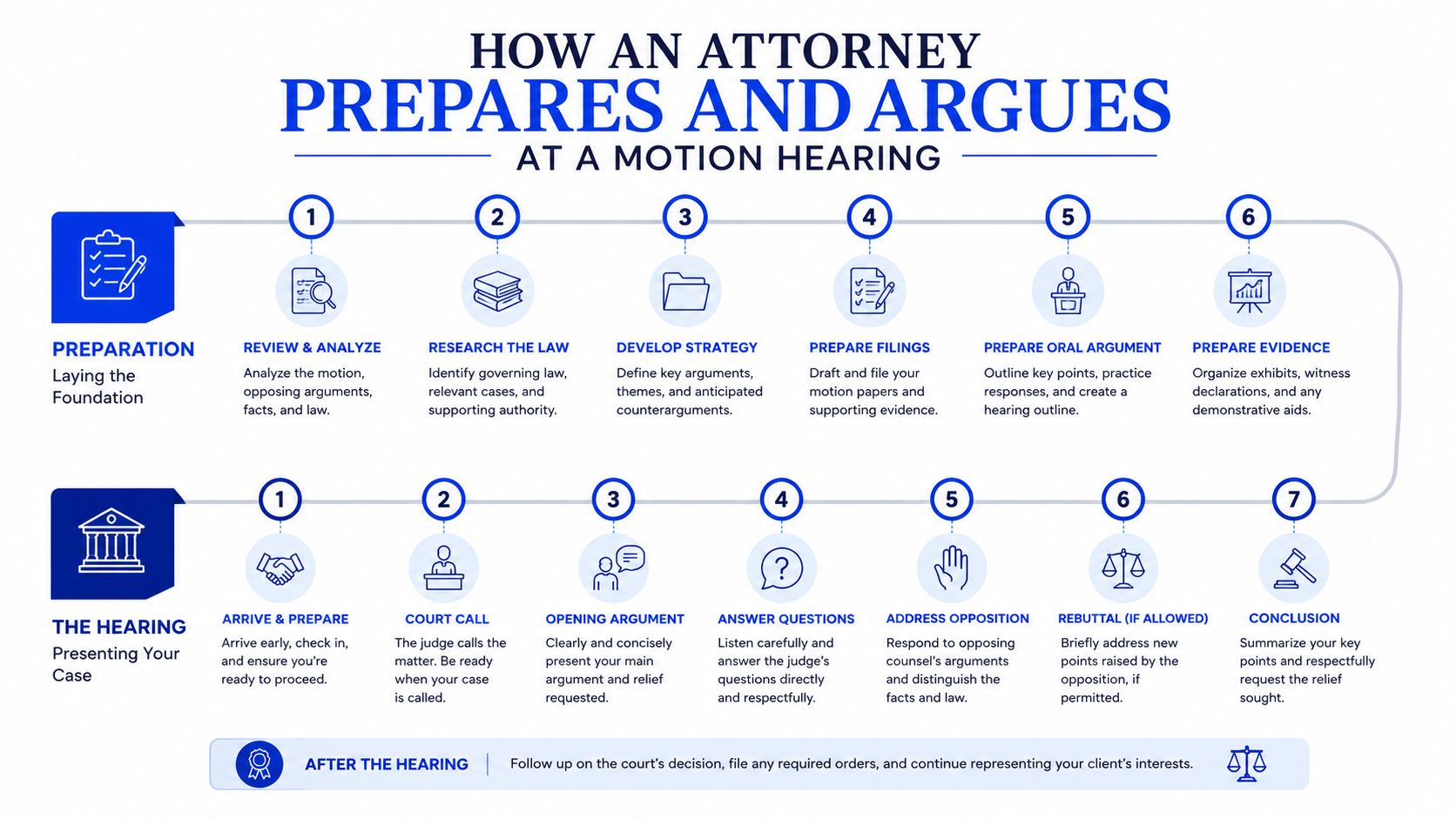
What preparation looks like in practice
A former prosecutor often brings a different lens to that work. The question is not just whether the police acted quickly or the evidence looks strong on paper. The question is what the State will argue in response, what proof the judge is likely to care about, and where the defense can press without losing credibility.
That means organizing exhibits, lining up witnesses if testimony is needed, and preparing a direct answer to the State's likely objections. It also means knowing the judge. Some judges want a tight legal argument. Others want the record built carefully before they rule. A lawyer who understands that difference can adjust tone, pacing, and emphasis in real time.
Why the argument has to be focused
The best hearing presentations don't try to win everything at once. They point the judge to the exact legal defect, the exact piece of evidence, or the exact reason the motion should be granted. That's where courtroom experience matters, especially in hearings that turn on witness credibility or cross-examination.
Courtroom advice: a motion hearing is won with a clean record, not with volume.
The broader point is that motion practice shapes timelines in a real way. A University of Denver study found summary judgment motions were filed in only about 13.7% of cases overall, with district-level variation from 9.7% to 22%, and cases with such motions had an average time to disposition of 694 days motion statistics and case timing. Those numbers come from civil practice, but they reinforce the same lesson that applies in criminal court, motions can materially affect how long a case stays alive.
If testimony becomes important, a lawyer must know how to question witnesses without wandering. That's why a careful approach to how to cross-examine witnesses can matter so much in suppression and evidentiary hearings.
Outcomes After a Motion Hearing and What Comes Next
A motion hearing usually ends in one of three ways. The judge grants the motion, denies it, or takes the matter under advisement for later ruling. Each result changes the case, even if the headline outcome feels simple in the moment.
If the motion is granted
A granted motion can be a major defense win. The court may suppress evidence, narrow what the State can use, order disclosure, reduce bond pressure, or even dismiss the case if the legal defect is serious enough. In a criminal case, that can dramatically weaken the prosecution's position before trial.
If the motion is denied
A denial doesn't always mean the issue is dead. The case usually keeps moving, but the defense may have preserved the ruling for later review or used the hearing to learn how the State will argue the issue at trial. Even a losing motion can clarify the courtroom battlefield.
If the judge wants more time
Sometimes the judge doesn't rule right away. The judge may request more briefing, take the issue under advisement, or reset the hearing if witnesses or documents are missing. That doesn't mean the motion failed. It usually means the court wants a fuller record before deciding.
What happens next depends on the ruling and the case posture. The court may set another pretrial date, schedule a plea discussion, or move the case closer to trial. In some cases, the hearing changes the tone of the entire prosecution because the State sees that its proof is under pressure.
The hearing is one step in the case, not the finish line. Good defense work keeps going after the ruling.
Motion Hearing Questions and Next Steps for Florida Defendants
People usually ask the same few questions right before a motion hearing. The first is how long it takes. There's no single answer, because a short legal issue can move quickly while a contested evidentiary hearing can take much longer. The second question is whether the defendant has to testify. Often the answer is no, but if the motion turns on facts the judge needs to hear, testimony may become part of the hearing.
Another common question is whether the defendant has to attend. In many Florida cases, presence matters, but that depends on the hearing and the court's direction. If there's any doubt, the safest move is to have counsel confirm the appearance requirement well before the hearing date. The final question is whether a motion hearing is the same as a trial. It isn't. A motion hearing addresses one legal or procedural issue, while a trial decides guilt or innocence on the full case.
For someone facing charges in Fort Lauderdale, Broward County, Miami-Dade, Palm Beach, or anywhere else in South Florida, the right lawyer should be ready to treat the hearing like a turning point, not a formality. Ticket Shield, PLLC handles motion practice, including suppression issues, with a former-prosecutor perspective that's built around challenging the State's proof before trial and keeping the focus on the client's rights, license, and record.
If your motion hearing is coming up, don't wait until the day before to understand the process. Talk with a lawyer who can review the motion, explain the likely courtroom sequence, and prepare you for what the judge may ask.
Ticket Shield, PLLC represents people facing criminal charges across South Florida and can help prepare for a motion hearing, including suppression, bond, discovery, and dismissal issues. If you need clear guidance before your court date, visit Ticket Shield, PLLC to schedule a confidential consultation and get a defense plan built around your case.