
Understanding Chain of Custody Evidence in Florida
Jason Goldsmith, Esq
You're sitting at home in Fort Lauderdale, Broward County, Miami-Dade, or Palm Beach, reading an arrest report or charging document for the first time. The State says it has evidence. Maybe it's a blood sample in a DUI case, a bag of suspected drugs, a recovered firearm, surveillance footage, or property tied to a theft allegation. To you, that word alone can sound final.
It isn't.
In Florida criminal court, the evidence itself is only part of the fight. The other part is the paper trail behind it. If police, lab staff, or another custodian mishandled that item, failed to document a transfer, stored it improperly, or let the wrong person access it, that “small” mistake can become a major defense issue. In some cases, it can be the issue that changes everything.
That's where chain of custody evidence comes in. Clients often assume the case turns on what an item is. A former prosecutor knows better. Cases also turn on whether the State can prove that the item shown in court is the same item collected, tested, stored, and preserved the right way from start to finish.
When that proof is weak, the prosecution has a problem. When that proof is missing, the prosecution may have a fatal problem.
Table of Contents
Your Case and the Paper Trail You Did Not Know Existed
Individuals charged with a crime rarely encounter the phrase “chain of custody” until they sit down with a defense lawyer. They hear “the lab confirmed it,” “the officer recovered it,” or “the State has the video,” and they assume the case is airtight.
That reaction is normal. It's also often premature.
A criminal case in Broward County or Miami-Dade can look strong on the surface and still contain procedural cracks underneath. A firearm may have been seized correctly but logged sloppily. A blood vial may have been drawn properly but stored poorly. A phone may contain important messages, yet the records showing who handled it after seizure may be incomplete. Those details matter because criminal prosecution depends on proof, not assumptions.
Why clients miss this issue at first
Police reports usually focus on the accusation. They don't highlight every handoff, every signature, every storage decision, or every missing timestamp. But defense lawyers read cases differently. They ask:
Who collected the item
Where it went next
Who signed for it
When it was opened
How it was stored
Whether anyone touched it without documentation
That's not technical nitpicking. That's how evidence gets authenticated.
Practical rule: If the State can't prove where the evidence was, who had it, and what happened to it at every critical point, the defense has something real to work with.
The clients who do best in these cases are often the ones who stop assuming the prosecution's paperwork is complete. In Florida domestic violence defense, theft crime penalties in Florida cases, probation violation matters, and Fort Lauderdale DUI lawyer searches alike, the same concern keeps coming up. People want to know whether the State's version of events is the whole story.
It usually isn't. The paper trail is often where the actual fight begins.
What Is Chain of Custody in a Criminal Case
A Miami-Dade officer seizes a bag of pills during an arrest. By the time that bag reaches the courtroom, several people may have touched it, logged it, transported it, tested it, stored it, and signed for it. If the paperwork does not clearly show each of those steps, the State can have a serious proof problem.
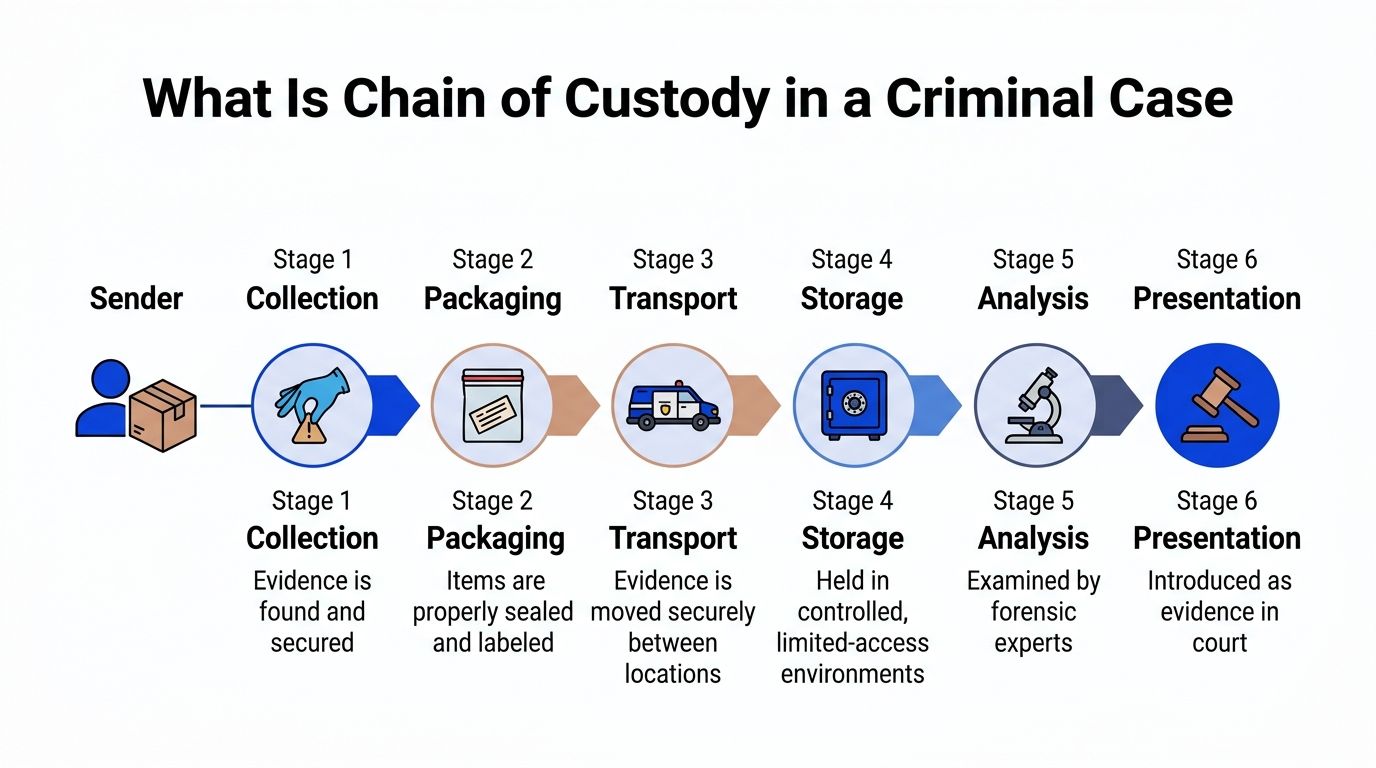
Chain of custody is the documented history of an item of evidence from seizure through testing, storage, and courtroom presentation. The National Institute of Justice definition, quoted in a Keiser University discussion of chain of custody, describes it as chronological documentation of custody, control, transfer, analysis, and disposition. That definition matters in practice because one unaccounted-for handoff can give the defense a real basis to challenge whether the item in court is the same item police originally collected.
A shipping record is the closest everyday comparison, but criminal evidence carries higher consequences and stricter scrutiny. In Broward and Miami-Dade cases, chain of custody questions come up with suspected narcotics, DUI blood vials, firearms, phones, stolen property, and body-worn camera downloads. The State has to show more than possession. It has to show continuity.
What the record should show
A proper chain usually answers a few direct questions:
Who collected the item
Where and when it was collected
How it was packaged and sealed
Who received it at each handoff
Where it was stored between transfers
Who tested or examined it
What happened to it after testing
That sounds basic. It is. And that is exactly why these cases turn on small errors.
In a drug crime defense case, for example, the issue is not just whether an officer says he found suspected contraband. The issue is whether the prosecution can prove the substance tested by the lab is the same substance allegedly seized in the field, in the same condition, with no undocumented access in between. As a former prosecutor, I can tell you that clean evidence logs make prosecutors comfortable. Sloppy property sheets, missing initials, and vague testimony force hard conversations about whether the evidence can survive a motion to suppress, an objection at trial, or a motion in limine.
Courts do not admit evidence because a witness says it looks familiar. Courts want a documented trail that makes substitution, contamination, or tampering less likely.
In South Florida, the weak spots are often ordinary clerical failures. A seal is missing initials. A property receipt has no time entered. A narcotics envelope is checked into evidence, but the transfer to the crime lab is not tied to a specific custodian. A blood kit is logged, but refrigeration details are thin. Those mistakes may look minor on paper. In court, they can become the pressure points that expose reasonable doubt.
Why a Solid Chain of Custody Is Critical for the Prosecution in Florida
In Florida, prosecutors don't get to show up with a bag, a sample, or a digital device and ask the judge to trust them. They have to lay a foundation. That means proving the item is what they say it is and that it remained authenticated through the life of the case.
Florida courts require continuity
Under Chapter 90, Florida Statutes, the prosecution must provide continuous, documented authentication of evidence from seizure to court presentation. As explained in this Florida chain of custody overview, any gap in that chronological record can render biological, digital, or physical evidence inadmissible in a Florida criminal trial.
That standard matters in every South Florida courtroom, from Fort Lauderdale to West Palm Beach to Miami.
If the State wants to introduce blood results in a DUI case, it must connect the draw, the packaging, the transport, the storage, the testing, and the courtroom presentation. If the State wants to use seized property in a theft case, it must show the jury that the item wasn't mixed with other property, altered, or handled outside protocol. If the State wants to rely on a firearm or suspected narcotics, it must establish continuity.
What prosecutors need and what defense lawyers attack
As a former prosecutor, I can tell you this plainly. When the chain is clean, prosecutors feel confident. When the paperwork gets messy, they start looking for ways to patch the hole with testimony. Sometimes that works. Sometimes it doesn't.
The defense looks at different pressure points:
Issue | Why it matters |
|---|---|
Missing transfer documentation | It raises the question of who had the item and whether it was secure |
Broken seals or unclear packaging | It suggests tampering, contamination, or substitution |
Poor storage conditions | It can affect biological samples, digital devices, or trace evidence |
Inconsistent testimony | It undermines the reliability of the paperwork and the witnesses |
In Florida gun charge defense, Broward County drug crime attorney matters, and probation violation lawyer cases where physical evidence drives the allegation, this issue can become central fast. The prosecution bears the burden. The defense doesn't have to prove tampering occurred. The defense has to expose why the State can't prove that it didn't.
A jury can't fairly evaluate evidence if the State can't account for it.
That's why chain of custody evidence isn't side litigation. It's often the foundation holding up the rest of the case.
Common Weak Links How the Chain of Custody Gets Broken
The chain usually doesn't break because of some dramatic act. It breaks because people rush, assume, forget, or cut corners. In busy South Florida jurisdictions, that can happen at the street level, in the property room, during transport, or inside the lab.

The mistakes that appear again and again
A useful starting point comes from forensic protocol. A forensic review published through PubMed Central states that every transfer entry on a chain of custody form should include a signature, date, and time, and notes that incomplete logging, such as missing witness signatures, creates a break in the chain that can lead to the dismissal of a case.
In practice, the weak links usually look like this:
Late logging: An officer seizes an item but doesn't enter it immediately into evidence.
Incomplete forms: A transfer record is missing a signature, time, date, or purpose.
Bad storage: A sample is left in conditions that raise questions about reliability.
Unauthorized handling: Someone accesses the item without being listed as a custodian.
Broken packaging: The bag, seal, or container doesn't match the paperwork.
Undocumented movement: Evidence moves from one location to another without a clean handoff record.
For related constitutional issues, many of the same cases also involve questions about how the evidence was obtained in the first place. That's why chain problems often overlap with illegal search and seizure defenses.
A quick primer helps illustrate how these issues surface in real investigations:
Why weak links matter even before trial
Florida courts and lawyers sometimes distinguish between a weak link and a missing link. A weak link means the documentation is imperfect but the custodians may still be traceable. A missing link means someone in the chain can't be identified or a transfer can't be accounted for at all. That distinction is discussed in the earlier Keiser source, but the practical point is simpler.
Weak links give the defense ammunition. Missing links can gut admissibility.
Small paperwork errors don't always win a case by themselves. But they often create the opening that lets the defense challenge everything built on top of that evidence.
This is why a seasoned defense lawyer doesn't shrug at clerical issues. In criminal litigation, clerical issues often become evidentiary issues.
Chain of Custody Failures in DUI Drug and Theft Cases
Chain problems don't show up the same way in every case. The weak spots depend on the type of evidence, the people handling it, and how much the prosecution needs that item to prove its theory.
DUI cases
In a DUI prosecution, especially one involving blood evidence, the chain can become one of the most important issues in the entire case. The State must connect the roadside stop or hospital draw to the sealed vial, the transport, the storage, the analyst, and the result.
If a defense lawyer sees a time gap, a labeling problem, inconsistent testimony about refrigeration or storage, or conflicting records about who transported the sample, that deserves immediate attention. This is also why THC-related driving cases often demand careful review of chemical testing procedures and assumptions tied to those tests. Related issues often overlap with questions discussed in breathalyzer test for THC cases.
Drug cases
Drug prosecutions often look straightforward until the paperwork is pulled. Police may claim they found a substance in a car, pocket, home, or backpack. But the defense still needs to know whether the substance seized is the same substance tested.
The FDLE Crime Laboratory Evidence Submission Manual imposes specific handling rules, including removing batteries from electronic cigarettes and maintaining chain of custody on digital media, to prevent tampering or data alteration. Failure to follow those rules can compromise the evidence.
That can matter in cases involving vape devices, phones, surveillance systems, or mixed physical and digital proof.
Theft cases
In theft prosecutions, the evidence problem is often identity and condition. Was the recovered item really the complainant's property? Was it stored with similar items? Did officers photograph it before moving it? Did the property room records match the report?
A stolen watch, laptop, phone, or tool set can lose evidentiary value if the State can't document where it was, how it was tagged, and who released or examined it. In retail theft and organized theft investigations, chain errors can also affect video, receipts, and recovered merchandise.
In theft cases, the State often assumes ownership and recovery records will speak for themselves. They usually don't.
Potential Chain of Custody Weaknesses by Case Type
Case Type | Evidence Example | Common Vulnerabilities |
|---|---|---|
DUI | Blood sample, breath-related records, urine sample | Mislabeling, storage issues, transport gaps, unclear collection timing |
Drug | Suspected narcotics, vape device, packaging, digital media | Unsealed packaging, inconsistent weights, undocumented transfers, FDLE submission failures |
Theft | Recovered property, receipts, store video, photos | Poor tagging, mixed storage, weak ownership documentation, missing release records |
Your Defense Challenging Flawed Chain of Custody Evidence
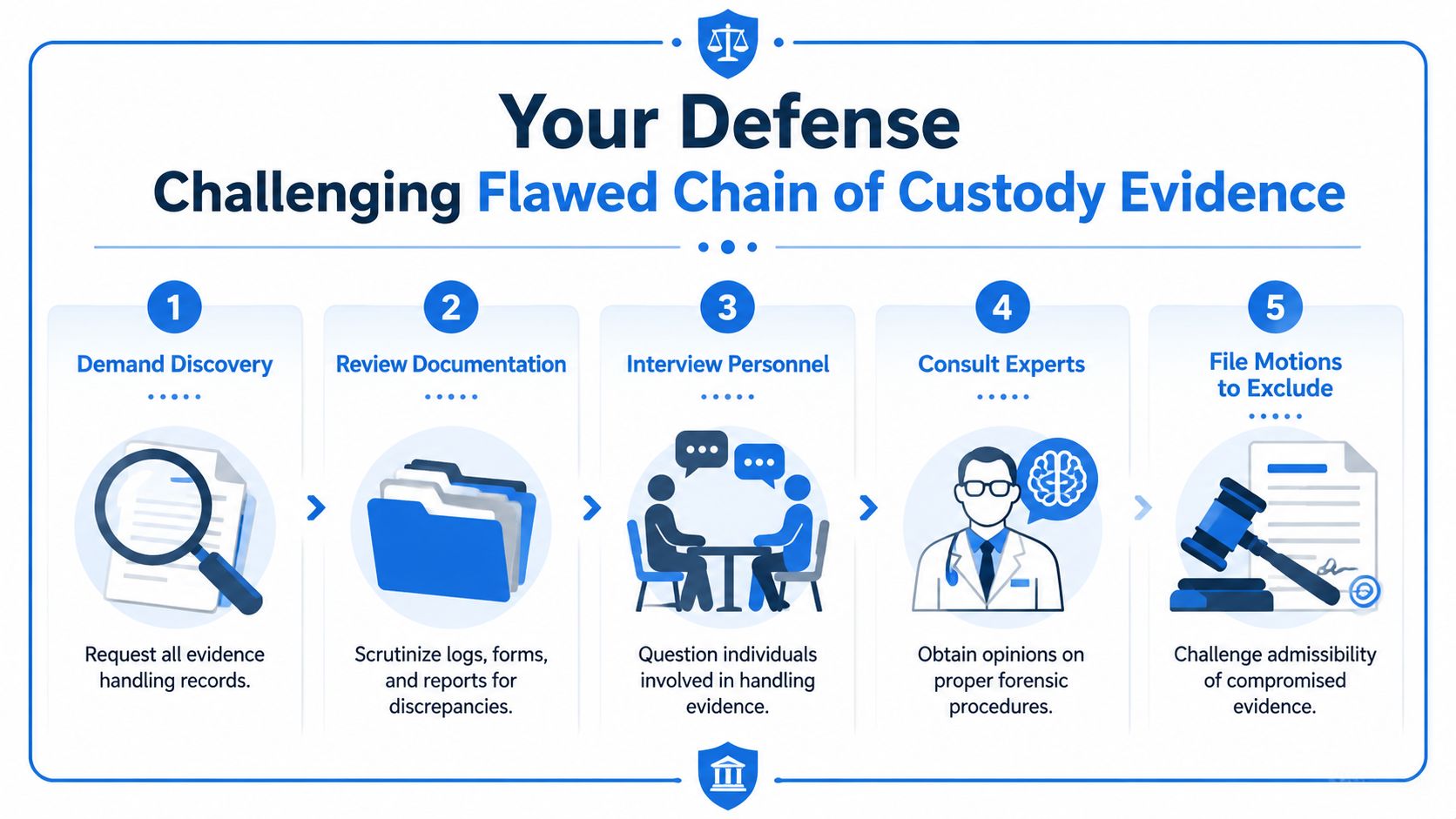
If the State's evidence has chain problems, the defense can't rely on vague complaints. It has to build the challenge systematically, with records, testimony, and motions that force the prosecution to account for every gap.
What a defense lawyer actually does
The work usually starts in discovery. The defense demands the property receipts, evidence logs, lab submissions, chain forms, reports, photographs, body camera footage, and any internal records showing who handled the item.
Then the records get compared against each other.
Reports vs. forms: Do the times, locations, and descriptions match?
Seals vs. testimony: Did the witness describe packaging that the photos contradict?
Transfers vs. access logs: Does every handoff appear in the records?
Lab intake vs. collection report: Is the tested item clearly traceable to the seizure event?
A careful defense investigation may also include depositions, hearings, subpoenas, and expert consultation, depending on the case. In South Florida courts, that kind of detailed review often separates a generic defense from a strategic one.
Why motions matter
When the problem is serious enough, the next move may be a motion asking the court to exclude the evidence. If the judge agrees that the State can't properly authenticate the item or that the chain is too compromised, the prosecution may lose a key exhibit.
That's where a motion to suppress evidence becomes especially important. In some cases, the chain issue stands alone. In others, it combines with illegal search, improper seizure, or defective testing protocol.
A strong motion doesn't complain in general terms. It identifies the exact missing signature, unexplained transfer, broken seal, or contradictory testimony that prevents the State from laying a proper foundation.
If the challenged evidence is central, the case may weaken quickly. Charges can sometimes be reduced. Negotiations can change. In the right case, dismissal becomes a serious possibility. No honest lawyer should promise that result, but no good defense lawyer should ignore the opportunity either.
If you're charged with DUI, drug crimes, theft, domestic violence, federal crimes, juvenile offenses, or a probation violation in Broward County, Fort Lauderdale, Miami-Dade, Palm Beach, or elsewhere in South Florida, this is one of the first issues your attorney should examine.
Frequently Asked Questions About Chain of Custody
Is a typo enough to break the chain
Not always. A minor typo by itself may be treated as a weakness rather than a fatal defect, especially if the witnesses and surrounding documents still identify the item clearly. But even a small error can matter if it creates confusion about what item was seized, who had it, or when a transfer happened.
The key is context. One typo may be harmless. One typo combined with a missing signature, an unclear seal, and inconsistent testimony can become a serious admissibility issue.
How does this work with digital evidence
Digital evidence creates a different kind of chain problem. Photos, videos, texts, phone data, and surveillance files may rely on embedded metadata, including GPS information, timestamps, device IDs, and hash verification. A 2025 YouTube forensic training session noted that 92% of digital examiners use metadata embedding for chain integrity, while many Florida courts still require human testimony for each transfer. That conflict can create an opening for the defense.
In plain terms, the State may argue that the file is authentic because the metadata is intact. The defense may respond that the human handling still matters, especially if the device or file moved through multiple hands without clean documentation.
What happens if the judge suppresses the evidence
It depends on how important that evidence is to the case.
If the suppressed item is central, the State may have trouble proving the charge beyond a reasonable doubt. That can lead to reduced charges, a better negotiated outcome, or a dismissal. If the prosecution still has independent proof, it may try to move forward without the excluded evidence.
Either way, suppression shifts the power dynamic. It forces the State to reassess the case from a weaker position.
Does chain of custody matter outside felony cases
Yes. It matters in misdemeanor and felony prosecutions alike. A misdemeanor DUI, a petit theft, a drug possession case, or a probation violation can rise or fall on whether the State can properly authenticate its evidence. The seriousness of the charge changes the stakes. It doesn't erase the rules.
Can missing signatures really matter that much
Yes. Florida SART guidelines require every person who takes possession of evidence to sign a receipt, and if someone refuses to sign, that person is barred from receiving the item. That kind of rule exists for a reason. Unrecorded possession creates doubt, and doubt is exactly what a defense lawyer is trained to expose.
If you're facing criminal charges in Broward County, Fort Lauderdale, Miami-Dade, Palm Beach, or anywhere in South Florida, don't assume the State's evidence is untouchable. A careful review of the chain of custody can expose weaknesses that change the direction of your case. For a confidential consultation about DUI, drug charges, theft offenses, weapons allegations, probation violations, or other Florida criminal matters, contact Ticket Shield, PLLC.
Every piece of evidence has a paper trail — and gaps in it can win your case. Learn how chain of custody works in Florida courts.