
Can Police Take Your Car in Florida? a Driver's Guide
Jason Goldsmith, Esq
Yes, Florida police can take your car, but the legal authority matters. Under Florida law, a seizure may lead to release after fees, a court-supervised forfeiture case, or a constitutional challenge that puts the vehicle back within reach.
You may be standing on a Broward County shoulder while red-and-blue lights wash over the pavement. An officer gives a warning, asks who owns the SUV, and calls a flatbed. Your child watches from the back seat as the vehicle disappears, even though you haven't been convicted of anything and may not have been the person driving.
That tow can disrupt work, school pickup, medical appointments, immigration obligations, and the household budget within hours. The most important question isn't can police take your car. It's why did they take it, under which authority, and what must happen before they can keep it?
Florida officers may rely on consent, probable cause, an administrative or inventory impound, or a civil forfeiture theory. Those categories affect the clock, the costs, the government's burden, and your route toward recovery. By the end, you'll know how to identify the authority used and what to do before delay weakens your position.
Table of Contents
When the Keys Leave Your Hand in South Florida
At 11 p.m. on a Broward or Miami-Dade roadside, the tow truck operator doesn't need to explain the entire legal process before attaching the hooks. The officer may hand you paperwork, direct you away from the vehicle, and tell you where the SUV is going. Your first instinct is often to argue, but the scene moves faster than your questions.
The legal answer depends on the facts. Florida police may impound a car after an arrest, a licensing or registration problem, an unsafe situation, or suspected criminal use. A temporary tow is different from a seizure aimed at keeping ownership, and confusing the two can cause you to miss the correct remedy.

Practical rule: Don't sign away ownership rights just to get through an upsetting roadside encounter.
A driver needs to separate the stop from the tow and the tow from any later forfeiture case. The Fourth Amendment may control the stop and search, Florida statutes may authorize an impound, and a civil case may determine whether the government can permanently retain the car. Read the explanation of reasonable suspicion versus probable cause before assuming an officer's statement settles the issue.
The rest of this guide follows those pathways in plain English. It also addresses the difficult situation where the registered owner wasn't driving, because a passenger's alleged conduct doesn't automatically answer whether an innocent owner can recover the vehicle.
The Four Legal Authorities Police Use to Seize a Car
Police don't use one universal power when a vehicle leaves the scene. Start by identifying the legal category written on the paperwork or described by the agency.
Consent search and seizure
Consent begins with permission. A tourist stopped for suspected DUI may hand over the keys or agree to a search because the officer asks in a way that feels compulsory. Voluntary permission can authorize police action, but consent must come from someone with authority and must not result from coercion or an unclear understanding.
Probable-cause seizure
Police may seize a vehicle when facts connect it to a crime and support probable cause. A suspected drug courier stopped on I-95 near Fort Lauderdale presents a different problem from a routine parking tow. The government must identify a lawful connection between the car, suspected contraband, or the alleged criminal conduct.
Inventory impound
An inventory impound is intended to secure a vehicle, protect property, and document its contents after a lawful tow. An arrested driver at a Miami Dolphins game may leave a car without another responsible driver available. Officers may arrange towing under an established policy rather than claiming that the vehicle itself is criminal property.
Civil asset forfeiture
Civil forfeiture is the most serious category because the agency seeks to keep the vehicle. The car becomes the subject of a separate civil proceeding based on an allegation that it facilitated criminal activity. That can affect a clean owner whose passenger allegedly hid contraband, even when the owner wasn't accused of the underlying offense.
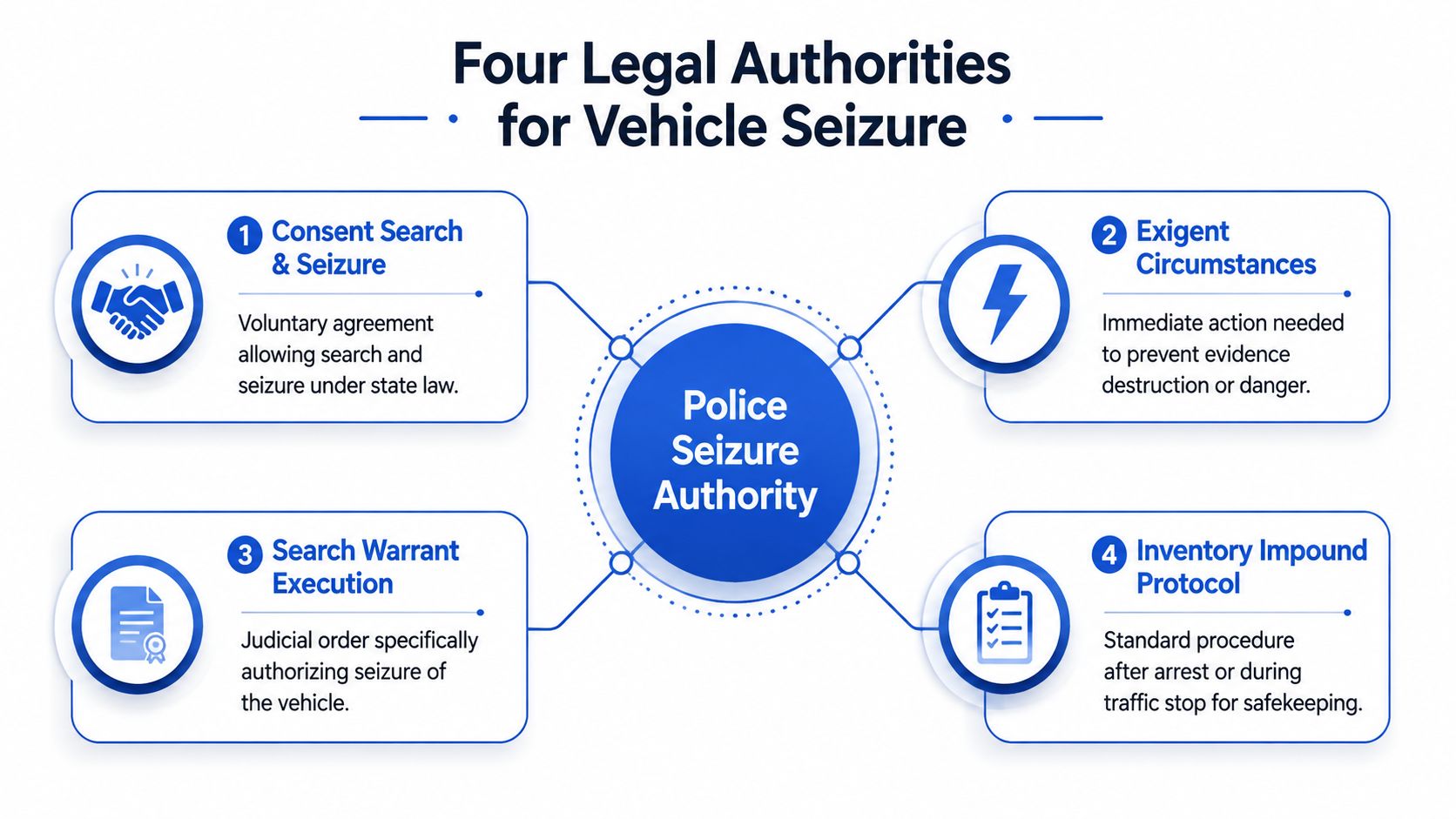
These categories control the clock, cost, evidentiary burden, and path home. A driver who treats every tow as a simple traffic matter may miss a suppression issue or fail to respond to forfeiture papers. For a deeper explanation of constitutional challenges, review illegal search and seizure issues.
Probable Cause and Consent in Vehicle Stops
A police hunch isn't the same as probable cause. For a warrantless seizure tied to suspected criminal use, officers need articulable facts connecting the vehicle to a felony, contraband, or an item used in the offense. Nervous behavior alone doesn't establish that connection.
That distinction matters in a Fort Lauderdale drug investigation or a DUI-related seizure. The State may point to observations, statements, physical evidence, or the circumstances of the stop. A defense lawyer tests whether those facts existed before the seizure or were developed only after officers had already taken control of the vehicle.
Consent creates a separate route, but it isn't automatically valid because a driver signed a form. The questions include who gave permission, whether that person had authority over the car, what the officer requested, and whether the encounter was coercive. A passenger generally can't grant permission for areas or property the passenger doesn't control.
Defense attacks that change the case
A defense attorney may file a motion to suppress under Florida Rule of Criminal Procedure 3.190(h), challenge an inventory sheet, and subpoena body-worn-camera footage. The footage can show whether the officer asked for consent, implied that refusal wasn't allowed, or expanded the search beyond the permission given.
Florida's recording law also matters to how an encounter is documented. Counsel should examine the officer's warnings and the recording itself under the applicable requirements of Florida Statutes section 943.1712.
Element | Probable Cause Seizure | Consent Seizure |
|---|---|---|
Required basis | Specific facts tying the vehicle to suspected criminal conduct | Voluntary permission from a person with authority |
Main defense | Attack the factual nexus, timing, and scope | Show coercion, ambiguity, lack of authority, or withdrawal |
Useful evidence | Stop video, reports, canine records, witness accounts | Body-camera footage, forms, audio, and witness testimony |
Practical objective | Suppress evidence or invalidate the seizure | Suppress the search or prove permission didn't cover the action |
Don't rely on general impressions about a traffic stop. Compare the facts against the legal standard explained in probable cause during a traffic stop, then preserve the evidence before the narrative hardens.
Administrative and Inventory Impounds Explained
Administrative impound is often the reason a driver loses a car without facing a forfeiture allegation. Florida Statutes section 715.07 addresses the removal and storage framework, while the underlying facts may involve a suspended or revoked license, no valid registration, or an arrest when no responsible driver can take the vehicle.
Consider a Miami Beach rental car stopped during a street-sweeping operation. The registered driver is across the country, and nobody at the scene can lawfully assume custody. The tow may be administrative and temporary, even though officers still document the car and its contents.
What happens at the lot
The process usually follows a practical sequence:
Triggering event: An officer identifies a licensing, registration, arrest, abandonment, or safety problem.
Tow authorization: The agency orders removal to a designated facility.
Inventory: Personnel record visible property under a standardized policy.
Hold review: The agency determines whether another legal reason prevents release.
Release decision: The owner or authorized person presents required documents and resolves the applicable charges.
An inventory search isn't a free-ranging criminal investigation. Under the principles associated with South Dakota v. Opperman, officers may document the contents of a lawfully impounded vehicle when they follow standardized procedures. If the inventory looks selective, incomplete, or designed to search for evidence, counsel should challenge it.
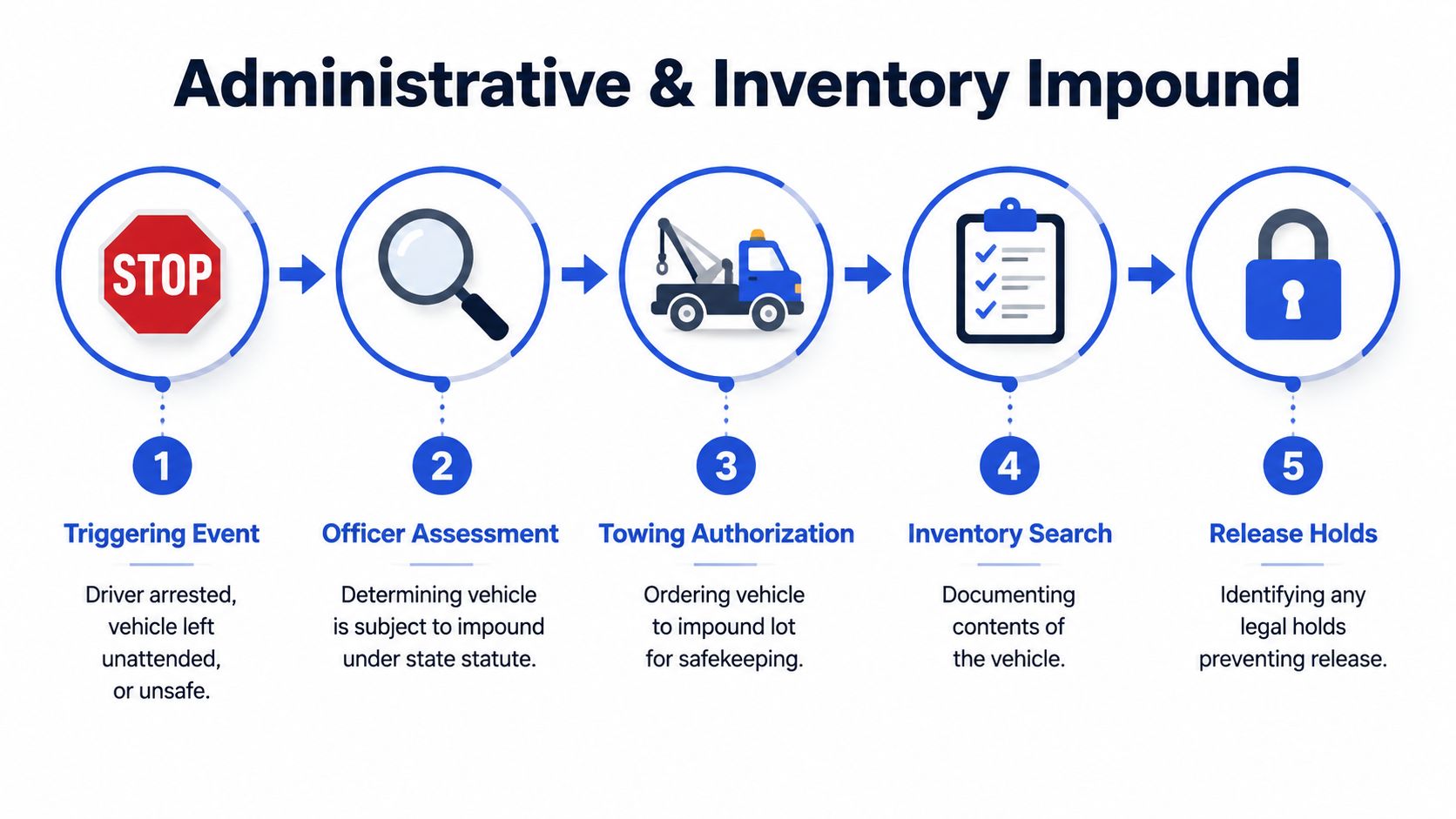
Storage charges begin working against the owner while the paperwork sits. Florida's Contraband Forfeiture Act requires the seizing agency to apply to a court within 10 business days after seizure for a probable-cause determination, so police can't retain a vehicle indefinitely without moving into formal proceedings. The deadline appears in Florida Statutes section 932.703.
Don't assume a local tow estimate is a guaranteed legal amount. Ask the lot for a written fee schedule, the release conditions, and the precise reason for every hold. For license-related problems, review administrative license suspension separately from the vehicle issue.
Temporary Impound vs Civil Asset Forfeiture
A temporary impound is custody. Civil asset forfeiture is an attempt to change ownership. That difference should shape every decision you make after the tow.
A temporary impound generally ends when the owner satisfies the release conditions, such as resolving a licensing or registration problem, showing insurance, and paying authorized towing and storage charges. In the United Kingdom, official guidance illustrates the basic custody model, allowing police to seize vehicles used without proper licensing or insurance, dangerously or illegally parked, abandoned, or driven in a way that causes alarm, harassment, or distress. The guidance identifies a release fee of up to £200 and storage charges of £20 per day or part day. Those figures apply to the UK framework, not Florida, but they show why delay increases retrieval costs. See the UK vehicle seizure guidance.
Florida forfeiture is different. Under Chapter 932, the seizing agency may claim that the vehicle facilitated criminal activity, even when the owner wasn't the driver or was never charged. Florida law requires a court application for probable cause within 10 business days after seizure, and the owner receives notice and a right to an adversarial preliminary hearing. A final forfeiture order requires proof beyond a reasonable doubt that the property was used in violation of the Act. See Florida's forfeiture procedure and the statutory hearing provisions in section 932.703.
Factor | Temporary Impound | Civil Asset Forfeiture |
|---|---|---|
Who acts | Officer or towing authority | Seizing agency through a civil case |
Purpose | Safekeeping or correcting a vehicle problem | Permanent retention based on alleged criminal use |
Owner's path | Satisfy release conditions | Respond to notice and contest the forfeiture |
Possible result | Vehicle returned after lawful charges | Vehicle may remain with the government or be sold |
Innocent owner issue | Usually focuses on release eligibility | Can determine whether a non-driving owner recovers the car |
Don't treat a forfeiture notice like a tow bill. The recent legal developments continue to evolve, with disputes over warrantless impoundment and new seizure categories reinforcing the need to identify the precise authority rather than accept a yes-or-no answer. The cited legislative material is not a substitute for Florida-specific advice.
How to Reclaim Your Car and Win It Back
Act quickly, but don't act blindly. Your first task is to find out whether the vehicle is sitting in a routine impound lot or is subject to a criminal or forfeiture hold.
Locate the vehicle. Call the agency that ordered the tow, usually the local police department or sheriff's office. Ask for the lot address, case number, tow receipt, current hold, and the name of the person who can authorize release.
Collect ownership and driving documents. Gather your driver's license, current registration, proof of insurance, title or purchase documents, and any authorization needed for another person to retrieve the vehicle. A spouse may need written authorization if the lot won't release the car directly to that person.
Separate fees from disputed allegations. Pay legitimate release charges only after confirming what they cover. Keep receipts, request an itemized statement, and arrange personal-property retrieval under the lot's documented procedure.
Protect the forfeiture claim. If the agency sends a Notice of Seizure, consult counsel before signing anything. Florida's statutory process gives the owner notice and an adversarial preliminary hearing, and the court examines affidavits and other evidence to decide whether probable cause exists.
Ask about hardship relief. A non-driving owner or family relying on one vehicle may have grounds to request temporary return while the case proceeds. Explain the work, childcare, school, or medical consequences with documents rather than a general statement of inconvenience.
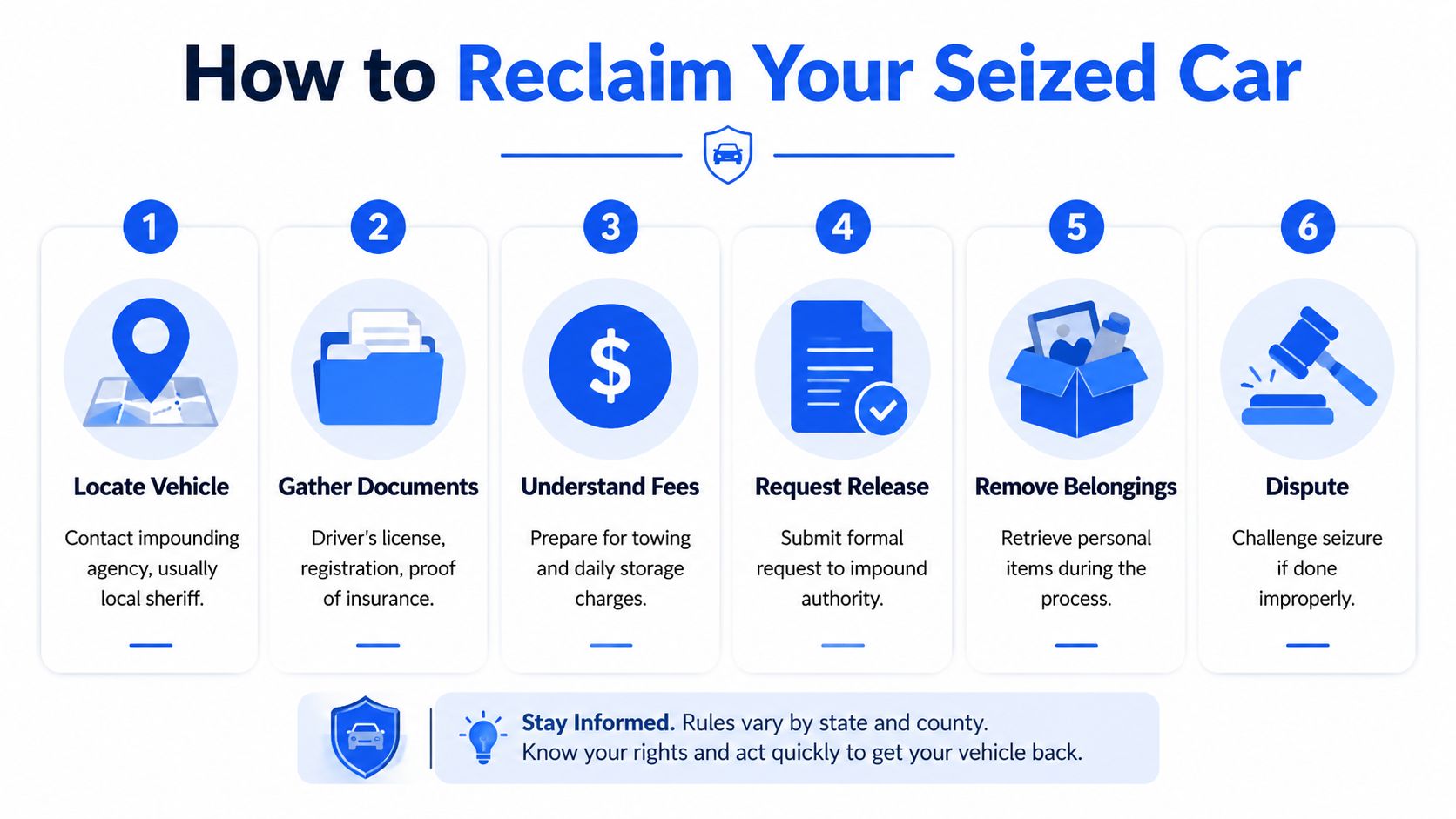
The most damaging mistakes are predictable. Owners miss a claim deadline, pay a forfeiture agent before getting legal advice, or sign a release that could undermine an innocent-owner defense. If the seizure followed a search, read about motions to suppress evidence before deciding that the tow makes the evidence untouchable.
Why a Defense Attorney Changes the Outcome
The first call should be to a Florida defense attorney who understands both criminal procedure and vehicle forfeiture. This isn't because every seizure requires a lawsuit. It's because the early paperwork often determines whether you can challenge the stop, request a hearing, preserve ownership arguments, or obtain a hardship release.
Florida's Contraband Forfeiture Act requires the agency to seek a probable-cause determination within 10 business days after seizure. Florida law also provides notice and an adversarial preliminary hearing, where the court reviews the agency's affidavits and other evidence. The owner shouldn't assume that a tow receipt explains the entire case.
What counsel investigates immediately
A lawyer can:
Test the stop: Determine whether officers had lawful grounds before taking control of the vehicle.
Challenge the nexus: Demand facts tying this particular car to the alleged offense.
Examine the inventory: Compare the written checklist with body-camera footage and witness accounts.
Protect innocent ownership: Document title, purchase history, lawful use, and lack of knowledge.
Seek hardship relief: Show why temporary return is necessary for work, childcare, school, or medical care.
Preserve suppression issues: File the appropriate motion when officers exceeded constitutional limits.
The driver and the owner may have different interests. A spouse, parent, employer, or co-owner may need to act even though that person wasn't stopped. Civil forfeiture materials from Illinois illustrate this broader problem, including hardship motions and innocent-owner arguments, but Florida's statutory procedure controls a Florida case. Read the Illinois civil-asset-forfeiture explanation for the general distinction, not as Florida law.
The owner who waits for the criminal case to solve the vehicle problem may lose valuable leverage while the car remains unavailable.
A lawyer can't promise a particular result. A lawyer can force the agency to identify its authority, comply with procedure, and defend the evidence it wants to use.
Your Next Steps After a Florida Vehicle Seizure
The tow truck leaving doesn't end your options. It starts a documentation and deadline problem, and the person who creates a clean record early is in a much stronger position.
Write down the facts before memory shifts
Record the time, location, officer's agency, case number, stated reason for the tow, names of witnesses, and exact words used about consent or release. If it's safe, photograph the scene, the paperwork, and any visible damage. Request the property receipt, written inventory, tow company's name, lot address, and every hold placed on the vehicle.
Within the first day, contact a Florida defense attorney experienced in search-and-seizure and forfeiture matters. Don't sign agency release forms, ownership waivers, or statements about the alleged offense before counsel reviews them. If the vehicle is needed for work or medical care, say so immediately and gather proof of that need.
Track the statutory clock
Florida's Contraband Forfeiture Act requires the seizing agency to apply to a court within 10 business days for a probable-cause determination. Ask counsel to verify whether the agency complied and to request the available post-seizure hearing.
Gather title, registration, insurance records, and purchase documents promptly. Use them to establish ownership and support any innocent-owner or hardship request. Storage can continue while the case moves, so ask about a release hold, an itemized bill, and whether the vehicle may be released while the legal dispute continues.
Your immediate checklist: Find the car. Preserve every document. Don't consent to unnecessary searches. Don't sign a waiver. Get legal advice before the deadline passes.
Florida vehicle seizures can arise alongside DUI, drug charges, theft allegations, weapons cases, violent-crime investigations, probation violations, or traffic offenses. The underlying charge and the seizure authority should be analyzed separately. A weak criminal allegation doesn't automatically make the tow lawful, and a lawful tow doesn't automatically prove forfeiture.
Every day of delay can increase cost and reduce practical advantage. A confidential consultation can identify whether the fastest path is administrative release, a hardship request, a forfeiture claim, or a constitutional challenge.
Ticket Shield, PLLC reviews Florida vehicle seizures, DUI-related impounds, search-and-seizure violations, and civil forfeiture notices for drivers and owners across Broward County, Fort Lauderdale, Miami-Dade, Palm Beach, and surrounding South Florida communities. Contact Ticket Shield, PLLC for a free, confidential consultation so you can protect your vehicle, your license, and your next legal deadline.