
DUI in Florida Law: A Complete Guide to Charges
Jason Goldsmith, Esq
You're driving home in South Florida, the light behind you flashes, and the next few minutes start to split your life into two tracks. One track is the criminal case in court. The other is the DMV fight over your license, and both can move faster than people expect.
In Florida, a DUI stop isn't just about what happened on the roadside. It's about what the officer wrote down, what the machine said, whether the stop was lawful, and whether the State can turn those facts into a conviction. That's where cases in Broward County, Fort Lauderdale, Miami-Dade, Palm Beach, and across Florida get decided.
Table of Contents
The Moment Everything Changes During a Florida DUI Stop
The stop usually starts with lights in the mirror, then a deputy or officer walking up to the car with a very narrow set of questions in mind. Was the stop lawful. Did the driver show signs of impairment. Is there enough to justify field testing or an arrest. That moment is stressful because the driver is reacting, while the officer is building a file.
A lot of people think the case starts in court. It doesn't. It starts with observations, body camera footage, roadside instructions, and the words used at the scene. If the officer thinks the driver is impaired, the investigation usually shifts quickly from a traffic stop to a DUI case that can affect both the criminal record and the driver's license.
Florida's DUI process is layered, not single-track. A person can be dealing with criminal court while also facing license consequences, and those paths don't wait on each other. That's why a stop that feels brief on the roadside can turn into weeks of real pressure.
Practical rule: Don't treat the roadside as a throwaway moment. What happens there often becomes the core evidence later.
In South Florida, that matters because local prosecutors and judges are dealing with heavy DUI dockets, and the case often turns on the smallest details. If you want a clear look at how police stops are examined before the DUI case even starts, see this discussion of pretext traffic stops. That issue comes up more often than drivers realize, especially when the officer says one thing at the scene and the video shows another.
The first decision point is simple: the State will try to convert the stop into proof. The defense job is to ask whether the stop, the detention, and the observations support that conversion.
How Florida Law Actually Defines DUI
Florida law uses a dual-theory DUI framework. The State can prove DUI in one of two ways. It can show impairment of normal faculties, or it can prove a per se BAC or breath alcohol level of 0.08 or higher through chemical testing. The state's administrative guidance says the prosecution doesn't need both to move forward, and that changes the whole defense approach. Florida DHSMV DUI administrative suspension guidance
Impairment proof comes from what officers see
When prosecutors go the impairment route, the officer's notes matter. Slurred speech, balance issues, coordination problems, odor, confusion, and roadside test performance all get packaged as evidence of impaired normal faculties. That means a driver can face DUI even if the breath result is low or nonexistent, because the State can lean on the officer's observations instead of the machine.
That's why field sobriety exercises matter so much. They're not just roadside formalities. They often become courtroom exhibits through the officer's testimony and the bodycam. If the officer describes poor balance or missed clues, that narrative can carry the case unless it gets challenged early and specifically. A driver who looked shaky because of fatigue, injury, anxiety, or a medical issue can still be treated like an impaired driver unless the defense raises a real alternative explanation.
The chemical test path has its own problems
The per se path is simpler on paper. If the State proves a qualifying alcohol level, it has a direct theory. But a number alone doesn't end the case, because the defense can still challenge how the sample was taken, whether the machine was maintained correctly, and whether the result really reflects the driver at the time of driving.
The State does not need a perfect case. It needs a provable one.
That's the practical pressure point in DUI in Florida law. The prosecution can win on observations alone or on a chemical result alone. Defense work usually focuses on the weak lane in the case, not on trying to disprove every possible theory at once.
For a plain-language comparison of charge choices in traffic cases, this DUI versus reckless driving explanation helps show why prosecutors sometimes prefer one path over another.
Administrative License Suspension and the New Refusal Law
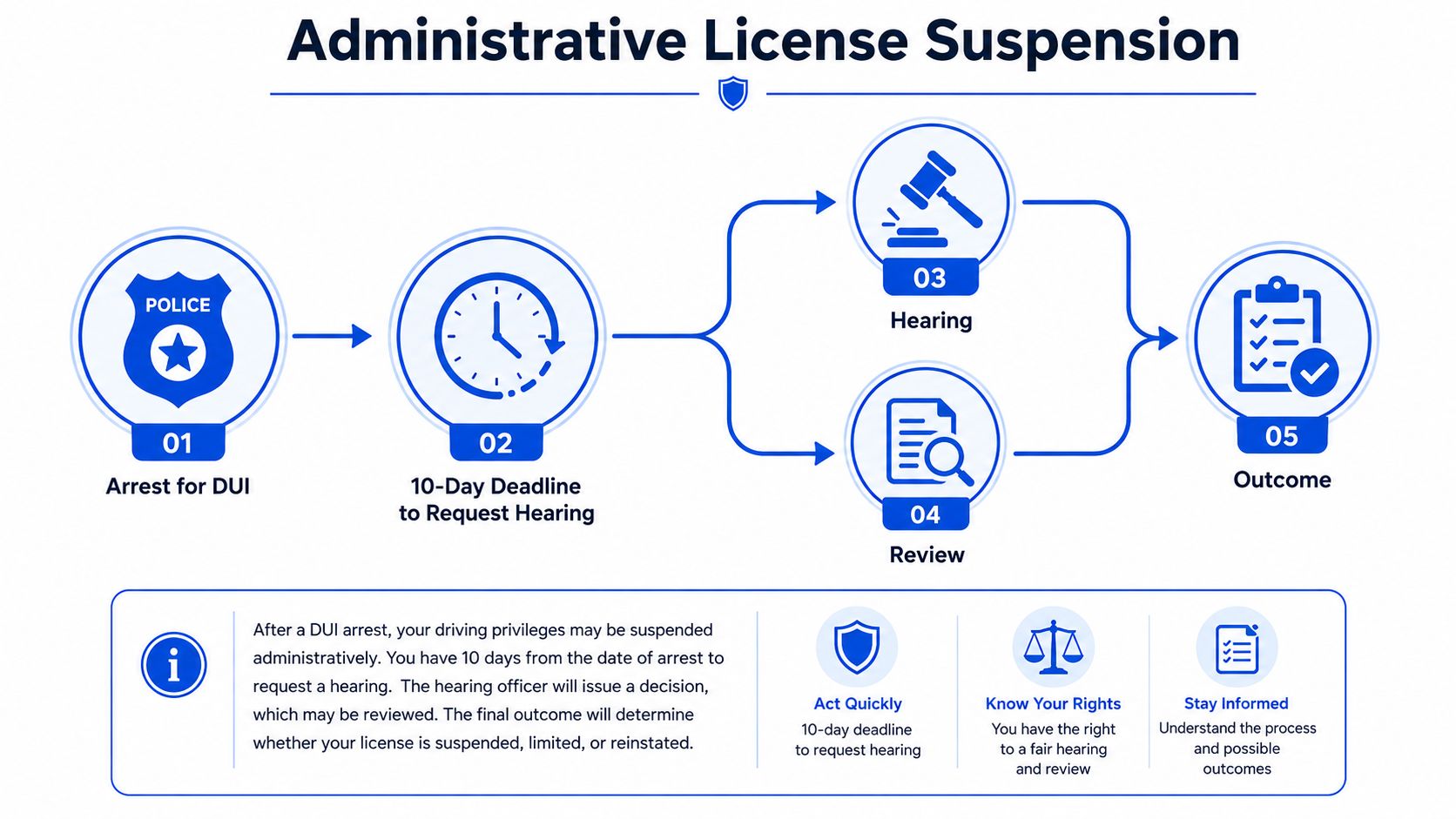
A DUI arrest in Florida can trigger a license problem right away, before the criminal case is resolved. That separate DMV issue is where people lose time if they wait too long to act. The key point is that the criminal court calendar and the license calendar do not move together, and missing the early deadline can make the administrative side much harder to fight.
The refusal rule changed in October 2025
Older advice told drivers that refusal was mainly a license issue. That was the old world. Under reporting on Trenton's Law, starting October 1, 2025, refusing a lawful breath or urine test after a DUI arrest can become a criminal offense rather than only an administrative consequence. A 2025 explanation of the change describes a first refusal as a second-degree misdemeanor and notes continued license-suspension exposure. Florida DUI refusal law update on Trenton's Law
That shift matters because refusal is no longer a reflexive “safer” option. The decision now depends on the facts, the stop, the officer's conduct, and the type of test requested. A driver can still face administrative consequences, but now there's a criminal layer that older DUI articles often miss.
The timeline is what traps people
The pressure comes from timing. Once the arrest happens, the driver has a very short window to respond to the license issue, and that window runs alongside the criminal case. Work schedules, school drop-offs, and family obligations do not pause just because paperwork is pending.
For a basic walkthrough of how breath test refusals are commonly discussed in Florida, this refusal explainer is useful context. It also shows why the new refusal law creates a different legal calculation than many drivers expect.
What a Florida DUI Conviction Actually Costs
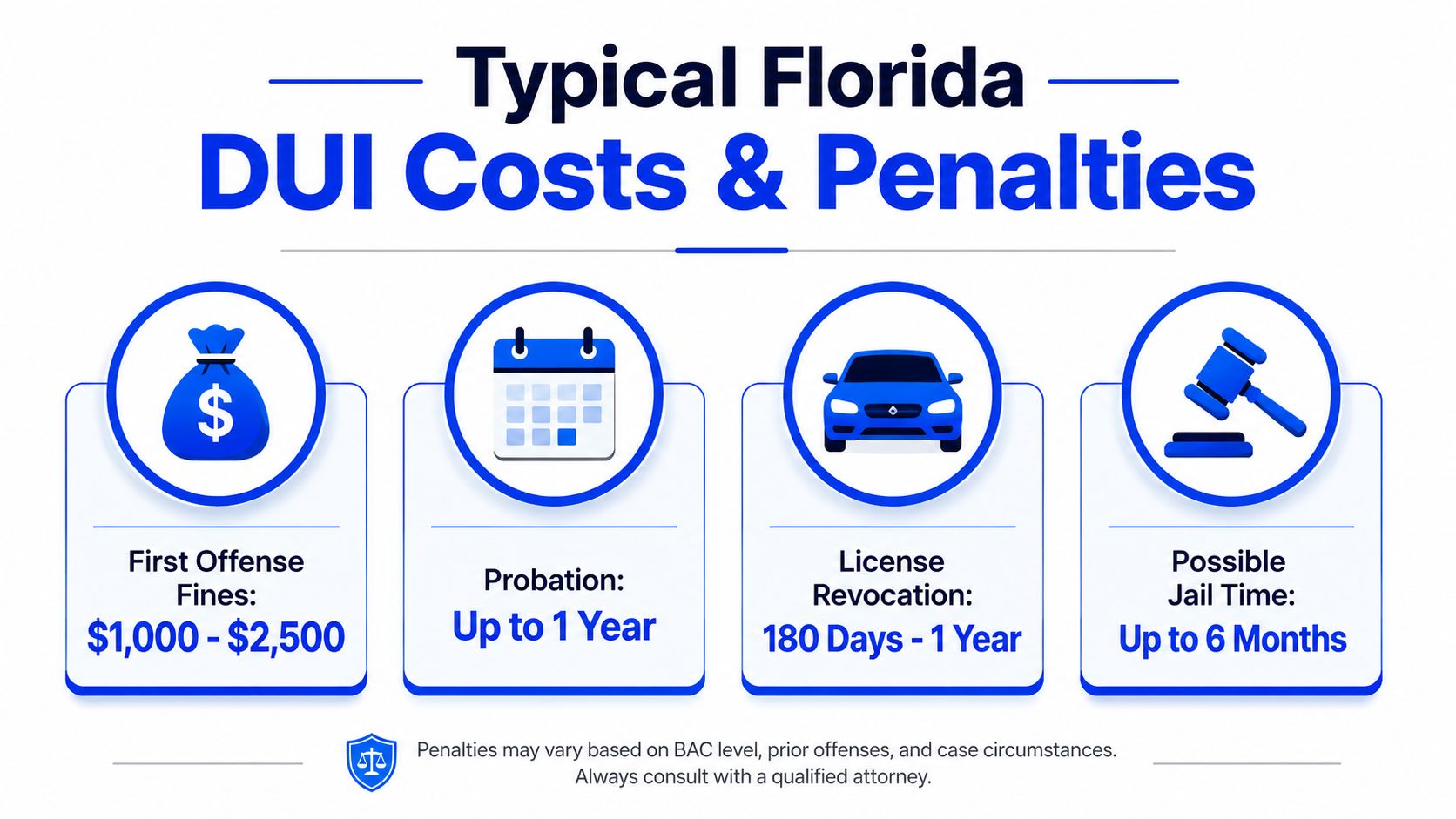
A Florida DUI case can look routine at the start and expensive by the end. Recent reporting based on Florida court data says there were 69,311 DUI cases across 65 Florida counties from 2023 to 2025, with a 91.9% guilty rate, a 1.2% dismissal rate, and 2.1% of cases ending in withheld adjudication. The same dataset reports an average convicted sentence of 3.9 months and an average fine of $1,047, which shows why this charge is treated as real criminal exposure, not a traffic inconvenience. Florida court DUI data
The numbers show the practical risk
Those figures matter because they show how often DUI cases end in a conviction or guilty outcome rather than a clean dismissal. They also show that even when the case resolves by plea, the exposure is not trivial. Jail time, fines, court costs, DUI school, license consequences, and insurance fallout can follow the case long after the arrest date.
The broader public-safety data points in the same direction. A Florida impaired-driving fact sheet reported 3,558 impaired-driving traffic fatalities in 2022, and 1,044 deaths tied to impaired driving, equal to 29.3% of all traffic fatalities that year. Those numbers help explain why prosecutors and judges often treat these cases as public-safety matters first and plea discussions second.
Conviction costs go beyond the sentence
The sentence is only part of the damage. A DUI conviction can also trigger:
License consequences, including suspension or revocation exposure.
DUI school requirements, which can be burdensome and time-consuming.
Ignition interlock issues, depending on the case and prior history.
Insurance problems, which often outlast the courtroom part of the case.
Record impact, because DUI remains on the Florida record and isn't expungeable under the Florida sources cited here.
Florida's penalty structure spells out how fast those consequences can grow, and this Florida DUI penalties page gives useful background. The practical point is simple. The State may talk in terms of one arrest, but the client usually feels the cost in several different places at once.
Misdemeanor vs Felony DUI in Florida
Florida separates misdemeanor DUI from felony DUI by looking at prior convictions and timing. A first or second DUI is usually handled differently from repeat conduct, and the lookback period often decides how far the case can go. Once a driver moves into certain repeat-offense territory, the case stops being a routine criminal traffic matter and turns into a much heavier exposure problem.
Florida DUI Penalty Tiers at a Glance | |
|---|---|
Offense Tier | Charge Level, Typical Penalty Range, License Impact |
First DUI | Usually misdemeanor, penalties depend on the facts, license consequences are still serious |
Second DUI | Usually misdemeanor, penalties can increase, license consequences can intensify |
Third DUI within 10 years | Third-degree felony under Florida law, much higher exposure |
Fourth or subsequent DUI | Felony treatment, strong prison and long-term record risk |
Prior dates shift bargaining power
A prior conviction inside the relevant window can change the charge, the room for a plea, and the court's view of sentencing. That is why a defense lawyer has to verify priors carefully, including out-of-state history when it affects how the Florida case gets charged.
Florida sources also note that a third DUI within 10 years of a prior conviction is a third-degree felony, and a fourth or subsequent DUI is also treated as a felony. Florida sources further note that DUI stays on the record and cannot be expunged. Florida DUI law overview
Why the charge level matters in practice
A misdemeanor and a felony are different problems. A felony carries different collateral consequences, different pressure in plea discussions, and a longer burden for work, housing, and licensing. A repeat DUI case also usually leaves the court with less patience for mistakes, so early defense work matters more than it does in a first-offense case.
Practical rule: Always confirm the prior convictions before you assume the charge level is right.
Why Older DUI Advice No Longer Applies
A driver gets pulled over in Florida, the officer starts asking about drinking, and the old advice kicks in. Refuse the breath test, keep the State from getting a number, and make the case harder. That advice came from a time when refusal mostly meant an administrative fight. Under the post-October 2025 refusal law, that shortcut is far less dependable.
The choice is fact-specific now
Trenton's Law changed the pressure point. Refusal can now carry license consequences and criminal exposure, so the old one-size-fits-all advice no longer matches the current framework. If an officer asks for a lawful breath or urine test after a DUI arrest, the driver has to weigh whether taking the test gives the State more evidence, while refusing may create a separate refusal charge.
Florida's impaired-driving problem keeps those choices grounded in real cases, not theory. As noted earlier, state data showed alcohol-confirmed crashes, drug-confirmed crashes, and crashes involving both substances, along with deaths tied to alcohol, drugs, and combined impairment. Florida impaired-driving 2025 data
Breath, urine, and implied consent still matter
Breath tests remain the main fight in alcohol cases, but urine requests still come up, especially when drugs are involved. The implied consent framework still matters because officers use those warnings to move the case from a roadside encounter into a chemical-testing dispute. What changed is the consequence for saying no.
For drivers in Fort Lauderdale, Broward County, and the rest of South Florida, the practical answer is never “always refuse” or “always blow.” It turns on the stop, the reason for the test, the officer's warning, and the timing of the arrest. Those details often decide whether the State has a clean path or a problem it has to explain.
Defense Strategies That Actually Move Florida DUI Cases
The strongest DUI defenses usually don't start with a dramatic courtroom argument. They start with pressure on the State's proof. If the stop was weak, the observations were messy, or the testing procedures were flawed, the case can get a lot less solid very quickly.
Where the case cracks
Defense lawyers attack DUI cases in a few predictable places:
The stop itself. If the officer lacked a lawful basis to stop the vehicle, later evidence can be vulnerable.
The observations. Slurred speech, balance issues, and odor don't all mean impairment, especially if video or medical facts point another way.
Field sobriety exercises. These tests are highly situational, and roadside conditions matter.
Breath testing. Calibration, maintenance, and operator issues can undercut the result.
Blood draws and chain of custody. If the sample handling is sloppy, the State's best evidence can weaken.
Constitutional violations. An unlawful search or seizure can lead to suppression motions that strike key evidence before trial.
What actually helps a defendant
The best defense work is usually specific, not broad. A motion to suppress can matter more than a generic claim of innocence. Bodycam footage can help more than a long explanation. Medical records can explain behavior that looked like intoxication on paper. In some cases, the issue is not whether the driver had a drink. The issue is whether the State can prove the legal elements beyond a reasonable doubt.
Ticket Shield, PLLC also handles Florida DUI defense, license suspension and reinstatement help, and early case review for people trying to limit the damage before deadlines pass. That kind of early triage matters because the State builds momentum fast, and the defense has to answer with facts, not guesses.
From Arrest to Resolution and Why Early Help Matters
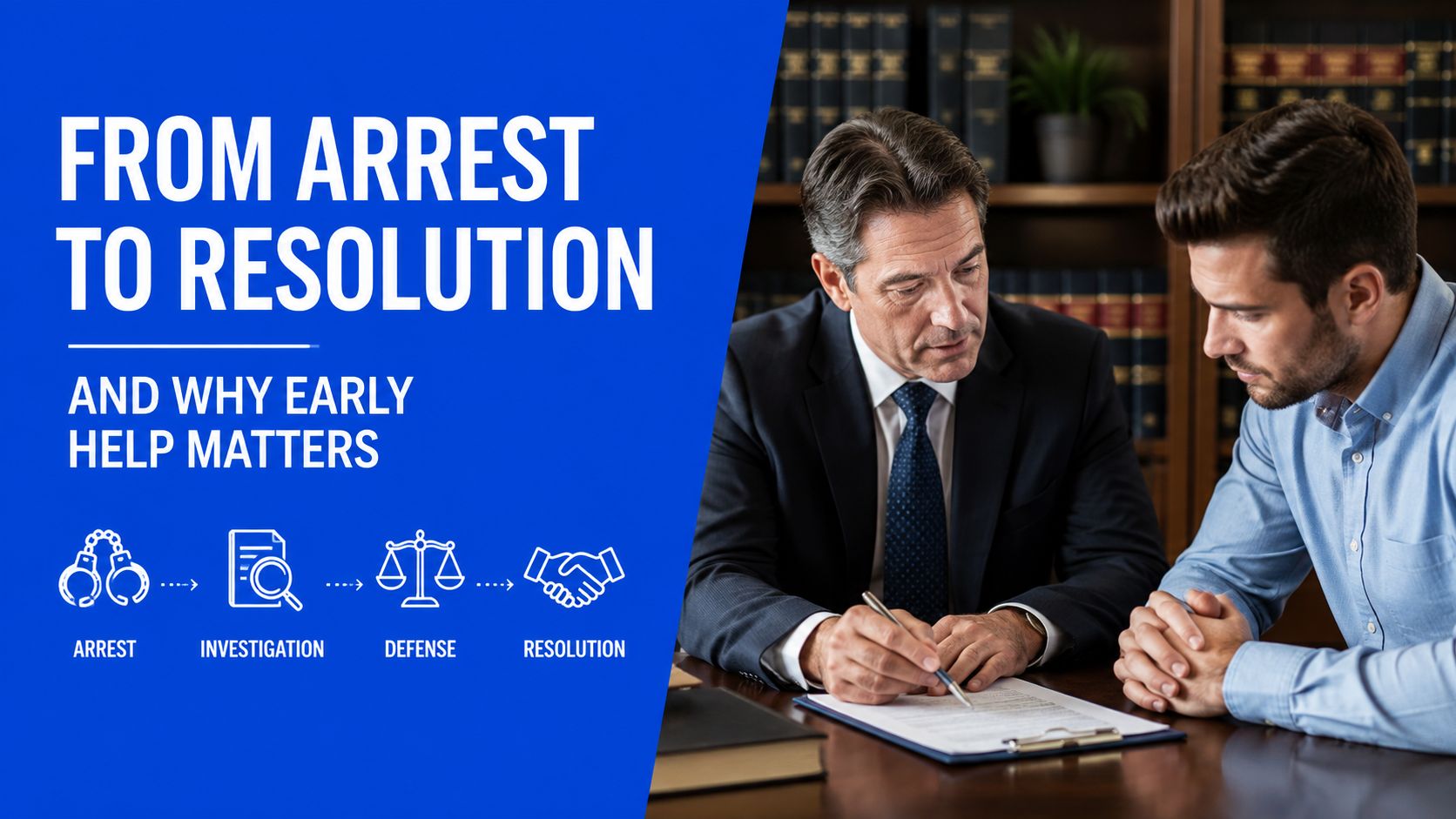
A DUI case in Florida usually moves through a predictable path, even if the outcome doesn't. Arrest and booking come first. Then there's the first appearance, arraignment, discovery, pretrial motions, negotiation, and either plea or trial. Each stage gives the defense a different way to press the State, but the earliest stages usually give the most advantage.
The first 30 to 60 days are often where the defense can preserve video, request records, challenge the stop, and force the State to show what it really has. Once deadlines pass and the case hardens, options can narrow quickly. That's why waiting to “see what happens” often costs more than people think.
If you're dealing with DUI in Florida law, the right move is to get the facts checked early, before the State locks in its version of events. Ticket Shield, PLLC reviews Florida DUI cases, license issues, and related criminal charges with direct attorney access and practical guidance. Visit Ticket Shield, PLLC to request a confidential consultation and get a clear read on your next step.