
Legal Blood Alcohol Limit in Florida: What Drivers Must Know
Jason Goldsmith, Esq
Florida's legal blood alcohol limit is 0.08 for adult drivers, 0.04 for commercial drivers, and 0.02 for drivers under 21. A driver can still be arrested and convicted below these thresholds if officers claim the person's normal faculties were impaired.
You may be reading this after a traffic stop, perhaps after having a couple of drinks with dinner and feeling certain you were under the limit. The officer may still have asked you to perform field sobriety exercises, requested a breath test, or arrested you despite a result below 0.08. That experience is frightening, but the number on a breath or blood test doesn't answer every legal question.
Florida DUI law uses two separate routes to prove a case. The State may rely on a qualifying alcohol concentration, or it may argue that alcohol or drugs impaired your normal faculties. Your driving pattern, speech, balance, admissions, and the way the investigation was conducted can all matter. A Fort Lauderdale DUI lawyer serving Broward County and South Florida will examine the entire encounter, not just the reported BAC.
Table of Contents
Understanding Florida Blood Alcohol Limits
Florida's general adult DUI standard is 0.08 grams of alcohol per 100 milliliters of blood or 0.08 grams per 210 liters of breath, under Florida Statute 316.1934. At or above that level, the statute treats the result as prima facie evidence that the driver's normal faculties were impaired. In practical terms, the State can use the qualifying chemical result as evidence of DUI even if the driver didn't appear severely intoxicated.
The legal picture changes by driver category. Commercial drivers may face a lower benchmark while operating a commercial vehicle, and Florida's under-21 rule uses a 0.02 alcohol concentration threshold for an administrative violation. The under-21 rule is explained in Florida's guidance on under-21 BAC rules.
The number isn't a safe harbor
A reading below 0.08 doesn't guarantee that prosecutors cannot file or pursue a DUI case. Florida law expressly allows a conviction when alcohol or drugs impair normal faculties, even without reaching the adult per se threshold. The statute identifies abilities such as seeing, hearing, walking, talking, judging distances, making decisions, responding to emergencies, and driving as part of the faculties officers and prosecutors may place in issue.
That creates an important distinction:
Chemical concentration path: The State relies on a blood or breath result at or above the applicable threshold.
Observable impairment path: The State relies on conduct and other evidence showing that alcohol or drugs affected normal faculties.
A low reading may help the defense, but it doesn't erase the rest of the evidence. Officers can still arrest when they claim the total circumstances establish probable cause, and prosecutors can still argue impairment from driving behavior or field observations.
Practical rule: Never treat a BAC number as a complete defense or a complete admission. The timing of the test, the reliability of the procedure, and the evidence gathered before and after it all deserve careful review.
How Florida Proves Impairment Beyond the BAC Number
Florida DUI prosecutions commonly follow one of two independent proof paths. The first is often called per se impairment, where the State points to a blood or breath alcohol concentration at or above the applicable legal threshold. The second is actual impairment, where prosecutors argue that the driver's normal faculties were affected, regardless of whether the chemical result reached 0.08.
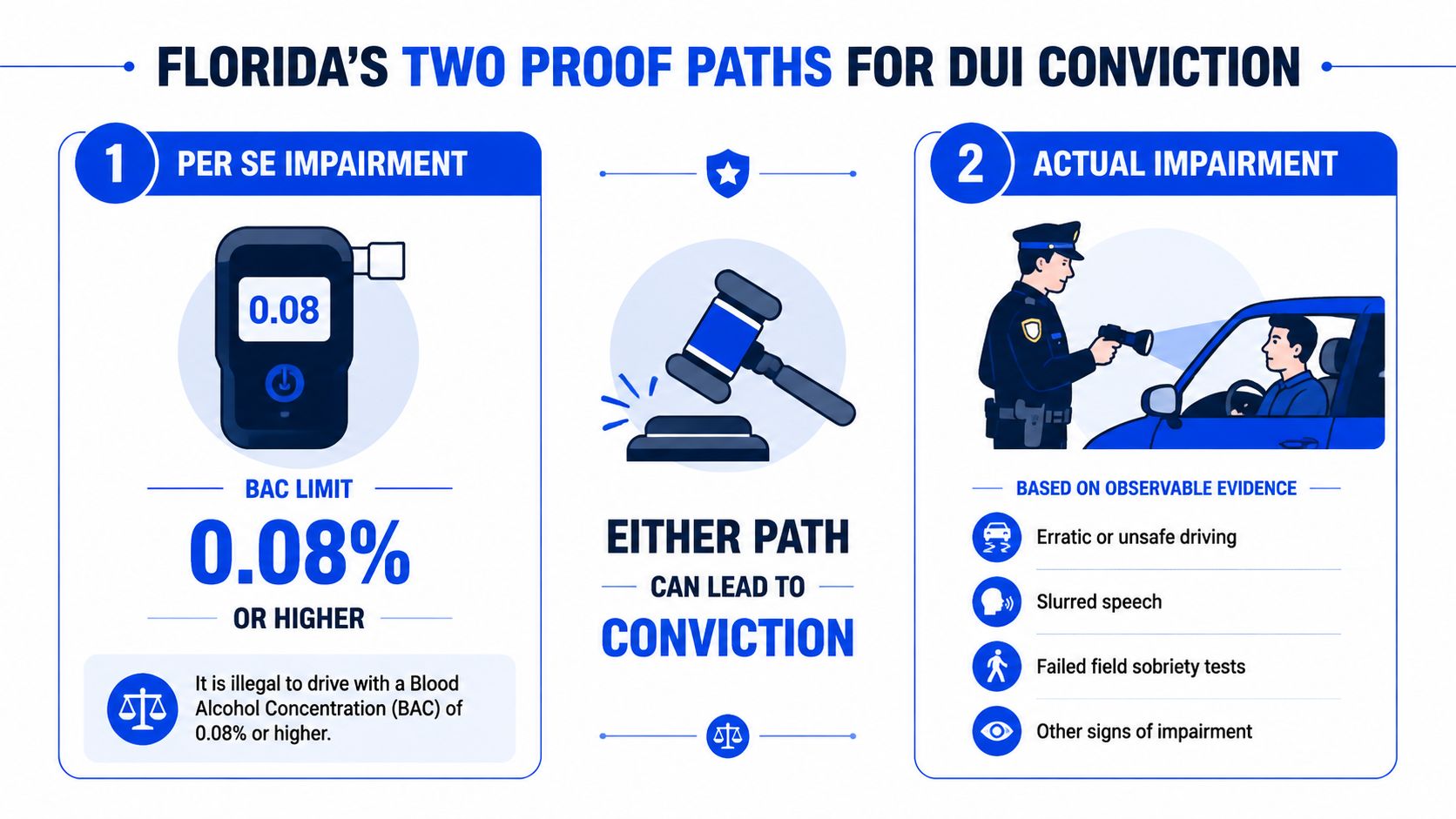
What the State may use
In an actual-impairment case, the prosecutor may present the officer's account of:
Driving conduct: Swerving, drifting, delayed braking, unusual turns, or other behavior the officer characterizes as unsafe.
Physical presentation: Bloodshot eyes, slurred speech, poor coordination, or an odor of alcohol.
Statements: Comments about drinking, where the driver was coming from, or how much the driver consumed.
Field sobriety performance: Difficulty with the walk-and-turn, one-leg stand, or horizontal gaze nystagmus exercise.
Video evidence: Dashcam or bodycam footage that captures the driving, conversation, testing, and arrest.
Consider a driver who produces a reported 0.06 result but struggles during the walk-and-turn exercise. That result doesn't establish per se impairment under the adult threshold, yet the State may argue that the exercise, speech, driving, and officer observations prove actual impairment. A driver who refuses testing may also face a case built around alleged swerving, statements, and field observations.
The defense doesn't count the clues. It tests whether each observation is reliable and whether the combined evidence proves impairment beyond a reasonable doubt. A Florida field sobriety test review can help explain why administration, conditions, and interpretation matter.
Why video can change the analysis
Reports summarize events. Video may show the pauses, instructions, lighting, traffic, footwear, road surface, and the driver's actual responses. It can also reveal whether an officer described a behavior more dramatically than the recording supports.
A careful defense review compares the report, dispatch recordings, bodycam, dashcam, breath-test records, and witness accounts. The goal isn't to dismiss every observation automatically. It's to determine whether the evidence proves impairment or merely reflects fatigue, anxiety, illness, an uneven surface, or ordinary mistakes during a stressful encounter.
Different BAC Thresholds for Different Drivers
Florida doesn't apply one alcohol benchmark to every person behind the wheel. The adult rule, commercial-driver standard, and under-21 administrative rule reflect different legal responsibilities. The table below summarizes the categories without suggesting that any threshold makes drinking and driving safe.
Florida BAC limits by driver category
Driver Category | BAC Limit | Key Consequences |
|---|---|---|
Adult non-commercial driver | 0.08 | A qualifying result can serve as prima facie evidence of impairment under the adult DUI statute. |
Commercial driver | 0.04 | A lower commercial-driver standard can create serious licensing and employment consequences, depending on the vehicle and circumstances. |
Driver under 21 | 0.02 | A violation can trigger administrative enforcement distinct from the ordinary adult DUI rule. Florida guidance states that an under-21 driver at or above 0.02 faces an immediate six-month license suspension for a first offense. |
The 0.04 commercial-driver threshold deserves special attention. Commercial drivers carry professional responsibilities that make a lower standard especially consequential. A CDL holder shouldn't assume the issue is minor because the reported level is below the ordinary adult threshold, or because the driver believes the rule applies only to a personal vehicle or only during working hours. The exact statutory and licensing consequences depend on the facts, the vehicle, and the proceeding.
The under-21 rule is also not merely a softer version of adult DUI law. Florida Statute 322.2616 creates a separate violation for driving or being in actual physical control of a vehicle at 0.02 or higher, despite the ordinary adult DUI framework in chapter 316. Parents and young drivers should understand that an administrative suspension may occur even when the evidence doesn't support an adult per se DUI charge.
The category of driver matters before anyone interprets the test result. A CDL holder, an under-21 driver, and an adult non-commercial driver may face different legal consequences from similar readings.
What Happens During a DUI Traffic Stop
When police lights appear behind you, the investigation starts immediately. The officer may listen to your speech, watch your eyes and movements, note an odor of alcohol, and record how you locate your license and insurance. Those observations can later appear in a report or testimony.
The officer may ask you to perform field sobriety exercises, including horizontal gaze nystagmus, the walk-and-turn, or the one-leg stand. These exercises are generally voluntary in Florida, although officers don't always make that clear. You can remain calm and respectful while asking whether an exercise is required and avoiding unnecessary explanations about what or how much you drank.
Roadside screening and evidentiary testing
A portable roadside breath device and a station-based evidentiary breath test don't serve the same purpose. A roadside device may help an officer decide what to do next, while the evidentiary test is handled under formal procedures and becomes a central piece of the State's evidence. The specific device, operator, records, timing, and procedure all matter.
You must provide your license, registration, and proof of insurance when requested. Beyond those basic requirements, you have a right not to answer investigative questions such as how many drinks you had or whether you believe you are impaired. A polite statement that you want to remain silent and speak with a lawyer is different from arguing with the officer or volunteering an account that may later be used against you.
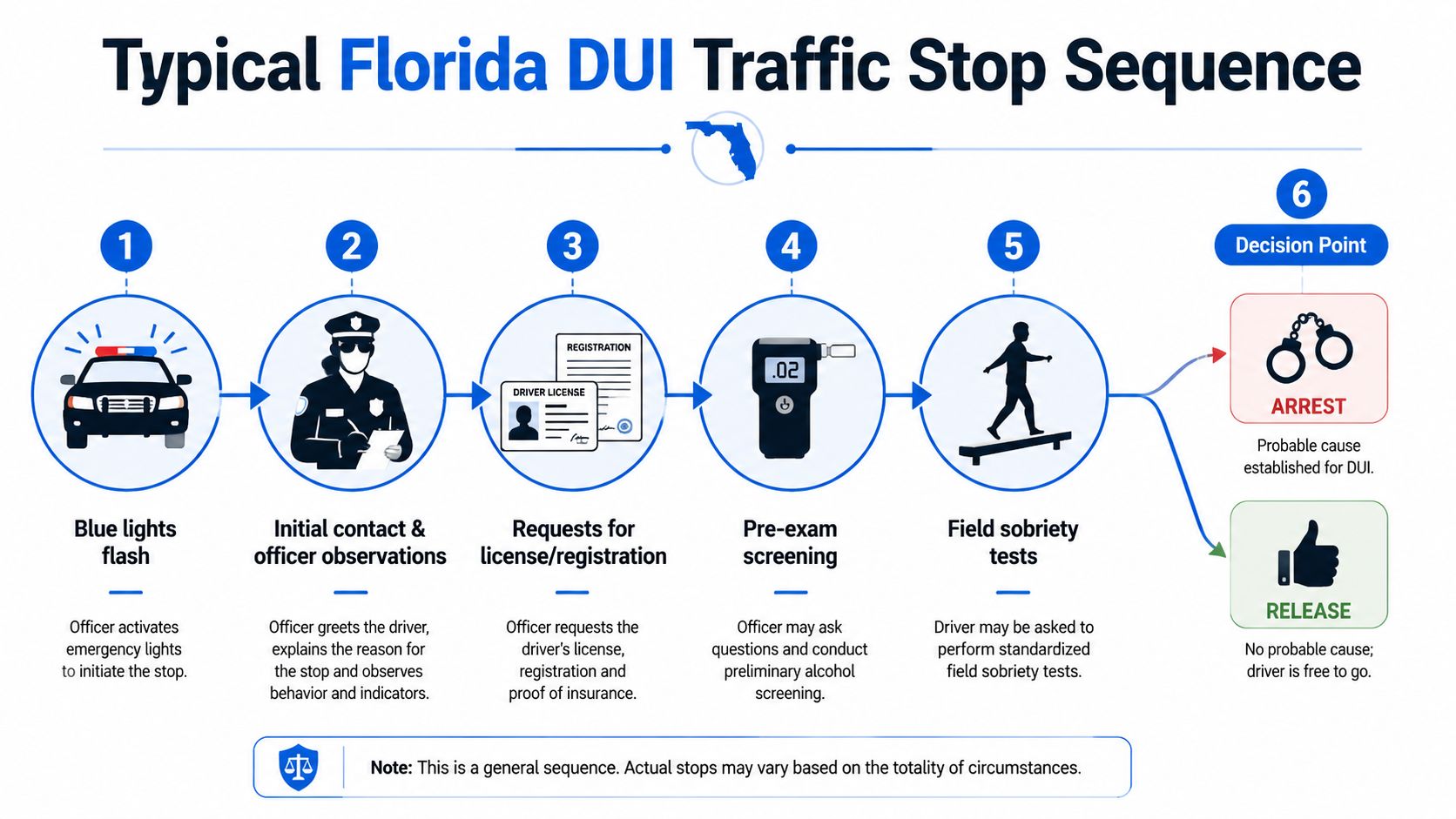
The probable cause issues in a Florida traffic stop can affect whether evidence gathered after the stop should be admitted. Implied consent generally becomes relevant after a lawful arrest and a request for chemical testing, not as a blanket requirement to answer every question during the initial investigation.
A calm approach works better than hostility. Give required documents, avoid physical resistance, don't debate the officer's conclusions, and clearly invoke your right to remain silent. Don't consent to searches without understanding that consent is voluntary, and don't assume silence makes you look guilty.
Administrative License Suspension and the 10-Day Rule
A DUI arrest can create two separate cases in practical terms. The criminal prosecution takes place in Florida court. The administrative license suspension is handled by the Florida Department of Highway Safety and Motor Vehicles, or DHSMV. Winning one proceeding doesn't automatically decide the other.
Under Florida administrative suspension rules, a license may be suspended after an arrest involving a qualifying alcohol test or a refusal to submit to testing. The citation can function as a temporary permit for 10 days, which makes the deadline unusually important. A driver generally must request a formal or informal review within that period to challenge the suspension.
The deadline comes first
Missing the review deadline can forfeit the opportunity to contest the administrative action. A lawyer can request the appropriate hearing, obtain available records, and identify problems involving the stop, arrest, testing, warnings, or documentation. The administrative hearing is not the criminal trial, but it can affect whether driving privileges remain available while the criminal case continues.
Florida guidance describes a six-month suspension for a first qualifying BAC failure and a 12-month suspension for a first refusal, with longer consequences for later events. These periods and scenarios should be evaluated against the driver's history and the specific suspension notice, rather than assumed from a general internet summary.
Scenario | First Offense | Second Offense | Third+ Offense |
|---|---|---|---|
Qualifying BAC suspension | Six-month suspension described in Florida administrative guidance | Consequences increase based on the driver's record and circumstances | Later events can create longer or more severe consequences |
Refusal suspension | Twelve-month first-refusal suspension described in Florida administrative guidance | Consequences increase for later refusals | Later refusals can create extended administrative exposure |
A hardship license may be available in some circumstances after the applicable hard-suspension period, but eligibility requirements apply and DUI school may be required. The Florida administrative license suspension process should be addressed immediately, not after the criminal arraignment.
Common Defenses Against DUI Charges in Florida
An arrest doesn't establish that every investigative step was lawful or reliable. A Florida DUI defense examines the State's evidence from the first claimed reason for the stop through the final chemical-test record.
Stop and arrest challenges
The officer must have a lawful basis for the traffic stop. If the stop lacked reasonable suspicion or another legal justification, a defense lawyer may seek suppression of evidence gathered afterward. The same close review applies to the transition from a traffic investigation to detention and arrest. The State must be able to explain why each escalation occurred.
Field sobriety exercises also require context. Uneven pavement, poor lighting, traffic, weather, footwear, disability, injury, fatigue, and nervousness can affect performance. The defense can compare the officer's instructions and scoring with the bodycam recording and the actual conditions at the scene.
Chemical and procedural issues
Breath-test results can be challenged through records involving calibration, maintenance, operator compliance, observation procedures, mouth alcohol contamination, and possible radio-frequency interference. The required observation period and the timing between driving, testing, and arrest may affect how much weight the result deserves.
A blood test raises different questions, including collection, storage, handling, laboratory work, chain of custody, and the availability of independent retesting. A rising-BAC defense may also matter where the evidence supports the argument that the alcohol concentration was lower while driving than when the later test occurred.
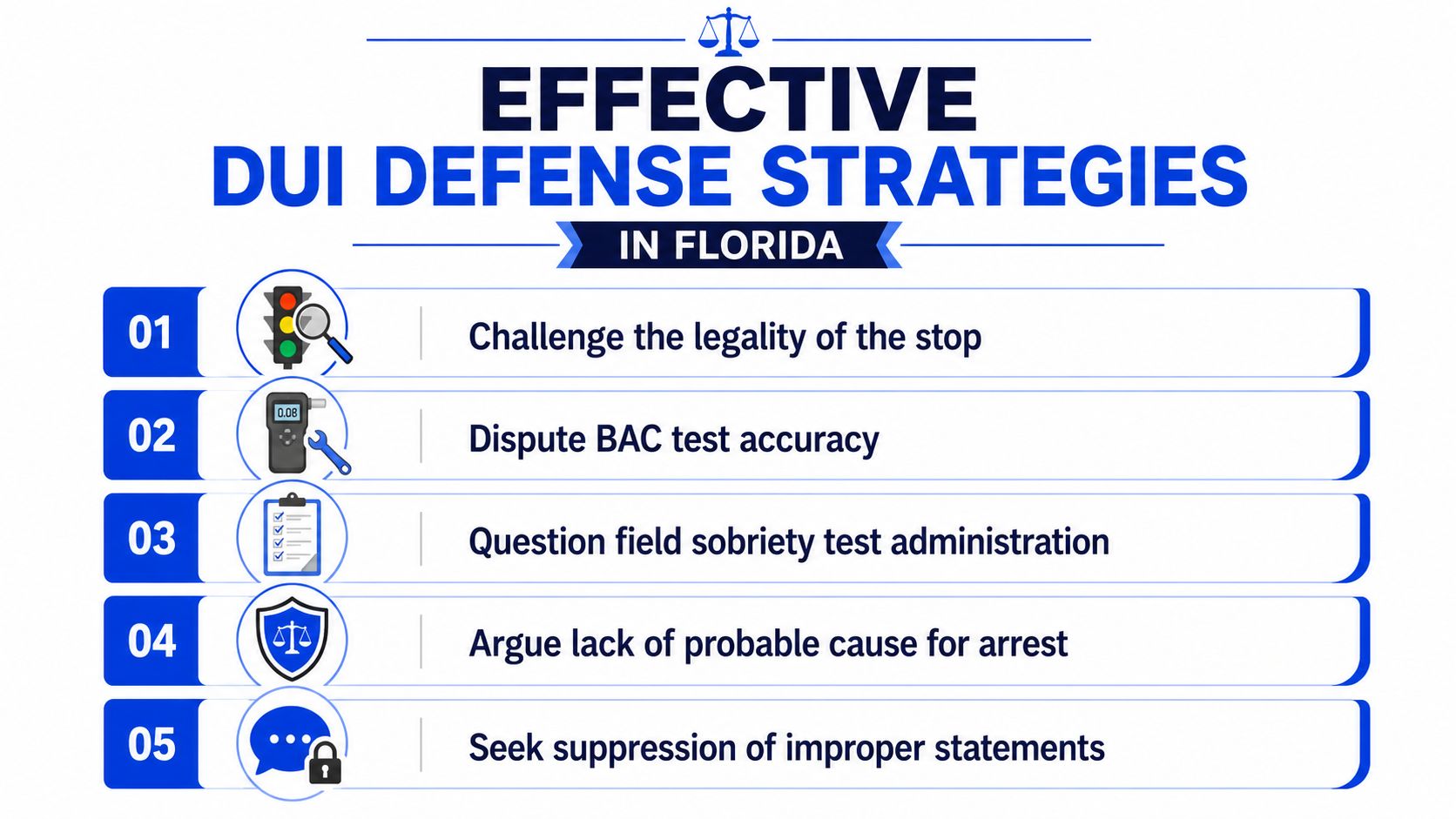
Statements and warnings require review as well. Miranda issues, defective implied-consent warnings, and failures to follow required procedures may support motions to exclude evidence. The Florida DUI defense process depends on the actual records, not a promise that one defense will work in every case.
A strong defense doesn't ask only, “What was the BAC?” It asks, “How did the State obtain it, what did the officer observe, and can the evidence prove impairment lawfully and reliably?”
Protecting Your Rights After a DUI Arrest
Treat the first days after a Florida DUI arrest as a period for action, not speculation. Preserve paperwork, identify the arresting agency, save any available dashcam or surveillance information, and avoid discussing the facts with friends or posting about them online.
Your immediate priorities are practical:
Protect your words: Use your right to remain silent beyond providing required identification and vehicle documents.
Address the license: Contact DHSMV or counsel promptly about the administrative review deadline.
Preserve evidence: Keep the citation, suspension notice, receipts, medical records, photographs, and contact information for witnesses.
Get the recording: Ask counsel to pursue bodycam, dashcam, dispatch, station, and breath-test materials.
Prepare for court: Expect stages such as first appearance, arraignment, pretrial motions, negotiations, and, when necessary, trial.
An arrest is not a conviction. Early representation can preserve evidence, challenge an unlawful stop, test the chemical result, address the license separately, and pursue an outcome that protects your freedom, driving privileges, and reputation. These concerns apply whether you need a Fort Lauderdale DUI lawyer, a Broward County criminal defense attorney, or counsel elsewhere in South Florida.
Ticket Shield, PLLC helps Florida clients address both the criminal DUI case and the separate administrative license consequences, including urgent DHSMV deadlines and evidence review. Visit Ticket Shield, PLLC for a confidential consultation about your arrest, suspension notice, and next steps.