
Under 21 BAC in Florida: Zero Tolerance Explained
Jason Goldsmith, Esq
A parent gets a late-night call. Their son or daughter was stopped in Fort Lauderdale, blew into a machine, and now everyone is asking the same questions. Was it really illegal after just one drink? Is this a DUI? Is the license already gone?
Those questions are fair. Under 21 BAC cases in Florida move fast, and the biggest mistake I see is treating the whole thing like one problem. It usually isn't. A young driver can be dealing with an immediate license issue on one track and a separate court case on another.
That distinction matters in Broward County, Miami-Dade, Palm Beach, and across South Florida. If you understand which fight is administrative and which fight is criminal, you can make smarter decisions early, protect important deadlines, and avoid giving up defenses that may still be available.
Table of Contents
A Single Drink and a Traffic Stop Can Change Everything
A common under 21 BAC case starts with a very ordinary decision. A young driver leaves dinner, a party, or a friend's house in Broward County after having what felt like a small amount to drink. They don't feel drunk. They aren't slurring. They think they're fine to drive.
Then the lights come on.
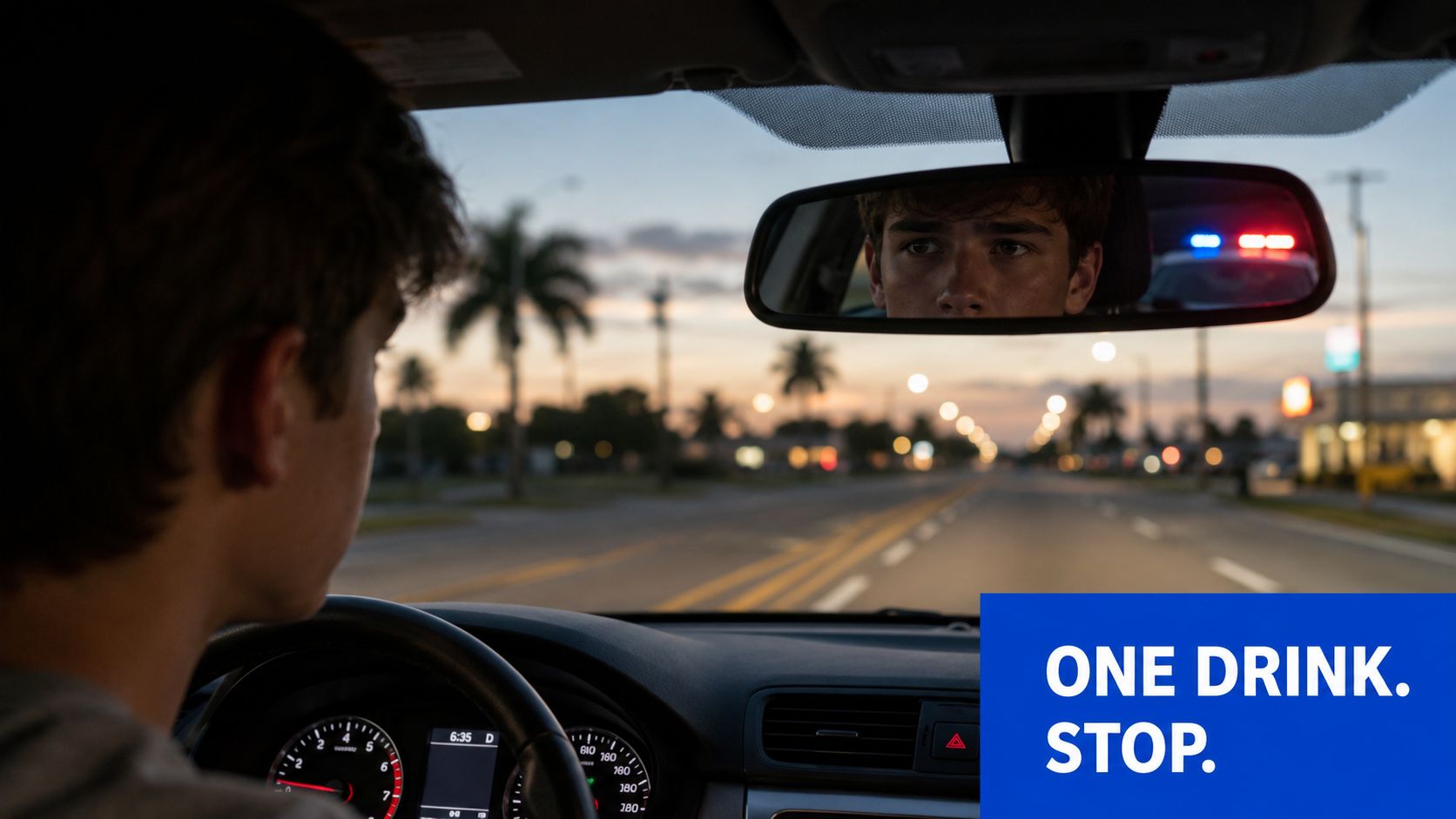
That moment gets stressful fast. The officer smells alcohol, asks a few questions, and requests field exercises or a breath test. For families, the panic usually starts before anyone understands what the actual allegation is. Many people assume a young driver has to be obviously intoxicated to be in real legal trouble. Florida law doesn't work that way.
The modern under-21 BAC standard comes from a nationwide zero-tolerance approach. By 1988, all 50 states and the District of Columbia had adopted laws setting a BAC limit of 0.02% or lower for drivers under 21, and the public-health review summarized by Teen Driver Source's discussion of impaired driving laws found that youth-specific BAC laws were associated with substantial reductions in alcohol-related fatal crashes involving young drivers.
What makes these cases feel so confusing
Parents often want one answer to one question: "How bad is this?"
The honest answer is that it depends on which part of the case you're asking about. A stop involving alcohol and a driver under 21 can affect:
Driving privileges: The State can move quickly against a license.
A criminal accusation: Prosecutors may pursue a separate court case.
School, work, and insurance issues: Even before the case is fully resolved, the practical fallout can start.
Practical rule: If your child is under 21, "I only had one drink" is not a defense by itself.
In South Florida courts, these cases are manageable when the response is immediate and organized. The first priority is to identify deadlines, preserve evidence, and stop the young driver from making admissions that lock in the State's version of events.
Florida's 0.02 BAC Limit The Zero Tolerance Rule Explained
Florida uses a zero tolerance framework for underage drivers. In plain English, if you're under 21 and your alcohol level reaches 0.02%, you can face consequences even if you never looked or acted "drunk" in the ordinary sense.
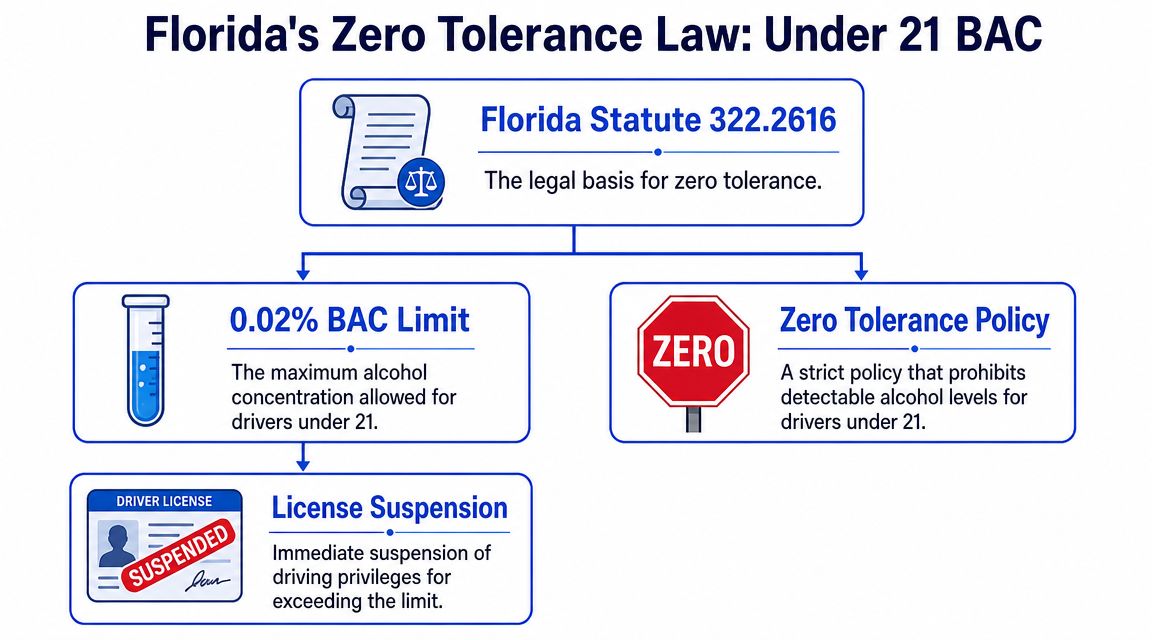
That low threshold is why under 21 BAC cases catch families off guard. The law isn't waiting for the same level usually associated with an adult DUI case. It's designed to intervene earlier.
For drivers under 21, this is part of a national pattern. According to NHTSA's Countermeasures That Work chapter on youth BAC laws, all states have BAC limits of 0.02 g/dL or lower for drivers under 21, and the guidance notes that a single drink can trigger a violation well before a driver appears obviously intoxicated. If you're trying to understand how Florida treats alcohol-related driving allegations more broadly, this overview of Florida DUI crimes gives useful background.
What 0.02 means in real life
The legal problem with under 21 BAC isn't that a young driver must be falling-down impaired. The problem is that the threshold is so low that "feeling sober" doesn't settle anything.
A person can believe they are fine and still test over the youth limit. Body size, food intake, timing, and how quickly alcohol was consumed all matter. So does the delay between driving and testing.
Here is the practical takeaway:
Subjective confidence doesn't control the case: "I felt okay" won't defeat a reading.
Small amounts matter: Low-level alcohol can still trigger action.
Timing matters: What was consumed, and when, often becomes a key defense issue.
Why the law is stricter for young drivers
The policy choice is deterrence. Lawmakers set a much lower threshold for younger drivers to reduce risk before BAC approaches the adult per se standard.
That doesn't mean every under-21 stop is automatically unwinnable. It means you need to evaluate the exact reading, the officer's observations, the timing of the stop, and whether the State is pursuing only a zero-tolerance license action or trying to build a criminal DUI case as well.
Most clients come in asking, "Was I over the limit?" The more important question is often, "Which limit matters for the charge or suspension I'm facing?"
Administrative License Suspension vs Criminal DUI Charges
This is the part most websites blur together. They shouldn't.
An under 21 BAC case in Florida can split into two separate legal fights. One involves your ability to drive. The other involves whether the State can prove a criminal offense in court.
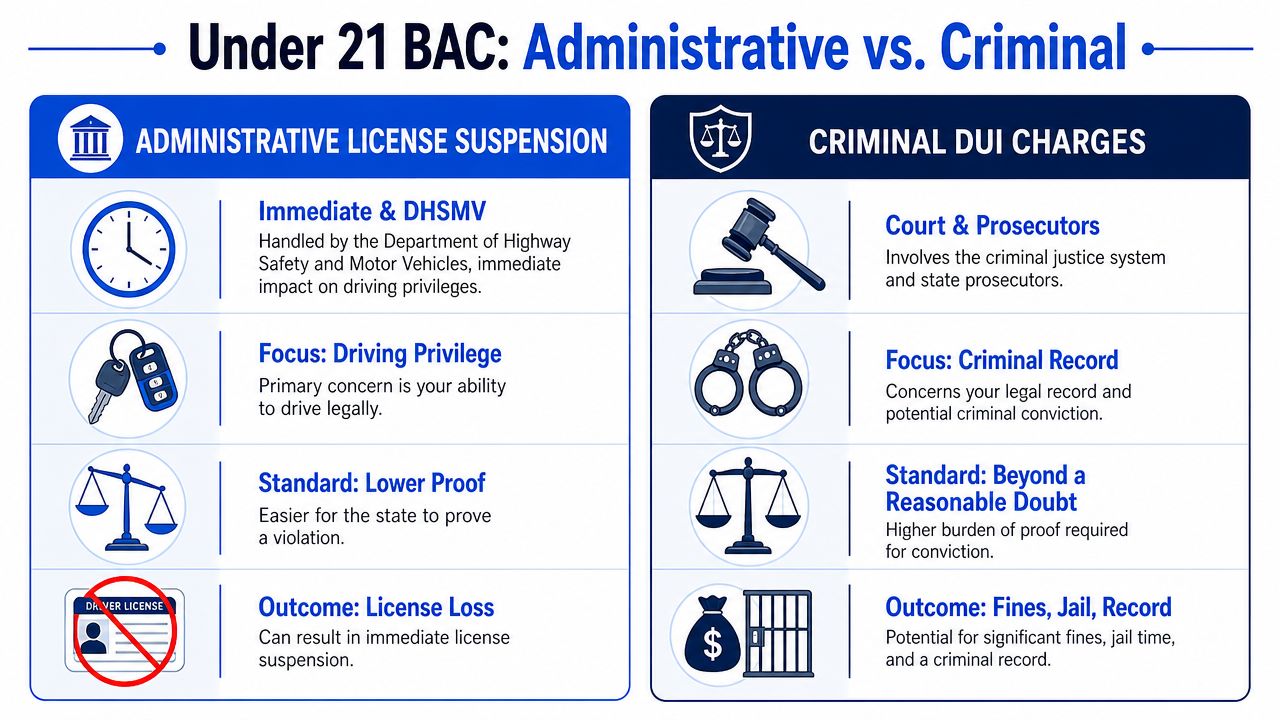
A good visual explanation helps, but the key point is simple. These tracks don't rise and fall together.
The license case starts first
The administrative side is usually the first thing people feel. A young driver may suddenly be unable to drive to school, work, practice, or treatment. That's why families often call a defense lawyer before they even know whether formal criminal charges will follow.
Other states show the same split between licensing consequences and court consequences. Massachusetts, for example, explains that an under-21 driver who fails or refuses a breath test can face a Youth Alcohol Program suspension or revocation and mandatory program completion through the RMV, separate from how any criminal matter is handled, as outlined in Massachusetts guidance on alcohol and drug suspensions for under 21 years of age.
In Florida practice, that means you should treat the license problem as urgent and independent. If your license is suspended, don't assume the criminal lawyer can "fix it later" just by winning in court. Sometimes that happens. Often it doesn't.
For many drivers, the immediate practical issue is getting lawful driving privileges restored as soon as possible. This guide on how to reinstate a suspended license is often a useful companion piece after the initial arrest.
A short explanation of the two-track problem appears below.
The criminal case is separate
A criminal DUI case moves through the court system. In Broward County, Miami-Dade, Palm Beach, and elsewhere in South Florida, that means prosecutors, court dates, evidence review, motions, negotiation, and sometimes trial.
The State's burden is different there. The prosecution has to prove the criminal allegation under criminal rules of evidence and procedure. That's not the same thing as an agency deciding whether to suspend driving privileges.
A useful way to think about it is this:
Issue | Administrative track | Criminal track |
|---|---|---|
Main focus | Whether you keep driving privileges | Whether you face a conviction or other court outcome |
Decision maker | Licensing authority | Judge or jury in court |
Immediate concern | Suspension and reinstatement steps | Record, penalties, and case resolution |
Defense focus | Procedure, notice, hearing rights, legal basis for suspension | Stop, arrest, testing, observations, admissibility, proof |
Why this distinction changes defense strategy
Clients sometimes hear good news in one forum and assume the whole matter is over. That's a mistake. You can get traction in the criminal case and still have a license issue to solve. The reverse is also true.
Winning the court case doesn't automatically erase every licensing consequence. Losing the license hearing doesn't automatically decide the criminal case.
That is why defense work in under 21 BAC cases has to be coordinated. The timeline matters. Statements made early can affect both tracks. So can decisions about hearings, documents, and how the facts are framed from the start.
How Police Measure BAC and When You Can Refuse
In Florida, officers usually build an alcohol-related driving case with a combination of observations and testing. In a typical stop, they may describe driving pattern, odor of alcohol, speech, eyes, admissions, field sobriety exercises, and a later chemical test.
How BAC is usually measured
For many drivers, the best-known tool is a breath-testing device. In Florida DUI practice, lawyers often scrutinize machines such as the Intoxilyzer 8000, the observation period before testing, the sequence of events, and whether the test administration matched required procedure.
Breath isn't the only type of evidence. Depending on the facts, law enforcement may also seek blood or urine testing. Which test was requested, when it was requested, and why it was chosen can all matter later.
One point that often gets missed is that underage alcohol laws are not perfectly uniform from state to state. As summarized by this discussion of DUI under 21 and state charging differences, a young driver with a BAC above 0.02% may face an underage alcohol-related charge, while a BAC at the adult 0.08% level may expose the person to a standard adult DUI charge. The exact charging path depends on state law and the facts of the stop.
Refusal decisions have consequences
Drivers also ask whether they can refuse testing. The actual answer is that refusal is a legal decision with consequences, not a free reset button.
Refusal may limit one type of evidence, but it can create a different problem. In Florida, implied consent rules can trigger separate administrative consequences when a lawful test is refused. For an under-21 driver already facing a license threat, that can make a bad situation worse.
Here is what usually works better than guessing at roadside decisions after the fact:
Get the documents immediately: Citation, suspension notice, and any temporary driving paperwork.
Write down the timeline: When drinking started, when it stopped, when the stop happened, and when testing occurred.
Preserve witness information: Friends, receipts, rideshare records, and messages can matter.
Review refusal issues with counsel early: Refusal cases often turn on whether the request was lawful and how officers explained the consequences.
If you're dealing with a refusal allegation, this page on refusal to submit to a breath test in Florida explains the issue in more detail.
Common Defenses Against Under 21 BAC Charges in Florida
An under 21 BAC arrest is not the same thing as a proven case. The most effective defense starts with one question. What exactly is the State relying on?
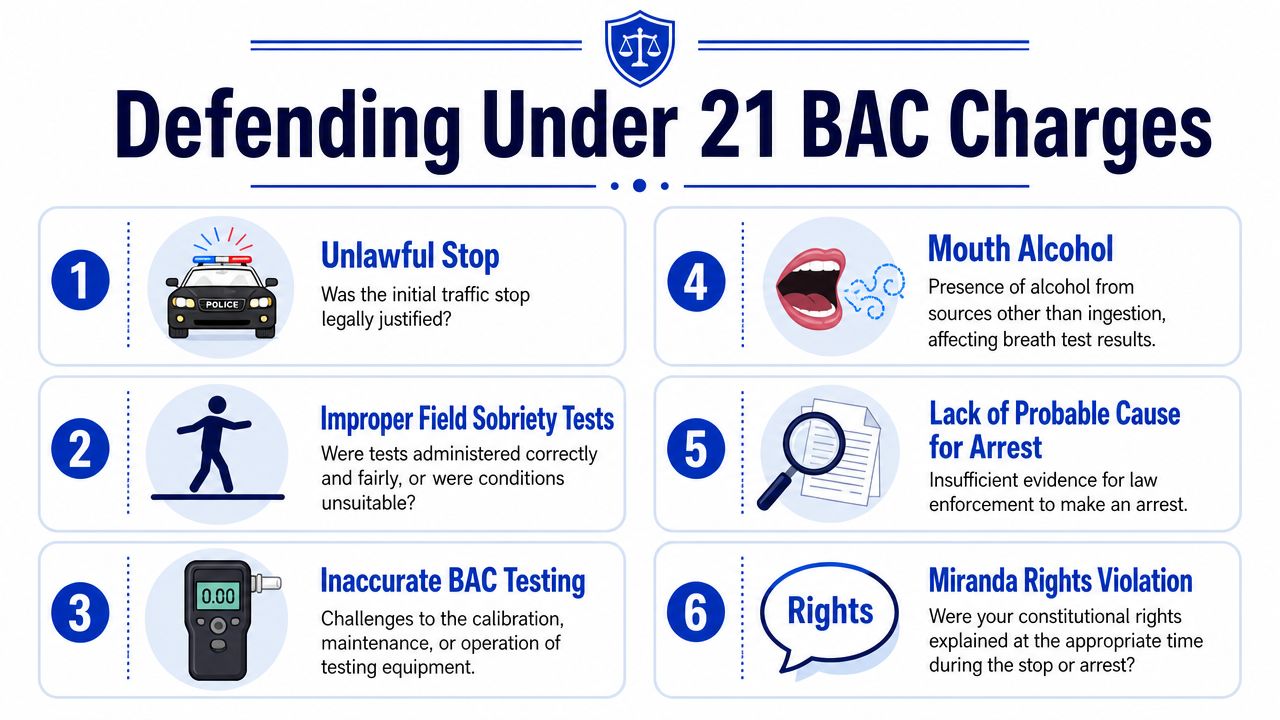
In many files, the answer is a mix of subjective observations and a low chemical reading. That combination leaves room to challenge both the facts and the procedure.
Michigan's official impaired-driving guidance makes a point that applies broadly in practice: officers may act based on observed impairment at any BAC level, and chemical testing is only one piece of evidence. That is why defense work often focuses on the officer's observations, the drinking timeline, and testing procedure, as reflected in Michigan's impaired driving law guidance.
The stop and arrest can be challenged
Not every traffic stop is lawful. If the officer lacked a valid reason to stop the vehicle, the defense may have grounds to attack everything that followed.
Common issues include:
Weak reason for the stop: A vague hunch is not enough.
Poorly documented driving behavior: Reports sometimes use conclusions without facts.
Thin probable cause for arrest: Smell of alcohol alone doesn't always answer the full legal question.
Body camera footage, dash video, dispatch records, and the report language are key factors. In South Florida cases, the video often tells a cleaner story than the narrative summary in the arrest paperwork.
The chemical evidence is not automatic
Low-BAC cases are often won or improved by careful technical review, not dramatic courtroom moments.
A defense lawyer may examine:
Machine maintenance and calibration: Was the instrument properly maintained?
Observation period problems: Was the driver monitored correctly before the breath sample?
Mouth alcohol issues: Recent consumption, vomiting, or contamination can affect results.
Timing problems: The BAC at test time may not cleanly prove the BAC at driving time.
Defense insight: A number on a printout looks powerful, but numbers still depend on procedure.
That is especially true in youth cases, where the legal threshold is so low that small procedural flaws can become important.
Low BAC cases often turn on details
Some underage cases involve a reading near the youth threshold with little evidence of actual bad driving. Others involve a reading high enough that prosecutors consider standard DUI treatment. Those are very different files, and they shouldn't be defended the same way.
What usually does not work:
Minimizing the stop without reviewing evidence
Assuming a low reading makes the case harmless
Waiting too long to address the license issue
Talking freely to police or school officials without legal advice
What often does help:
Fast evidence collection
Early review of video and test records
A strategy that treats the administrative and criminal tracks separately
A realistic assessment of whether to challenge, negotiate, or seek a reduced outcome
In practice, firms like Ticket Shield, PLLC may defend these cases by reviewing the stop, the testing process, and the separate licensing consequences rather than treating the arrest as one single issue.
Your Next Steps How a Broward County DUI Lawyer Can Help
If you're dealing with an under 21 BAC stop in Fort Lauderdale, Broward County, Miami-Dade, or Palm Beach, the next few days matter more than is widely understood. Waiting usually makes both tracks harder.
Start with the basics. Keep every paper the officer gave you. Write out the timeline while it's still fresh. Do not post about the incident. Do not assume a low reading means there's no real case.
Then get legal advice quickly, especially if your driving privileges are at risk. A Florida DUI lawyer should look at the license issue and the criminal exposure at the same time, but not as if they are the same proceeding. That includes checking deadlines, evaluating the stop, preserving hearing options, and reviewing whether the evidence supports impairment, a zero-tolerance violation, or both.
A focused response usually includes:
Protecting the license first: Missed deadlines can close off options.
Controlling statements and evidence: Early admissions can hurt.
Reviewing the charging path: Some cases are mainly administrative. Others carry broader criminal risk.
Planning locally: Court practice in Broward, Fort Lauderdale, and surrounding South Florida counties matters.
If you need a starting point for the broader process, this Florida DUI defense hub gives a practical overview of what to expect.
A young driver's mistake doesn't have to define the rest of their future. But it does need a prompt, disciplined response.
If you or your child is facing an under 21 BAC issue in South Florida, Ticket Shield, PLLC can help you evaluate both the immediate license threat and the separate criminal case. A confidential consultation can clarify what happened, what deadlines apply, and what defense strategy makes sense in Broward County, Fort Lauderdale, Miami-Dade, Palm Beach, and beyond.
Florida's zero tolerance law means drivers under 21 face penalties at just 0.02% BAC. Here's what young drivers and parents need to know.