
How to Fight DUI in Florida: Your Strategic Guide
Jason Goldsmith, Esq
The hours after a Florida DUI arrest are usually a blur. You're released, your paperwork is in your hand, your car situation may still be unresolved, and your mind jumps straight to the worst-case scenario. Am I going to jail? Am I losing my license? Do I just plead and get this over with?
Slow down. A DUI arrest is serious, but it is not the same as a conviction. In Broward County, Fort Lauderdale, Miami-Dade, Palm Beach, and throughout South Florida, the people who do best are usually the ones who act early, protect evidence, and avoid making fast decisions based on panic.
There's another point many people miss when they start searching for how to fight DUI charges in Florida. You are usually dealing with two separate problems at once. One is the criminal case in court. The other is the fight over your driver's license. Those two tracks move on different timelines, and the license issue can become urgent almost immediately.
That urgency exists for a reason. Drunk-driving enforcement is treated as a major public-safety issue. National Highway Traffic Safety Administration data states that drunk-driving crashes kill about 32 people every day, and NHTSA reported 11,904 deaths in 2024 on its drunk driving safety page. In practice, that means DUI law in Florida is highly technical. The stop, the arrest decision, and the testing process often matter as much as the allegation itself.
If you're looking for a broader overview of Florida DUI defense, the firm's Florida DUI defense hub is a useful starting point. But the immediate priority is understanding what has to happen now, not months from now.
Table of Contents
Your Guide to Navigating a Florida DUI Charge
You get out of jail, look at the paperwork on the passenger seat, and assume the case will be decided later in court. In Florida, that assumption can cost you driving privileges before the criminal case even gets traction.
A DUI arrest usually creates two fights at once. One is the criminal case, where the State tries to prove impairment or an unlawful breath or blood alcohol level. The other is the separate fight over your driver's license. Clients often focus on the court date and miss the fact that early decisions can affect both tracks.
That is why a Florida DUI defense starts with timing, paperwork, and evidence preservation. For a broader look at how these cases are handled from the license issue through trial strategy, see our Florida DUI defense guide.
Two cases start at the same time
The court case determines criminal penalties, a possible conviction, and what ends up on your record.
The license case moves on a different track. It is administrative, it starts fast, and it can put pressure on every later decision if you let deadlines pass. I have seen people come in ready to talk about trial defenses when the immediate problem was getting lawful driving back in place so they could keep working.
Practical rule: After a Florida DUI arrest, the first days matter because missed deadlines limit options.
Early action creates options
Strong DUI defenses are often built on procedure. The stop may have lacked legal justification. The arrest decision may have been rushed. The field sobriety exercises may have been poorly instructed or affected by weather, shoes, age, injury, or roadside conditions. The breath test may raise maintenance, observation-period, or operator issues.
The larger point is simple. Cases are won and improved by close review, not by assumptions.
The National Highway Traffic Safety Administration has published the standardized field sobriety testing materials officers rely on, and those manuals show how specific the administration standards are. If the officer departed from those standards, that can matter in negotiations and at trial, as reflected in NHTSA's SFST training resources.
A useful starting checklist includes:
Your paperwork: citation, notice of suspension, bond papers, and any court date notice
Your memory: where the stop happened, what the officer said, what you were asked to do, and anything that felt confusing or rushed
Potential records: dashcam footage, bodycam footage, dispatch records, 911 calls, breath test records, and agency videos
Practical concerns: work driving, school pickups, medical appointments, and any reason a license problem will create immediate pressure
Waiting until arraignment is a common mistake. By then, video can be harder to locate, details are less clear, and the license issue may already be in a worse position than it needed to be.
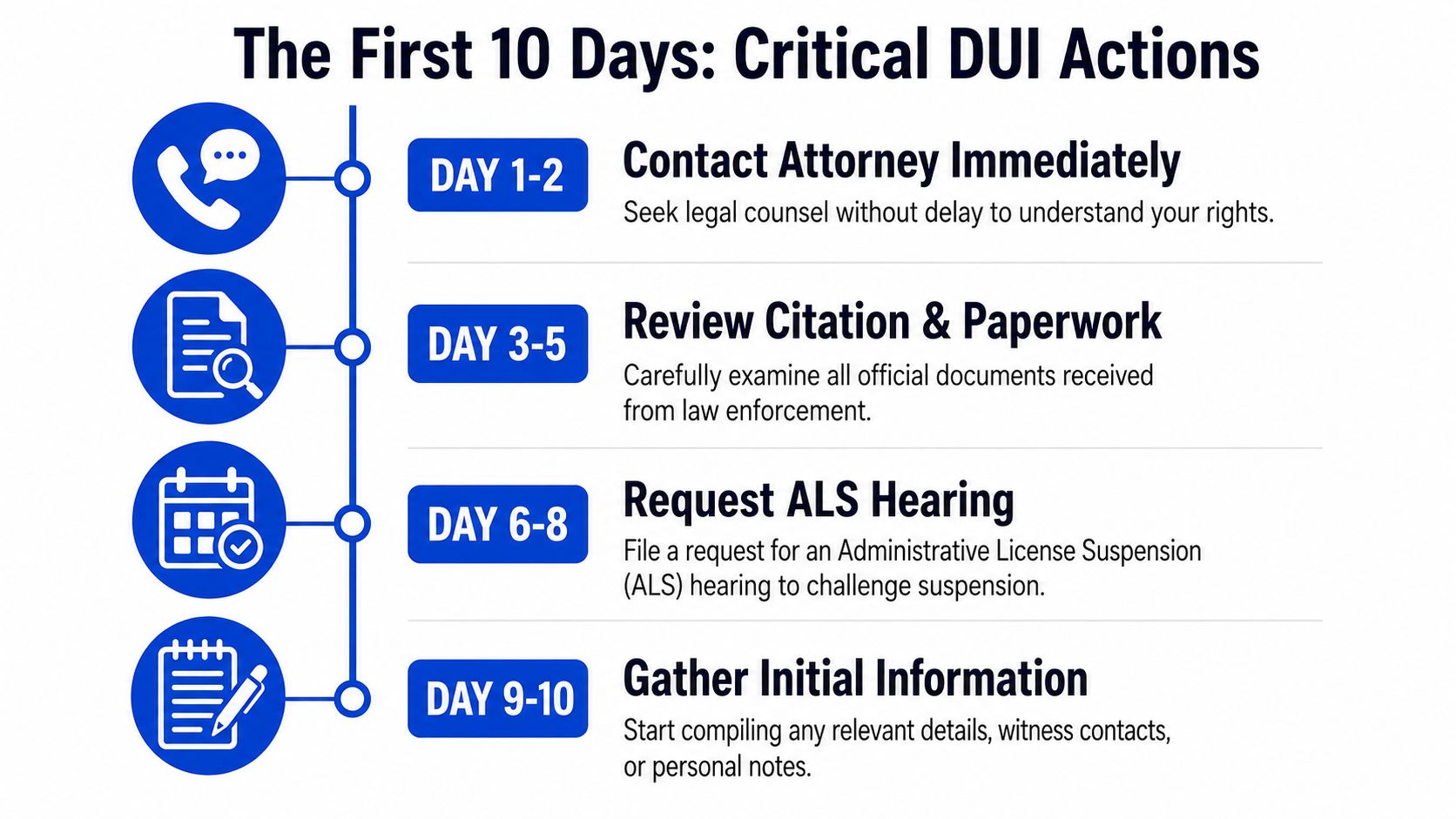
The First 10 Days Your Most Critical Window
The most urgent part of how to fight DUI charges in Florida usually has nothing to do with a courtroom. It's the license issue.
In Florida, a DUI arrest can trigger an immediate license suspension, and failing to request a formal review hearing within the first 10 to 14 days can result in an automatic suspension, according to this Florida-focused discussion of the DUI license deadline. In practical terms, that means a person can lose a key chance to challenge the State's initial evidence while the criminal case is still developing.
Why the license case moves faster
The court case and the DHSMV process are separate. That distinction matters.
A criminal judge decides the criminal case. The license action is administrative. If you miss the window to act, you may still be able to fight the criminal charge, but you've made the driving issue harder than it needed to be.
Clients are often surprised by how often this gets overlooked. Friends talk about court. Online articles talk about field sobriety tests. But if your job, family obligations, or medical needs depend on driving, the first deadline is often the one that affects your life fastest.
What to do before the deadline expires
Act with a simple priority list.
Get the documents together. Keep your citation, any notice of suspension, bond paperwork, and court date documents in one place.
Confirm the arrest date immediately. The deadline calculation starts there.
Speak with counsel before making assumptions. The hearing request is not just paperwork. It can affect strategy.
Treat the license issue as separate from the criminal case. Winning one doesn't automatically resolve the other.
This short video gives a practical overview of the urgency involved:
Missing the deadline doesn't mean the criminal case is over. It does mean you may lose a valuable chance to challenge the suspension early and preserve driving privileges.
If you're in Fort Lauderdale, Broward County, or anywhere in South Florida, don't wait for the first court date to start asking questions about your license. By then, the most important window may already be closed.
Preserving Evidence and Protecting Your Rights
A good DUI defense begins before the first substantive court hearing. It starts with preserving facts while they still exist.
A technically strong DUI defense requires immediate evidence preservation. Counsel should move within hours to secure body-cam video, dash-cam footage, breath-machine printouts, calibration and maintenance records, and the arrest report before routine retention windows expire, as explained in this practitioner article on building DUI defenses early. Waiting until the first court date can mean important evidence is gone.
What you should do right away
Your own memory is evidence too. Write everything down as soon as you can.
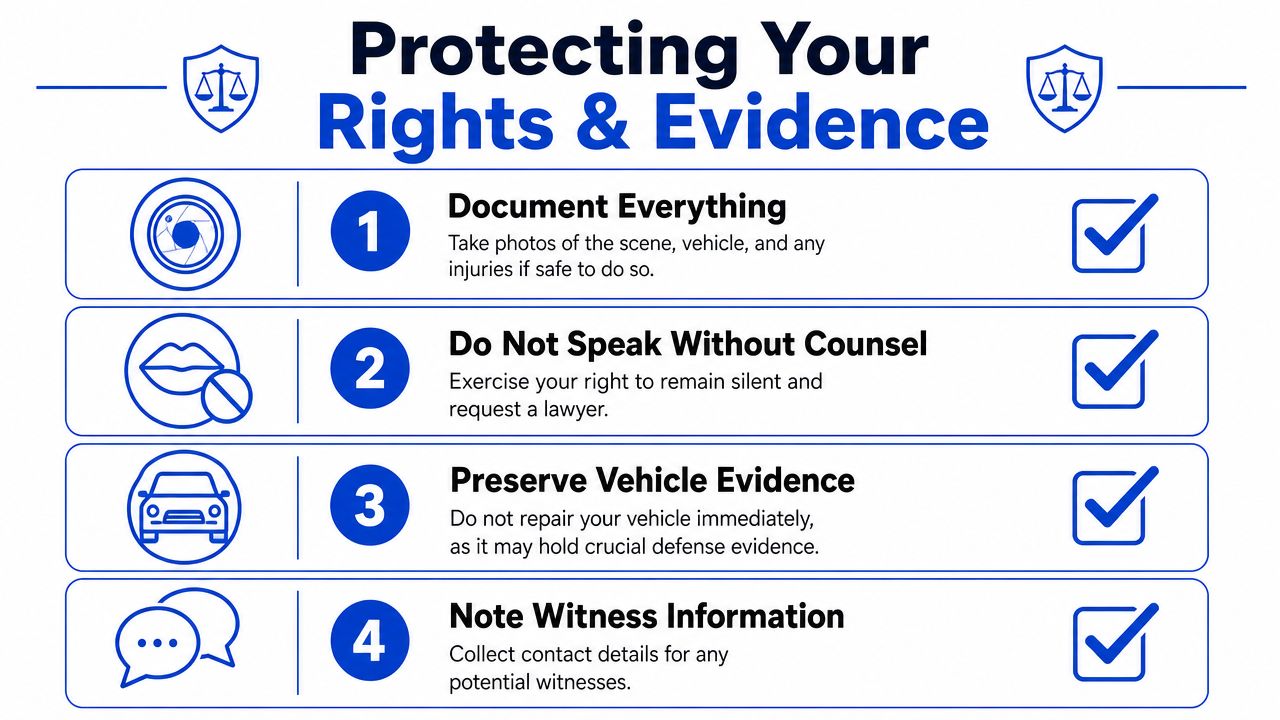
Useful details include:
Timeline details: where you were, what time you left, what you ate, what you drank, and when.
Officer contact: the first reason given for the stop, what questions were asked, and whether instructions were repeated or unclear.
Roadside conditions: weather, lighting, shoulder surface, footwear, traffic noise, and whether you had any physical issue affecting balance.
Testing details: whether you were observed continuously, how long you waited, and whether the officer's report matches your memory.
If your case involves a refusal allegation, Florida refusal issues carry their own strategic complications. This guide on refusal to submit to a breath test in Florida can help you understand that part of the case.
What to stop doing immediately
Some mistakes make a defensible case harder.
Stop posting online: don't discuss the arrest, your drinking, where you were, or what you think happened.
Stop texting detailed explanations: even messages to friends can become problems later.
Stop guessing about the facts: if you don't remember something, say that. Don't fill gaps with assumptions.
Stop treating the case casually: many damaging admissions happen after release, not during the stop.
Your lawyer can work around bad facts. It's much harder to work around new facts you create after the arrest.
The strongest early defense work is narrow and focused. It usually centers on a specific theory such as an illegal stop, unreliable testing, or whether the State can prove impairment at the time of driving.
Deconstructing the State's Case Against You
After a Florida DUI arrest, clients often focus on the breath number or what the officer wrote in the report. The better question is simpler. Can the State prove each step of the case with reliable evidence, and can your lawyer keep weak evidence out?
That matters in court and in license defense. The same facts that support a motion to suppress, a challenge to field sobriety exercises, or an attack on chemical testing often affect how the prosecutor values the case and how the hearing officer views the administrative suspension. This is one reason I treat the case as one connected fight from day one, not as separate problems.
The traffic stop
Every DUI case starts with the stop. If the officer did not have a valid legal basis to pull you over, the State can have a serious problem.
In practice, this is not about abstract law. It comes down to what the video shows, what dispatch recorded, and whether the officer's timeline makes sense. I have seen reports describe clear lane violations while the dashcam shows something much less definite. I have also seen officers stop a car based on a hunch, then write the report backward from the arrest.
Key issues include:
A report-video mismatch: the officer claims a traffic infraction or clear impairment, but the footage does not support it.
Weak driving facts: vague references to weaving, drifting, or “driving unusually” without specifics.
Sequence problems: the timestamps in dispatch, bodycam, and the report do not line up.
A bad stop can affect more than one part of the case. If the stop fails, the court case may weaken sharply, and the license suspension fight can improve with it.
Field sobriety exercises
Roadside exercises are subjective. Officers are trained to present them as standardized, but real-world conditions matter a great deal.
An anxious driver on the side of I-95 at night, in work boots, with traffic passing a few feet away, is not taking a laboratory test. The officer is watching, scoring, and interpreting at the same time. That gives the defense room to challenge both the setup and the conclusions.
One exercise that deserves close review is horizontal gaze nystagmus. This explanation of horizontal gaze nystagmus in Florida DUI cases covers why that test is often more technical than people expect.
When I review field sobriety exercises, I want answers to specific questions:
Were the instructions given correctly and completely?
Did the officer confirm the driver understood them?
Was the surface level, dry, and safe?
Did the officer ask about injuries, age, weight, footwear, or medical conditions?
Did the report describe actual observations, or just label the performance a failure?
That last point matters. “Failed the exercises” is only the officer's conclusion. Judges and juries need the underlying facts.
Breath or blood testing
Chemical testing can be powerful evidence, but it is not self-proving. Machines must be maintained. Rules must be followed. The result still has to be tied to the time you were driving.
In a breath case, I look at the observation period, the maintenance and inspection records, the operator's procedure, and the time gap between driving and testing. In a blood case, chain of custody, collection methods, storage, and lab handling become just as important.
Here is the practical framework:
Issue | Why it matters |
|---|---|
Observation period | An incomplete observation period can undermine the test result |
Calibration and maintenance | Poor records or missed checks can raise reliability problems |
Administration steps | Deviations from required procedure can affect admissibility or weight |
Timing of the test | The State must connect the number to your condition at the time of driving |
Good DUI defense is focused. A case built around a bad stop should stay centered there. A case with weak roadside exercises should press that weakness hard. A case with a questionable breath result should examine the records carefully and force the State to prove the number means what it claims.
That is how these cases are won in real courtrooms. The State has to prove every link in the chain. Your job is not to explain away everything. It is to make the State prove what it can prove, while protecting your ability to keep driving as the case moves forward.
Navigating the Court Process Negotiation or Trial
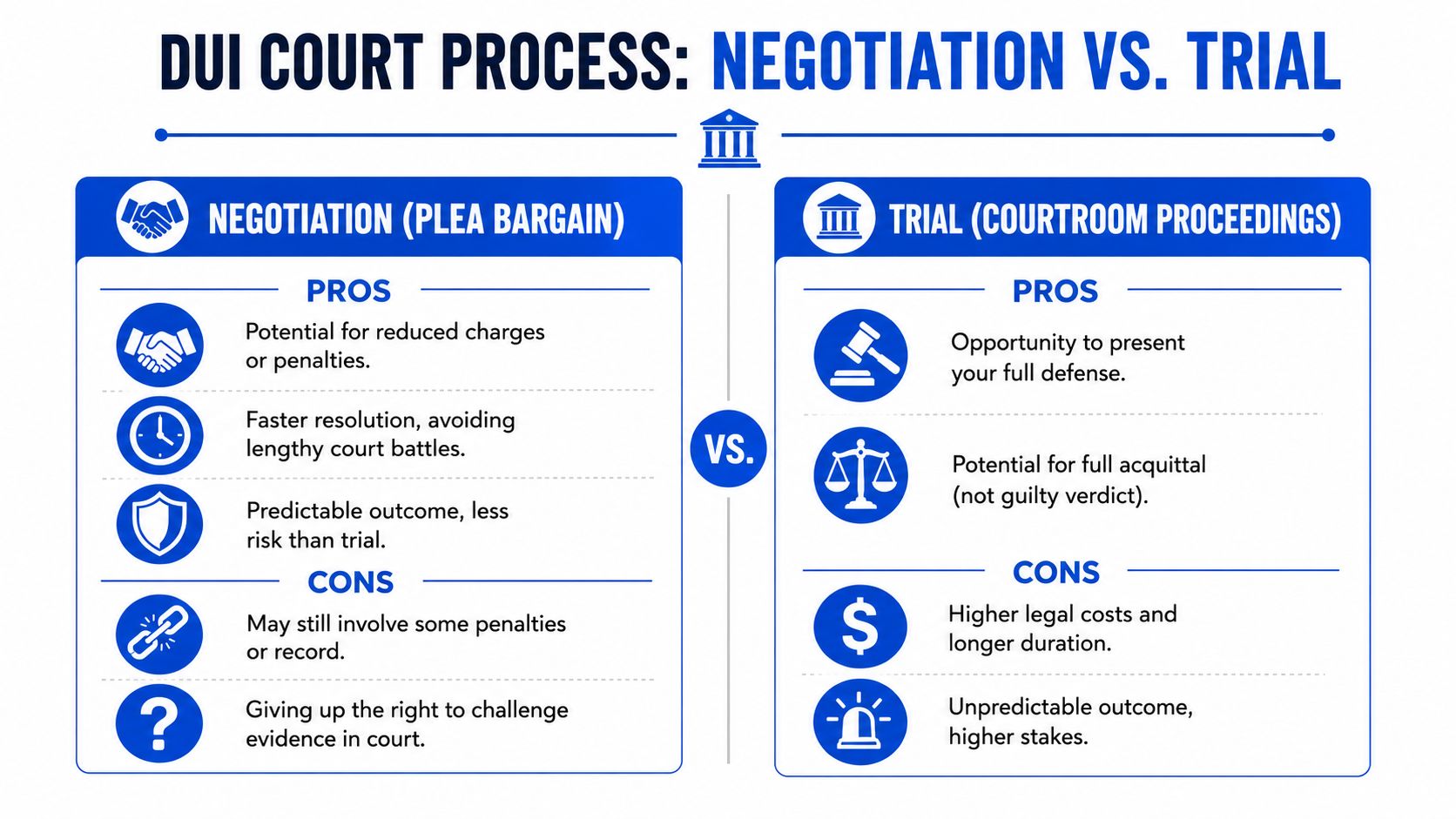
Most Florida DUI cases do not end with a dramatic trial. They resolve through negotiation, motion practice, mitigation, or some combination of all three. That doesn't mean trial is unimportant. It means the best strategy depends on the strength of the defense and the client's priorities.
When negotiation makes sense
Negotiation is often strongest when the defense has identified a real weakness and can also present meaningful mitigation.
That mitigation is not just saying you've learned your lesson. It works best when it is documented. NIH summarized a meta-analysis of 225 DUI-offender programs and found a 7% to 9% reduction in recidivism from educational, outpatient, inpatient, and self-help interventions in this NIH summary of DUI intervention outcomes. The same source notes that treatment appears most useful for problem drinkers when it lasts at least one year and includes weekly therapy plus bi-weekly individual interviews.
In real plea discussions, what helps is a mitigation packet that shows action:
Proof of enrollment: education, counseling, or treatment started early.
Attendance records: not just registration, but actual participation.
Personalized progress: evaluations, recommendations, and compliance documents.
Practical stability: work history, family responsibilities, and other factors presented carefully.
When trial becomes the better path
Trial becomes the better option when the State's proof has a serious weakness that cannot be fairly resolved through negotiation, or when the proposed plea does not reflect the actual risks in the evidence.
That doesn't mean every defensible case should be tried. It means the decision should be informed, not emotional.
Here's a practical comparison:
Path | Usually works best when | Main trade-off |
|---|---|---|
Negotiation | There is leverage plus mitigation | You accept a controlled resolution rather than a full fight |
Trial | A core part of the State's case is vulnerable | The outcome is less predictable |
In South Florida courtrooms, good DUI defense work usually involves both tracks at once. Prepare the case as if it may be tried. Negotiate from a position supported by facts, records, and legal issues.
Why an Experienced Florida DUI Lawyer Is Essential
Florida DUI cases move fast where it matters and slowly where people expect answers. That mismatch is what traps many defendants. The license issue may need immediate action. Video and machine records may need to be preserved before routine deletion. Court decisions about motions and negotiations may depend on details that are easy to miss if no one has framed the case correctly from the start.
A lawyer with prosecutorial experience brings a useful perspective because DUI cases are built from the inside out. The State relies on officer credibility, report language, roadside observations, and testing procedure. A former prosecutor knows how those cases are assembled and where they can break down.
That matters even more in higher-risk situations, including allegations that can expose a person to more serious consequences. If your case involves aggravating facts or prior history, this page on felony DUI in Florida may help you understand the added stakes.
There are firms that handle Florida DUI defense statewide. Ticket Shield, PLLC is one example. It represents people facing criminal and traffic-related charges and provides direct attorney access by phone, text, or email. What matters most is that counsel moves early, understands Florida DUI procedure, and builds a defense around the actual weaknesses in the case instead of generic promises.
Frequently Asked Questions About Florida DUI Defense
Can you still fight a DUI if the breath test was high
Yes. A breath result does not end the case by itself. The stop, the arrest decision, the observation period, the machine records, and the timing of the test can all matter. A strong defense may focus on whether the State can prove impairment at the time of driving, not just whether there was a later test result.
Is jail mandatory for a first DUI in Florida
Not every first DUI case leads to jail. Outcomes depend on the facts, the court, the person's history, the evidence, and whether mitigation has been handled well. Some cases are resolved through negotiation and sentencing advocacy that aim to reduce the harshest consequences. You should not assume jail is automatic, and you should not assume it is off the table either.
Should I just plead guilty and move on
Usually, that is not a smart first reaction. A guilty plea gives up the chance to challenge the stop, the officer's procedure, the testing, and other parts of the State's proof. It can also affect your record, license, insurance, and future. Before deciding, you need to know whether there are suppression issues, evidentiary weaknesses, or mitigation steps that could improve the result.
What affects the cost of defending a DUI case
Legal fees usually depend on the complexity of the case. Issues that can affect cost include whether there was a crash, a refusal allegation, prior record concerns, motion practice, expert review, and whether the case is likely to resolve through negotiation or proceed toward trial. The only useful way to discuss fees is in the context of your actual facts.
If you were arrested for DUI in Fort Lauderdale, Broward County, Miami-Dade, Palm Beach, or anywhere in South Florida, don't wait for the system to sort itself out. Contact Ticket Shield, PLLC for a confidential consultation so you can understand the license deadline, preserve critical evidence, and make informed decisions about how to fight the case.
A DUI charge isn't a conviction. This strategic guide covers the strongest ways to fight a Florida DUI, from bad stops to breath test errors.