Assault and Battery Charges in Florida: What to Know
Jason Goldsmith, Esq
You're leaving a bar near Wynwood after a loud argument. A drink gets thrown, someone shoves someone else, and the disagreement moves into the parking lot. Minutes later, Broward Sheriff's deputies arrive, separate the people involved, and ask you to explain what happened. You may be facing assault and battery charges, even if the incident lasted only a few seconds and nobody suffered a serious injury.
The first phone call matters. The same encounter can support an assault allegation, a battery allegation, both offenses, or a more serious felony depending on whether there was a threat, an attempted strike, physical contact, a weapon, an injury, or a prior conviction. Those classifications can affect release conditions, no-contact orders, employment, professional licensing, and whether you leave jail facing a misdemeanor citation or a felony hold.
Table of Contents
A Night That Changes Everything
The person who called 911 may describe a raised fist. A witness may remember only a shove. Security video may show the alleged victim throwing a drink first, or it may show contact that the witnesses missed. Police reports often contain competing accounts, incomplete camera footage, and statements made before anyone has had time to calm down.
That uncertainty doesn't make the case disappear. It tells me where the defense investigation must begin.
A threat without contact may point toward assault. An intentional touch or strike may support battery. A forceful act involving a weapon, serious injury, strangulation, or a protected victim can move the case into aggravated territory. In Florida, the legal label depends on specific elements, not merely on whether an argument became physical.
The practical rule: Don't try to “clear things up” with detectives, the alleged victim, or the other witnesses. A hurried explanation can become the most damaging evidence in the file.
After arrest, a judge may impose bond conditions and prohibit contact with the alleged victim. An employer may learn about the arrest. A professional licensing board, school, landlord, or immigration attorney may eventually see the case. A person who sends one angry text after release may create a separate violation problem, even if the original allegation is weak.
If you're in Fort Lauderdale, Miami-Dade, Palm Beach, or another South Florida community, contact a Florida criminal defense attorney before giving a statement. Your lawyer needs to preserve video, identify witnesses, examine the probable-cause affidavit, and determine whether the State can prove every required element.
How Florida Defines Assault and Battery
Florida separates simple assault and simple battery by focusing on threatened violence versus completed contact. Section 784.011 describes assault as an intentional and unlawful threat, by word or act, to commit violence, coupled with an apparent ability to carry it out and an act that creates a well-founded fear of imminent violence. Physical contact isn't required.
Section 784.03 addresses simple battery. The State generally must prove that the accused intentionally touched or struck the alleged victim against that person's will, or intentionally caused bodily harm. A person doesn't need to intend an injury for an intentional, unwanted touching to create a battery allegation.
Consider one example. A person raises a fist, steps toward another person, and causes a reasonable fear that a punch is about to land, but never makes contact. That conduct may support assault. If the fist lands, the prosecutor may pursue battery as well, assuming the State can prove the required intent and lack of consent.
For a practical explanation of how Florida handles these allegations, review this Florida battery charges guide. The important point is that prosecutors must match the evidence to the elements. A threat alone doesn't prove battery, and an accidental bump doesn't automatically prove an intentional touching.
Element | Simple Assault, Section 784.011 | Simple Battery, Section 784.03 |
|---|---|---|
Conduct | Intentional, unlawful threat by word or act | Actual intentional touching or striking |
Contact required | No | Yes |
Apparent ability | The accused must appear able to carry out the threat | The evidence must connect the accused to the contact |
Victim's reaction | The act must create a well-founded fear of imminent violence | The touching must be against the person's will or involve intentional bodily harm |
Typical classification | Second-degree misdemeanor | First-degree misdemeanor |
Simple assault is typically a second-degree misdemeanor, while simple battery is typically a first-degree misdemeanor. That difference affects maximum exposure, court handling, negotiation strategy, and the collateral consequences of a conviction.
The State may also charge both offenses when the evidence supports a threatening act followed by physical contact. A defense lawyer should test whether the alleged threat was imminent, whether the person had the apparent ability to act, whether the contact was intentional, and whether the witnesses' accounts are consistent.
Charges and Penalties You Could Be Facing
Florida's penalty ladder begins with misdemeanor allegations and can reach serious felony exposure. The charge often turns on facts people dismiss as minor, including whether the accused has a prior battery conviction, whether a weapon was involved, and whether the alleged victim falls into a protected category.
Simple assault, under Section 784.011, is generally a second-degree misdemeanor. It can carry up to 60 days in jail and a $500 fine. Simple battery, under Section 784.03, is generally a first-degree misdemeanor and can carry up to one year in jail and a $1,000 fine.
A prior conviction can change the analysis. Felony battery under Section 784.041 may apply when the defendant has a prior battery conviction. That offense is a third-degree felony with exposure of up to five years in state prison.
Aggravated assault under Section 784.021 is a third-degree felony. Aggravated battery under Section 784.045 is generally a second-degree felony when the evidence involves a deadly weapon or great bodily harm. Firearm allegations can create additional sentencing pressure, including the 10-20-Life firearms enhancement where its requirements are satisfied.

Facts that increase charging pressure
South Florida prosecutors may examine:
Weapon allegations: A firearm, knife, or other deadly weapon can support aggravated assault or aggravated battery theories.
Strangulation claims: Allegations that someone impeded normal breathing or blood circulation receive separate and serious treatment under Florida law.
Protected victims: The alleged victim's age, pregnancy, occupation, or status can affect the charge and sentencing. Florida law provides a concrete example involving aggravated battery against a person 65 years of age or older, which carries a mandatory minimum prison term of 3 years, a fine of up to $10,000, restitution, and up to 500 hours of community service. See the Florida aggravated battery statute for an older victim.
Prior convictions: A prior battery conviction can support felony battery treatment rather than a new misdemeanor.
Domestic relationship: A family or household relationship may trigger domestic violence procedures, no-contact conditions, and firearm consequences.
Florida simple battery generally involves intentionally touching or striking someone against that person's will, or intentionally causing bodily harm, and is generally a first-degree misdemeanor under Florida Statute 784.03. For a focused discussion of more serious allegations, review this Florida aggravated assault defense resource.
The accusation doesn't determine the final charge. The police report, video, witness accounts, injury documentation, and prior record all matter. A defense attorney should challenge the upgrade from misdemeanor to felony rather than accept the prosecutor's first classification.
Inside the Florida Criminal Process
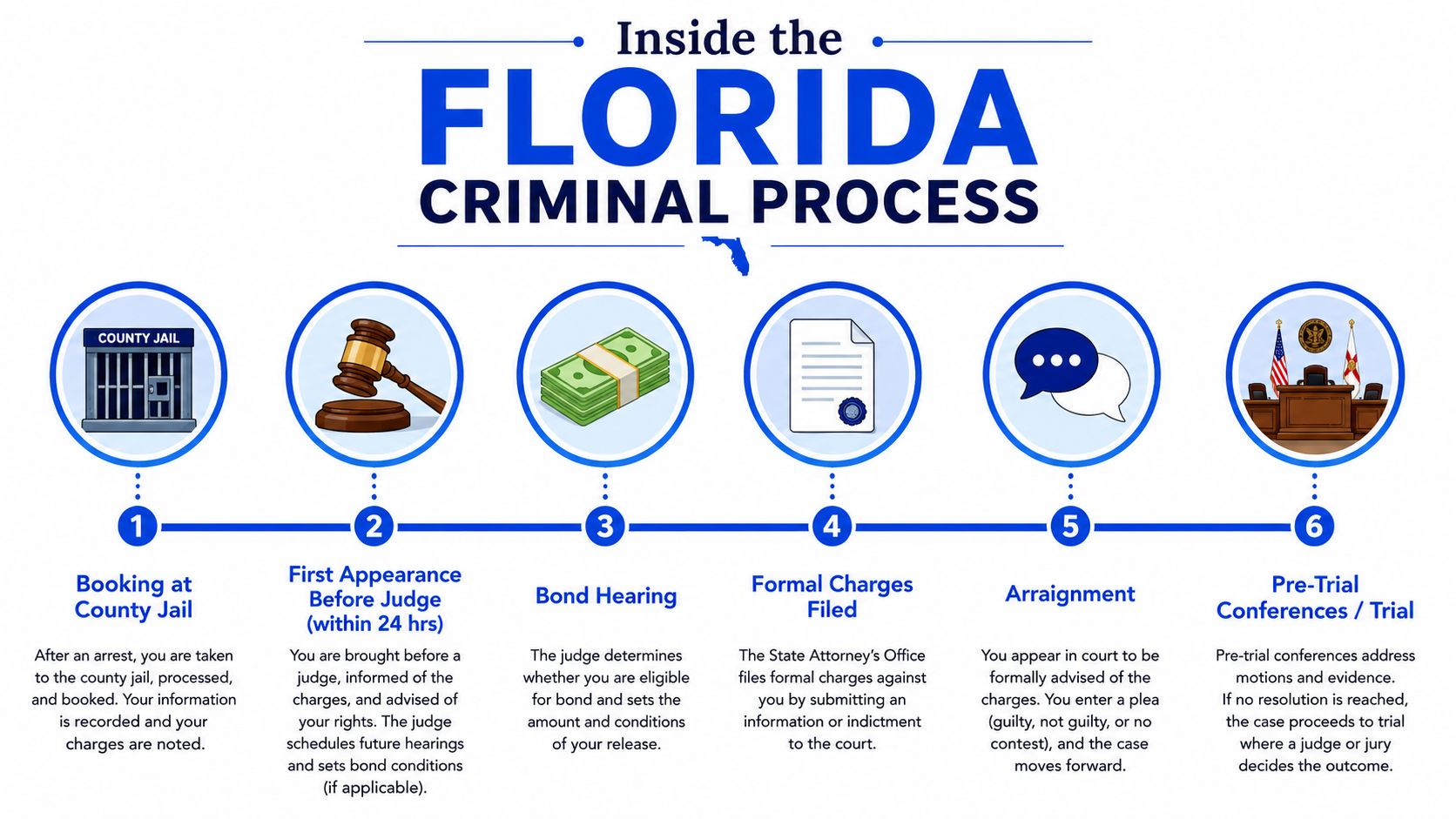
An assault or battery arrest usually begins with booking at the county jail. At first appearance, generally held within 24 hours, a judge addresses release, bond, and conditions. The court may impose a no-contact order, restrict travel, prohibit weapons, or require other conditions. A person who qualifies financially may receive a public defender.
The State Attorney's Office then decides how to proceed. The State may file an information, while more serious felony cases may proceed through a felony indictment. At arraignment, the defendant enters a plea and receives deadlines for the next stages.
What happens before trial
Discovery allows the defense to obtain materials such as reports, recordings, photographs, witness information, and other evidence the State intends to use. Counsel may file motions challenging statements, searches, identification procedures, or the admissibility of video and physical evidence.
Qualified first-time misdemeanor defendants may also be considered for diversion, including pretrial intervention. Eligibility isn't automatic, and domestic violence allegations, prior records, victim input, and prosecutorial policy can affect the decision.
The case may resolve through a negotiated plea, dismissal, diversion, or trial. Simple battery cases in county court are typically resolved in 2 to 6 months, while felony cases in circuit court can take 9 to 18 months. Those time ranges are practical expectations, not guarantees, and contested motions or crowded dockets can change the schedule.
You can monitor filings and hearing dates through the Broward Clerk of Courts online records or the Palm Beach Clerk of Courts online records. Online docket information may not show the full evidentiary picture, so don't treat a docket entry as a substitute for legal advice.
Read this explanation of what happens at an arraignment before appearing. Missing court, violating a no-contact condition, or discussing the facts in open court can damage your position before the defense has investigated the case.
Defenses That Actually Hold Up in Court
A defense succeeds when the evidence supports it and the legal elements fit the facts. Self-defense is not a claim that the other person was rude, intoxicated, or aggressive. The issue is whether you reasonably believed you faced imminent unlawful force and used legally justified force in response.
Florida's self-defense framework appears in Section 776.012. Florida's stand-your-ground protection under Section 776.013 can provide immunity when the statutory requirements are met. A lawyer may seek a pretrial immunity hearing, and in an appropriate case, the court may resolve the immunity issue before trial.
Match the defense to the evidence
Self-defense: Security video, 911 recordings, photographs, witness statements, and the sequence of injuries can show who initiated the physical encounter and whether the response was proportionate.
Defense of others: Text messages, video, and eyewitness accounts may establish that the accused acted to protect another person from imminent unlawful harm.
Defense of property or a dwelling: Entry records, surveillance footage, lease documents, and photographs can matter when the incident involves a home, vehicle, or other protected location under Florida's Castle Doctrine amendments.
Consent: Sports footage, gym records, event rules, or statements from participants may support consent in a contact-sport or mutual-combat setting. Consent is fact-specific and doesn't excuse conduct outside the agreed activity.
Lack of intent: A crowded bar, accidental collision, reflexive movement, or mistaken identification may undermine the required intentional act. The State still must connect the accused's deliberate conduct to the alleged contact.
False accusation or misidentification: Messages, surveillance video, location information, and independent witnesses may contradict the complainant's version.
Necessity and duress can apply in narrow factual circumstances, but they aren't catch-all excuses. The defense must show why the conduct was legally justified under the particular facts.
Defense | Supporting Evidence |
|---|---|
Self-defense | 911 calls, surveillance video, injury photographs, witness accounts |
Stand your ground | Location evidence, video, witness testimony, facts showing lawful presence and imminent threat |
Defense of others | Independent witnesses, recordings, messages, and the protected person's account |
Consent | Sports footage, event rules, participant statements, and prior communications |
Lack of intent | Video showing accidental contact, witness accounts, and inconsistent identification |
False accusation | Contradictory messages, timestamps, surveillance footage, and motive evidence |
A careful assault and battery defense analysis should begin with evidence preservation, not a rushed decision to plead guilty. The strongest defense is often the one that exposes a missing element before the prosecutor can rely on an emotionally powerful but incomplete narrative.
What to Do in the First 72 Hours After an Arrest
The most important rule is simple: invoke your right to remain silent under Miranda v. Arizona. Don't give a recorded statement at the police station, and don't agree to a “quick chat” with detectives who call after your release. Anything you say may be used against you, including an attempt to explain why the alleged victim is wrong.
Within the first day
Stop discussing the facts: Don't call the complainant, witnesses, or friends to coordinate stories.
Contact counsel: Reach a Florida criminal defense attorney before first appearance whenever possible.
Address release: Arrange bond review and identify a licensed bail bond agent if bond is required.
Preserve your phone: Don't delete messages, photographs, videos, location information, or call records.
During the next two days
Write down what you remember while the details are fresh, but give the notes to your lawyer rather than posting them online. Photograph injuries on both sides, keep clothing worn during the incident, and identify witnesses before memories fade. Your attorney can decide what should be preserved, disclosed, or investigated.
An automatic no-contact order can bar calls, texts, social media messages, and indirect communication through friends. Violating it can create a new criminal problem, so don't send an apology or ask the alleged victim to withdraw the complaint.

Don't clean up social media accounts. Deleting posts can look like evidence destruction, even when you believe the content is unrelated. A lawyer can issue preservation requests and assess the material without turning a manageable problem into a credibility issue.
For practical release information, review how to bail someone out of jail. Then let counsel handle communications with the court and the State.
Collateral Consequences Beyond the Sentence
A plea can create consequences that don't appear in the jail or fine calculation. Before accepting any resolution, a noncitizen should obtain immigration advice because criminal convictions can affect removal risk, visa status, admission, and naturalization. The Supreme Court's Padilla framework makes immigration consequences part of competent plea advice, but your criminal lawyer should coordinate with qualified immigration counsel when the stakes are serious.
Firearm rights require separate attention. Florida restrictions under Section 790.23 can affect possession for people with disqualifying convictions. Federal law under the Lautenberg Amendment can prohibit firearm and ammunition possession after a qualifying misdemeanor domestic violence conviction, even when the sentence is limited.
Expungement and sealing also require planning before a plea. Florida Statute 943.059 controls eligibility, and many battery cases involve a 10-year waiting window for certain relief. A period of probation can also disqualify an application. The exact charge, disposition, prior record, and whether the case was dismissed or resolved by plea all matter.
Consequence | Misdemeanor Battery | Felony Battery | Aggravated Assault |
|---|---|---|---|
Immigration | May affect immigration status depending on the facts and disposition | Can create substantial immigration risk | May create substantial immigration risk |
Firearms | Domestic violence convictions may trigger federal restrictions | Felony status can create serious firearm restrictions | Felony status can create serious firearm restrictions |
Record relief | Eligibility depends on disposition, prior history, and statutory requirements | Eligibility is narrower and fact-specific | Eligibility is narrower and fact-specific |
Employment and licensing | May appear in background checks and affect regulated work | Often creates greater licensing and employment scrutiny | Often creates greater licensing and employment scrutiny |
Housing and custody | May affect applications and family-court decisions | May create greater practical obstacles | May create greater practical obstacles |
Nurses, teachers, security professionals, and applicants seeking clearances may face licensing or suitability questions. A conviction can also affect housing applications and custody disputes, even when the criminal sentence seems manageable.
Florida domestic violence law includes assault, aggravated assault, battery, aggravated battery, stalking, kidnapping, and other listed offenses committed by one family or household member against another. Domestic battery by strangulation is separately defined and is a third-degree felony under Florida's domestic violence statute. That classification makes early legal advice especially important.
Choosing the Right Defense Attorney in Florida
The lawyer you hire during the first week can shape the investigation, bond strategy, charging discussions, and eventual resolution. Look for a Florida Bar-certified attorney in criminal trial law when available, meaningful courtroom experience, and a lawyer who understands how the Broward, Miami-Dade, and Palm Beach State Attorney's Offices develop battery cases.
Former prosecution experience can help counsel identify weaknesses in probable-cause affidavits, witness interviews, medical evidence, video review, and charging decisions. A documented trial record matters because the State needs to believe the defense is prepared to litigate, not merely accept the first plea offer.
Ask direct questions:
Who handles the file: Will the attorney personally manage the case, or will it be transferred to staff?
What happens first: Will counsel review the arrest affidavit, obtain video, preserve phone evidence, and address bond conditions?
What are the realistic paths: Can the lawyer explain dismissal, diversion, reduction, negotiated resolution, and trial without promising an outcome?
What can affect eligibility: Has counsel evaluated immigration, firearm, licensing, custody, and record-sealing consequences?
Pre-file intervention and diversion opportunities can disappear once formal charges are filed. Florida Statute 948.08 governs parts of the pretrial intervention framework, and bond motions may need immediate attention after arrest. Don't wait until the arraignment date to learn whether evidence has been overwritten or a no-contact condition is creating problems.
Red flags include guaranteed results, vague answers about who will appear in court, unfamiliarity with local procedures, and promises based only on a flat fee. You need a defense plan grounded in the actual report, evidence, witnesses, and statutory elements.
Ticket Shield, PLLC offers confidential consultations for people facing assault and battery charges in Broward County, Fort Lauderdale, Miami-Dade, Palm Beach, and surrounding South Florida communities. Visit Ticket Shield, PLLC to discuss the arrest, preserve evidence, address release conditions, and build a defense strategy before an avoidable statement or no-contact violation makes the case harder.