
Is Smell Probable Cause in Florida? What You Need to Know
Jason Goldsmith, Esq
In Florida, smell alone is rarely enough for probable cause anymore, especially when marijuana odor could come from legal hemp. Officers typically need corroborating evidence of impairment or illegal activity before they can justify a search or arrest.
You're pulled over on a Broward County road, and the officer says they smell marijuana or alcohol. Your heart starts racing. You may assume the officer's statement ends the discussion, giving police an automatic right to search your vehicle, order testing, or arrest you.
That assumption is outdated. Is smell probable cause? The accurate answer depends on what the odor indicates, where it was detected, which police action followed, and what other facts officers can prove. Florida courts evaluate odor under the totality of the circumstances, not as a universal shortcut around the Fourth Amendment.
The distinction matters in DUI, drug possession, weapons, probation, and search-and-seizure cases throughout Fort Lauderdale, Broward County, Miami-Dade, Palm Beach, and South Florida. An officer's claimed detection of an odor may matter, but it doesn't automatically establish impairment, illegal possession, or a lawful basis for every search.
Table of Contents
When Odor Triggers a Police Search
Consider a common traffic stop in Broward County. You're stopped for a traffic issue, the officer approaches the window, and they say they smell burnt cannabis. You haven't been driving erratically. Nothing illegal is visible. A passenger may have used a lawful product earlier, or the smell may be coming from hemp.
The officer asks you to step out and begins asking about the odor. You feel pressured to explain yourself. Then comes the search. Many people believe that once an officer says, “I smell marijuana,” the officer has won the constitutional argument.
That isn't automatic. The Fourth Amendment requires police to justify a search under a recognized exception to the warrant requirement. Odor can contribute to probable cause, but its strength depends on whether the smell is distinctive, whether the officer is qualified to identify it, and whether surrounding facts connect it to criminal conduct. The U.S. Supreme Court odor doctrine, as summarized in this discussion of smell and probable cause, treats officer qualification and odor specificity as important parts of the analysis.

The police statement isn't the legal conclusion
An officer may testify that they smelled marijuana or alcohol. Your defense attorney must still examine what happened before and after that statement.
Important questions include:
Where was the odor detected? Breath odor, clothing, the passenger compartment, and the trunk raise different issues.
Was the odor raw or burnt? A claimed odor of recent burning may be treated differently from a faint residual smell.
Who was connected to the odor? A vehicle odor doesn't necessarily prove that the driver possessed or used anything.
What else did officers observe? Driving behavior, speech, balance, admissions, visible items, and testing may change the analysis.
A traffic stop can become a criminal case quickly, but you still have rights. Don't consent to a search just because the officer sounds certain. Keep your hands visible, provide required identifying information, and state calmly that you don't consent. Don't argue roadside or volunteer explanations that may later be used as corroboration.
For a broader explanation of how an initial stop affects later police conduct, review this guide to probable cause during a traffic stop. If police searched your car or arrested you based primarily on an alleged odor, the body-camera recording, dispatch information, reports, and exact timing of each event may become central evidence.
Understanding Probable Cause and Reasonable Suspicion
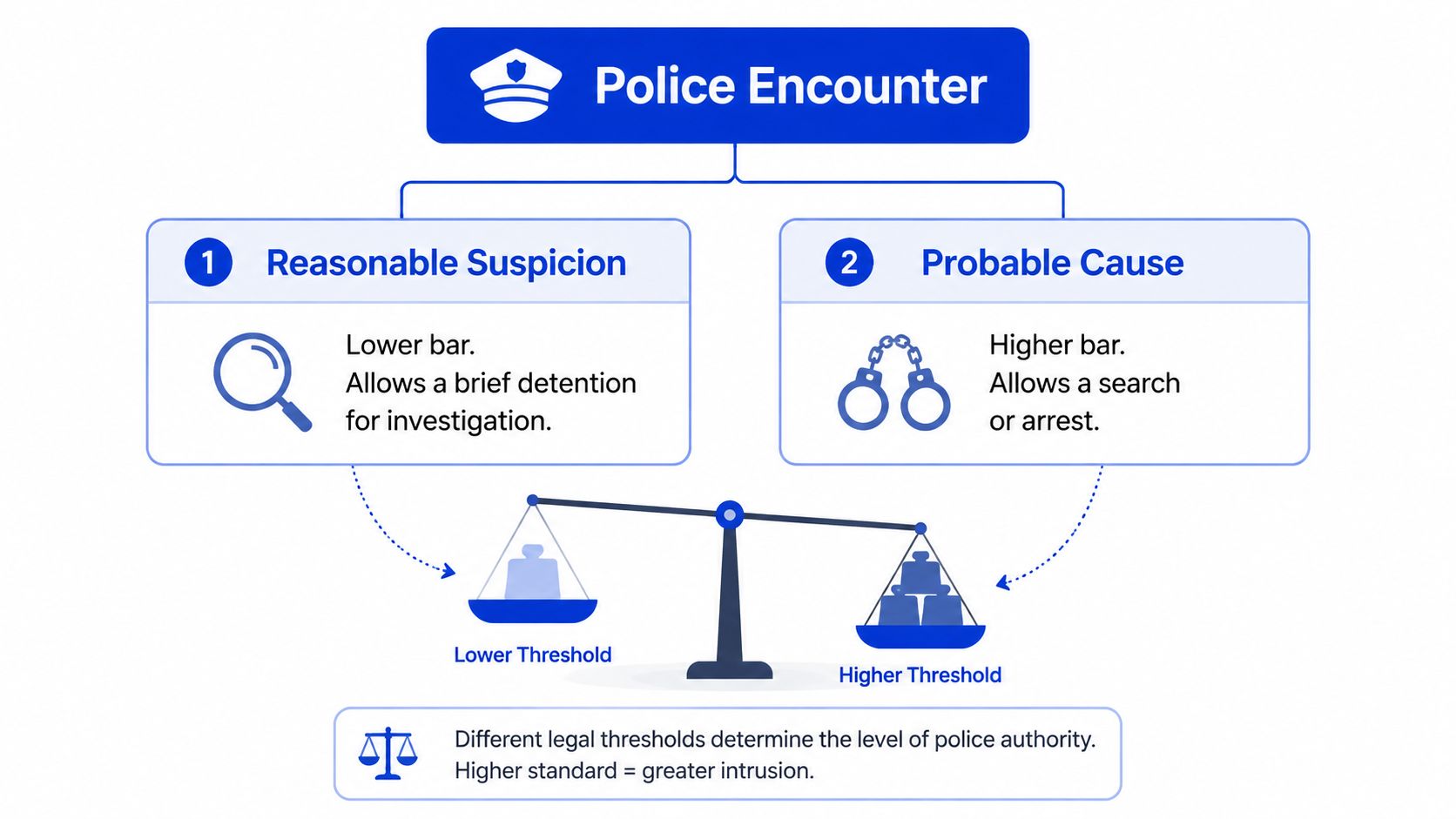
Reasonable suspicion and probable cause aren't interchangeable. They authorize different levels of police action.
Reasonable suspicion is the lower threshold. It permits officers to briefly detain someone to investigate specific facts suggesting possible criminal activity or a traffic violation. A claimed odor may help officers continue asking questions or investigate further, but the officer still needs to explain the circumstances that made the detention reasonable.
Probable cause is the higher threshold. It concerns whether the known facts would lead a reasonable officer to believe that a crime has occurred or that evidence of a crime will be found in a particular place. It doesn't require certainty, but it requires more than a hunch.
Smell is one puzzle piece
Think of probable cause as a puzzle. Odor may be one piece. The rest may include:
Driving conduct, such as weaving, an unexplained crash, or other unsafe behavior.
Physical indicators, such as slurred speech, poor balance, or difficulty following instructions.
Visible evidence, including containers, paraphernalia, or contraband.
Statements, admissions, inconsistent explanations, or facts tying an item to a particular person.
Officer qualifications, including training and experience identifying a specific odor.
A puzzle with one ambiguous piece may not establish probable cause. A distinctive smell combined with visible evidence and individualized facts may create a stronger constitutional basis.
Practical rule: A smell can justify further investigation without automatically justifying a search, arrest, breath test, blood draw, or vehicle seizure.
The police action also matters. A court may analyze the initial detention separately from the vehicle search, personal search, arrest, and compelled chemical testing. An officer might have enough information to investigate possible impairment but not enough to arrest. The same odor may carry different weight depending on whether the alleged source is a person, a vehicle, or a container.
For a plain-English comparison of these standards, see reasonable suspicion versus probable cause. Your attorney should map the encounter moment by moment, because probable cause cannot be justified by facts officers learned only after they conducted an unlawful search.
The Totality of the Circumstances Test in Florida
Florida courts generally don't isolate odor from everything else. They ask whether the totality of the circumstances created a fair probability that evidence of a crime would be found or that the person was committing an offense.
That approach prevents two opposite mistakes. Police shouldn't treat every odor as meaningless, but they also shouldn't treat every odor as proof of criminal conduct. The court weighs the quality of the smell, the officer's ability to identify it, its apparent source, and the facts surrounding the encounter.
What strengthens the State's argument
Suppose an officer reports a strong, unmistakable odor from inside a vehicle. The driver is also driving poorly, has slurred speech, admits recent use, and has visible items consistent with drug possession. Those facts may support a probable-cause argument because they connect the odor to a specific person and possible unlawful conduct.
The same reasoning can apply in a DUI investigation. Alcohol odor combined with poor driving, admissions, slurred speech, balance problems, or field sobriety results may support further action. The odor itself remains only one part of the record.
What weakens an odor-based search
A defense becomes stronger when the odor is vague, its source is uncertain, or officers can't identify any corroborating fact. A passenger may be the source. The smell may be residual. Legal hemp may be indistinguishable from marijuana by odor. Alcohol odor may show consumption without proving impairment.
Circumstance | Why it matters |
|---|---|
Odor from the vehicle, with no individualized link | It may not establish that the driver possessed or used anything |
Odor with no visible evidence | The State may lack corroboration for a warrantless search |
Legal hemp as a possible source | Smell may not distinguish lawful conduct from criminal conduct |
Odor plus erratic driving or admissions | Additional facts may support probable cause |
Officer lacks demonstrated training | The court may question odor reliability and specificity |
The North Carolina explanation of alcohol odor and intoxication captures the central distinction: an odor of alcohol can be evidence that someone drank, but it isn't proof by itself that the person was intoxicated. Courts apply the same logic to other odors when lawful and unlawful sources overlap.
The source of the odor matters
A person-search requires facts tying the alleged crime to that person. A vehicle search requires facts supporting the belief that evidence is in the vehicle. An arrest requires probable cause that the individual committed an offense.
Those aren't identical questions. A claimed smell may help officers investigate, but the prosecution must still prove why the particular search or arrest was lawful. In a Broward County drug crime case, a defense attorney should compare the officer's report with body-camera audio, passenger accounts, photographs, and the sequence of questions before any consent or search.
How Hemp Laws Changed the Marijuana Odor Rule
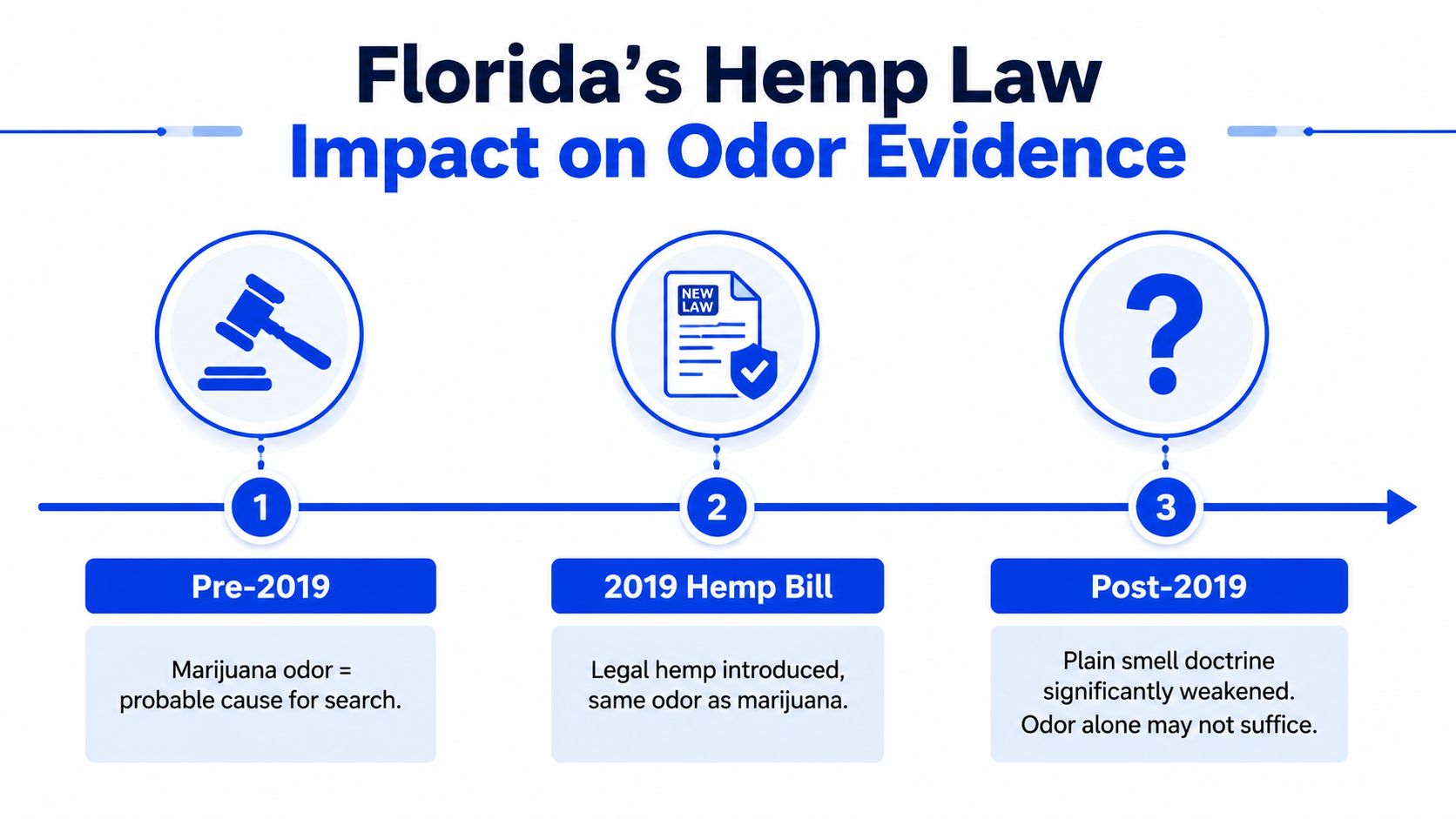
Older Florida advice often treated marijuana odor as a near-automatic basis for searching a vehicle. That rule developed when marijuana was broadly illegal and its distinctive smell was viewed as strong evidence of contraband. The legal environment changed as medical cannabis and hemp became lawful in defined circumstances.
The constitutional problem is straightforward. Legal hemp and illegal marijuana can smell the same. If an officer can't distinguish those substances by odor alone, the smell doesn't necessarily identify criminal activity. The odor may indicate cannabis, but it may not establish that the cannabis is illegal.
A 2025 Florida appellate decision regarding the plain smell of marijuana reflects that shift. The court held that marijuana odor alone was no longer sufficient for probable cause for a warrantless vehicle search because lawful hemp and illegal marijuana could not be distinguished by smell alone. Officers needed additional facts, such as visible contraband, admissions, paraphernalia, impairment indicators, or consent.
The rule isn't uniform across Florida
Many online explanations become misleading. Florida appellate districts have not necessarily applied the same approach at the same time. Earlier Florida precedent supported vehicle searches based on marijuana odor, including a decision holding that odor emanating from a vehicle provided probable cause for a warrantless search. That earlier rule appears in the Fifth District Court of Appeal opinion.
The more recent shift creates a jurisdiction-specific issue. A search in one Florida appellate district may be evaluated under older precedent, while a newer decision may support suppression in another jurisdiction. Lawyers handling cases in Fort Lauderdale, Miami-Dade, Palm Beach, and other South Florida locations must identify the controlling appellate authority for the courthouse handling the case.
The practical point: Marijuana odor may identify cannabis, but it doesn't always identify illegal cannabis or prove that a particular person committed a crime.
This doesn't make recreational marijuana possession legal in Florida. It changes the justification for a warrantless search. Prosecutors may still rely on additional evidence, including statements, visible contraband, paraphernalia, conduct suggesting impairment, or facts linking the suspected substance to the accused. The defense question is whether officers had those facts before the search, or whether they found them only after entering the vehicle.
If your case involves alleged cannabis possession, review the legal issues surrounding possession of marijuana in Florida. The date, location, officer's exact words, and sequence of events can determine whether a suppression motion deserves serious consideration.
Alcohol Odor and DUI Probable Cause
Alcohol odor creates a different legal problem from marijuana odor. A smell of alcohol may support an investigation because it can suggest consumption. But consumption and impairment are not the same thing, and neither one automatically proves an unlawful blood-alcohol concentration.
Florida's legal limit is 0.08% BAC, as described in the provided Florida DUI authority. The odor of alcohol can result from drinking less than the amount required to reach that limit, so an officer must connect the smell to actual impairment or an unlawful BAC. The North Carolina legal explanation cited earlier also distinguishes drinking from intoxication, and that distinction remains useful when evaluating the evidentiary gap in a DUI arrest.
Odor compared with impairment evidence
Alcohol odor may show | Alcohol odor does not automatically show |
|---|---|
That someone may have consumed alcohol | That the driver is impaired |
A reason to ask additional questions | That the driver exceeded the legal limit |
A basis for continued investigation in context | That an arrest or forced testing is automatically lawful |
Officers may use odor along with driving behavior, speech, balance, admissions, and field sobriety observations. But if the driver operated the vehicle normally and displayed no meaningful signs of impairment, the defense can challenge whether the State had probable cause for arrest.
The same principle applies to testing. A smell may lead to field sobriety exercises or additional questioning, but the legal justification can change depending on whether police seek a breath test, blood draw, or arrest. The officer's report should explain the facts supporting each step, not just repeat that alcohol was detected.
For a Florida-specific overview of DUI consequences and defense issues, see Florida DUI law. A Fort Lauderdale DUI lawyer should examine the traffic violation, the officer's observations, the field sobriety instructions, video evidence, and testing procedures rather than accepting the odor allegation as conclusive.
Why the defense focuses on the link
DUI cases often turn on whether the prosecution can prove impairment at the relevant time. Odor is indirect evidence. It may suggest prior consumption, but it doesn't describe how much was consumed, when it was consumed, or whether it affected driving ability.
That doesn't mean you should debate those issues on the roadside. Politely provide required information, don't consent to searches, and avoid making guesses about what you drank or when. Tell your attorney exactly what happened while the memory is fresh.
Defending Against Odor-Based Searches and Arrests
An odor-based case should be tested, not surrendered. The prosecution must establish a lawful basis for the police action, and the defense can challenge each factual link supporting that basis.
The officer's training and experience matter. Courts may consider whether the officer was qualified to recognize a particular odor and whether the odor was distinctive enough to identify contraband. “Based on my training and experience” isn't a substitute for examining what the training involved, how current it was, and whether the officer could distinguish marijuana from lawful hemp.
Five defense questions that can change the case
Challenge officer training. Was the officer trained to identify the claimed odor, and can the State document that training?
Question odor specificity. Could the smell have come from hemp, a lawful product, a passenger, clothing, or a prior event?
File a motion to suppress. Did police search without a warrant, consent, or sufficient probable cause? A motion to suppress evidence asks the court to exclude evidence obtained through an unconstitutional search or seizure.
Examine the stop itself. Did officers lawfully stop the vehicle, or did the alleged odor arise after an unjustified detention?
Gather independent evidence. Body-camera footage, witness testimony, testing records, photographs, and passenger accounts may contradict the officer's description.
The timing is critical. If police claim they smelled cannabis, searched the vehicle, and then discovered an item that supposedly confirmed the smell, the discovered item can't automatically justify the earlier search. The court must evaluate what officers knew before they acted.
Suppression is only one defense tool
A successful suppression argument may remove physical evidence from the case. It doesn't guarantee dismissal, because prosecutors may rely on statements, independent witnesses, or other evidence. But excluding illegally obtained evidence can substantially change the State's position in a drug, weapons, theft, or probation case.
The defense should also examine whether the alleged odor supports the charged offense. Even if a court permits a search, the State may still need to prove possession, knowledge, control, identity, or impairment. A smell in a shared vehicle doesn't automatically prove constructive possession by every occupant.
Your job at the roadside is safety and restraint. Your lawyer's job is to test the search after reviewing the full record.
Don't consent to a search. Don't reach for items. Don't argue about whether the officer can smell anything. Ask whether you're free to leave, and if you're arrested, invoke your right to remain silent and request counsel. Those steps won't decide the case by themselves, but they can prevent an avoidable statement from becoming the prosecution's strongest evidence.
Protecting Your Rights After a Search
If police searched your vehicle or arrested you based on an alleged odor, act quickly. Preserve photographs, names of passengers and witnesses, tow records, receipts, medical or hemp-product information, and any paperwork from the stop. Don't post explanations online or contact the passenger to coordinate stories.
A Florida criminal defense attorney can review the body-camera footage, police reports, dispatch records, search timeline, and testing evidence. The attorney can determine whether the odor supported reasonable suspicion only, whether probable cause existed before the search, and whether a motion to suppress should be filed.
The law requires more than a vague suspicion when police invade your privacy. If you're facing a DUI, drug charge, weapons charge, or probation violation in Broward County or elsewhere in South Florida, get advice before entering a plea or making statements about the odor.
Ticket Shield, PLLC reviews odor-based searches, DUI investigations, and drug charges by examining body-camera footage, police reports, and the exact sequence of events that led to the search. Contact Ticket Shield, PLLC for a confidential consultation and a clear defense plan focused on protecting your freedom, license, record, and future.