Leaving the Scene of an Accident in Florida: Laws
Jason Goldsmith, Esq
A crash can leave you standing beside a damaged vehicle with your heart racing, traffic moving around you, and no clear idea what to do next. You may have driven away in confusion, returned later, or learned that police are investigating after identifying your vehicle. In Florida, those facts can lead to a criminal case even when the collision itself was accidental and you didn't cause it.
The charge commonly called leaving the scene of an accident in Florida depends on more than the fact that a driver left. The State must prove the applicable statutory duties, the driver's knowledge and conduct, and the level of harm caused by the crash. The difference between property damage, bodily injury, serious bodily injury, and death can change the case from a misdemeanor to a serious felony.
Table of Contents
What Florida Law Expects After a Crash
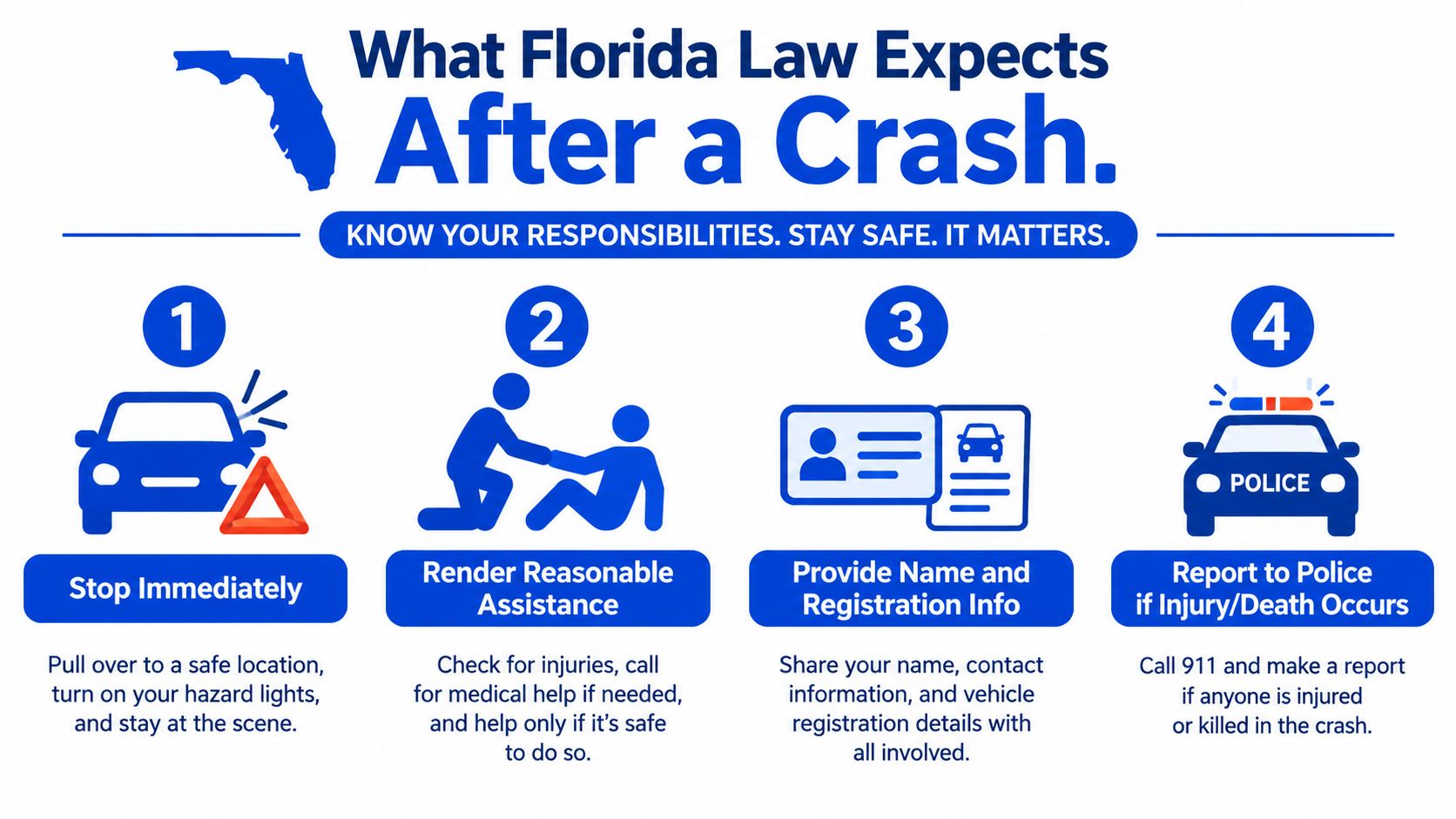
Florida's basic rule is straightforward. If you're involved in a crash, stop as soon as it is safe, remain at or near the scene, provide identifying information, and offer reasonable assistance when someone is injured. These duties apply whether you caused the collision, contributed to it, or believe the other driver was entirely at fault.
If you strike an occupied vehicle, speak with the driver, passengers, or property owner. If you hit an unattended vehicle in a parking lot, you still have to make a reasonable effort to locate the owner and provide the required information. Leaving a note may help in some circumstances, but a note doesn't automatically resolve every statutory duty or reporting obligation.
The immediate responsibilities
After a collision:
Stop safely: Pull over or stop as close to the scene as traffic and safety conditions allow.
Check for injuries: Call emergency services and provide reasonable assistance if anyone appears hurt.
Exchange information: Give your name, address, registration information, and driver's license when properly requested.
Report when required: Contact law enforcement when the crash involves injury, death, or circumstances requiring an official report.
The statutory duties can apply on public roads and, under the relevant provisions, on private property as well. The Florida criminal laws guide provides broader context about how Florida criminal statutes create separate offenses for conduct that may seem like an ordinary traffic mistake.
Practical rule: Don't assume that moving your car, leaving to calm down, or going home to call police satisfies the duty to remain. The facts and the order of your actions matter.
A person who has already left shouldn't make the situation worse by deleting messages, repairing the vehicle, or giving an improvised explanation to investigators. The next sections address the elements prosecutors must prove, how injury classifications affect charges, and the defenses that can challenge the State's version of events.
The Core Offense Explained in Plain English
Florida uses different statutes depending on what the crash caused. Section 316.061 addresses crashes involving property damage only, while section 316.027 addresses crashes involving injury or death. The statutes require a driver involved in a crash to stop and complete specific duties. The precise charge turns on the facts the State can prove, not on the label “hit-and-run.”
What prosecutors must establish
A typical prosecution examines several questions:
Were you involved in a crash? The State must connect you to the collision, whether through witnesses, video, vehicle evidence, records, or an admission.
Did you know a crash occurred? A driver isn't automatically guilty because a vehicle later shows damage. Knowledge can become the central disputed issue.
Did you stop as required? A brief stop may not be enough if the driver leaves before completing the statutory duties.
Did you remain long enough? Stopping the vehicle and remaining at the scene are related but separate obligations.
Did you provide identifying information? The law requires an exchange of information with the appropriate people.
Did you render reasonable assistance? When someone is injured, the driver must take reasonable steps to obtain help.
Did the crash involve the level of harm alleged? Injury classification can determine whether the case is a misdemeanor or felony and which felony degree applies.
Consider a driver who backs into a parked car in a Publix lot. If the driver knew contact occurred and leaves without locating the owner or fulfilling the information duties, prosecutors may pursue a property-damage charge under section 316.061. A cracked bumper doesn't by itself prove that the driver perceived the impact, however.
A cyclist clipped by a side mirror presents a different analysis. The vehicle may have made contact, but the State still must establish the driver's knowledge of the crash and the facts supporting the injury level. A driver who stops briefly, looks around, and leaves before police arrive may face a stronger prosecution than someone who never perceived contact, but the State still has to prove each required element.
A shifted mirror or cracked windshield may support an inference, but it doesn't automatically prove actual knowledge or a willful departure.
Florida prosecutors sometimes treat physical damage as conclusive proof that the driver knew what happened. Defense counsel should test that assumption against road noise, lighting, traffic, weather, the point of impact, and whether the damage was visible from the driver's position. The statutory duty to stop lasts longer than the instant needed to pull over, but the State can't skip the knowledge and conduct questions.
How Penalties Escalate by Crash Outcome
The penalty structure follows the result of the crash, not merely the driver's state of mind or the amount of damage to the accused vehicle. Florida recorded 104,273 hit-and-run crashes in 2023, including 271 fatalities and 871 serious bodily injuries, according to the Florida Highway Safety and Motor Vehicles hit-and-run data. Property damage alone accounted for 86,987 crashes, approximately 83.4% of the statewide total, but the smaller number of injury and fatal crashes produced the most severe consequences.
Crash Outcome | Statute | Degree of Offense | Maximum Penalty | License Consequence |
|---|---|---|---|---|
Property damage only | Fla. Stat. § 316.061 | Second-degree misdemeanor | Up to 60 days in jail and a $500 fine | No identical mandatory revocation tier under section 316.027, but other driving and insurance consequences may follow |
Bodily injury | Fla. Stat. § 316.027 | Third-degree felony | Up to five years in prison and a $5,000 fine | At least three-year license revocation |
Serious bodily injury | Fla. Stat. § 316.027 | Second-degree felony | A felony carrying substantially greater prison exposure | At least three-year license revocation |
Death | Fla. Stat. § 316.027 | First-degree felony | Up to 30 years in prison | At least three-year license revocation, plus a mandatory minimum prison term |
The current statute makes leaving a fatal crash a first-degree felony with a mandatory minimum four-year prison term under the Aaron Cohen Life Protection Act. The Florida statutory text for leaving the scene also shows why a fatal departure cannot be treated as an ordinary traffic citation.
The serious-injury category requires careful medical analysis. Florida law describes serious bodily injury as a condition creating a substantial risk of death, serious personal disfigurement, or protracted loss or impairment of the function of a bodily member or organ. Medical records, treatment history, expert opinions, and the actual duration of impairment can affect the felony classification.
Potential consequences also extend beyond the sentence. A conviction may affect license status, insurance, employment, travel, and financial obligations. Restitution, civil claims, and criminal fines are separate issues that counsel should evaluate independently. For a related discussion of Florida charges arising from a collision and departure, review Florida hit-and-run consequences.
Three Real-World Scenarios From South Florida Roads
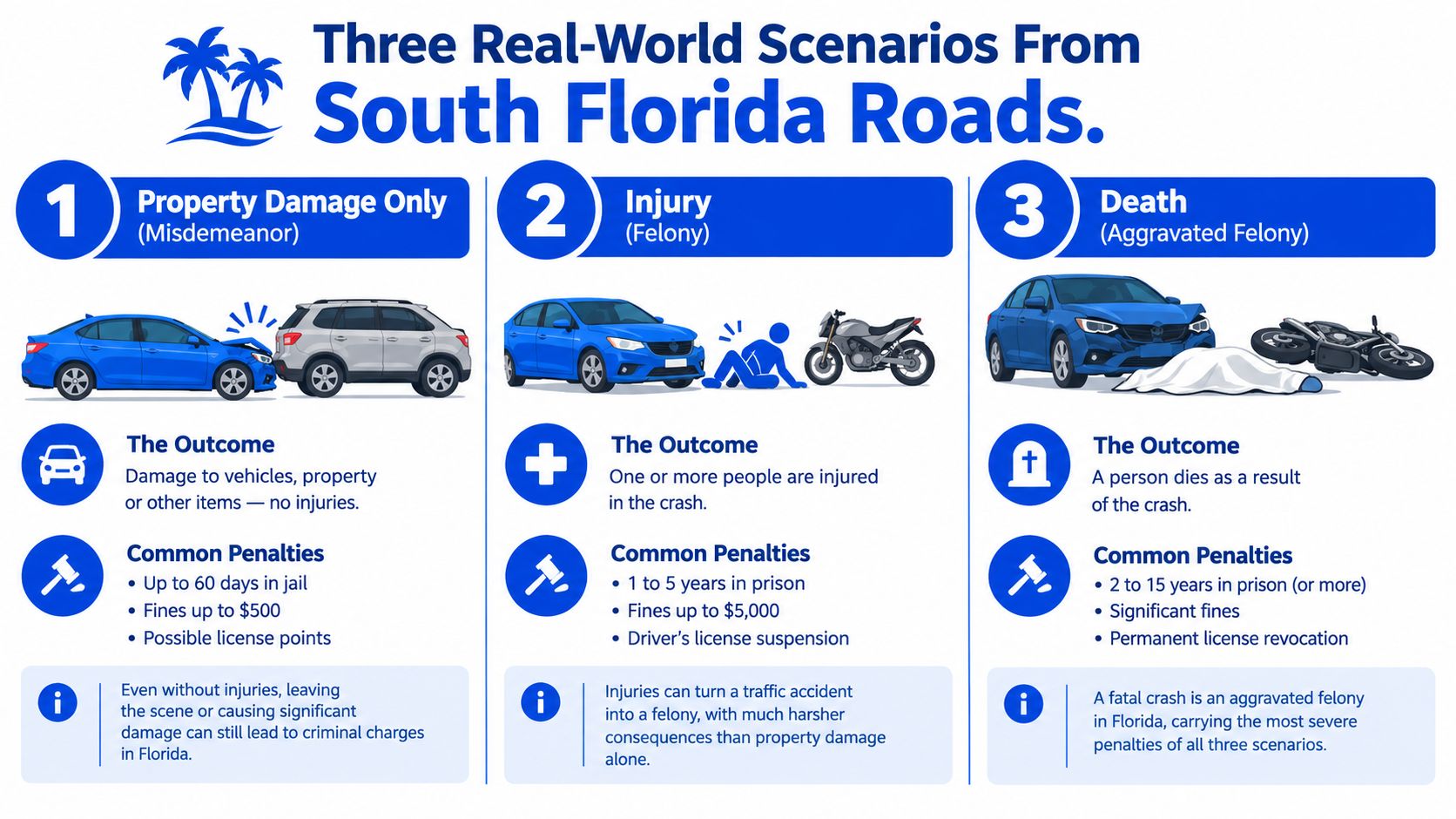
The same decision to drive away can produce very different exposure depending on what happened at the scene. These representative South Florida situations show why the injury classification and proof of knowledge matter more than the emotional label attached to the conduct.
A parking-garage sideswipe
A driver scrapes another vehicle in a Brickell parking garage, sees a small mark, panics, and drives home. No one is injured. If prosecutors can prove the driver knew contact occurred and failed to stop and exchange information, the likely charge is a second-degree misdemeanor under section 316.061.
The driver's actual fault for the underlying sideswipe remains a separate question. The immediate criminal concern is whether the driver was involved, knew about the crash, and failed to fulfill the property-damage duties. Surveillance footage, the vehicle's condition, and the visibility of the impact may determine whether the allegation can be proved.
A collision involving a cyclist
A driver strikes a cyclist near Miami Beach and leaves. The cyclist suffers a broken collarbone. The case moves into felony territory because the crash involved bodily injury, assuming the State can prove the driver's involvement, knowledge, and willful failure to complete the required duties.
The State Attorney's Office may focus on witness accounts, traffic-camera footage, vehicle damage, emergency calls, and the driver's conduct after the collision. The defense should separately examine whether the driver perceived the contact and whether the medical evidence supports the charged injury level.
A fatal interstate crash
A fatal crash on I-95 presents first-degree felony exposure when the driver leaves the scene. Under current Florida law, that charge carries a mandatory minimum four-year prison term, along with substantial additional consequences.
The prosecution still must prove the statutory departure and the relevant facts. A fatal result does not eliminate disputes about identity, knowledge, timing, or whether the driver completed any required duties before leaving. The license, insurance, civil, and employment consequences can continue even while the criminal case is pending.
Why Leaving Does Not Automatically Mean You Caused the Crash
Many people assume that a leaving-the-scene charge proves the driver caused the collision. It doesn't. Florida treats the underlying crash and the later departure as related but distinct legal questions.
The State may need to litigate at least three separate issues:
Crash causation: Which driver, if any, caused the collision?
Knowledge and willfulness: Did the accused know a crash occurred and intentionally fail to perform the required duties?
Injury classification: What injury did the crash cause, and does the evidence meet the statutory definition of serious bodily injury?
A driver may be blameless for the collision and still face a charge for failing to stop. Conversely, evidence that a driver caused the crash doesn't automatically prove the driver perceived the contact or deliberately left. Flight can look suspicious, but suspicion isn't a substitute for proof beyond a reasonable doubt.
The injury question can change the case
A soft-tissue complaint, a temporary limitation, and a condition involving protracted impairment aren't interchangeable. The defense should examine medical records, diagnostic findings, treatment gaps, testimony from treating providers, and the actual functional effect of the injury. The State may try to use a broad description in an initial report to support a more serious charge, even when later medical evidence does not fit the statutory definition.
The Florida discussion of probable cause helps explain why an arrest or charge doesn't resolve these factual disputes. A prosecutor may have enough information to investigate while still lacking evidence to prove every element at trial.
A careful defense doesn't concede the whole case because the driver left. It attacks causation, identity, knowledge, willfulness, and injury severity one at a time.
Defenses That Can Reduce or Dismiss the Charge
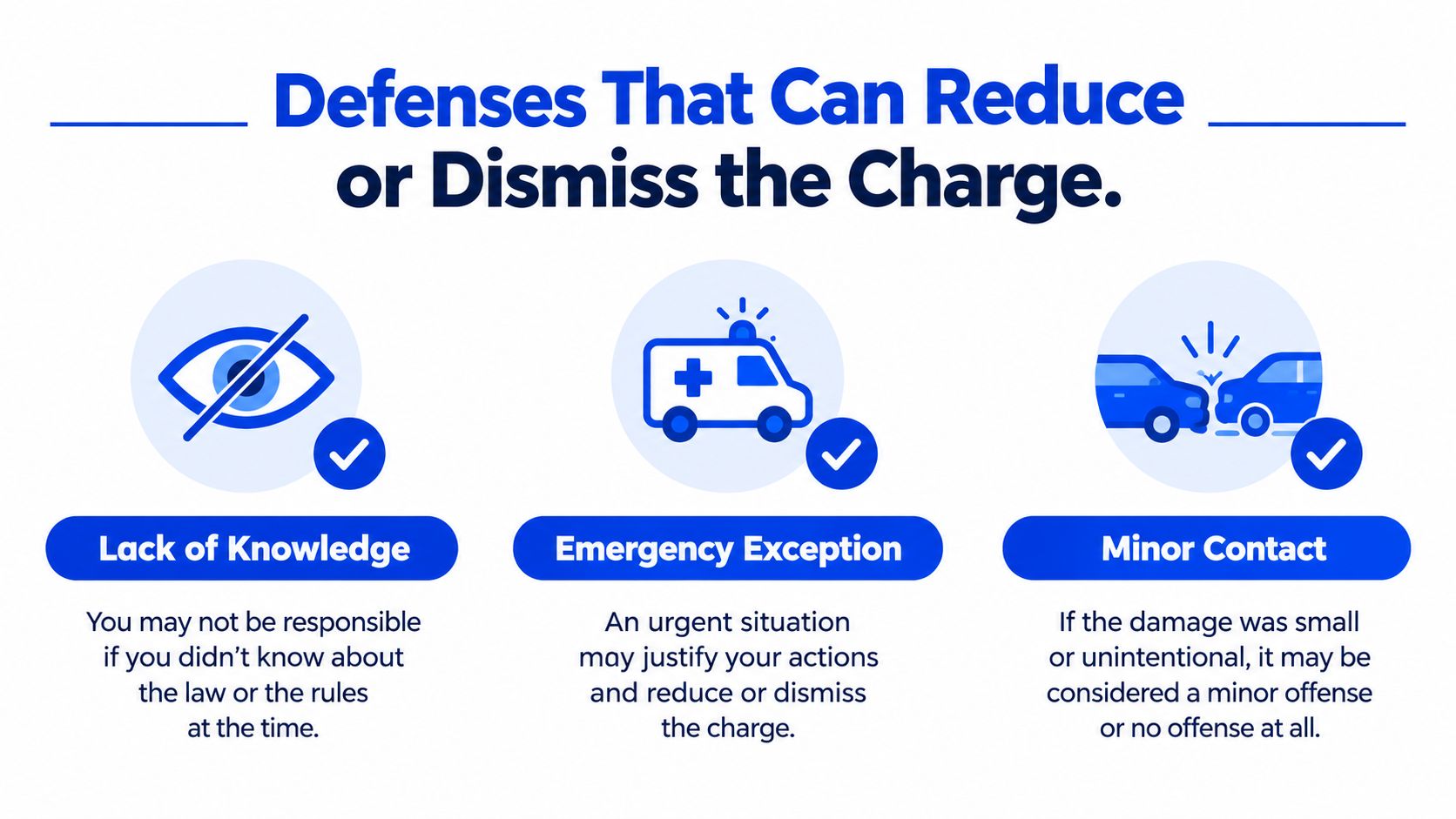
The strongest defenses address an element the State can't prove, rather than relying on general explanations about panic or regret. A lawyer should compare the physical evidence with the driver's account before deciding whether to challenge the charge directly, seek a reduction, or negotiate an outcome that avoids a felony conviction.
Lack of knowledge
A driver may not realize that contact occurred. Low-speed parking-lot bumps, a side impact hidden from the driver's view, heavy traffic, poor lighting, road noise, and minor vehicle movement can all matter. The Florida property-damage statute requires analysis of the driver's involvement and conduct, not speculation based solely on later-discovered damage.
Vehicle inspection should preserve the condition of the car before repairs or cleaning. Accident reconstruction may show that the damage is inconsistent with the alleged collision. Surveillance footage can reveal that the vehicle never made contact or that another vehicle was responsible.
Emergency or safety circumstances
A credible emergency may explain why a person left to summon help, escape an immediate safety threat, or obtain medical care. The defense must connect the departure to the emergency and show why remaining at that moment was unreasonable. Leaving because the driver felt embarrassed or feared a conversation usually presents a much weaker argument.
Willfulness and medical events
The statute requires a willful violation in the injury and death context. A medical event, blackout, memory impairment, or other condition may affect whether the driver consciously chose to leave. These defenses need supporting evidence, such as medical records, witness observations, phone data, or timing evidence. A later claim of memory loss without corroboration rarely carries the case by itself.
Compliance and identity disputes
The facts may show that the driver flagged down an officer, contacted emergency services, returned promptly, or left identifying information at an unattended vehicle. Those actions don't automatically end the investigation, but they can undermine the claim that the driver failed every statutory duty.
Investigators can also identify the wrong person. Vehicle ownership doesn't prove who was driving. Cell-phone records, surveillance footage, dashcam files, event data, and witness interviews may rebut the State's timeline or identify another driver.
Preserve first, explain second. A vehicle, phone, or camera file can answer questions that a nervous statement only complicates.
Negotiation remains part of effective defense work. Restitution discussions, documented cooperation through counsel, prompt evidence preservation, and an early presentation of weaknesses may support a reduction or pretrial resolution. They shouldn't replace a legal defense, and no lawyer can guarantee dismissal or a particular sentence. The Florida overview of criminal defenses explains why the defense must match the facts and the element being challenged.
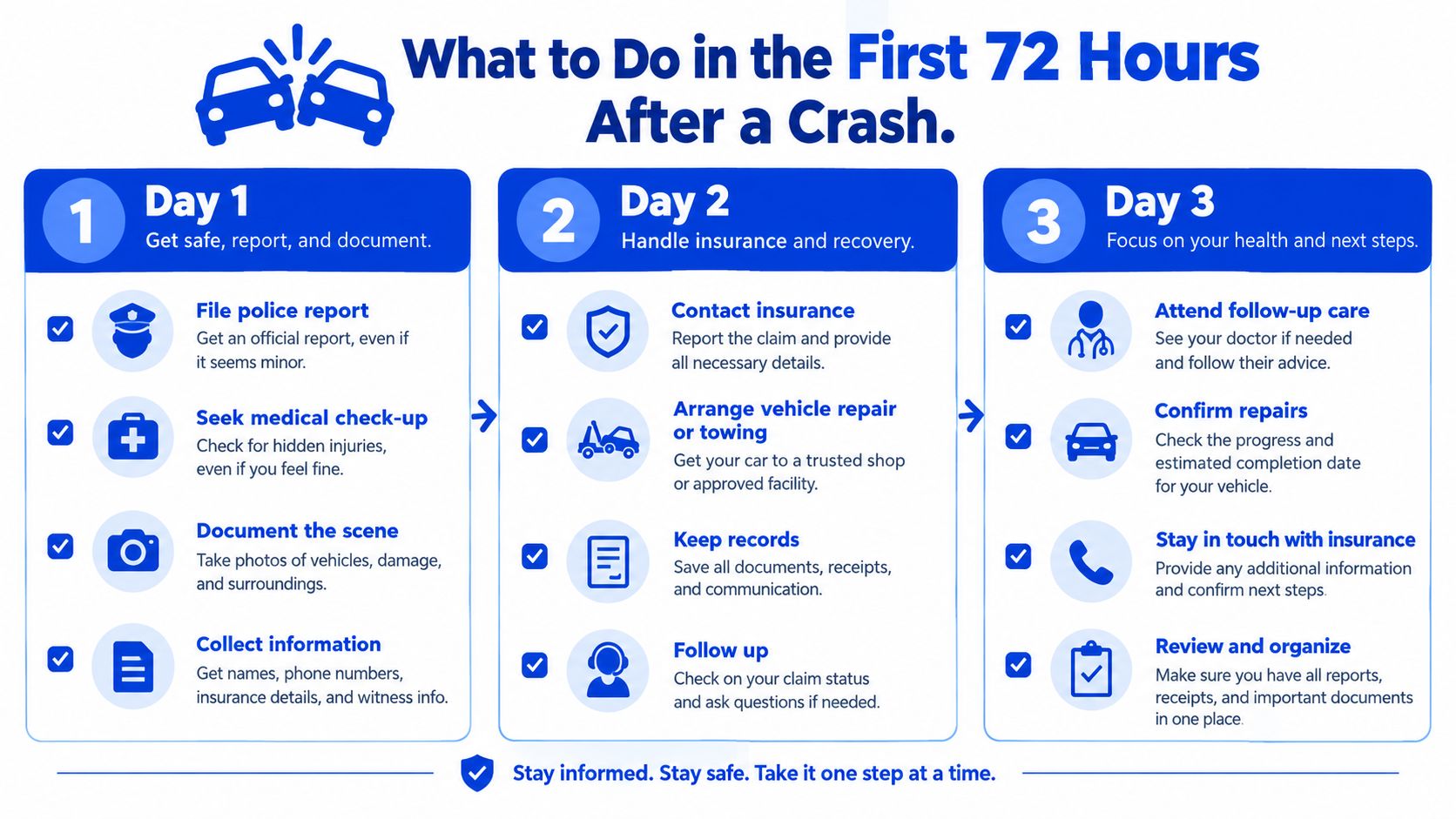
What to Do in the First 72 Hours After a Crash
The first few days often determine whether evidence survives and whether a confused event becomes a damaging narrative. This is a practical checklist, not a legal deadline.
Day 1
Seek medical attention if you have symptoms or may have been injured. Preserve the vehicle in its current condition, save dashcam footage, and prevent phone settings from automatically deleting relevant messages, location history, or videos. Contact law enforcement when a report is required or when you need to clarify that a crash occurred, but don't guess about facts you don't remember.
Notify your insurer of the incident as required by the policy. You can provide basic notice without volunteering a recorded statement or speculating about fault, speed, visibility, or what you heard. Ask that substantive questions be handled after you consult counsel.
Day 2
Write a private timeline while your memory is fresh. Record where you were, what you noticed, the lighting and traffic conditions, any contact with other people, and every call or message connected to the event. Don't post about the crash or discuss it with witnesses in a way that could appear coordinated.
An attorney can send preservation requests for surveillance video and review the vehicle before repairs. Counsel should also evaluate whether police want a formal interview, whether investigators have contacted other occupants, and whether the injury description supports the charge being considered.
Day 3
Gather insurance documents, registration records, photographs, medical records, and contact information for witnesses. Don't delete anything, alter the vehicle, or submit a written narrative that combines memory with guesses.
If you left the scene, returning or contacting investigators may have legal consequences that depend on the facts. Speak with a defense lawyer before a formal interview, supplemental report, or recorded statement. The lawyer can help distinguish a necessary report from an unnecessary admission.
The legal duties after a crash can be difficult to apply under pressure. This short video offers additional general guidance about immediate post-crash decisions:
Protecting Your License, Record, and Freedom
A leaving-the-scene case usually runs on several tracks at once. Criminal court addresses guilt and punishment. The Florida Department of Highway Safety and Motor Vehicles may address driving privileges separately. Civil claims may seek payment for property damage, medical losses, or wrongful death regardless of what happens in the criminal case.
A criminal acquittal doesn't automatically restore every driving privilege, and a negotiated plea can create consequences that extend beyond the sentence. The Florida driver's license suspension resource explains why license issues deserve separate attention rather than being treated as an afterthought.
Restitution also isn't automatically the same as liability for the entire collision. Florida courts require a causal relationship between the convicted offense and the claimed loss. The Florida Supreme Court's restitution decision reflects the distinction between losses caused by the criminal conduct and damages arising from the underlying accident. Insurance claims, civil judgments, and criminal restitution should be analyzed separately.
Early legal intervention can affect whether the case remains in a property-damage tier, whether the State files a felony, and whether investigators preserve evidence that supports the defense. Ticket Shield, PLLC offers consultations and defense representation for Florida leaving-the-scene accusations, including investigation of the evidence, protection of client communications, and efforts to reduce or dismiss charges where the facts support that result.
If you're being investigated or charged after a Florida crash, contact Ticket Shield, PLLC for a confidential consultation about the vehicle evidence, injury classification, license consequences, and your next communication with investigators. The firm serves clients across Broward County, Fort Lauderdale, Miami-Dade, Palm Beach, and surrounding Florida areas, with direct attorney communication available to help you act before avoidable mistakes become part of the case.