
How Long Can Police Detain You: Florida Rights Guide
Jason Goldsmith, Esq
A general police custody limit can reach 48 hours after arrest, while a legitimate temporary investigative stop in Florida typically lasts only 20 to 30 minutes. Those timeframes address different kinds of police contact, and confusing a temporary stop with an arrest can lead to serious misunderstandings about your rights.
You may be standing beside your vehicle, sitting on a curb, or answering questions in a public place when an officer says you're not free to leave. Your heart is racing, but the officer hasn't said whether you're under arrest. That uncertainty matters because the legal rules change as the encounter develops.
The key question isn't always, “How long can police detain you?” It may be, “What kind of detention is this, and what legal basis supports it?” Florida law treats a brief investigative stop differently from an arrest, and a lawful arrest triggers judicial review requirements that don't apply in the same way to every police encounter.
Table of Contents
Understanding Temporary Stops vs Arrests in Florida
A temporary investigative stop restricts your movement while an officer investigates specific facts suggesting possible criminal activity. The officer doesn't need the same level of proof required for an arrest, but a mere hunch isn't enough. The detention must remain connected to the reason for the stop and last only as long as reasonably necessary to investigate it.
In practical terms, a routine stop may involve questions, identification checks, witness comparisons, or a limited inquiry into suspected criminal conduct. Florida law says temporary detention may not last longer than reasonably necessary, and information that creates probable cause can justify an arrest. You can review the statutory framework in Florida's temporary detention statute.
An arrest is a more substantial restraint. Officers may handcuff you, transport you to a jail or processing facility, begin booking, and hold you for court proceedings. An arrest generally requires probable cause, meaning facts support the conclusion that you committed an offense.
Signs the encounter may be changing
Courts examine the total circumstances rather than relying only on the officer's label. These details can matter:
Physical restraint: Handcuffs, locked doors, or an officer's command that you remain in place may indicate custody, although handcuffs alone don't always prove an arrest.
Transportation: Being moved from the original location to a station or jail can signal that the encounter has become more than a brief stop.
Police presence: Multiple officers surrounding you, blocking exits, or controlling every movement can make the encounter feel and function like an arrest.
Questioning purpose: Questions that began with a specific investigation may shift into a broad search for evidence.
Practical rule: Don't argue about labels on the roadside. Ask calmly whether you're free to leave, and preserve the details for a lawyer who can examine whether the stop became an arrest without sufficient legal justification.
For a deeper explanation of the evidence standards involved, see this guide to reasonable suspicion versus probable cause.
Florida 24-Hour Detention Rules Explained
Florida has a faster first-appearance requirement than the federal probable-cause benchmark. Under Florida Rule of Criminal Procedure 3.130(a), a person who has been arrested and not lawfully released generally must be brought before a judicial officer, personally or through audio-video technology, within 24 hours of arrest. This hearing addresses matters such as the arrest, notice of the accusation, counsel, release conditions, and continued custody.
Florida also uses a separate 48-hour probable-cause checkpoint when a defendant remains in custody after a warrantless arrest. These are not interchangeable events. First appearance concerns the court's immediate oversight of the person's custody and release status, while probable-cause review tests whether sufficient grounds support continued detention.

What the agency can and cannot do
For certain serious offenses eligible for pretrial detention, Florida law allows the arresting agency to hold a defendant before first appearance or before the State Attorney files a detention motion for no more than 24 hours. That temporary agency authority is different from judicial authority to keep someone jailed after a hearing.
The clock makes documentation important. Families should record the approximate arrest time, location, transport details, booking time, and whether a first appearance occurred. A lawyer can compare those records with jail logs, arrest affidavits, court dockets, and audio-video hearing records.
The rule doesn't promise automatic release when the hour arrives. A warrant, probation hold, lawful bail decision, or judicial detention order may provide a separate basis for continued custody. The practical question is whether a judge reviewed the case and what legal authority supports confinement after the agency's temporary authority ends.
Read what happens after an arrest in Florida for additional procedural context. The exact timing and the offense charged can affect the next available remedy.
Federal Probable Cause Requirements After 48 Hours
A person held after a warrantless arrest reaches a separate federal constitutional checkpoint. In Gerstein v. Pugh, the U.S. Supreme Court required a prompt judicial determination of probable cause when custody continues after such an arrest. In County of Riverside v. McLaughlin, the Court stated that a probable-cause determination within 48 hours of arrest will generally satisfy the promptness requirement. Read the Supreme Court opinion addressing prompt probable-cause review.
The 48-hour benchmark does not authorize police to delay review without reason. An unnecessary or deliberate delay can violate the Constitution even when a judge reviews probable cause before the deadline. Administrative convenience, such as waiting to combine hearings, does not by itself justify extended detention.
The arrest classification matters. A temporary investigative stop rests on a limited purpose and duration. If officers impose restraints, transport the person, prolong questioning, or otherwise exercise custody beyond that purpose, the encounter may function as an arrest. Once a warrantless arrest occurs, the prompt judicial review rule becomes relevant.
How the rules fit together
Florida's first-appearance requirement and the federal probable-cause requirement address different decisions during early custody:
Initial arrest: Officers assert probable cause and take the person into custody.
First appearance: A Florida judicial officer addresses immediate custody and release issues.
Probable-cause review: The court decides whether sufficient grounds support continued detention.
Pretrial detention or bail process: The court evaluates whether the person may remain jailed while the case proceeds.
If review occurs after 48 hours, the government must show a genuine emergency or another extraordinary circumstance. Probable-cause review sets a deadline for judicial oversight; release depends on the separate bail and detention analysis.
A probable-cause finding establishes an early threshold for continuing the criminal case. It does not resolve guilt. Because both standards hinge on evidence quality, review this guide to the definition of probable cause before the first appearance. The defense may later challenge the arrest, statements, searches, identification procedures, charging decision, or sufficiency of the State's evidence.
Common Misconceptions About Detention Limits
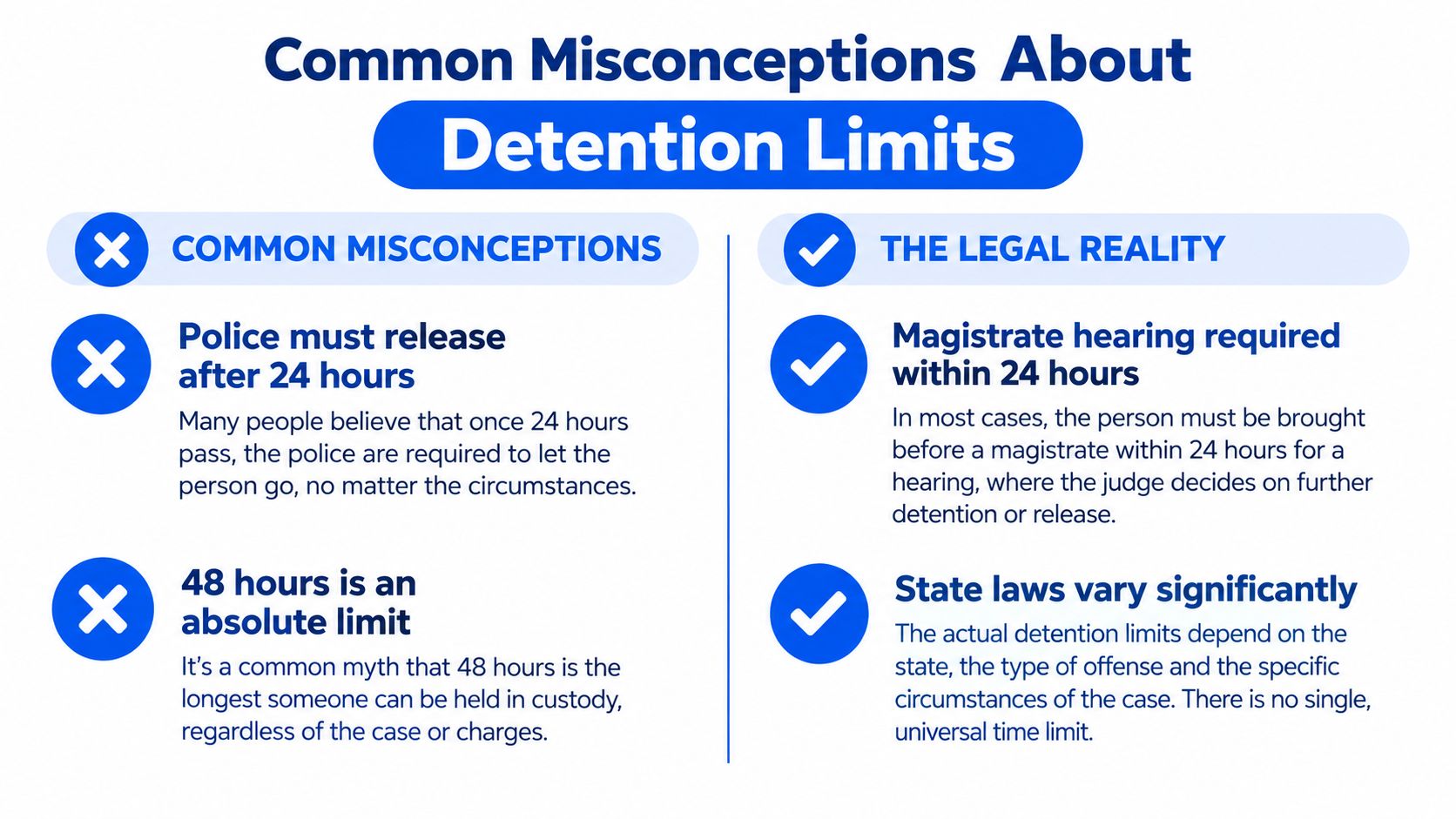
Many people assume the passage of a deadline automatically opens the jail door. That isn't how these rules work. The 24-hour and 48-hour milestones generally require judicial action, but they don't guarantee release if a court enters a lawful bail or detention order.
Misconception | Legal reality |
|---|---|
Police must release everyone after 24 hours | Florida generally requires first appearance within 24 hours, but a court may authorize continued custody. |
Forty-eight hours is an absolute maximum for all custody | The federal rule concerns prompt probable-cause review after a warrantless arrest, not every form of pretrial detention. |
A probable-cause finding means the person is guilty | Probable cause is an early legal threshold, not a conviction or final determination. |
Calling the encounter a “temporary stop” resolves the issue | Courts examine what officers actually did, including restraint, transportation, duration, and questioning. |
Florida's first-appearance process can be especially important in felony cases. Florida Courts materials identify categories that generally must be held until first appearance, including life felonies, offenses punishable by life, first- and second-degree felonies, domestic-violence charges, and failure-to-appear warrants. At that hearing, the judge considers the probability that the defendant committed the offense, past and present behavior, statutory release criteria, community safety, court appearance, and preservation of the judicial process. The Florida Courts first-appearance bench card describes that process.
If the court finds detention necessary, a full pretrial-detention hearing generally must occur within five days of first appearance, subject to the applicable timing rules. A prosecutor's detention motion must state particular grounds and essential supporting facts. Continued incarceration should rest on a judicial process, not just the fact that officers made an arrest.
Real-Life Examples of Escalating Detention Scenarios
A traffic stop begins with an officer asking for a driver's license and registration. The officer notices facts that raise a specific suspicion about a separate offense, so the officer asks the driver to remain outside the vehicle while the inquiry continues. At this stage, the encounter may still be a temporary investigative stop.
The officer then asks questions about an item visible in the vehicle. The driver gives inconsistent answers. Another officer arrives, stands behind the driver, and places the driver in handcuffs while the first officer searches for additional information. The officers may still describe the situation as an investigation, but the practical restraints are becoming more significant.
The moment the legal analysis changes
Suppose the officers transport the driver to a station, continue questioning, and no longer explain that the person may leave. That conduct may support an argument that the stop became an arrest. The issue won't be decided by the officer's preferred vocabulary. A court can examine the full sequence, including the original suspicion, the duration, handcuffs, transportation, number of officers, location, commands, and whether probable cause developed before the restraint intensified.
If officers discover facts that establish probable cause, the escalation may be lawful. For example, evidence observed during a valid encounter may support an arrest, subject to separate search and seizure issues. But if officers prolong the stop without a continuing investigative purpose, the defense may challenge statements or evidence obtained after the unlawful extension.
The best response during the encounter is controlled compliance with safety commands, not physical resistance. Ask whether you're under arrest, ask whether you're free to leave, and avoid answering investigative questions until you've spoken with counsel.
A stop can become an arrest through conduct before anyone uses the word “arrest.”
Later, counsel can reconstruct the timeline from body-camera footage, dispatch records, witness accounts, jail logs, and officer reports. That reconstruction often matters more than the approximate time a person remembers from a stressful encounter.
Know Your Rights During Police Encounters
Your first objective is to avoid turning a questionable detention into a stronger criminal case. Stay calm, keep your hands visible, and don't make sudden movements. You can preserve your legal position without arguing with the officer at the scene.
Use short, clear statements:
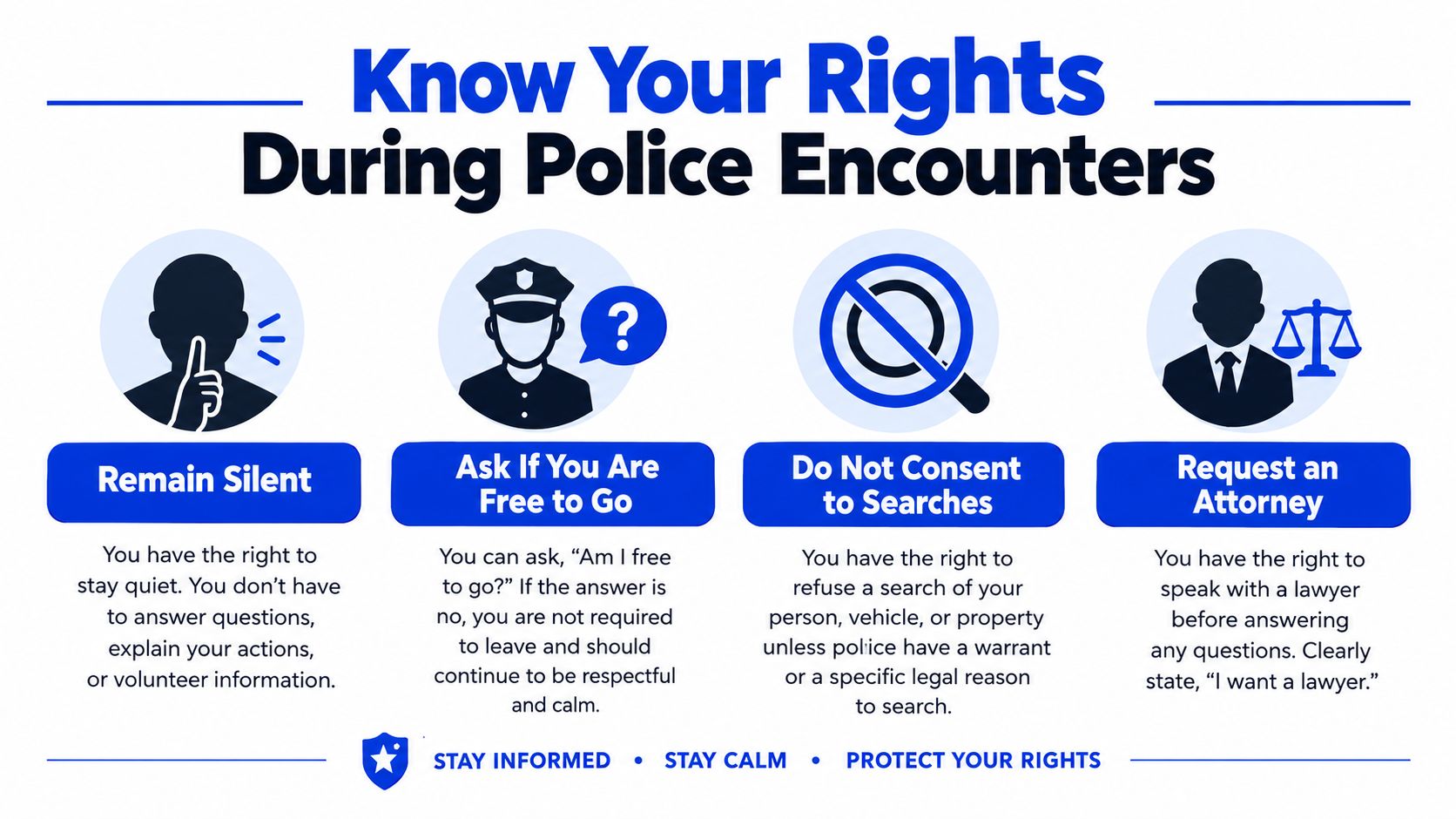
Ask if you're free to leave. If the officer says yes, leave calmly. If the answer is no, ask whether you're being detained or arrested.
Remain silent. You can provide required identifying information when appropriate, but you don't have to explain every detail of an accusation. Say that you're choosing to remain silent.
Don't consent to searches. State clearly that you don't consent, but don't physically interfere if officers search anyway.
Request a lawyer. Say that you want an attorney and stop answering substantive questions.
Why the wording matters
Miranda warnings generally concern custodial interrogation, not every investigative question or temporary stop. Officers may ask questions before giving a warning, and a person can damage a defense by volunteering information before counsel arrives. Learn more about Miranda rights and custodial questioning.
You don't need to persuade the officer that the detention is unlawful. The roadside is rarely the right place to litigate suppression issues. Preserve the objection verbally, avoid consent, follow safety instructions, and let counsel challenge the encounter through the proper court process.
After release, write down what happened while your memory is fresh. Include the officer's words, where you were moved, when handcuffs appeared, what searches occurred, who was present, and when questioning began.
Protecting Your Freedom with Legal Counsel
Early legal advice can change the direction of a criminal case. A lawyer can determine whether the encounter was a stop or arrest, identify when the legal basis changed, and examine whether officers exceeded the lawful scope of the investigation.
That review may involve more than the custody clock. Counsel can assess the arrest affidavit, dispatch history, body-camera recordings, witness statements, search procedures, statements made during questioning, and court records. If officers detained someone without sufficient grounds or delayed required judicial review, the defense may seek remedies that include suppression of evidence or dismissal of specific charges, depending on the facts and governing law.
What effective early review looks like
A useful defense evaluation should answer concrete questions:
When did custody begin? The relevant moment may precede booking if police conduct effectively restrained the person as an arrested suspect.
What justified the original stop? Officers need objective facts supporting an investigative detention.
When did probable cause develop? The timing can affect whether an arrest, search, or statement was lawful.
What did the court decide? First appearance, probable-cause review, bail, and detention proceedings create separate records.
What evidence exists outside the report? Video, dispatch logs, jail records, and witness testimony may reveal a different sequence.
A former prosecutor understands how officers document stops, how prosecutors evaluate affidavits, and where procedural gaps commonly appear. That perspective doesn't guarantee a result, but it can help counsel focus quickly on defenses that may protect against conviction, reduce penalties, or support dismissal where the evidence and law allow.
If you're deciding whom to contact, review these questions to ask a criminal defense lawyer. Don't wait for the case to become more complicated before preserving records and asserting your rights.
Ticket Shield, PLLC provides Florida criminal defense representation for people facing misdemeanors, felonies, violent-crime allegations, weapons charges, drug cases, theft accusations, and probation violations, with direct attorney communication and early case evaluation. If you or a family member is being held in Broward County, Fort Lauderdale, Miami-Dade, Palm Beach, or elsewhere in Florida, visit Ticket Shield, PLLC to discuss the detention timeline and available defense options.