
Drivers License Suspension Florida: Causes and Reinstatement
Jason Goldsmith, Esq
Florida's driver-license suspension system is far broader than many realize. A statewide analysis reported that, as of November 2022, 716,383 Floridians had suspended licenses because of unpaid fines and fees, equal to 1 in 24 driving-age adults. The same analysis found that Florida issued more than one million suspension notices for nonpayment each year, and that unpaid court debt accounted for roughly three out of every four suspension notices, while only 3% involved DUI or other dangerous-driving offenses. Florida's license-suspension statute and state framework show why “drivers license suspension Florida” isn't a single problem. It's a set of administrative, financial, and criminal tracks that require different solutions.
If you're in Broward County, Fort Lauderdale, Miami-Dade, Palm Beach, or elsewhere in South Florida, the first question isn't whether your license is suspended. It's why. The reason determines whether you need to resolve a court case, challenge a DHSMV action, complete a program, address a support-related hold, or defend a new driving-while-suspended charge.
Table of Contents
The Scale of Florida License Suspensions
Florida suspends driver licenses on a scale that surprises many clients. Between 2017 and 2021, more than 5.1 million suspension notices were issued for unpaid court debt, according to the statewide analysis referenced through Florida's statutory license-suspension framework. That analysis also reported that nonpayment suspension notices affect over one million people each year.
Those figures change how you should read a suspension notice. A suspended license does not automatically mean the state believes you drove dangerously or committed DUI. Unpaid fines, fees, failure to appear, and administrative holds often create the suspension before any criminal charge exists.
Suspension cause | Annual cases | Share of notices | Duration |
|---|---|---|---|
Unpaid fines and fees | Over one million notices annually | Roughly 3 in 4 notices | Depends on the underlying requirement |
DUI or other dangerous-driving offenses | Not separately stated in the verified data | 3% | Depends on the offense and applicable statute |
Other administrative triggers | Not separately stated in the verified data | Not stated | Depends on the trigger |
The table also shows what statewide data cannot answer. It identifies the dominant causes, but it does not establish a reliable average duration for every category. Do not assume a reinstatement date from the word “suspended.” Your driving record, notice, court docket, and DHSMV requirements determine what happens next.
Why the cause matters more than the label
A suspension for unpaid court debt may require action with the clerk or court before DHSMV will clear the hold. A point suspension may require completion of a statutory period or other available relief. A DUI-related administrative suspension proceeds separately from the criminal DUI prosecution, so a dismissal in court does not automatically erase the administrative action.
The immediate danger is continuing to drive because the suspension seems administrative or unfair. Florida law treats driving while suspended differently based on knowledge and circumstances. A financial or procedural problem can become a traffic-crime case when the driver received notice and keeps driving.
Practical rule: Treat “suspended” as a warning, not an explanation. Obtain the exact cause, effective date, notice history, and reinstatement conditions before driving.
Repeated moving violations require a separate review for a habitual traffic offender designation. Florida's HTO rules can produce a five-year revocation, and driving during that revocation carries significantly greater criminal exposure. Review the Florida habitual traffic offender law and compare it with the actual driving record before assuming a routine reinstatement will solve the problem.
Administrative Versus Court-Ordered Suspensions
Florida uses two related but distinct systems. Administrative suspensions are imposed through DHSMV authority or another agency's reporting process. Court-ordered suspensions arise from a judge's sentence or a criminal case, although DHSMV may still maintain a separate administrative action arising from the same conduct.
The tracks side by side
Question | Administrative suspension | Court-ordered suspension |
|---|---|---|
Who initiates it | DHSMV or a reporting agency | Criminal or traffic court |
Typical triggers | Unpaid fines, failure to appear, points, test refusal, or agency holds | Conviction, sentence, or court order |
Hearing option | Some actions permit a prompt DHSMV review | Usually addressed through the court process |
Main remedy | Resolve the underlying hold, request review, or satisfy DHSMV conditions | Complete court requirements and obtain clearance |
Criminal case required | Not always | Usually connected to a court matter |
Can both exist together | Yes | Yes |
The distinction matters because the agencies don't automatically solve each other's problems. A criminal defense lawyer may handle the DUI case, but the DHSMV hearing has its own deadline and evidence. Conversely, paying a court obligation may resolve the reason for a suspension without ending a separate DUI administrative action.
Florida's implied-consent system is a clear example. A refusal to submit to a lawful breath, blood, or urine test can trigger an immediate administrative suspension before a DUI conviction. Florida law provides a 1-year suspension for a first refusal and 18 months for a later refusal, with a 10-day temporary driving permit for an otherwise eligible driver. Florida's implied-consent statute describes the separate administrative consequences.
What drivers often get wrong
Many clients assume a judge can restore every type of suspension. That isn't always true. A court may resolve a failure-to-appear matter or modify a sentence, while DHSMV still requires its own documentation, fee, hearing result, or course completion.
Likewise, a DHSMV hearing officer doesn't decide whether you are guilty of DUI. The hearing addresses the administrative suspension and the statutory issues applicable to that action. A favorable administrative result and a favorable criminal result are separate outcomes. For an explanation of the criminal consequences of continuing to drive, see Florida penalties for driving with a suspended license.
Common Triggers That Suspend Your Florida License
The same word, “suspension,” can describe very different events. Start with the trigger shown on your driving record or notice, then match the response to that trigger.
Points and moving violations
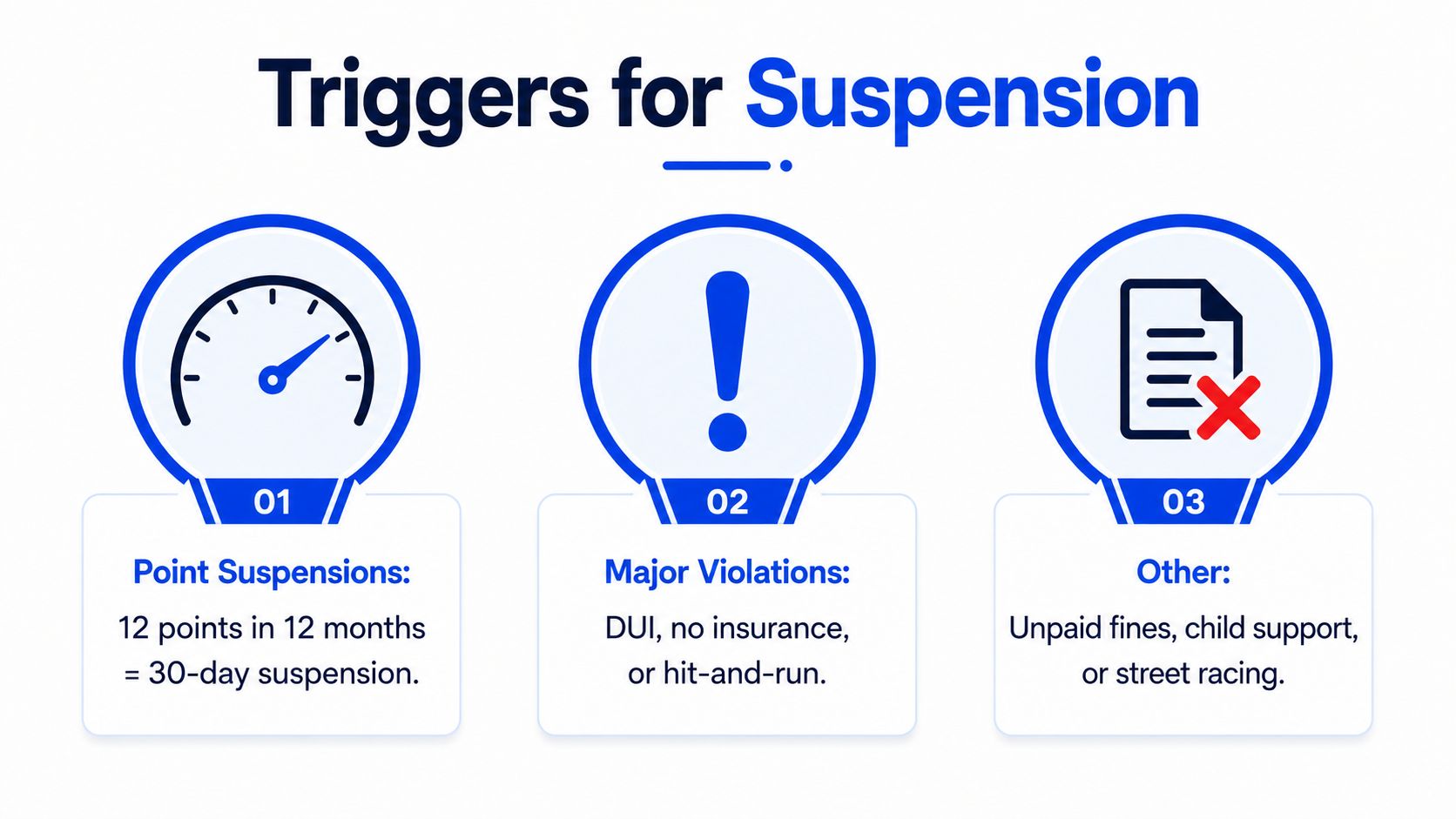
Florida's point system can suspend a license after 12 points in 12 months, 18 points in 18 months, or 24 points in 36 months, as described in Florida DHSMV suspension and revocation guidance. Minor violations can accumulate, and the relevant time window matters. Don't assume an old citation is irrelevant without reviewing the record.
Habitual traffic offender status is a different escalation. Florida's framework uses either 15 moving violations with points assessed within five years or three major violations within five years. Once designated, the driver faces a five-year revocation. The counting rules and dates deserve close review because an incorrect underlying classification can affect the entire revocation.
Unpaid citations and failure to appear
A ticket can create a suspension when the driver doesn't pay, resolve the case, or appear as required. A failure-to-appear hold may involve the clerk, the court, and DHSMV, so paying another unrelated citation may accomplish nothing.
The first practical step is identifying the court that reported the matter. Ask for the case status, available compliance options, and written proof of resolution. Then confirm that DHSMV received the clearance. A court receipt is valuable, but it isn't the same as a reinstated license.
DUI and implied consent
DUI arrests can generate two separate license consequences. The administrative action may begin immediately, while a conviction can produce additional court-related consequences. An OPPAGA report notes that DUI arrests typically result in suspensions lasting six months to one year, while refusal suspensions are one year for a first refusal and 18 months for a later refusal. Florida's current statutory chapter on driver licenses sets out the broader statutory framework.
A first DUI alcohol-level suspension can run six months for a driver aged 21 or older at .08 or above, while a first refusal carries the separate one-year administrative consequence. The Florida DUI administrative suspension materials also explain the review process and temporary driving permissions.

Other holds and overlapping problems
Florida guidance identifies additional triggers, including child-support delinquencies and insurance-related issues. These aren't interchangeable with a DUI suspension. One person can have a court-related hold and a separate agency requirement, which is why generic online instructions often fail.
The safest sequence is:
Obtain the complete DHSMV driving record.
Identify every active suspension, not just the most recent notice.
Contact each responsible court or agency.
Confirm whether a hearing deadline remains open.
Do not drive until the record confirms that your privilege is valid.
The 10-Day Window and Your Hearing Rights
The most expensive mistake after a DUI arrest is waiting for the criminal case to resolve before addressing the license. Florida provides a 10-day period after certain DUI-related administrative actions to seek review. The temporary permit may expire after that period, and waiting can eliminate an important opportunity to challenge the suspension. The Florida Fourth District Court of Appeal's discussion of refusal suspensions confirms the separate nature and duration of the refusal process.
Formal and informal review
A formal review generally involves a more developed evidentiary process. Depending on the suspension, the driver may challenge issues such as probable cause, whether a lawful request was made, whether the driver refused, and whether the required warning was given.
An informal review is more document-centered. It may be appropriate when the dispute turns on paperwork, notice, or the contents of the submitted record rather than contested testimony. The correct choice depends on the suspension and the evidence, not on which option sounds easier.
What the hearing cannot do
A DHSMV hearing isn't a DUI trial. Winning the administrative hearing doesn't automatically dismiss the criminal charge, and losing it doesn't determine guilt in the criminal case. The two proceedings use different decision-makers, records, and legal questions.
The court case and the license case may arise from the same arrest, but they are not the same case.
A lawyer can examine whether the officer had probable cause, whether the refusal was legally established, and whether the state followed required notice procedures. In an appropriate formal hearing, subpoenas and witness examination may matter. Breath-test records, maintenance documentation, and chain-of-custody questions can also become relevant when the administrative record depends on testing evidence.
Use the Florida administrative license suspension hearing guide to understand the process, but don't rely on a general page to calculate your personal deadline. The date on your paperwork and the exact type of action control.
Reinstatement Steps and Hardship License Options
Reinstatement is usually a sequence, not a single payment. The wrong first step can waste time because satisfying one requirement doesn't necessarily clear another suspension.
Start with the record
Pull the DHSMV record and identify:
The suspension or revocation reason.
The effective date and end date.
Any separate holds.
Whether a hearing deadline remains available.
The court, agency, course, or insurance documentation still required.
Don't assume the notice you received lists every active problem. A driver who resolves an unpaid fine may still have a point suspension, a refusal action, or a court-imposed condition.
Clear the underlying requirement
The next step depends on the trigger. A court-related suspension may require resolving the case with the clerk or judge. A DUI matter may require a course, proof of insurance, an ignition interlock condition, or compliance with a mandatory period. An insurance-related hold may require the documentation DHSMV specifies.
Reinstatement fees also vary by the violation and the applicable administrative rule. Avoid relying on an online figure unless it appears on your current DHSMV record or official reinstatement instructions.
Consider restricted driving carefully
A hardship or Business Purpose Only license isn't a general permission to drive whenever you want. Florida materials describe hardship eligibility as potentially involving a hearing, course completion, and proof of serious hardship. Permitted travel may include work, school, medical appointments, or religious services, but the exact restrictions depend on the license and suspension type.
A restricted license can help with essential obligations, but driving outside its terms can create a new violation and undermine the reinstatement strategy. Ask for the permitted purposes in writing and keep the license conditions with you.
Apply through the correct channel
After completing the requirements, submit the documentation through the appropriate DHSMV office or authorized tax collector and confirm that the record changed. Don't drive merely because you paid a fine, completed a course, or left a hearing. Drive only after the state confirms that your privilege is reinstated or that a restricted license is active.
The Florida suspended-license reinstatement guide can help organize the process. For a specific case, a lawyer should review the complete record before advising that you drive.
How a Former Prosecutor Approaches Suspension Defense
A former prosecutor knows that the state's file often depends on records that nobody has tested closely. The defense question isn't whether DHSMV shows a suspension. It's whether the state followed the law, whether the notice was adequate, whether the underlying event supports the action, and whether a later driving charge can prove the required elements.
The evidence gets tested from both directions
A suspension defense may involve reviewing:
The legality of the traffic stop.
The facts supporting probable cause.
The officer's request for chemical testing.
Warning language and refusal documentation.
Breath-test maintenance and calibration records.
Chain-of-custody materials.
DHSMV notice and address records.
The dates and classifications used to calculate points or HTO status.
The criminal and administrative proceedings require different strategies, but an error in one record can affect the other. A missing notice, incorrect date, or misclassified prior offense may create an advantage even when the driver can't avoid every consequence.
What early action preserves
Some mandatory suspensions cannot be negotiated away. That limitation should be stated plainly. But early review can preserve a hearing, identify a procedural defect, prevent an incorrect HTO designation, or resolve the underlying court matter before a new DWLS charge develops.
A driver in Fort Lauderdale, Broward County, Miami-Dade, or Palm Beach County may also need coordination among a criminal court, traffic division, clerk, DHSMV, and a hardship hearing office. The Broward County criminal defense attorney resource provides a starting point for contacting counsel familiar with those overlapping systems.
Frequently Asked Questions About Florida Suspensions
Can I drive to work with a suspended license?
Usually not, unless DHSMV has formally granted a restricted or hardship license. A work commute by itself doesn't make ordinary driving lawful.
What happens if I drive while suspended?
Under Florida Statute 322.34, driving without knowledge can be treated differently from driving with knowledge. With knowledge, the offense can become criminal, and repeated conduct or driving during an HTO revocation can create substantially greater exposure.
Will another state's suspension follow me?
It may. Florida participates in interstate driver-record reporting arrangements, so don't assume an out-of-state issue disappears after moving. Obtain both records and ask DHSMV how the suspension is being treated.
Is a revocation the same as a suspension?
No. A suspension temporarily withdraws driving privileges for a defined period or until conditions are met. A revocation cancels the privilege and generally requires a more involved path before a new license can issue.
Does paying the fine reinstate my license?
Not automatically. The court or agency must clear the underlying matter, and DHSMV may still require fees, courses, insurance documentation, or other conditions.
How do I check my status?
Use the official Florida DHSMV online driver-license services and obtain your driving record. If the record is unclear, don't drive until a lawyer or DHSMV confirms your current privilege.
Ticket Shield, PLLC handles Florida suspended-license tickets and related DUI, traffic-crime, and criminal defense matters, including review of DHSMV records and administrative hearing deadlines. For a confidential consultation about your suspension in Broward County, Fort Lauderdale, Miami-Dade, Palm Beach, or elsewhere in Florida, contact Ticket Shield, PLLC before you drive or let a hearing deadline expire.