
What Is Forgery and Uttering in Florida
Jason Goldsmith, Esq
You sign paperwork at a Clearwater dealership, endorse a money order for a landlord, or deposit a check from a new employer. Days later, a detective calls and says the signature or document may be fraudulent. You may be wondering whether you're accused of making the document, using it, or both.
The answer starts with a distinction that many people miss. Forgery and uttering are related, but they describe different conduct under Florida law. Forgery generally concerns making or changing a false document. Uttering concerns knowingly presenting or using that document as genuine. A person may face both allegations involving the same document, but the State still has to prove the separate elements of each charge.
A signature, printed name, electronic mark, or digital stamp isn't automatically criminal. The prosecution must connect the accused to a false or altered item, establish the required knowledge and intent, and prove each element beyond a reasonable doubt. If you've received a target letter or an arrest call, learning what happens after an arrest in Florida can help you avoid making the situation worse while you seek legal advice.
Table of Contents
When a Signature Becomes a Crime
The first question is not merely, “Did your name appear on the document?” The more useful questions are what the document was, who created or changed it, what the accused knew, and what the accused intended.
Suppose a buyer signs a dealership form using a name they're authorized to use. That may be legitimate. If someone changes a deed, adds another person's signature without authority, or creates a false certificate to make it look official, the State may view the conduct differently. Even then, prosecutors must prove more than an error, misunderstanding, or sloppy paperwork.
Two acts, two theories
Forgery focuses on the alleged creation or alteration of the item. The document may be a public record, deed, certificate, note, check, or another legally significant writing. The central issue is whether the accused knowingly made or materially changed something so it appeared authentic, with an intent to injure, deceive, or defraud.
Uttering focuses on the later presentation or attempted use of the item. The person accused of uttering may not have created the document. The State instead must show that the person knew it was false and still passed, offered, published, tendered, or used it as genuine with the required fraudulent intent.
Practical rule: Possession of a questionable document isn't automatically proof that someone uttered it.
Florida statutes place related offenses in Chapter 831, but the underlying distinction remains important. A prosecutor may argue that one person fabricated a writing and then presented it. A defense lawyer should test the evidence separately for each act rather than treating the two accusations as interchangeable.
Defining Forgery Under Florida Law
A person signs a deed for someone else, changes a certificate after it was issued, or creates a writing that appears to carry official authority. Florida prosecutors may call that forgery, but the label alone does not prove the charge. The State must connect the accused to the false writing or alteration and prove the required fraudulent intent.
In plain English, forgery is the alleged making, altering, or counterfeiting of a writing so that it appears genuine, together with an intent to injure, deceive, or defraud when the charged statute requires it. The issue is not just whether paperwork contains a mistake. A legitimate amendment, authorized signature, clerical correction, or reissued document can raise a different legal question from a fabricated or materially changed item.
Florida Statutes § 831.01 addresses falsely making, altering, forging, or counterfeiting certain public records and official documents. The provision includes specified certificates, returns, and attestations issued by public officers when they relate to matters that may be accepted as legal proof. The Florida forgery statute for public records and official documents identifies the document categories covered by that provision.
Three questions the State must answer
Was the writing false, forged, or altered? The prosecution must identify what makes the item legally false. An unusual appearance alone may not establish forgery. The original document, the alleged change, and whether the change was substantial or material can all matter.
Did the accused make or materially change it? The State must provide evidence tying the person charged to the alleged creation or alteration. Another person's handwriting, access to a computer, or use of a device does not automatically prove authorship.
Was there fraudulent intent? A mistake, misunderstanding, or inaccurate statement does not necessarily show an intent to deceive or defraud. Prosecutors may rely on surrounding circumstances, but the evidence still must support the mental state required by the statute.
Florida Statutes § 831.04 addresses certain erasures, alterations, interlineations, and interpolations in covered writings and instruments. That language makes the document's original form, the timing and nature of the change, and the accused's knowledge relevant defense issues. A forgery allegation can also intersect with broader fraud theories, as explained in our guide to organized scheme to defraud.
The alleged making or alteration may support a forgery theory even if no court or government office ultimately accepts the item. A failed transaction does not automatically end the investigation, while an unusual document does not automatically establish every element. The State must prove the specific charged conduct and intent.
Defining Uttering Under Florida Law
A customer hands a clerk an insurance card and says it is valid. The card is fake, but the customer did not design or print it. That conduct can still support an uttering charge because the alleged crime centers on presenting the item as genuine.
Uttering means knowingly presenting, passing, publishing, offering, tendering, or attempting to use a false item as though it were genuine. The term may sound technical, but the question is practical: did the accused represent a false document or instrument as real? The State does not necessarily need to prove that the same person created it.
Florida Statutes § 831.02 addresses uttering or publishing a false, forged, or altered record or writing as true. The State must prove that the accused knew the item was false and acted with intent to injure or defraud. The statute's history reaches back to 1868, and the offense is a third-degree felony. The text of Florida Statutes § 831.02 sets out the conduct and mental state the prosecution must establish.
Use matters more than authorship
Florida Statutes § 831.09 covers knowingly passing or tendering certain false, altered, forged, or counterfeit financial instruments as genuine. The listed instruments include notes, bank bills, checks, drafts, and promissory notes. This provision also requires intent to injure or defraud another person. It is a third-degree felony, traces to 1868, and lists a 2001 amendment in its history. The Florida Chapter 831 statutory text provides the statutory language.
Uttering theories also arise in prescription cases, which carry their own rules. See our overview of prescription fraud defense in Florida.
The customer in the example may face an uttering theory because of the presentation, even if someone else produced the card. A clerk who accepted it without knowing it was false may lack the knowledge required for the charge.
The State must therefore prove more than falsity. It must connect the accused to the presentation, show knowledge of the item's falsity, and establish the required fraudulent intent. Defenses may examine whether the person knew the truth, whether the item was offered as genuine, and whether the surrounding facts support the claimed purpose.
How Forgery and Uttering Differ
Forgery and uttering can appear in the same investigation, but they answer different questions. Forgery asks who made or changed the item. Uttering asks who knowingly presented it as genuine.
Element | Forgery | Uttering |
|---|---|---|
Core act | Making, altering, or counterfeiting a false writing or instrument | Passing, publishing, offering, tendering, or using a false item as genuine |
Mental state | Knowledge of the falsity or alteration, together with intent to injure, deceive, or defraud | Knowledge that the item is false, together with the required intent to injure or defraud |
Statutory home | Florida Statutes §§ 831.01 and 831.04 address specified public documents and alterations | Florida Statutes §§ 831.02 and 831.09 address false records, writings, and financial instruments |
Who may be charged | The person the State claims made or materially changed the document | A person who knowingly presents the item, even if another person created it |
Typical evidence | Original and altered versions, handwriting or signature comparisons, metadata, templates, communications, and access records | Transaction records, surveillance, messages, delivery evidence, statements, and proof of knowledge |
State's proof | The State must connect the accused to the creation or material change and fraudulent intent | The State must prove knowing presentation as genuine and fraudulent intent |
Why one document can produce two counts
If a person allegedly alters a deed and later submits it for recording, the State may claim the alteration supports forgery and the submission supports uttering. Those theories aren't automatically established just because the same document appears in both allegations.
The prosecution still has to prove authorship, falsity, knowledge, materiality where required, and intent. It may also need to establish that the document fits the statute charged. A defense lawyer should examine each count independently, just as they would examine the difference between unauthorized taking and other property offenses under Florida's theft statute.
Real Scenarios in Florida Courtrooms
The same legal distinction can look different depending on the document and the alleged conduct. These examples show how prosecutors may package the facts, while also showing what remains unproven until the evidence is tested.
A check used at a Tampa grocery store
A customer writes a check from a closed account and gives it to a grocery store. The State may pursue an uttering theory if it can prove the customer knowingly presented the check as genuine and intended to injure or defraud the store.
That fact pattern doesn't automatically establish an independent forgery charge. Prosecutors would still need evidence that the customer made, altered, or counterfeited the check, rather than merely used an instrument created by someone else. The defense may examine account records, communications, the customer's understanding of the account status, and the circumstances of the transaction.
An altered deed in Duval County
Someone changes the grantee's name on a deed and submits the document to a clerk for recording. The alleged change may support a forgery theory involving a public record or legally significant writing. The submission may also create an uttering issue if the State claims the person knowingly presented the altered deed as authentic.
The State must still prove who changed the name, whether the change was authorized, whether it was material, and what the accused knew when the deed was submitted. The original deed, recording history, metadata, communications, and access to the document may become central evidence.
A forged prescription pad at a Broward pharmacy
A person creates a prescription using a medical provider's information and then presents it at a pharmacy. The alleged creation supports the forgery theory. The later presentation may support uttering if the State can show the person knew the prescription was false and intended to obtain medication through deception.
Prescription-related allegations can involve additional criminal theories depending on the facts. A defense lawyer should preserve the prescription, pharmacy records, surveillance video, messages, and electronic data before focusing on assumptions about who created the document. The same sequence can support two distinct allegations, but each still requires separate proof.
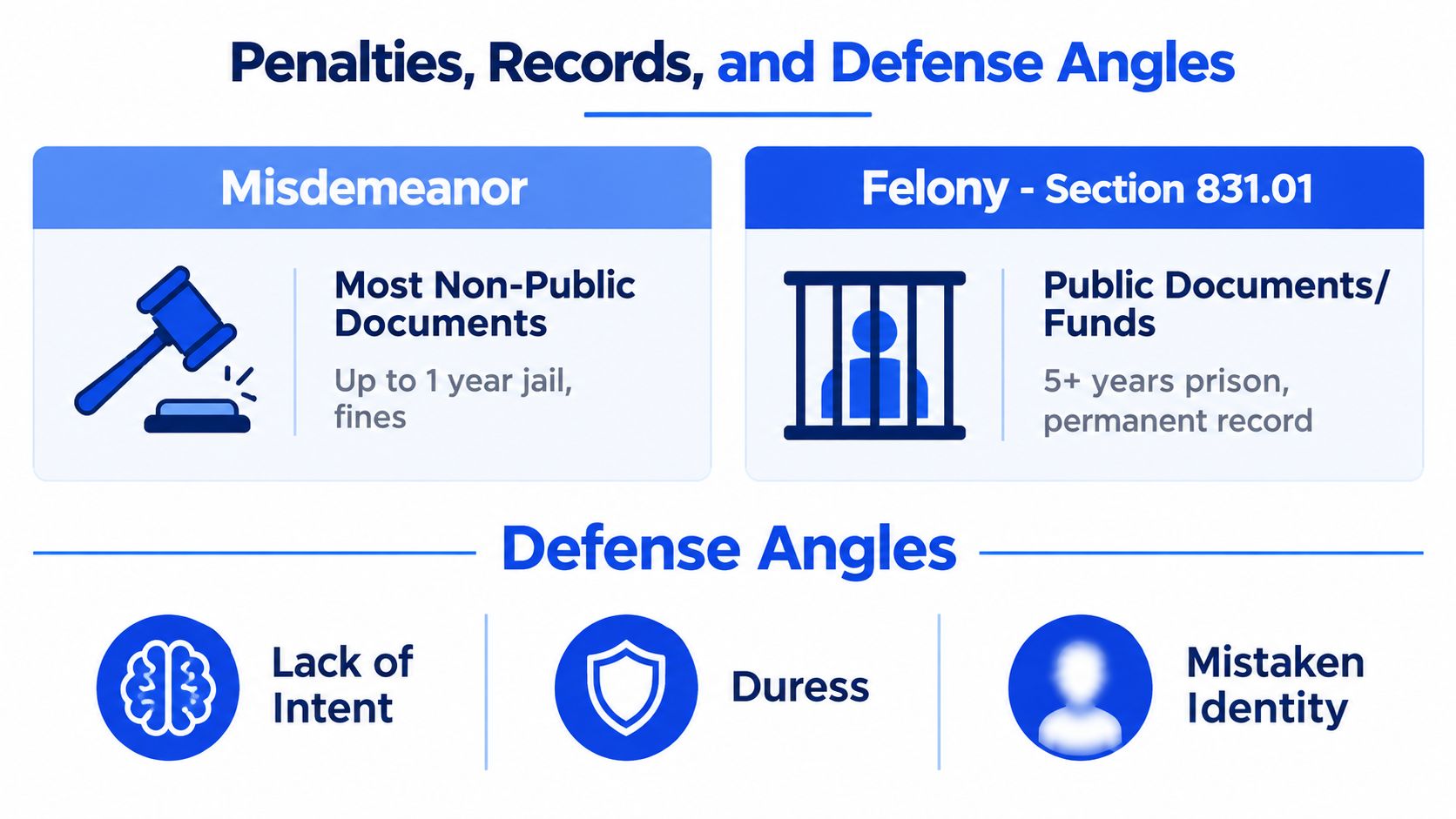
Penalties, Records, and Defense Angles
Florida's Chapter 831 offenses can carry felony consequences. Florida Statutes § 831.01 classifies specified forgery of public records and official documents as a third-degree felony, while §§ 831.02 and 831.09 also identify third-degree felony treatment for the conduct described in those provisions. The exact exposure depends on the statute charged, the document involved, the alleged conduct, prior history, and the sentencing decision available in the case.
The statute doesn't turn every paperwork dispute into forgery. A defense lawyer should identify whether the document falls within the statute, whether the alleged change was material, and whether the State can prove knowledge and fraudulent intent. Those issues can affect negotiations, motions, trial strategy, and the potential outcome.
Evidence that deserves scrutiny
A careful investigation may focus on:
Intent: Did the accused know the item was false, or did they reasonably believe it was authentic or authorized?
Materiality: Did the alleged alteration substantially change the writing where the charged provision requires that kind of change?
Identity: Who signed, edited, printed, uploaded, or submitted the document?
Digital records: Can the State authenticate metadata, electronic messages, device data, or account activity?
Chain of custody: Did investigators preserve the original item and document every transfer and examination?
Pressure and inducement: Did another person use coercion, threats, or improper inducement that affects the defense?
The State carries the burden of proving every element beyond a reasonable doubt. Circumstantial evidence may be important, but a suspicious circumstance isn't the same as proof of criminal intent. A defense lawyer may also investigate suppression issues, unreliable identification, inconsistent explanations, and gaps between the document and the person accused.
A conviction can affect employment, licensing, reputation, and immigration status. The potential record consequences depend on the resolution and the person's circumstances. Before accepting any plea, ask whether a diversionary option, dismissal, or other resolution may be available and whether the result can later qualify for record sealing under Florida law.
Questions Clients Ask After Being Charged
Can charges be dropped before arraignment?
Sometimes. A complaining witness's refusal to cooperate doesn't automatically end a case because prosecutors may have bank records, surveillance, electronic communications, or other evidence. But if the evidence doesn't establish falsity, identity, knowledge, presentation, or intent, the defense may have grounds to seek a decline, dismissal, or reduction.
Don't contact an alleged victim to pressure them or explain your side. That communication can create new evidence and may be misunderstood. Route communications through counsel whenever possible.
Should I give law enforcement a document or handwriting sample?
Don't hand over records or provide a recorded statement without understanding your rights and speaking with a lawyer. You generally have the right to remain silent after a custodial interrogation under Miranda, and the Sixth Amendment protects the right to counsel once it attaches in the criminal process. The exact application depends on the circumstances, so ask counsel before responding to police, a bank investigator, or a recording officer.
A handwriting request also deserves careful attention. A lawyer can assess whether the request is voluntary, compelled, properly documented, or useful to the defense. Don't destroy, edit, hide, or discard documents, phones, messages, or account records. Preserve them and provide them to your attorney.
How does a lawyer challenge the State's case?
The defense often starts with the original instrument, not a photocopy or screenshot. Counsel may demand chain-of-custody records, subpoena surveillance video, review bank and recording-office files, and retain a forensic document examiner to evaluate signatures, alterations, printing characteristics, and authenticity.
The lawyer also separates the mental states. Someone may have handled a document without knowing it was false. Someone may have believed they had authority to sign. Someone may have delivered paperwork without intending to defraud anyone. Those explanations require evidence, and the defense should test whether the State can disprove them beyond a reasonable doubt.
What might the timeline look like?
A case may begin with an arrest, notice to appear, or investigative contact. The first appearance addresses immediate court issues, while later hearings give the defense time to obtain discovery, examine documents, investigate witnesses, and identify weaknesses.
Resolution may come through dismissal, diversion, a negotiated plea, or trial, depending on the evidence and the client's objectives. The timeline varies by county, charge, and complexity. Avoid discussing the facts publicly or posting documents online while the case is pending.
Ticket Shield, PLLC represents people accused of forgery, uttering, prescription fraud, and other Florida criminal offenses, with a focus on protecting constitutional rights and testing the State's evidence. Contact Ticket Shield, PLLC to discuss the document, the alleged use, and the next step in your South Florida defense.