
DUI Hit and Run in Florida: Charges, Penalties, and Defense
Jason Goldsmith, Esq
You may be reading this after leaving a crash in Broward County, sitting in a police interview room, or learning that investigators identified your vehicle hours later. Maybe you panicked. You saw damage, felt the pressure of alcohol on your judgment, and drove away before anyone could ask questions. That decision can create serious exposure, but panic isn't the same thing as proof of every allegation.
A DUI hit and run in Florida usually involves two separate issues: whether you were driving under the influence and whether you unlawfully left a crash scene. The State Attorney may pursue both counts independently. Your priority now is to stop giving investigators new evidence, preserve what already exists, and get a Florida criminal defense lawyer involved before statements and license deadlines work against you.
Table of Contents
What Happens When a DUI Becomes a Hit and Run in Florida
After midnight on a Broward road, the pavement may still be warm beneath the headlights when a driver realizes there has been contact. The car may have a damaged mirror, a dented bumper, or almost no visible mark at all. The driver stands on the shoulder with two immediate choices: stay and explain, or leave before a witness notices the driver's eyes, speech, or balance.
People often choose the second option out of fear, not because they planned a criminal offense. They may worry about arrest, immigration consequences, employment, a prior record, or losing a license. That panic-driven decision still creates a separate legal problem. Florida prosecutors can treat the alleged impaired driving and the alleged failure to remain at the scene as parallel charges.
A DUI already carries potential consequences involving fines, incarceration, license revocation, and ignition-interlock requirements. A leaving-the-scene allegation under Florida Statute 316.027 adds another count, and the degree of that count depends primarily on the harm caused. Property damage may remain a misdemeanor. Injury, serious bodily injury, or death can move the case into felony court.
Practical rule: Leaving the scene doesn't make the DUI disappear. It gives investigators another theory of the case and may give the prosecution additional leverage.
The evidence also expands. A DUI investigation may focus on the traffic stop, driving pattern, field sobriety exercises, statements, and chemical testing. A hit-and-run investigation adds vehicle identification, crash reconstruction, surveillance footage, witness accounts, and proof that the driver knew a crash occurred.
You should read the Florida DUI framework alongside the leaving-the-scene allegation, not treat them as one blended accusation. The firm's explanation of Florida DUI law and common defense issues provides useful context, but your own facts determine whether the State can prove either count beyond a reasonable doubt.
How Florida Grades the Leaving the Scene Charge
If you left after a crash because panic took over, the legal consequences depend heavily on what happened to the other person or property. Florida grades the leaving-the-scene charge by the collision's result. The same decision to drive away can remain a misdemeanor in one case and become a serious felony in another.
Property damage only
When a crash causes property damage but no bodily injury, leaving the scene is generally a second-degree misdemeanor. The driver must stop, provide required identifying and insurance information, and take the reasonable steps required by law. Florida's statutory maximum for a second-degree misdemeanor is up to 60 days in jail, in addition to applicable fines and court consequences.
A damaged parked vehicle in Fort Lauderdale can therefore lead to a criminal case even when nobody visits a hospital. Do not treat a minor dent as legally harmless. Reported damage, vehicle evidence, and the circumstances of your departure still matter.
Injury
Bodily injury can produce a more serious misdemeanor. Florida distinguishes between lesser injury and more serious injury, and the charge can reach a first-degree misdemeanor. That offense can carry up to one year in jail, while a second-degree misdemeanor has the lower statutory maximum.
Prosecutors may examine medical records, emergency calls, photographs, witness observations, and the force of the impact when deciding how to characterize the injury. A person's soreness alone does not determine the charge, but the medical evidence can change the case quickly.
Serious bodily injury
If the crash causes serious bodily injury, leaving the scene becomes a third-degree felony. The statutory maximum is up to five years in prison. A felony can affect employment, professional licensing, housing, immigration status, firearm rights, and eligibility to seal or expunge a record.
For a Broward County driver, the other person's medical condition may matter more than the visible vehicle damage. Get the injury evidence reviewed before assuming the charge will stay at a misdemeanor level.
Death
Leaving a crash scene involving death is a first-degree felony under Florida law, carrying a statutory maximum of up to 30 years in prison and a $10,000 fine. Florida law also provides a mandatory minimum prison term of 4 years for a qualifying fatal leaving-the-scene offense. Review the statutory language and related requirements through Florida's hit-and-run and DUI statutory provisions.
Harm Level | Charge Degree | Max Punishment |
|---|---|---|
Property damage only | Second-degree misdemeanor | Up to 60 days in jail |
Injury | Second-degree or first-degree misdemeanor, depending on injury | Up to 1 year in jail |
Serious bodily injury | Third-degree felony | Up to 5 years in prison |
Death | First-degree felony | Up to 30 years in prison and a $10,000 fine |
The State generally does not need to prove that you intended to injure anyone. It must prove your involvement in the crash, the duty to stop and provide information, your failure to comply, and the applicable harm level. The charge also remains separate from any DUI count. Read a framework for how Florida treats a DUI alongside a separate failure-to-remain charge, and have the facts evaluated before making statements or decisions about the case.
How DUI Penalties Stack on Top of the Hit and Run
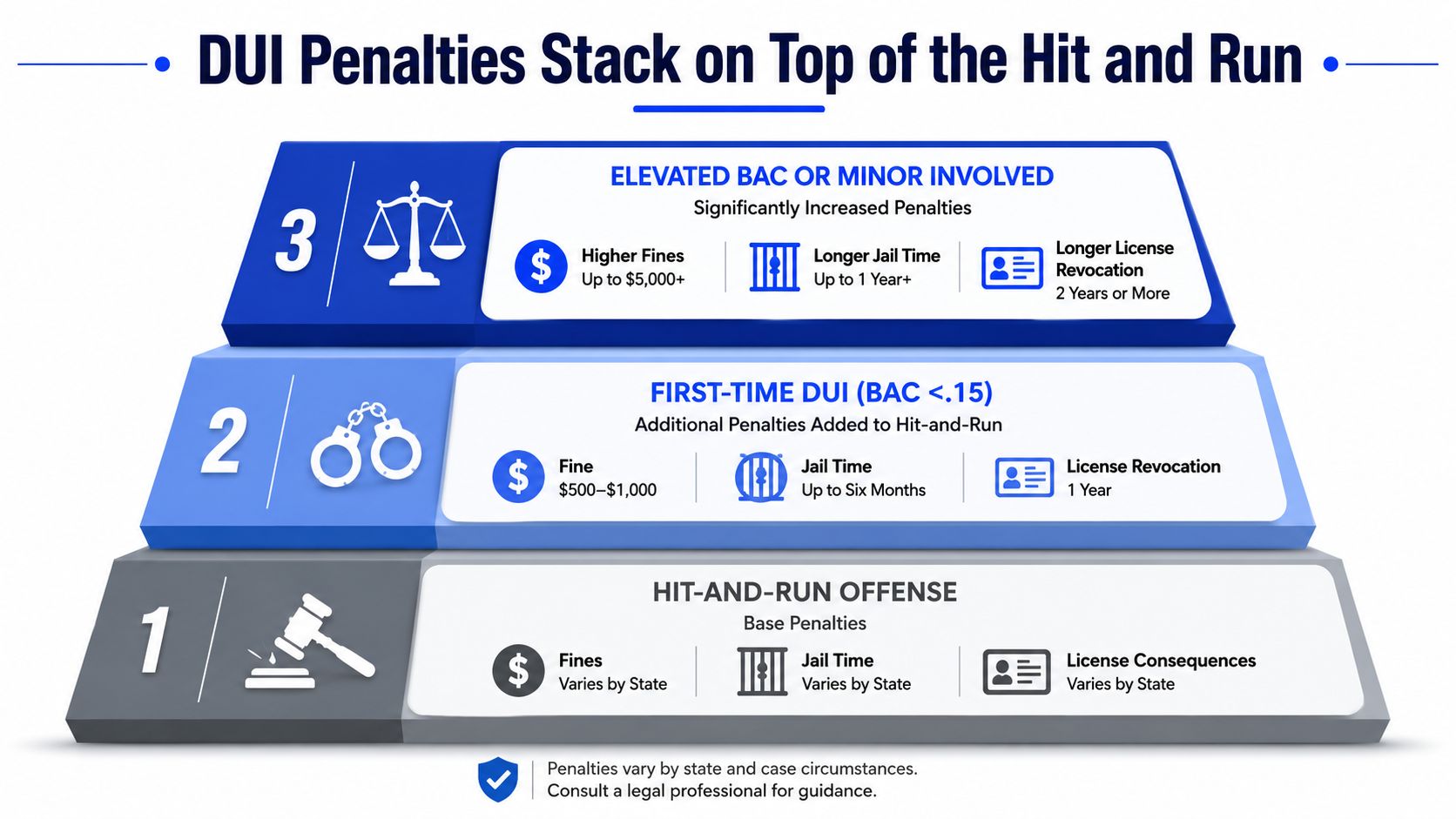
Leaving the scene is only one charge. The DUI count brings separate penalties, and the State can pursue both. Florida's tiered statute grades the leaving-the-scene offense by harm, so a crash that begins as a misdemeanor allegation can become a felony case once injury, DUI history, or other enhancements enter the picture. Review the exact statute that classifies leaving-the-scene charges from misdemeanor to first-degree felony based on harm before assuming the charges will remain at the lowest level.
For a first-time DUI with a BAC below .15, Florida law provides a $500 to $1,000 fine, up to six months in jail, and a one-year license revocation. A BAC of .15 or higher, or a minor in the vehicle, raises the fine range to $1,000 to $2,000, increases potential jail exposure to up to nine months, and requires at least nine months of ignition interlock use under the applicable DUI framework. See Florida DUI penalty guidance for the DUI-specific consequences.
A refusal creates a separate administrative problem. Florida law permits an administrative suspension when a driver has an unlawful blood-alcohol or breath-alcohol level of 0.08 or higher, or refuses a lawful chemical test. A first refusal suspension lasts 1 year, while a prior refusal can result in an 18-month suspension.
Why the charges create combined pressure
Each count requires separate proof, but the evidence overlaps. The prosecutor may call the alleged flight consciousness of guilt. The defense may show panic, confusion, injury, or lack of knowledge caused the departure. A high BAC makes negotiations harder, but it does not eliminate challenges to the stop, testing process, or identity evidence.
A fourth or subsequent DUI is a third-degree felony and can lead to permanent license revocation. Whether sentences run concurrently or consecutively depends on the charges, sentencing rules, criminal history, and the judge's rulings. The practical risk is clear: DUI penalties can sit on top of a harm-based leaving-the-scene felony, producing exposure far beyond either allegation viewed alone.
First 48 Hours After the Crash and the Arrest
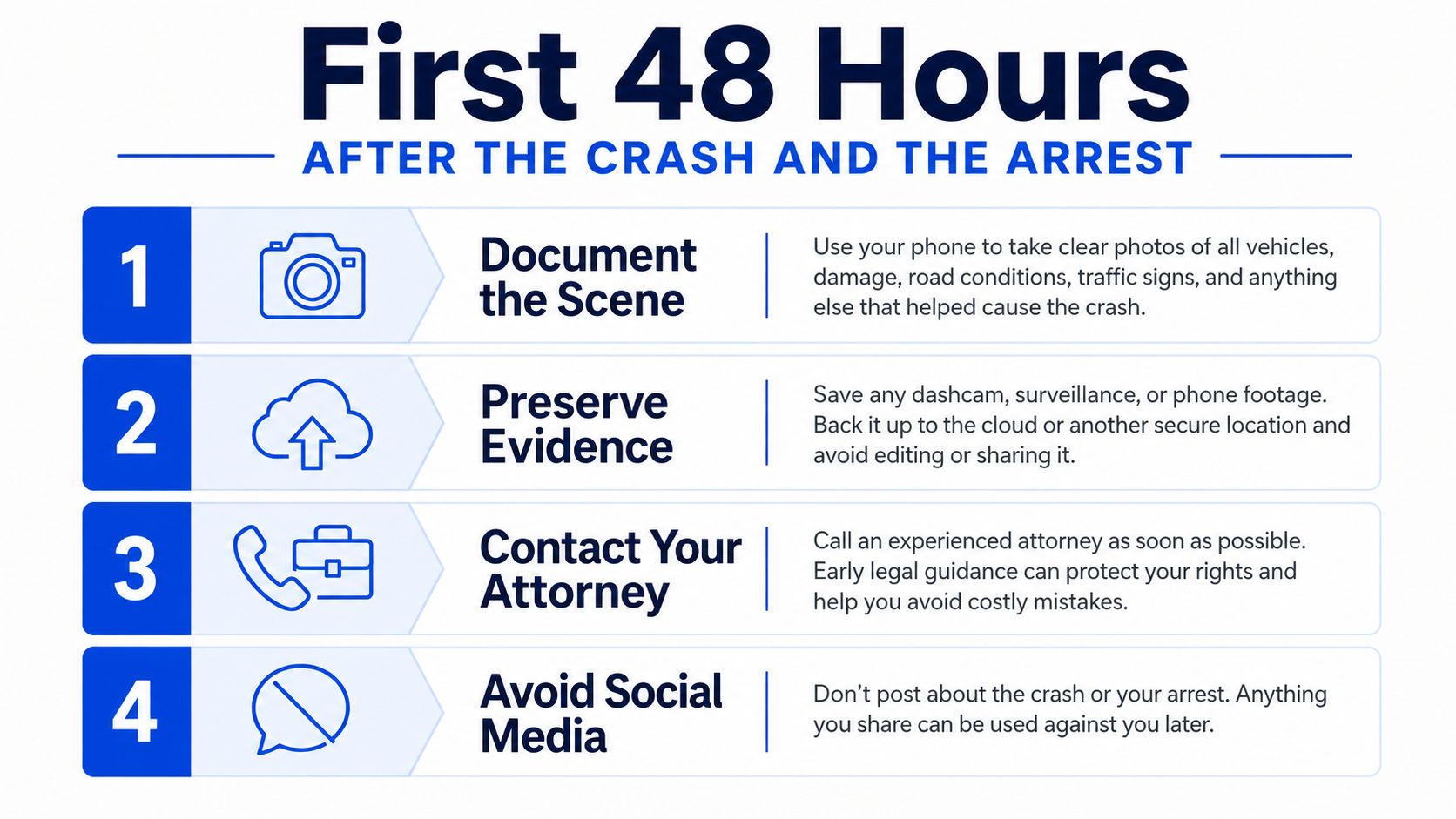
If you left a crash scene in panic and were arrested hours later, your first decisions can shape both cases. Do not call, text, or speak with the other driver, police, or an insurance adjuster about what happened before consulting counsel.
Start with physical evidence
Photograph your vehicle from every angle, including damage, missing parts, paint transfer, tire condition, and the interior. Keep it in its current condition unless your lawyer advises otherwise. A repair shop could replace or discard parts that a crash reconstruction expert may need.
Save dashcam files, phone videos, location records, photographs, and messages immediately. Devices can overwrite footage, and accounts may delete material automatically. Preserve original files and store copies securely.
Control communications
Law enforcement may contact you after identifying the vehicle. Provide basic identifying information when legally required, but do not guess about speed, alcohol, impact, timing, or your reason for leaving. Avoid social media posts about the crash, drinking, vehicle, or whereabouts. A post from the first night can become evidence.
Your first statement may become the prosecution's clearest timeline. Do not create it while frightened or intoxicated.
Protect the license
Florida's administrative suspension process runs separately from the criminal case. Calendar the 10-day deadline to request a formal review of the suspension. Missing it can eliminate an important opportunity to challenge the administrative action.
A refusal is not risk-free, and it does not end the criminal investigation. Review the consequences with counsel through Florida breathalyzer refusal guidance, then address the suspension promptly.
How Investigators Build a DUI Hit and Run Case
Investigators rarely rely on one piece of evidence. They assemble a timeline from separate sources and try to connect the vehicle, the driver, the crash, and alleged impairment.
The vehicle and roadway trail
Police may collect business-camera footage, red-light camera recordings, toll-transponder data, debris, paint transfer, and partial plate information. They may canvass homes and businesses near the crash site for witnesses. A damaged bumper that matches fragments from the roadway can become more important when a witness remembers only a vehicle color or body style.
Phone-location data, vehicle event-data-recorder downloads, and social media posts may help investigators place a person and vehicle near the incident. Each source has limitations. Location data may show a device, not who held it. A vehicle module may record impact-related information without proving intoxication. Social media posts can lack reliable timestamps or context.
Delayed identification and toxicology
When police identify a driver hours or days later, they may pursue a blood draw under Florida's implied-consent framework or rely on later observations and statements. A delayed BAC result doesn't automatically establish the driver's condition at the time of the crash. The defense should examine timing, collection procedures, storage, laboratory methods, and whether the State can scientifically connect the result to the driving event.
The CDC describes the practical evidentiary footprint of impaired-driving crashes, including toxicology, witness observations, crash timing, and physical evidence, in its impaired-driving facts and enforcement overview. That combination gives investigators several paths, but each path still has to satisfy constitutional and evidentiary requirements.
Evidence Type | What It Shows | Auto-Delete Window |
|---|---|---|
Traffic and business video | Vehicle movement, collision, driver conduct | Varies by system |
Toll-transponder records | Vehicle passage and route timing | Depends on custodian and retention policy |
Paint and debris | Possible vehicle involvement | Physical evidence can be altered or discarded |
Phone records | Device location and communications | Provider and account retention varies |
Ring or Nest footage | Nearby activity and vehicle movement | Account settings and storage policies vary |
Event-data recorder | Vehicle speed, braking, and impact-related information | Vehicle and module handling can affect availability |
Blood or breath testing | Chemical evidence of alcohol concentration | Collection, storage, and laboratory records matter |
A defense lawyer should send preservation letters quickly to businesses, homeowners, toll authorities, phone carriers, and other custodians. The purpose is to prevent routine deletion before the State Attorney files charges. Florida legal blood-draw issues can also affect whether toxicology evidence is admissible.
Defenses That Can Reduce or Dismiss the Charges
Leaving a crash scene during a panic can create serious exposure, but the State still must prove every required element. A weak identification, uncertain crash connection, or missing proof of knowledge can change the charge and the available defenses.
Lack of knowledge
The prosecution must show that the driver was involved in the relevant crash and knew facts that created a duty to stop. Low-speed contact, darkness, loud traffic, hidden damage, or an unfamiliar mechanical noise can support a factual dispute over whether the driver realized a collision occurred.
Test that explanation against the physical and recorded evidence. A sudden stop, visible damage, witness testimony, or a statement acknowledging impact can weaken it. Prosecutors still need evidence that the driver recognized the collision. Assumptions about what every driver would have noticed are not enough.
Safety and emergency circumstances
A driver who believed the location was unsafe may have pulled over nearby, driven to a lighted business, or left to get emergency help. Fear for personal safety can explain the timing and distance, although it does not excuse every departure. Video, phone records, 911 calls, medical records, and witness accounts may show whether the driver fled or moved briefly to a safer place.
The timeline matters. A short move followed by a call for help presents a different factual question from continued travel without any effort to report the crash.
Identity and vehicle disputes
Partial plates, uncertain descriptions, and delayed memories can create reasonable identification problems. Investigators must connect the accused person to the vehicle, then connect that vehicle to the crash. A similar car in the area, standing alone, does not establish either connection.
Challenging the DUI proof
The DUI count may be challenged through an unlawful stop, unsupported detention, unreliable field sobriety exercises, defective equipment, improper testing, or delayed toxicology. Counsel should examine whether officers followed required procedures and whether the evidence proves impairment while driving, rather than impairment only after the collision.
These defenses can be raised before trial, during suppression litigation, and in negotiations. If the State cannot prove knowledge, identity, injury level, or impairment, the result may be a reduced charge, dismissal of a count, or a trial defense. Defense succeeds when multiple links in the State's chain show gaps, rather than through one dramatic argument.
How an Attorney Responds to Limit Your Exposure
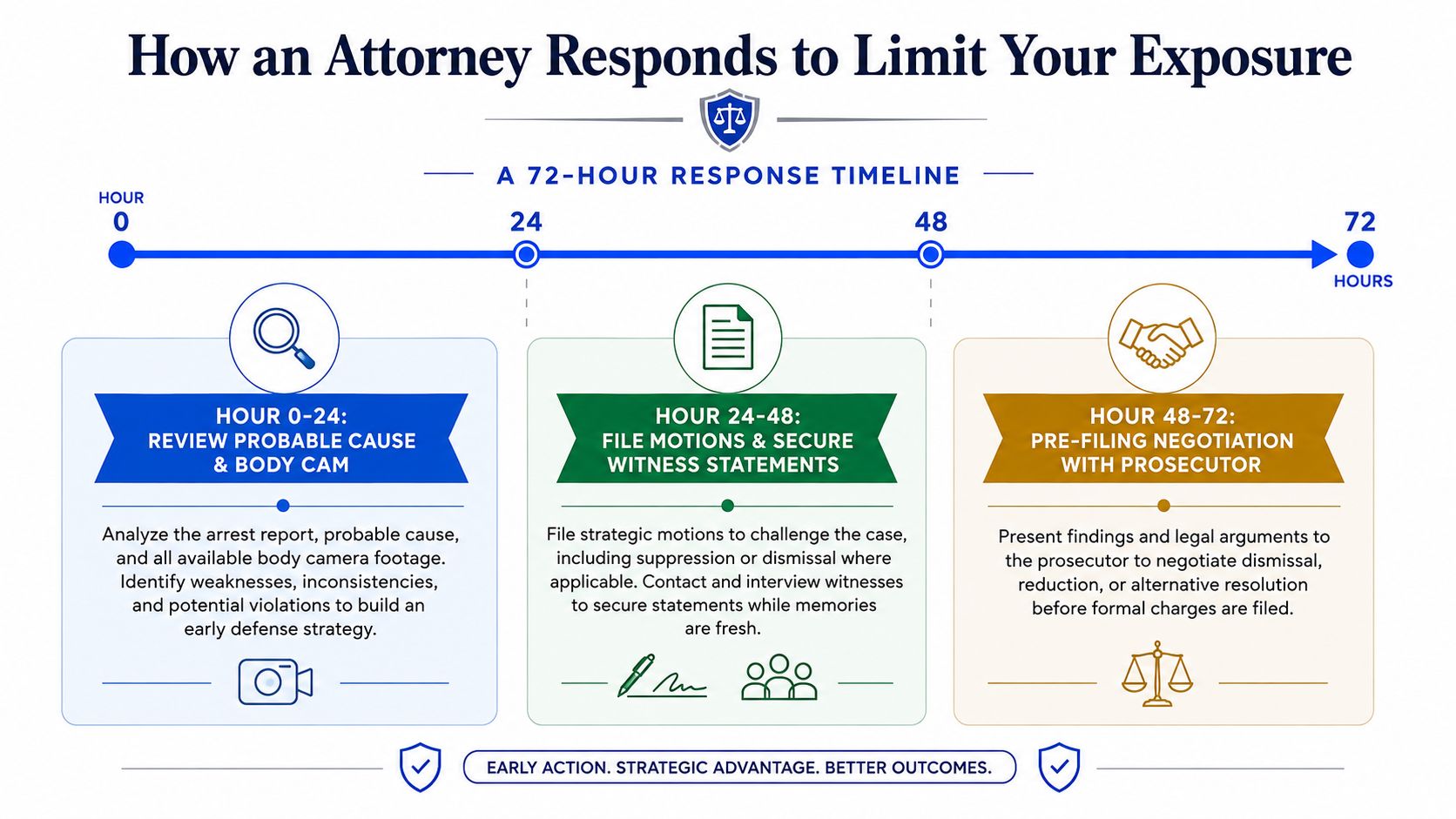
A former prosecutor defending a DUI hit-and-run case shouldn't wait for the formal information to arrive before investigating. The first 72 hours are used to identify disappearing evidence, test probable cause, and decide whether the case can be changed before the prosecutor commits to a felony theory.
Hour 0 to 24
The lawyer obtains the BSO or FHP crash report, body-camera footage, dispatch records, 911 audio, arrest affidavit, and available chemical-test materials. The first review asks practical questions:
Traffic stop: Did the officer have a lawful basis to stop or detain the vehicle?
Field exercises: Did officers administer and describe the exercises accurately?
Arrest: Did probable cause exist when the arrest occurred?
Crash evidence: Does the vehicle evidence match the alleged collision?
Statements: Did police obtain admissions after questioning without proper warnings or after an invocation of rights?
The lawyer also photographs the vehicle and identifies surveillance sources before routine retention systems erase them.
Hour 24 to 48
Counsel sends preservation requests and secures witness statements while memories remain fresh. A nearby Ring camera, business system, toll record, or phone account may contain evidence that supports either side. The lawyer should preserve favorable material, not only search for damaging evidence.
If the stop or arrest was unlawful, counsel may prepare a motion to suppress. Suppression can affect breath, blood, statements, observations, and derivative evidence. It doesn't guarantee dismissal, but it can change the prosecution's advantage.
Hour 48 to 72
Before formal filing, counsel may present focused mitigation to the State Attorney. A clean record, voluntary return, documented medical emergency, credible safety concern, or proof that the driver didn't know a crash occurred can affect charging decisions. The objective isn't to make excuses. It's to show why the State's initial felony theory may not fit the evidence.
The hit-and-run allegation should be analyzed separately from the DUI count. A prosecutor may have stronger proof of impairment than proof of knowledge, or stronger vehicle evidence than proof of intoxication at the time of driving. That separation can support negotiations for a reduced charge, reckless-driving resolution, diversion where legally available, or a withhold when a conviction can't be avoided.
When trial becomes the right call
Trial may be appropriate when the State's identification is unreliable, the crash evidence is inconsistent, the DUI testing is inadmissible or weak, or the injury classification is overstated. A plea may be reasonable when the evidence is strong and the negotiated result avoids a felony or limits license and custody consequences. No lawyer can promise an outcome, and the correct decision depends on the discovery, your history, and the judge and prosecutor handling the case.
Ticket Shield, PLLC offers direct attorney communication and Florida criminal defense for DUI, hit-and-run accusations, license suspensions, and related traffic crimes. If you're in Broward, Fort Lauderdale, Miami-Dade, Palm Beach, or another Florida jurisdiction, contact Ticket Shield, PLLC for a confidential consultation so counsel can preserve evidence, evaluate the charges, and protect your license before critical deadlines pass.