
What Is Probable Cause? a Florida Criminal Defense Guide
Jason Goldsmith, Esq
A patrol car pulls in behind you on I-95. The blue lights come on. Your stomach drops.
Maybe the officer says you drifted out of your lane. Maybe they ask if you've been drinking. Maybe they say they smell marijuana, or they want to look through your car, or they tell you to step out. What started as a routine stop in Broward County or Fort Lauderdale suddenly feels like it's turning into something much bigger.
At that moment, one legal question matters more than is commonly appreciated. Did the officer have enough facts to move from a stop to a search, or from a detention to an arrest? That question is really about probable cause.
If you're facing DUI, drug charges, a weapons case, theft allegations, or another criminal accusation in South Florida, understanding probable cause isn't academic. It's one of the main ways courts decide whether the police acted lawfully and whether key evidence can be used against you. It also connects closely to other rights you may have heard about, including Miranda rights in Florida criminal cases.
Table of Contents
Reasonable Suspicion vs Probable Cause The Critical Difference
Probable Cause in South Florida Arrests Scenarios and Examples
The Blue Lights Behind You What Happens Next Matters
A lot of people charged in South Florida remember the moment things changed. It wasn't the court date. It wasn't the booking process. It was the roadside conversation.
An officer says they stopped you for speeding on Federal Highway, suspicious driving near Las Olas, or a traffic issue in Miami-Dade or Palm Beach County. Then the questions start. Where are you coming from? Have you had anything to drink? Is there anything illegal in the car? Why do you seem nervous?
A stop can widen fast
The law allows police to make some brief investigative stops on less evidence than an arrest requires. That's where many people get confused. They assume that if police can stop them, police can also search the car, empty their pockets, or arrest them on the spot.
That's not how it works.
A traffic stop may begin with one level of justification and then expand only if the officer develops stronger facts. If those stronger facts never materialize, the search or arrest may be unlawful. That's a major issue in DUI defense, drug crime defense, gun charge defense, and search and seizure litigation throughout Broward County and the surrounding courts.
Practical point: A lawful stop doesn't automatically make everything that happens after it lawful.
Why this matters if you've been arrested
Probable cause is one of the constitutional guardrails between a police hunch and a criminal case. It comes from the Fourth Amendment, which was ratified in 1791 to protect against arbitrary searches and seizures and generally requires warrants based on probable cause unless an exception applies, as explained by the Alameda County District Attorney's discussion of probable cause and the Fourth Amendment.
If you're under investigation for DUI, drug possession, domestic violence, theft crimes, probation violations, or traffic crimes in Fort Lauderdale or anywhere in South Florida, the facts at the scene matter. Small details in the officer's report, body camera footage, witness statements, and timing can determine whether the State keeps its evidence or loses it.
Defining Probable Cause in a Florida Courtroom
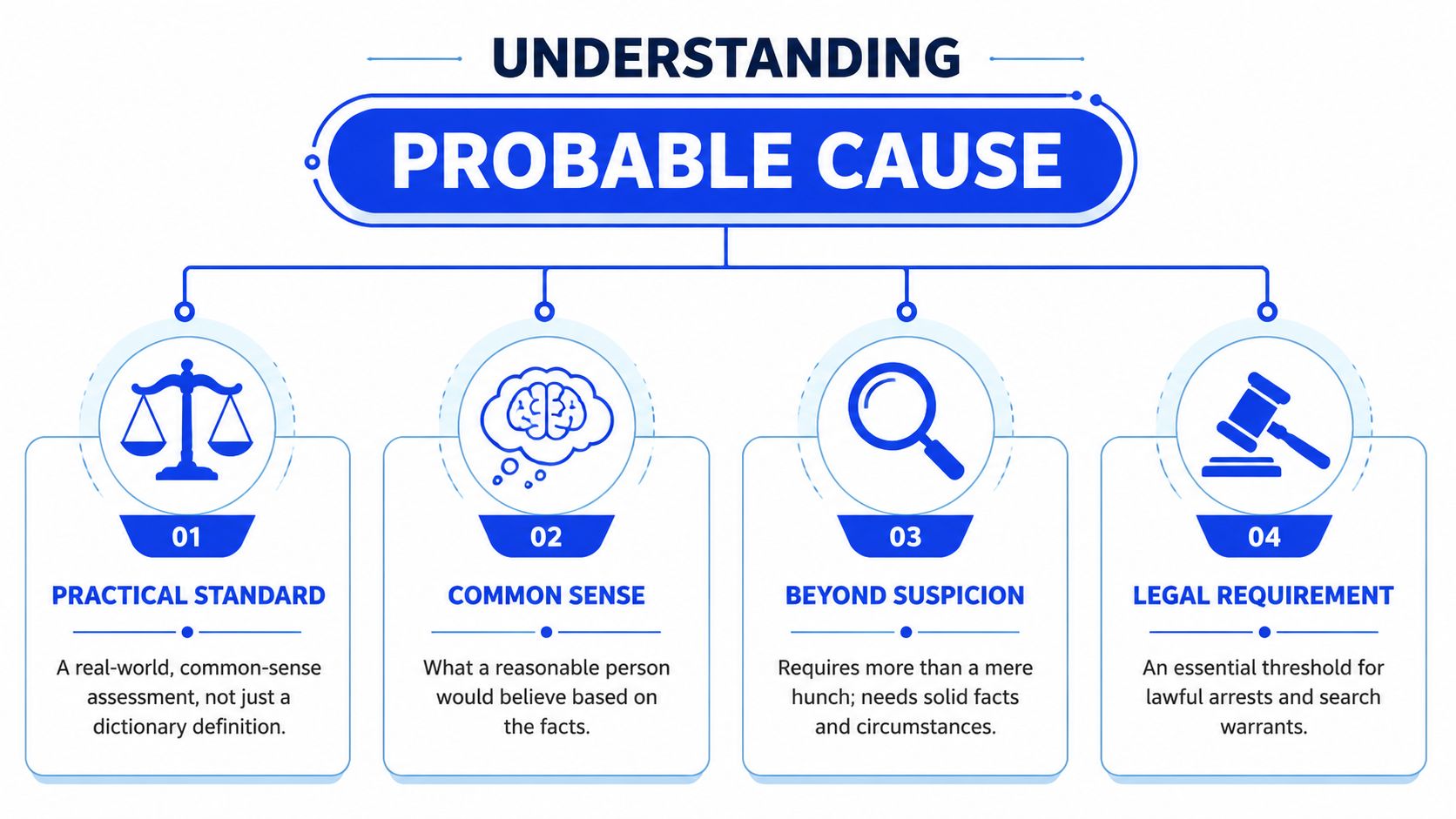
What is probable cause? In plain English, it's the level of evidence police need before they can lawfully make certain major moves, such as making an arrest or seeking a warrant.
What the standard actually means
Probable cause is not a technical math formula. It's a common-sense legal judgment based on the facts known at the time.
The best working definition is this: probable cause exists when the facts and circumstances within an officer's knowledge would justify a prudent person in believing a crime was committed or that evidence of a crime is in a particular place. The Supreme Court has described it as a "fair probability" or "substantial chance" of criminal activity, and it has rejected the idea that the standard can be reduced to a fixed percentage, as summarized in the discussion of probable cause and Beck v. Ohio.
That matters in real life. Officers don't get to rely on a gut feeling alone. They need concrete facts. At the same time, the State doesn't have to prove guilt at that stage.
Why the 51 percent idea is wrong
People often assume "probable" must mean more than 50 percent likely. That's a normal everyday reading of the word. It's also legally misleading.
The Supreme Court rejected the idea that probable cause requires a preponderance of the evidence, meaning more likely true than false. In other words, this isn't a civil lawsuit standard wearing a criminal law label. It doesn't require mathematical certainty, and it doesn't require crossing a fixed line like 51 percent.
Probable cause lives in the real world, not on a spreadsheet.
This is one reason probable cause fights can be difficult and important at the same time. The standard is flexible. That flexibility gives prosecutors room to argue. It also gives defense lawyers room to show that the officer's claimed facts were too thin, too vague, or too unreliable.
For related issues involving unconstitutional police conduct, many clients dealing with drug charges or weapons allegations also need to understand illegal search and seizure defenses in Florida.
How judges look at the full picture
Courts don't isolate one fact and pretend it answers everything. They look at the totality of the circumstances.
The Supreme Court adopted that modern framework in Illinois v. Gates (1983), explaining that probable cause is a "fluid, non-technical concept" based on the collective weight of the facts rather than a rigid checklist, as discussed by the Cornell Legal Information Institute's overview of probable cause.
A few examples show how that works:
Situation | Likely result |
|---|---|
Officer notices only nervousness during a stop | Usually not enough by itself |
Officer sees open alcohol containers, hears slurred speech, and observes poor balance | Stronger basis for probable cause |
Anonymous accusation with no follow-up investigation | Usually weak standing alone |
Tip plus video, witness statements, or direct observations | Much stronger case |
The key point is simple. Judges ask whether all the facts, taken together, would cause a reasonable and cautious person to believe criminal activity was involved. If the answer is no, the defense may have a strong suppression argument.
Reasonable Suspicion vs Probable Cause The Critical Difference
The outcome of many South Florida cases often hinges on probable cause. Police can do more when they have probable cause than when they only have reasonable suspicion.

What police can do at each level
The law recognizes a ladder of proof. Reasonable suspicion sits lower. Probable cause sits higher. Proof beyond a reasonable doubt is the trial standard for conviction.
Florida courts and legal authorities treat probable cause as the middle ground between a temporary stop and a criminal conviction. It requires more trustworthy facts than reasonable suspicion and is needed for intrusive actions like arrests and warrantless searches, as explained in the Nolo legal dictionary entry on probable cause.
A simple comparison helps:
Legal standard | What it allows | What it doesn't automatically allow |
|---|---|---|
Reasonable suspicion | Brief detention, investigation, limited stop | Full arrest or full evidentiary search |
Probable cause | Arrest, warrant request, some warrantless searches | Conviction |
Beyond a reasonable doubt | Criminal conviction after trial | Not relevant roadside |
The escalation gap in real cases
The biggest mistake officers make is treating the first step like it automatically authorizes the second.
A DUI stop is a common example. An officer may have enough to stop a car after seeing drifting, speeding, or another traffic violation. That doesn't mean the officer automatically has probable cause to arrest for DUI. The officer still has to gather stronger facts that support the next level of intrusion.
The same issue appears in drug and weapons cases. A person may seem nervous. They may make a sudden movement. They may have a prior record. Those facts can raise suspicion, but suspicion isn't the same as probable cause.
Defense insight: The most important question often isn't why the police stopped you. It's what happened next, and whether the facts actually justified the escalation.
In South Florida, this issue also appears at DUI checkpoints. A checkpoint may be lawful in general, but what an officer does after initial contact still has to fit the legal standard for the next step. That's why many drivers charged after roadside investigations also need to review Florida DUI checkpoint legality and related search issues.
A defense attorney looks for the exact moment the case crossed the line. Did the officer have a concrete basis to continue? Or did the officer jump from a hunch to a handcuff decision? That gap is where suppression motions often begin.
Probable Cause in South Florida Arrests Scenarios and Examples
Probable cause becomes easier to understand when you see how officers try to build it in everyday cases across Broward County, Fort Lauderdale, Miami-Dade, and Palm Beach.
DUI traffic stops
A classic South Florida DUI investigation often starts with a moving violation or unusual driving. The officer may report weaving, braking irregularly, or nearly striking another vehicle. After the stop, the officer may add observations such as bloodshot eyes, slurred speech, the odor of alcohol, inconsistent answers, or trouble producing a license.
Those details matter because Florida law allows warrantless arrests in certain circumstances. Under Florida Statute §901.15(2), an officer may arrest without a warrant if the officer reasonably believes a felony has been committed and that the person committed it, and Florida law also permits warrantless DUI arrests under Chapter 316 based on probable cause even when the offense did not occur directly in the officer's presence, as stated in Florida Statute 901.15.
A DUI report is often built like a chain:
Driving pattern: The stop begins with observed conduct on the road.
Personal observations: The officer adds signs of impairment after contact.
Field investigation: The officer claims the facts grew stronger during the roadside encounter.
The defense question is whether that chain is solid or padded.
Drug investigations and car searches
Drug cases frequently turn on whether police had enough to search a vehicle, a bag, or a phone. In some cases, officers claim they saw contraband in plain view. In others, they rely on conduct they describe as suspicious.
Common points of dispute include:
Vague odors: The officer says they smelled drugs, but the report lacks detail.
Movement in the vehicle: The State argues the driver made a furtive gesture, but video may show something less dramatic.
Tips from others: Police receive information but must still connect that information to real-world facts.
In practical terms, a South Florida drug defense often focuses on whether the officer can explain specific observations that support a fair probability that evidence would be found, rather than broad statements that sound suspicious only in hindsight.
A police report can sound stronger on paper than the stop looked on video.
Theft and other street level investigations
Theft and shoplifting cases often involve a different pattern. Police may respond after store employees report a suspect, security footage is reviewed, or property is recovered nearby. Probable cause may rest on a combination of witness identification, matching clothing, possession of recently taken items, and the suspect's location when police arrive.
The same style of analysis applies in other cases too:
Domestic violence investigations often turn on statements, injuries, and scene evidence.
Gun and weapons charges may involve what an officer saw in the vehicle or on the person.
Probation violation arrests can raise separate questions about what level of proof applied to the police conduct that produced the evidence.
The officer's job is to articulate facts. The defense job is to test them. If those facts don't hold together, the arrest or search may not survive judicial review.
How a Defense Attorney Challenges Probable Cause
When probable cause is weak, the defense doesn't just complain about it. The defense attacks it methodically.
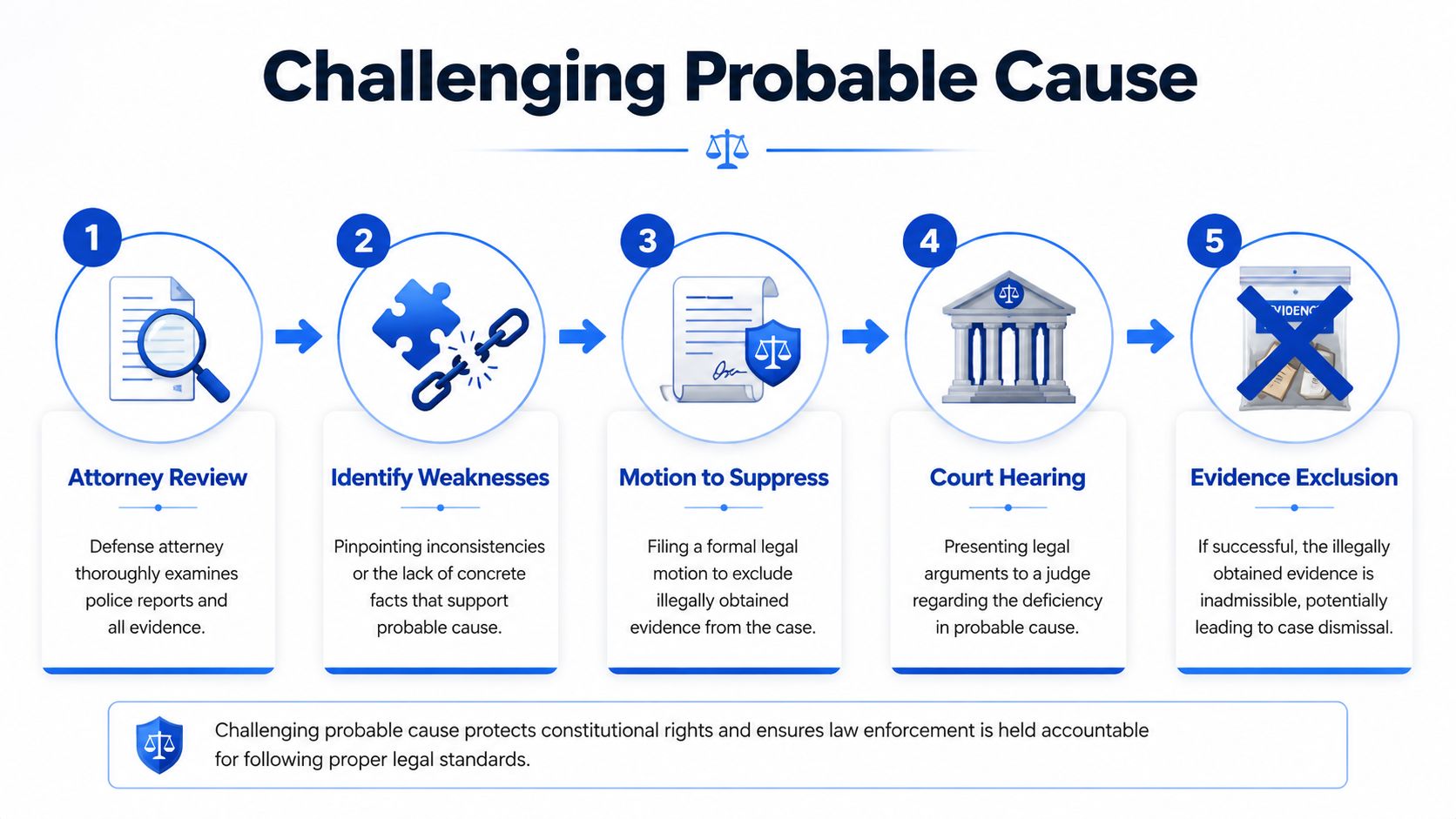
A lawyer challenging a South Florida arrest starts by examining every piece of evidence that existed at the moment of the stop, search, or arrest. That means the police report, body camera footage, dashcam video, dispatch records, witness statements, and any affidavit used to seek a warrant.
Where the State's story often breaks down
Probable cause challenges usually focus on one or more of these problems:
Thin facts: The officer describes suspicion, but not enough concrete facts to justify a search or arrest.
Inconsistencies: The report says one thing, while the body camera or dashcam tells a different story.
Timing issues: Facts discovered later get used to justify actions that happened earlier.
Reliability problems: The State relies on an accusation, tip, or assumption that wasn't adequately verified.
Overreach during a stop: An officer expands a detention beyond what the initial facts allowed.
These details are central in DUI defense, drug crime cases, traffic crimes, and search and seizure litigation in Broward County courts. A case may look straightforward at first glance. It can look very different after a close review of the actual sequence of events.
A key procedural safeguard also matters here. When police seek a warrant in Florida, they must submit an affidavit to a judge. If police make a warrantless arrest, a judge must review probable cause within 24 hours, and if the judge finds no probable cause, the arrest is unlawful and the evidence may be suppressed, as explained in this Florida arrest warrant and search warrant guide.
This overview may help you visualize how suppression challenges develop in real cases.
How suppression fights work in court
The main tool is a motion to suppress evidence. In that motion, the defense asks the judge to exclude evidence obtained through an unconstitutional stop, search, or arrest.
That might include:
Physical evidence, such as drugs, a firearm, or items seized from a car
Statements, if they flowed from an unlawful detention or arrest
Observations, when they stem from police conduct that exceeded constitutional limits
Courtroom reality: If the evidence is suppressed, prosecutors often lose the part of the case they needed most.
The hearing itself can be decisive. Officers testify. Video gets played. Timelines are compared. Language in the affidavit or report gets tested line by line. In many cases, the difference between guilt and dismissal is whether the judge believes the officer had enough trustworthy facts at the critical moment.
If you want to understand that process in more detail, review how a motion to suppress evidence works in Florida criminal court.
Florida Probable Cause Frequently Asked Questions
Can police arrest me without a warrant in Florida
Yes, in many situations they can. Florida law permits warrantless arrests in specific circumstances, including situations where officers claim they had probable cause. Whether that arrest was lawful depends on the facts known at the time, not just what officers wrote later.
Can an anonymous tip justify my arrest
Not by itself in Florida. Anonymous tips or confidential informant information are insufficient on their own to establish probable cause for a search warrant or arrest. Police must provide more corroborating evidence, and stronger probable cause proofs often include factual evidence such as video footage, 911 calls, or witness statements, as explained in this Florida probable cause FAQ discussing corroborating evidence.
Does probable cause mean the police can convict me
No. Probable cause is much lower than the proof required for a conviction. It may justify an arrest or search, but the State still has to prove the charge in court under a much stricter standard.
What should I do if I think the stop or search was illegal
Stay calm, don't argue roadside, and don't try to litigate the case with the officer. Preserve what you can remember.
Write down:
Where it happened: The street, intersection, checkpoint, or parking lot
What the officer said first: The stated reason for the stop matters
What happened in order: Timing is often critical in suppression issues
Who was present: Passengers, witnesses, store staff, or bystanders may matter
Whether cameras were present: Dashcam, bodycam, store surveillance, and phone video can be important
Then speak with a Florida criminal defense lawyer quickly. In DUI, drug crimes, domestic violence defense, theft crimes, juvenile crimes, white collar cases, federal crimes, probation violations, and record sealing matters, early case review can identify constitutional issues before they get buried under paperwork.
If the police lacked probable cause, that may not end the case automatically. But it can change the case dramatically.
If you're facing charges in Fort Lauderdale, Broward County, Miami-Dade, Palm Beach, or anywhere in South Florida, Ticket Shield, PLLC can review the stop, search, arrest, and evidence for probable cause problems. A confidential consultation can help you understand your rights, possible defenses, and whether the State's case can be challenged before it gains momentum.