
Burglary Laws in Florida: A Practical Reference Guide
Jason Goldsmith, Esq
You're sitting in a Broward County jail after an arrest, or you've received a call saying detectives want to discuss a break-in. Maybe nothing was taken. Maybe you had permission to be inside, entered by mistake, or walked into a building after a confrontation. Those details can matter because Florida burglary law focuses on intent, permission, the type of property, and aggravating facts, not just on whether property disappeared.
A burglary accusation can affect your freedom, record, employment, housing, immigration status, and ability to possess firearms. The charge on the arrest paperwork isn't the final answer, however. Prosecutors still must prove every required element, and a defense lawyer should test the evidence supporting entry, remaining, intent, occupancy, identification, and any alleged weapon or violence.
Table of Contents
How Florida Defines Burglary Under the Statute
Florida burglary law is centered on Chapter 810 of the Florida Statutes, especially Florida Statute § 810.02. The statute uses a three-tier felony model. The degree depends on what was entered, whether it was occupied, and whether the State can prove aggravating conduct such as an assault, battery, dangerous weapon, explosive, or certain vehicle-related damage.
Section 810.02 addresses burglary involving a dwelling, structure, or conveyance. Section 810.06 addresses burglary involving an unoccupied structure or conveyance. Both provisions center on entering or remaining in a place without the required privilege, while intending to commit an offense inside. That offense need not be theft. The alleged objective could involve another criminal act.
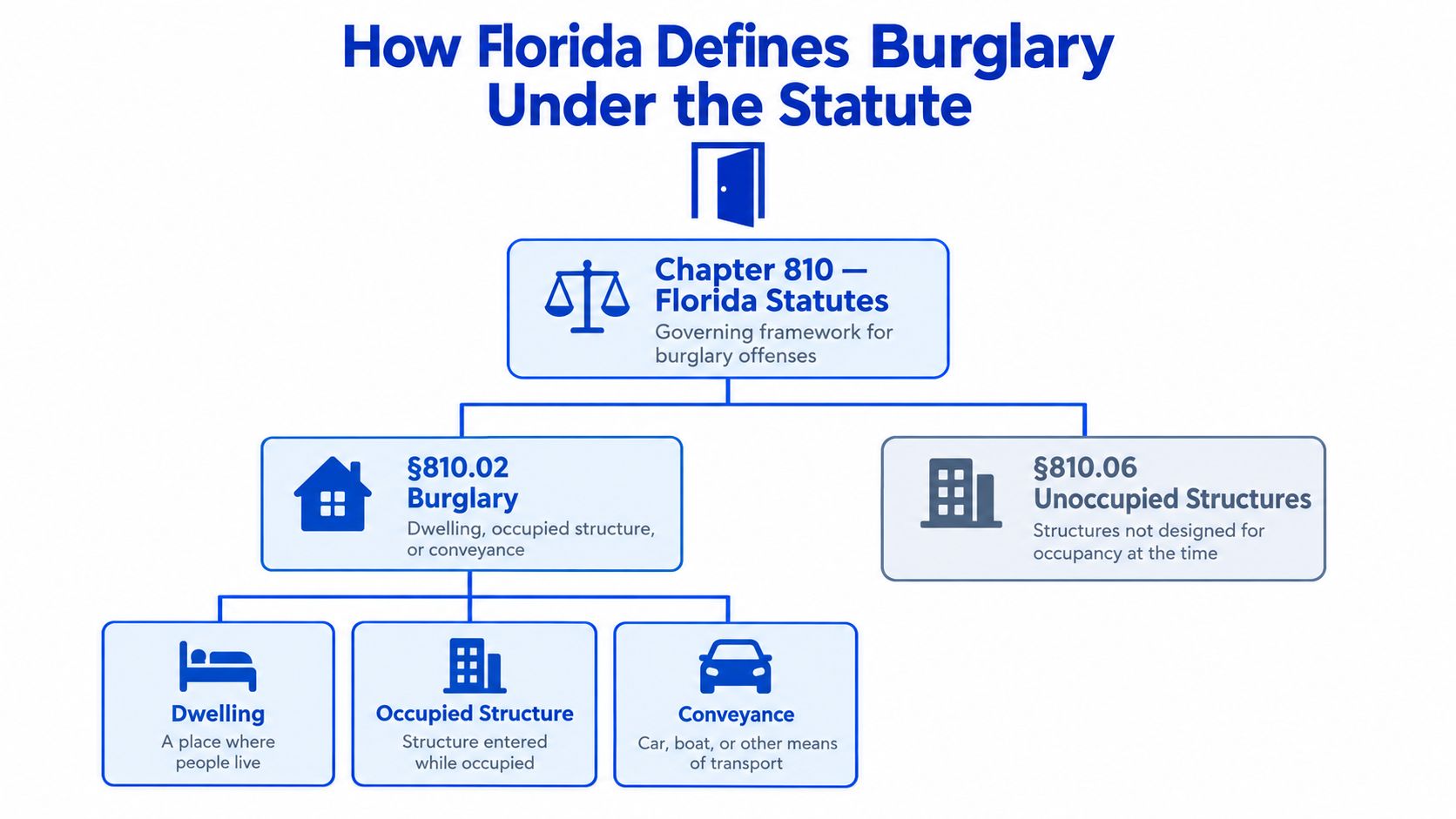
The structure of the charge
At the highest level:
First-degree burglary involves specified aggravators, including an assault or battery, becoming armed with a dangerous weapon or explosive, or certain aggravated entry-and-damage conduct.
Second-degree burglary generally covers more serious property categories and circumstances without the first-degree aggravators.
Third-degree burglary generally covers lower-risk allegations involving an unoccupied structure or conveyance without a weapon, assault, or battery.
The statute's framework has remained materially stable across the 2021, 2022, 2023, 2025, and 2026 Florida statutes, as reflected in the current statutory references above. The practical lesson is simple: the State's theory about the property and the alleged aggravators can change the case dramatically.
Practical rule: A burglary defense should begin with the exact property classification and the facts used to assign the degree, not with the assumption that the case is merely about stolen property.
The Four Elements the State Must Prove
A Florida burglary prosecution generally requires proof of four central points under § 810.02:
Entry into a structure, dwelling, or conveyance.
Lack of permission or privilege, including remaining after permission was effectively revoked.
A qualifying method of entry or remaining, such as surreptitious entry, force, threat, or deception.
Intent to commit an offense inside at the relevant time.
Entry can be broader than many people expect. The State may argue that inserting any part of the body, such as reaching a hand through a broken window, satisfies entry. The prosecution may also use a remaining-in theory. For example, a guest might enter lawfully, refuse to leave after permission ends, and allegedly remain with criminal intent. A worker who hides in a business after hours presents a different factual theory, but the same legal question remains: what was the person's purpose while remaining?
Element | Statutory Language | Practical Example |
|---|---|---|
Entry | Entering a dwelling, structure, or conveyance | Reaching through a broken window may support the State's entry theory |
Permission | Entering or remaining without authorization | A person stays after an owner clearly withdraws permission |
Qualifying conduct | Surreptitious entry, force, threat, or deception | Someone enters through a concealed route or uses a false explanation |
Criminal intent | Intent to commit an offense inside | Prosecutors claim the person entered intending to steal, damage property, or commit another offense |
The State must prove the elements beyond a reasonable doubt. A defense doesn't need to explain every suspicious fact. It can be enough to show that one required element remains unproven, such as the absence of criminal intent at entry or uncertainty about whether permission continued.
Degrees of Burglary and How Charges Get Elevated
Florida's burglary grades are driven by aggravating facts. Prosecutors often fight over those facts during filing decisions, bond arguments, discovery, motions, and plea negotiations. A charge can move from a lower felony level to a far more serious one because of the property category, an alleged weapon, or an encounter with a person inside.
The current statute treats first-degree burglary as the most serious level. It can apply when the offender makes an assault or battery, becomes armed with explosives or a dangerous weapon, or uses a motor vehicle to damage the structure under the statute's aggravated entry-and-damage provisions. First-degree exposure is especially severe because imprisonment may extend to life.
Second-degree burglary commonly involves a dwelling, occupied structure, occupied conveyance, or certain specially protected properties when the first-degree aggravators aren't established. Third-degree burglary generally covers an unoccupied structure or conveyance when no weapon, assault, or battery is alleged.
Degree | Statute | Aggravators |
|---|---|---|
First degree | § 810.02(2) | Assault or battery, dangerous weapon or explosive, or specified aggravated entry-and-damage conduct |
Second degree | § 810.02(3) | Dwelling, occupied structure, occupied conveyance, or specified protected property without first-degree aggravators |
Third degree | § 810.02(4) | Lower-risk circumstances involving an unoccupied structure or conveyance without a weapon, assault, or battery |
The charging decision should be tested against the evidence. Was the location in fact a dwelling? Was it occupied under the statutory framework? Did the accused possess a weapon, or did someone merely find an object nearby? Did a vehicle cause the alleged structural damage, and does the evidence satisfy the statutory language?
For a related discussion of an unoccupied dwelling issue, see Florida burglary of an unoccupied dwelling. The label matters because Florida's sentencing code separately caps many third-degree felonies at 5 years and many second-degree felonies at 15 years, as explained in Florida Statute § 810.02's sentencing framework.
Sentencing Ranges Behind Each Degree
The felony degree is a sentencing milestone, but it isn't the entire sentence. Florida's Criminal Punishment Code uses offense severity levels, prior record, additional counts, victim-related facts, and other scoring factors to produce a scoresheet. The judge then works within the statutory framework and any applicable mandatory provisions.
The basic statutory ceilings are:
Degree | Severity Level | Prison Cap | Maximum Fine |
|---|---|---|---|
Third-degree felony | Level 3 | 5 years | $5,000 |
Second-degree felony | Level 7 | 15 years | $10,000 |
First-degree felony | Level 9 | Up to life imprisonment | $10,000 |
The third-degree figures and felony classification are also discussed in Florida third-degree felony law. The second-degree and third-degree burglary provisions use Florida's general felony sentencing rules, while first-degree burglary permits a term of years not exceeding life under the statute.
A scoresheet can make the practical exposure different from the abstract maximum. Prior convictions, injury allegations, multiple burglary counts, and related offenses may increase the score. Consecutive sentences can also create substantial cumulative exposure when separate counts qualify for separate punishment.
A statutory maximum is a ceiling, not a prediction. The useful question is how the State's evidence, scoresheet, prior record, and charged counts interact in this particular case.
Statewide court data reported in the statutory research materials shows burglary cases falling from 12,314 in 2023 to 11,333 in 2025, while the average sentence increased from 3.2 to 3.7 years. Those figures come from the Florida statutory burglary reference, and they shouldn't be treated as a forecast for an individual defendant.
How Prosecutors Prove Criminal Intent
Intent is often the central dispute because people rarely announce their purpose at the moment they enter. Prosecutors therefore assemble a circumstantial case from the surrounding facts. A late hour, concealed entry, gloves, a mask, unexpected tools, drawn blinds, pry marks, or a lack of relationship with the owner may appear in the arrest affidavit or discovery.
The State may also examine what happened immediately before and after the alleged entry. Statements to police, messages, admissions, possession of property, and communications with an alleged accomplice can become important. The admissibility of a statement depends on the facts and governing evidence rules, including the principles applied in Williams v. State.
Intent at entry versus intent while remaining
The timing matters. If the prosecution claims the defendant intended to commit an offense when entering, the defense may focus on a lawful explanation for arriving and the absence of evidence showing a criminal objective at that moment. If the State relies on remaining, counsel may examine when permission ended, whether the defendant understood that permission had been withdrawn, and whether criminal intent developed afterward.
A person can look suspicious without the State proving the required mental state. Defense counsel may present evidence of consent, mistaken location, retrieval of personal property, employment-related access, an emergency, or another lawful purpose. The defense can also challenge whether circumstantial evidence excludes reasonable innocent explanations.
Evidence question: Don't ask only what the police found. Ask what each item proves about the defendant's intent at the legally relevant time.
Dwellings, Structures, Conveyances, and Unoccupied Property
Property classification often determines the degree before the court considers the remaining evidence. Florida's framework distinguishes dwellings, structures, conveyances, and unoccupied property, and the prosecution must support the category it charges.
A dwelling is a place where people live. That can include a residence used temporarily, and the classification may remain important even if no one was present at the precise moment of entry. A furnished second home, apartment, or recreational vehicle may require careful factual analysis rather than a quick assumption based on whether the owner was physically inside.
An occupied structure can include a business, office, warehouse area, or storage space that isn't a dwelling. Occupancy questions may involve how the property was used, whether people regularly worked there, and what the evidence shows about the premises. A conveyance includes transportation-related property such as a car, boat, aircraft, or trailer.
What evidence establishes the category
Prosecutors may rely on:
Victim testimony: The owner or occupant describes how the place was used.
Rental and ownership records: Documents may show whether a person lived there or whether the property was used commercially.
Video evidence: Doorbell footage and surveillance can establish the location and circumstances of entry.
Physical layout: The presence of living areas, furnishings, business operations, or vehicle features can support classification.
Unoccupied structures and conveyances generally fall within the lower-level statutory framework when no additional aggravator applies. That doesn't make the case harmless. A felony conviction can still create serious long-term consequences.
For vehicle allegations, Florida burglary of a motor vehicle provides related context. In any case, counsel should compare the charging language with photographs, records, witness accounts, and the statutory definitions rather than accepting the police description as conclusive.
How Burglary Differs From Florida Trespass
Trespass and burglary both appear in Chapter 810, but burglary requires more. Florida trespass law generally addresses unauthorized entry or remaining, while burglary adds the intent to commit an offense inside and, depending on the theory, a qualifying method of entry or remaining.
For trespass in a structure or conveyance, Florida generally classifies the offense as a second-degree misdemeanor. It becomes a first-degree misdemeanor when a person is present inside at the time. If the person carries a firearm or dangerous weapon, or arms themselves while inside, the offense can rise to a third-degree felony, according to Florida's Chapter 810 trespass provisions.
Trespass on property other than a structure or conveyance is generally a first-degree misdemeanor, as provided by Florida Statute § 810.09.
Burglary | Trespass |
|---|---|
Requires intent to commit an offense inside | Doesn't require that additional criminal intent |
Degree depends heavily on property type and aggravators | Grade depends on location, presence of people, and weapons |
May involve surreptitious entry, force, threat, or deception | Focuses primarily on unauthorized entry or remaining |
A person found in a fenced yard with no evidence of an intended offense may face trespass rather than burglary. A person who picks a lock and enters with a screwdriver may face burglary even if nothing is taken, because theft isn't required. Prosecutors sometimes file both counts, and trespass may become relevant as a lesser-included offense during negotiations or jury instructions.
Related Charges That Travel With Burglary
Burglary allegations often come with companion charges because the State evaluates the entire sequence, not just the entry. The charging document may include offenses arising from force used inside, tools found before entry, property allegedly taken afterward, or communications about selling that property.
Robbery under § 812.13 focuses on taking property through force, violence, assault, or putting a person in fear. Home-invasion robbery under § 812.135 addresses especially serious conduct involving a dwelling and an assaultive taking. Those charges can create separate exposure from the burglary count because they protect different interests and require different proof.
Other related allegations may include:
Possession of burglary tools: The State claims the person possessed tools with intent to use them in a burglary. This can be charged separately from completed entry.
Trafficking in stolen property: The prosecution claims someone knowingly dealt in property obtained through theft. The evidence may involve sales, transfers, messages, or possession after the alleged burglary.
Theft: A separate theft allegation may concern the value and identity of property allegedly taken. The statutory framework for Florida theft charges under § 812.014 should be analyzed independently.
The scoresheet impact depends on the exact offenses, whether counts arise from separate criminal episodes, prior record, and the factual findings supported by admissible evidence. A lawyer should not evaluate a burglary count in isolation when several charges appear together.
Sentencing Factors and Habitual-Offender Exposure
Florida sentencing begins with the Criminal Punishment Code scoresheet. The primary burglary offense, additional counts, prior convictions, victim-related findings, and applicable enhancements can all affect the score and the recommended sentencing range. A defense lawyer should obtain the actual scoresheet and verify every point rather than relying on an informal estimate.
Prior felony convictions and prior qualifying burglaries may increase exposure. Alleged weapons, masks, injury, or other facts can also affect charging, scoring, or both. When the score reaches the statutory threshold that requires a prison commitment, the defense must identify lawful grounds for a downward sentence or challenge the points producing that result.
Habitual-offender designations
Section 775.084 permits the State to seek designations such as habitual felony offender or habitual violent felony offender when statutory requirements are met. Florida also recognizes qualifying repeat-offender categories connected to burglary and similar property offenses. The consequences depend on the designation, prior convictions, timing, and current offense.
Probation is not automatic. Section 948.01 governs probation authority, and statutory restrictions may limit probation for higher-degree burglary or particular sentencing circumstances. Restitution can also be ordered for documented losses, and it may remain important even when incarceration isn't imposed.
The practical work includes checking certified prior records, objecting to unsupported scoring, separating unrelated cases, reviewing enhancement notices, and presenting mitigation backed by reliable documents. No attorney can promise that these steps will produce a particular result, but failing to examine them can leave avoidable exposure unchallenged.
Defenses Florida Courts Actually Consider
A burglary defense is built from the State's proof, not from the label on the charging document. The first question is often intent. If the evidence doesn't establish that the accused intended to commit an offense inside at entry or while remaining, the burglary theory may fail even if presence or unauthorized entry is undisputed.
Consent and lawful authority can be equally important. A key, text message, work assignment, invitation, lease, or prior relationship may support permission, but the surrounding circumstances matter. If permission was revoked, the prosecution must still connect the later remaining to the required criminal intent.
Constitutional and proof challenges
Counsel may file motions addressing:
Unlawful searches: Evidence from a warrantless entry or search may be challenged under the Fourth Amendment.
Unlawful arrest: If officers lacked probable cause, statements or physical evidence may face additional scrutiny.
Identification problems: Poor lighting, limited viewing time, inconsistent descriptions, and unreliable surveillance can create reasonable doubt.
Chain of possession: Physical evidence must be properly identified, preserved, and connected to the accused.
Occupancy proof: The State must support its classification of the premises with evidence, not assumption.
Alibi evidence: Records, witnesses, location data, and other proof may challenge identity or timing.
The State carries the burden throughout trial. Defense counsel doesn't have to prove innocence, and a defendant generally shouldn't try to explain a complicated burglary allegation to detectives without legal advice. A confidential review of the allegation, evidence supporting intent, degree issues, and search concerns is available through Ticket Shield's Florida burglary defense service.
Quick Reference for Burglary Degrees in Florida
This table condenses the central degree distinctions under § 810.02. It's a starting point, not a substitute for reviewing the particular subsection charged and the facts alleged in the information or arrest affidavit.
Degree | Statutory Subsection | Triggering Aggravator | Maximum Penalty |
|---|---|---|---|
First degree | § 810.02(2) | Assault or battery, dangerous weapon or explosive, or specified aggravated entry-and-damage conduct | Imprisonment for a term of years not exceeding life |
Second degree | § 810.02(3) | Dwelling, occupied structure, occupied conveyance, or specified protected property without first-degree aggravators | General felony sentencing provisions, commonly capped at 15 years |
Third degree | § 810.02(4) | Unoccupied structure or conveyance without a weapon, assault, or battery | General felony sentencing provisions, commonly capped at 5 years |
The key analytical sequence is property, permission, entry or remaining, intent, and aggravators. A prosecutor may describe the same event in a way that emphasizes a weapon or occupant, while the defense may have evidence showing an ordinary object, no actual occupant, continuing permission, or a lawful purpose.
Classification can also affect negotiations. Reducing a first-degree allegation may require challenging an aggravator. Reducing a second-degree allegation may require disputing occupancy or the dwelling classification. A third-degree case may still require a factual defense, scoresheet review, and attention to collateral consequences.
Common Questions About Burglary Charges in Florida
Can attempted burglary be charged?
Yes. Attempted burglary can be prosecuted under Florida's attempt law, and the grading analysis can depend on the same type of alleged aggravating circumstances. A person doesn't necessarily avoid serious exposure because the State claims entry was interrupted. The prosecution still must prove the required intent and conduct showing more than mere preparation.
Is possession of burglary tools a separate offense?
Yes. Section 810.06 addresses possession of burglary tools as a separate offense. The State generally must prove possession and intent to use the tools during a burglary. Merely owning an ordinary tool isn't automatically enough, so the surrounding facts and alleged purpose matter.
Can a juvenile be charged as an adult?
A juvenile may be subject to adult prosecution in circumstances permitted by Florida law, including allegations involving serious first-degree burglary conduct and a dwelling. The decision depends on the child's age, history, allegations, and statutory procedures. A juvenile defense lawyer should review transfer issues immediately.
What collateral consequences can follow?
A felony burglary conviction can affect voting rights, firearm possession, employment, housing, professional licensing, and immigration. Immigration consequences can be especially fact-specific, so a noncitizen should obtain advice that addresses both criminal and immigration law before entering a plea.
What happens before trial?
The court may address pretrial release, reporting conditions, travel, substance restrictions, and no-contact orders involving property owners or alleged victims. A defendant should obey every condition and avoid contacting witnesses or posting about the case. Sealing and expungement are different remedies, and eligibility depends on the disposition, prior record, and statutory limits. An adjudication of guilt can create significant barriers to either remedy.
Ticket Shield, PLLC reviews Florida burglary allegations, including degree classification, occupancy questions, intent evidence, and search-and-seizure issues, during confidential consultations. Visit Ticket Shield, PLLC to discuss the charge, protect your rights early, and identify a practical defense strategy.