3rd Degree Felony in Florida: Penalties and Defenses
Jason Goldsmith, Esq
In Florida, a third-degree felony is the lowest felony tier, punishable by up to 5 years in prison, a $5,000 fine, and up to 5 years of probation. The charge is serious, but the statutory maximum doesn't automatically tell you what will happen in your case.
You may be sitting in a Broward County home, looking at arrest paperwork that says “third-degree felony” and wondering whether you'll go to jail, lose your job, or carry the charge forever. Those questions are understandable. Florida uses the same degree label for many different offenses, and the practical outcome depends on the specific statute, the alleged facts, your record, the sentencing score, and the court handling the case.
A charge isn't a conviction. The State still has to prove every required element, and early legal work can affect whether the case is dismissed, reduced, resolved through an alternative, or taken to trial.
Table of Contents
What a 3rd Degree Felony Means in Florida
Florida's third-degree felony category is the bottom rung of the state's felony system. Under Florida law, a felony that doesn't have another degree specified generally falls into the third-degree category unless a different rule applies. That classification still exposes a person to state-prison punishment, rather than only the county-level consequences generally associated with a misdemeanor. Florida's felony classifications and third-degree penalties explain this distinction in plain terms.
The maximum prison sentence is 5 years, and the maximum fine is $5,000. Separately, Florida sentencing law permits up to 5 years of probation for a felony case. Probation isn't the same as incarceration, but it can involve reporting, treatment, testing, restrictions on travel, and other court-ordered conditions.
Felony versus misdemeanor in practical terms
A misdemeanor and a felony aren't interchangeable labels. A felony conviction can expose someone to state-prison supervision and can create a lasting criminal record with consequences outside the courtroom. A misdemeanor may still disrupt employment, housing, driving privileges, or family relationships, but felony status usually creates broader legal and practical obstacles.
For example, a person arrested in Fort Lauderdale for alleged drug possession may see the words “third-degree felony” before knowing whether the evidence can be challenged. The charge might later change after a suppression hearing, laboratory review, witness evaluation, or negotiation. The paperwork describes the State's accusation, not the final result.
Practical rule: Don't make a plea decision based only on the phrase “lowest felony tier.” Lowest felony tier still means felony exposure, and the exact offense controls the next questions.
People who want a basic explanation of the classification can review this guide to what a felony charge means in Florida. A Florida criminal defense lawyer can then examine the arrest report, charging document, evidence, and prior record to determine what the label means for the individual case.
How Florida Grades Felony Severity Levels
Think of Florida's felony degrees as rungs on a ladder. The third-degree felony rung is the baseline felony level. The second-degree and first-degree rungs represent higher statutory exposure, although the specific offense and sentencing rules still control what a judge can impose.
Florida Statute § 775.082 sets out the basic maximum prison terms and fines. A third-degree felony carries up to 5 years in prison and a maximum $5,000 fine. A second-degree felony has a maximum prison term of 15 years, while a first-degree felony has a maximum of 30 years. Florida's felony penalty structure places those levels in context.
Felony Degree | Maximum Prison | Maximum Fine |
|---|---|---|
Third-degree felony | 5 years | $5,000 |
Second-degree felony | 15 years | Not specified in the verified data for this article |
First-degree felony | 30 years | Not specified in the verified data for this article |
Why the degree matters
The degree of the charge sets the statutory ceiling, but it doesn't answer every sentencing question. Two cases involving similar conduct can be treated differently if one is charged under a statute carrying a different degree, includes a qualifying enhancement, or involves facts that affect the Criminal Punishment Code score.
That makes charge screening important. The prosecutor's choice of statute, the evidence available at filing, and later negotiations can change whether a person faces felony or misdemeanor exposure. The same conduct may also raise different legal issues depending on whether police obtained the evidence lawfully and whether the State can prove ownership, intent, identity, value, or another required element.
A third-degree felony isn't automatically a prison sentence. The statutory maximum tells you the upper limit for the basic classification. The final outcome may involve incarceration, probation, community control, a reduced charge, dismissal, or trial acquittal, depending on the case.
For a broader overview of Florida offenses and classifications, see this explanation of Florida criminal laws. The important point is simple: the degree tells you the category, not the complete outcome.
Common 3rd Degree Felony Charges in South Florida
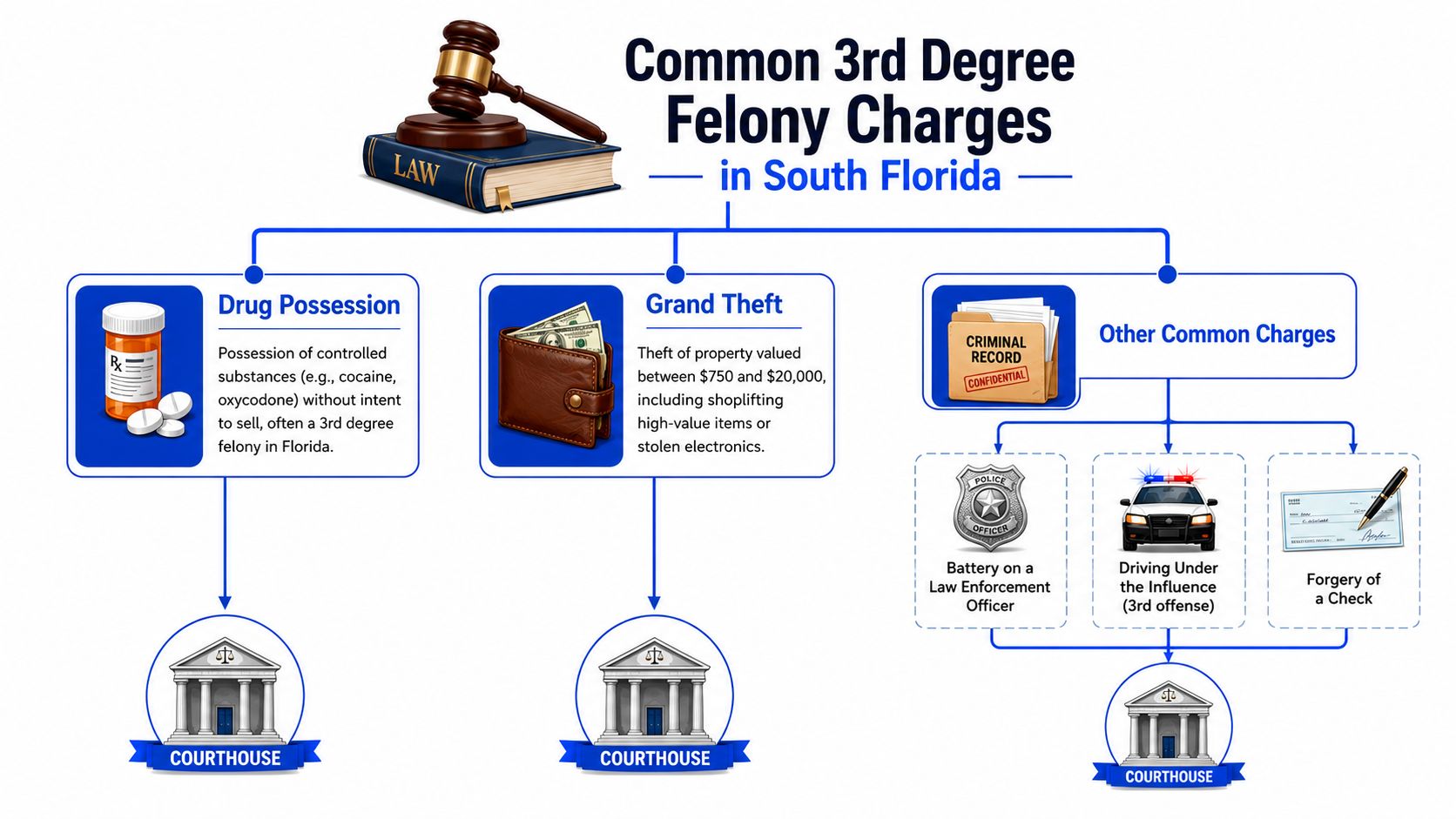
South Florida courts see third-degree felony allegations across several practice areas. In Broward County, Miami-Dade County, Palm Beach County, and neighboring jurisdictions, the same label can describe conduct with very different factual and constitutional issues.
Drug and theft allegations
A drug possession case may be filed as a third-degree felony when the State alleges possession of a controlled substance without lawful authorization. The defense may need to examine whether the substance belonged to the accused, whether police had probable cause, whether the search was valid, and whether the laboratory evidence supports the allegation.
Theft allegations can reach the third-degree felony level when the alleged property value and circumstances meet Florida's grand-theft requirements. A person accused of taking high-value electronics from a store, for example, may face a different charge from someone accused of taking low-value property. The State still must prove the required value, ownership, taking, and intent elements. More information about these issues appears in this guide to grand theft in Florida.
Weapons, violence, and driving-related charges
Certain weapons offenses can be charged as third-degree felonies depending on the firearm, possession theory, location, and alleged conduct. A case involving a weapon may raise questions about constructive possession, the legality of the stop, statements made during the investigation, or whether the State can connect the person to the item.
Some assault, battery, DUI-related, forgery, burglary, and probation-related allegations may also carry felony consequences under particular statutory circumstances. The offense name alone doesn't tell you whether a case is weak or strong. A burglary allegation involving an unoccupied conveyance presents different proof issues from a drug case, even if both are labeled third-degree felonies.
The Florida felony penalty provisions establish the maximum exposure for clients charged with offenses commonly placed in this category, including drug, theft, and weapons allegations. The practical stakes are substantial, but the defense must focus on the exact statute and evidence rather than treating every third-degree felony as identical.
How Sentencing Scores Are Calculated Under the Criminal Punishment Code
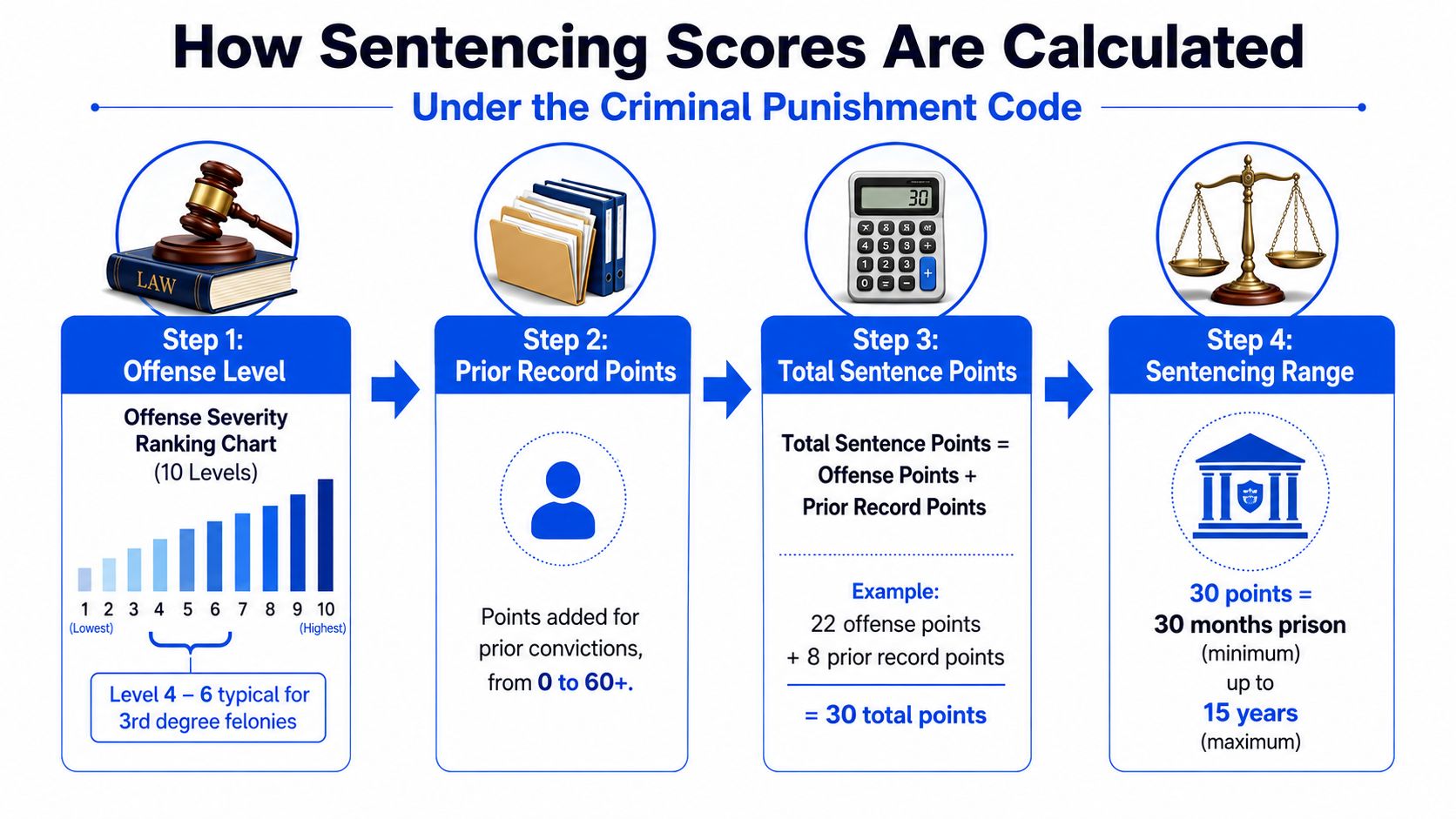
The phrase “third-degree felony” doesn't predict a sentence by itself. Florida's Criminal Punishment Code uses an offense-severity ranking chart with 10 levels, from level 1 through level 10, and assigns each felony offense a severity level. That level feeds into a sentencing score, along with other factors such as qualifying prior record.
The charge label is only the starting point
A third-degree felony can appear at different severity levels because Florida classifies many separate offenses under that degree. The offense level, victim-related facts, additional offenses, and prior record can all affect the score. A person with no qualifying history may face a different sentencing calculation from someone with prior felony convictions.
The Code also contains a detail that surprises many readers. Certain attempts, solicitations, and conspiracies connected to lower-level third-degree felonies can be scored as misdemeanors rather than felonies under the applicable rules. That doesn't mean every attempted third-degree felony receives misdemeanor treatment, so the specific offense and severity level must be checked. Florida's Criminal Punishment Code statute contains the ranking and scoring framework.
Why county and fact pattern matter
The Code creates a statewide framework, but real cases still vary by county, judge, prosecutor, facts, evidence, and negotiation posture. A Broward County drug possession case may develop differently from a Palm Beach theft case because the proof, prior history, and local courtroom practices differ.
That variation makes generic promises unreliable. An aggregate sentencing report can't tell you what will happen in a particular Fort Lauderdale, Miami-Dade, or Palm Beach courtroom without the offense statute and case details. A defense lawyer needs to calculate the score, identify disputed facts, and determine whether the State can prove the charge as filed.
The most useful question isn't, “What's the maximum?” It's, “What facts place my case on the sentencing scoresheet, and can the defense challenge them?”
Sentence Enhancements and Probation Alternatives
The base classification isn't always the end of the exposure analysis. A prior record, weapon allegation, or habitual-offender issue can change the way prosecutors and courts evaluate a case. These issues need careful review because an enhancement may depend on the precise conviction history and statutory requirements.
Factors that can increase risk
Prior felony convictions may affect sentencing calculations and negotiation power. A weapon allegation can create additional legal consequences or increase the seriousness of the State's theory. Habitual-offender designations may also create enhanced punishment exposure when the statutory requirements are met.
Those labels can sound technical, but the practical lesson is clear. A person with no prior record and a person with qualifying convictions may face very different paths even when the new charge carries the same degree. The defense should obtain the actual record, not rely on an arrest history summary or assumptions about what counts.
Probation and community control
Florida law authorizes a court to impose probation or community control in felony cases. When a court places a defendant on felony probation, the Department of Corrections supervises that probation. Florida's probation statutes provide the statutory framework for those alternatives.
Probation isn't “getting off.” It replaces incarceration with enforceable conditions. Those conditions may include reporting, treatment, testing, employment requirements, restrictions on contact, payment obligations, and compliance with every court order. A technical violation or new-law allegation can create a separate probation case and place the original sentence back at issue.
Probation can protect you from prison, but only if you understand every condition and build a plan to comply with it.
A negotiated resolution may involve probation, community control, a reduced charge, or another outcome. The right strategy depends on the evidence and the client's goals. Someone concerned about supervision conditions should address those terms before entering a plea, rather than discovering them after the judge imposes sentence.
Readers evaluating alternatives can also review information about deferred prosecution in Florida. Diversion or deferred options aren't available in every case, but early investigation can help determine whether asking for one is realistic.
Collateral Consequences That Outlast the Sentence
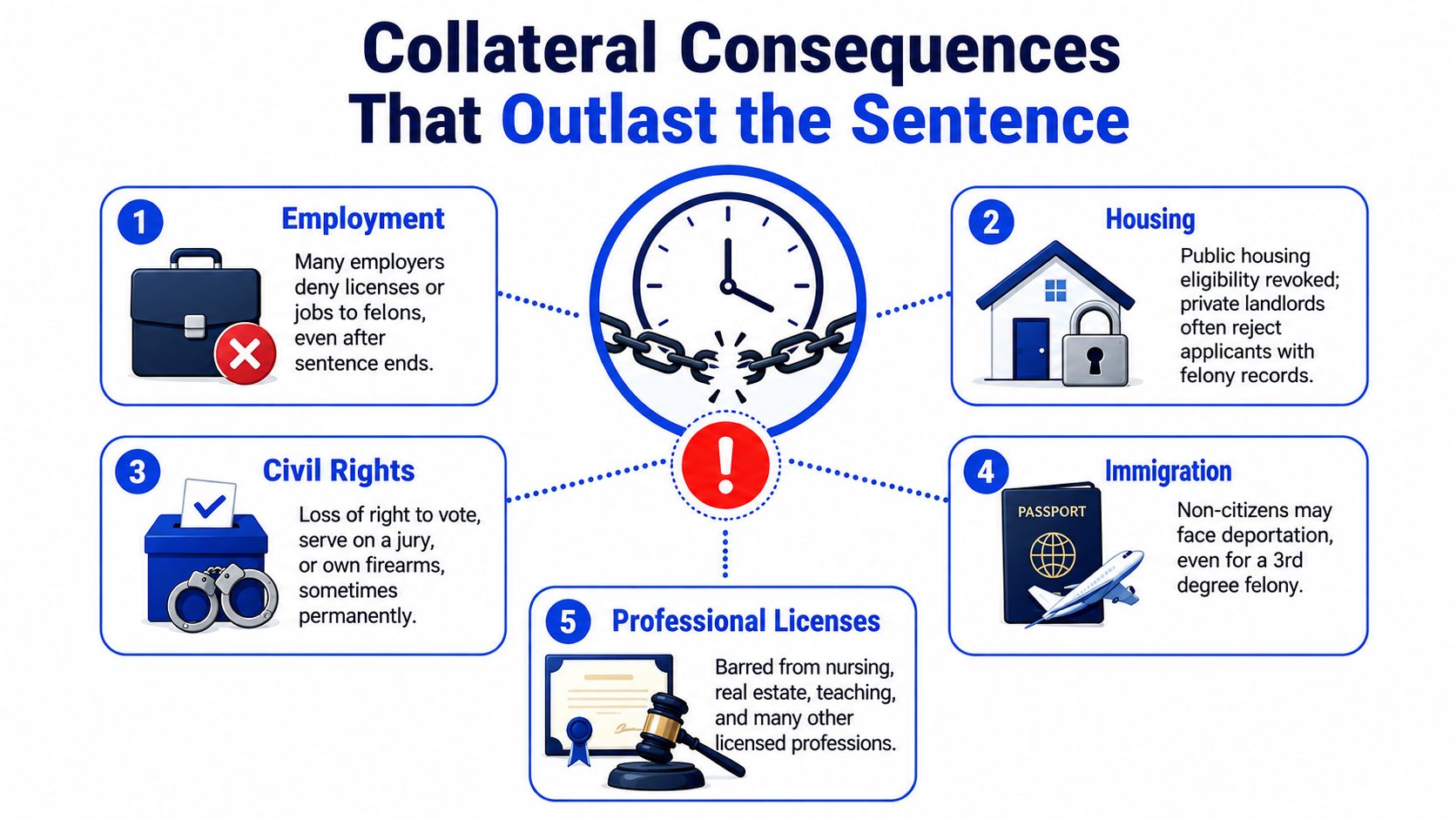
Many people focus on one question: “Will I go to prison?” That matters, but a conviction can affect life after court supervision ends. Collateral consequences are separate from the sentence imposed by the judge, and they may involve employment, housing, licensing, firearms, benefits, voting, or jury service.
Work and professional licensing
A felony record can create barriers for people seeking regulated work in South Florida. Applicants in nursing, real estate, education, security, healthcare, financial services, and other licensed fields may have to address criminal-history questions or licensing review.
An employer or licensing board may look beyond the sentence itself. The offense description, disposition, time passed, rehabilitation evidence, and applicable licensing rules can all matter. A person who avoids conviction may preserve options that become harder to recover later.
Housing, firearms, benefits, and civil rights
Background checks can affect apartment applications and housing decisions. Firearm possession may become restricted under applicable state or federal law. Public-benefits access can also raise questions, particularly for people moving through incarceration and reentry.
Voting and jury-service disabilities may apply depending on the jurisdiction and restoration rules. The overview of collateral consequences for Florida felony convictions describes these categories as legally separate from the direct sentence.
The result is that the total cost of a conviction may exceed the courtroom punishment. That doesn't mean every consequence applies to every person, and restoration rules can be complicated. It does mean that avoiding a conviction, negotiating an appropriate disposition, or pursuing an eligible record-clearing remedy should be part of the defense discussion from the beginning.
The case doesn't necessarily end for your future when the judge closes the file.
Defending a 3rd Degree Felony Charge and Your Next Steps
A strong defense begins with the evidence, not the label. The State must prove the charge beyond a reasonable doubt, and the defense can test how police obtained evidence, whether witnesses are reliable, and whether the alleged facts satisfy every element of the statute.
Common defense questions
Was the search lawful? A motion to suppress may matter if officers lacked a valid warrant, consent, probable cause, or another recognized legal basis.
Can the State prove possession or identity? Mere presence near an item doesn't automatically establish knowing possession, and witness identification can require close examination.
Are the tests reliable? Field tests, laboratory results, photographs, videos, and chain-of-custody records should be reviewed rather than accepted without question.
Does the conduct meet the charged degree? The evidence may support a reduction, a misdemeanor disposition, or dismissal if the State can't prove value, intent, injury, weapon possession, or another required element.
Are the witnesses credible? Conflicting statements, incentives, omissions, and inconsistent timelines can affect whether the prosecution can meet its burden.
A broader discussion of types of criminal defenses in Florida can help organize these issues. In a South Florida case, early work may include obtaining surveillance video, preserving phone records, interviewing witnesses, reviewing body-camera footage, challenging a stop or search, and examining the charging document for defects.
Frequently asked questions
Can a third-degree felony be reduced?
It can be possible, depending on the offense, evidence, prior record, and negotiation posture. A reduction isn't automatic, and the defense must identify a lawful and factually supported path to a lower charge or alternative resolution.
Will I go to jail for a first offense?
Not necessarily. A first offense may still involve serious consequences, but a prison sentence isn't automatic solely because the charge is a third-degree felony. The sentencing score, offense facts, prior record, available alternatives, and court decision all matter.
Can a third-degree felony be sealed in Florida?
Eligibility depends on the offense, final disposition, prior record, and Florida's record-sealing and expungement rules. A conviction generally creates more limitations than a qualifying dismissal or diversion result, so record-clearing questions should be addressed before resolving the case.
Ticket Shield, PLLC offers confidential consultations for people facing DUI, drug, theft, violence, weapons, and probation-related allegations throughout Broward County, Fort Lauderdale, Miami-Dade, Palm Beach, and surrounding Florida communities. The firm can review the charging documents, investigate constitutional issues, and discuss realistic options without promising a particular result.
If you're facing a 3rd degree felony charge, contact Ticket Shield, PLLC for a free, confidential consultation about the evidence, sentencing score, and collateral risks in your case. Speaking with an experienced former prosecutor early can help you understand your options before you make a decision that may affect your freedom, license, work, and record.