Grand Theft vs Petty Theft in Florida: A Clear Guide
Jason Goldsmith, Esq
You're standing in a South Florida loss-prevention office, trying to explain that the item was a mistake, not a plan. The officer has your identification, the store has video, and someone has started discussing whether the merchandise was worth enough for a felony. At that moment, the difference between grand theft vs petty theft isn't a technical vocabulary question. It can determine whether you're facing a misdemeanor or felony record, different plea options, and consequences that continue long after the store recovers its property.
Florida's dividing line is usually the property's value, but value isn't the only issue. Prior theft convictions, the location of the taking, the type of property, ownership, intent, and the quality of the State's evidence can all change the charge. This guide explains where the line generally falls and what an accused person should do before accepting a plea that may affect employment, housing, licensing, immigration, or future charging decisions.
Table of Contents
What the Difference Really Means for You in Florida
A Hialeah shopper leaves Walmart with a Bluetooth speaker she says she forgot to scan. Loss prevention stops her, recovers the item, and calls it shoplifting. Then an employee adds up the tags and reports a value that could support a felony charge.
That change can occur before a lawyer reviews the video, checks the receipt history, tests the valuation method, or interviews witnesses. The arrest report's label does not establish guilt, yet it can affect the initial bond request, the prosecutor's opening position, restitution discussions, and defense strategy from the first court date.
The value of the property often sets the charge level, but the reported price is only the starting point. Florida measures the legally relevant value under its theft statute, and the State must prove that value with admissible evidence. A defense lawyer should examine whether the calculation uses the right item, condition, quantity, and valuation method. A price tag, inventory record, or employee estimate may not settle the dispute.
The full value tiers are laid out in the table under the next heading and explained there in detail. Those classifications come from Florida's theft statute.
A felony label also may reflect more than the alleged value. Prior theft convictions can increase the charge or penalty. The location of the taking, the type of property, and other circumstances may trigger separate treatment. Ownership and intent remain contested issues, and weak video, inconsistent witnesses, or incomplete records can change the State's position before trial.
That is why a person should not accept the store's valuation or the arrest report's classification without testing both. Counsel should identify the evidence supporting the degree of the offense, review any prior record for escalation risks, and determine whether a lawful alternative disposition is available. A misdemeanor resolution and a felony resolution can produce very different effects on employment, housing, licensing, immigration, and future charging decisions. For a general comparison, see this explanation of misdemeanor and felony theft in Florida.
Florida's Statutory Thresholds Under Section 812.014
Florida's theft classifications turn on value, but the number must be proven correctly. The relevant measure is the property's market value at the time and place of the offense, not automatically the store's checkout price. If market value cannot be satisfactorily determined, the statute allows reasonable replacement cost. The governing text is Florida Statute Section 812.014.
The ordinary value tiers
Property valued at less than $100 generally constitutes second-degree petit theft. Property valued at $100 or more but less than $750 generally constitutes first-degree petit theft. At $750, ordinary property usually becomes third-degree grand theft, as long as its value remains below $20,000.
The higher felony tiers are:
Property Value | Charge Level | Statute | Offense Degree |
|---|---|---|---|
Less than $100 | Petit theft | Section 812.014 | Second-degree misdemeanor |
$100 to less than $750 | Petit theft | Section 812.014 | First-degree misdemeanor |
$750 to less than $20,000 | Grand theft | Section 812.014 | Third-degree felony |
$20,000 to less than $100,000 | Grand theft | Section 812.014 | Second-degree felony |
$100,000 or more | Grand theft | Section 812.014 | First-degree felony |
As of 2026, the $750 felony boundary set in 2019 remains the operative threshold. Articles that still cite $300 as the ordinary boundary rely on the pre-2019 framework and are outdated. For a deeper walkthrough of how the statute is applied, see this guide to Florida Statute 812.014.
The statute also creates special grand-theft categories that do not depend only on ordinary market value. The property's type, location, or other statutory circumstance can affect the degree of the charge, so a dollar-value chart does not resolve every case.
Why the number may be contested
The State may use a retail price, employee estimate, inventory record, or replacement-cost figure. Each item requires testing. Ask when the value was calculated, whether the property was new or used, whether the figure reflects fair market value, and whether recovered property was counted in the alleged loss.
Separate incidents may create further exposure if prosecutors claim that property belonging to different owners should be combined. That aggregation theory needs a legal and factual basis. Counsel should challenge an unsupported combined figure instead of accepting it as established.
A low-value allegation can also carry greater consequences for someone with prior theft convictions. Analyze the valuation evidence, the statutory category, and the accused person's record together. That combination often determines whether the case stays a misdemeanor, becomes a felony, or supports a more favorable resolution.
Elements the State Must Prove in a Theft Case
A theft accusation is not established merely because a person left a store with merchandise or possessed property that someone else claims to own. The State must prove the statutory elements beyond a reasonable doubt, including the required conduct, the required intent, and the correct classification of the property.
The conduct and the property
The State generally must prove that the accused knowingly obtained or used, or endeavored to obtain or use, the property of another. It must also prove that the property was, or was intended to be, temporarily or permanently deprived of the owner's rights.
That language creates several factual questions. Did the accused know the property belonged to someone else? Did the accused have permission to possess it? Did the person take control of it, or was the contact accidental? Did the video show concealment, or does it show an ordinary transaction, confusion, or an attempt to correct a mistake?
Ownership and possession deserve separate attention. A person may dispute who owned the item, whether the complaining witness had lawful possession, or whether the accused had a claim of right. A receipt, text message, prior agreement, payment record, or witness statement may become important evidence.
Intent often decides the case
The State must prove the required intent to temporarily or permanently deprive the owner of a right to the property or a benefit from it. A genuine claim of ownership, mutual mistake, or intent to return the item can undermine that element, although the result depends on the evidence and the specific facts.
Returning merchandise doesn't automatically erase a theft allegation. It can, however, affect the factual analysis, restitution discussions, and negotiation posture. Immediate payment may also help show how the parties understood the transaction, but it doesn't guarantee dismissal.
Value is an element of the degree
The State must establish the property's legally relevant value at the time of the offense. That makes valuation evidence a central defense issue, not an afterthought. Counsel should examine invoices, inventory records, depreciation, replacement-cost documents, witness knowledge, and the basis for any number written in a probable-cause affidavit.
A strong defense separates the alleged act from the alleged degree. Even if the State can prove an unauthorized taking, it still may fail to prove the value required for a felony classification.
Penalties and Records Side by Side
The practical difference between petit theft and grand theft is larger than the labels suggest. A misdemeanor generally carries less severe exposure than a felony, while a felony conviction can create broader consequences for professional licensing, employment screening, housing, immigration, and future charging decisions.
Florida's statute identifies the theft classifications, while the State's general punishment provisions supply the applicable misdemeanor and felony penalty framework. The exact exposure depends on the degree, prior record, sentencing status, and facts of the case. The statute and related legislative materials also recognize that repeated theft convictions can increase the classification of a later petit-theft offense. See the Florida grand theft overview for additional context.
Offense | Max Incarceration | Max Fine | License Action | Record Level |
|---|---|---|---|---|
Second-degree petit theft | Governed by misdemeanor punishment law | Governed by misdemeanor punishment law | Ask counsel to evaluate collateral consequences | Misdemeanor record exposure |
First-degree petit theft | Governed by misdemeanor punishment law | Governed by misdemeanor punishment law | Ask counsel to evaluate collateral consequences | More serious misdemeanor record exposure |
Third-degree grand theft | Governed by felony punishment law | Governed by felony punishment law | Ask counsel to evaluate collateral consequences | Felony record exposure |
Second-degree grand theft | Governed by felony punishment law | Governed by felony punishment law | Ask counsel to evaluate collateral consequences | More serious felony record exposure |
First-degree grand theft | Governed by felony punishment law | Governed by felony punishment law | Ask counsel to evaluate collateral consequences | Highest ordinary felony record exposure |
Restitution is separate from the criminal fine and can include the proven value of the loss and permitted investigative costs. The amount should be tied to evidence, not automatically accepted because a store representative states it. Recovered property, damaged merchandise, insurance payments, and unsupported administrative charges may all require review.
A conviction also isn't the only outcome that matters. An arrest, plea language, adjudication status, diversion completion, dismissal, and sealing eligibility can produce different results on background screening. Employers and licensing boards may read a felony theft disposition differently from a misdemeanor petit-theft disposition even when the underlying merchandise was recovered.
Enhancements That Can Push a Misdemeanor Into a Felony
Value is the usual starting point, but it isn't the entire Florida theft analysis. The statute recognizes circumstances that can increase the severity of an offense regardless of ordinary value. That's why a defense lawyer must examine the item, location, prior convictions, and alleged conduct before giving an opinion about charge level.
One important escalation involves prior theft convictions. Florida legislative materials explain that petit theft with one prior theft conviction is treated as a first-degree misdemeanor, while petit theft with two or more prior theft convictions can become a third-degree felony. The State must still establish that the prior dispositions legally qualify and that the current charge satisfies the statute.
The location can matter too. Property worth $40 or more but less than $750 taken from a dwelling or its unenclosed curtilage can qualify as third-degree grand theft. Certain specially protected property can also trigger grand-theft treatment regardless of ordinary value. The controlling statutory language appears in the Florida Senate's current theft chapter.

The item itself can change the classification
The theft of specially listed property may receive grand-theft treatment without the ordinary value analysis. Controlled substances are another example identified in the statute. A defense review should determine whether the State has correctly identified the property category and proved the facts required for the enhancement.
The practical lesson is simple. Don't evaluate a theft case by looking only at the price tag. A prior record, dwelling allegation, protected property category, or charging theory can move the case into felony territory. Counsel should obtain certified disposition records, verify the legal status of prior convictions, and test every enhancement element rather than accepting the prosecutor's summary.
Collateral Consequences Most People Underestimate
A theft disposition can affect much more than the sentence imposed in court. The most important question for many clients is whether the final outcome will interfere with work, housing, licensing, immigration matters, education, or future applications.
A nurse, teacher, real estate agent, or accountant may face professional review after a theft plea or conviction. A landlord may treat a theft record as a reason to deny an application or decline renewal. A bank, bonding company, or employer may view a theft-related disposition as relevant to honesty-sensitive work even after restitution has been paid.

A conviction can outlast the courtroom case
Noncitizens should treat any theft plea as a serious immigration issue, particularly when a visa, adjustment, naturalization, or removal matter is pending. Criminal defense counsel should coordinate with qualified immigration counsel before a plea is entered. A disposition that seems minor in state court can have consequences under federal immigration law.
Felony dispositions can also affect firearm rights, depending on the governing law and the exact disposition. College students may face school discipline, scholarship problems, or financial-aid complications. Those consequences often arise outside the criminal courtroom, where the sentencing judge has little control over the decision-maker.
Record relief requires planning
A dismissal, diversion completion, or withheld adjudication may create different record-relief possibilities than an adjudicated conviction. Eligibility depends on the person's history, the exact offense, and the final disposition. It isn't safe to assume that paying restitution automatically produces a clean record.
Before accepting a plea, ask how the outcome may affect screening, licensing, immigration, and future applications. Then ask whether a different resolution could preserve more options. A lawyer should evaluate Florida record sealing and expungement before the case is resolved, not after a damaging disposition is already entered.
Defenses and Negotiation Strategies That Actually Work
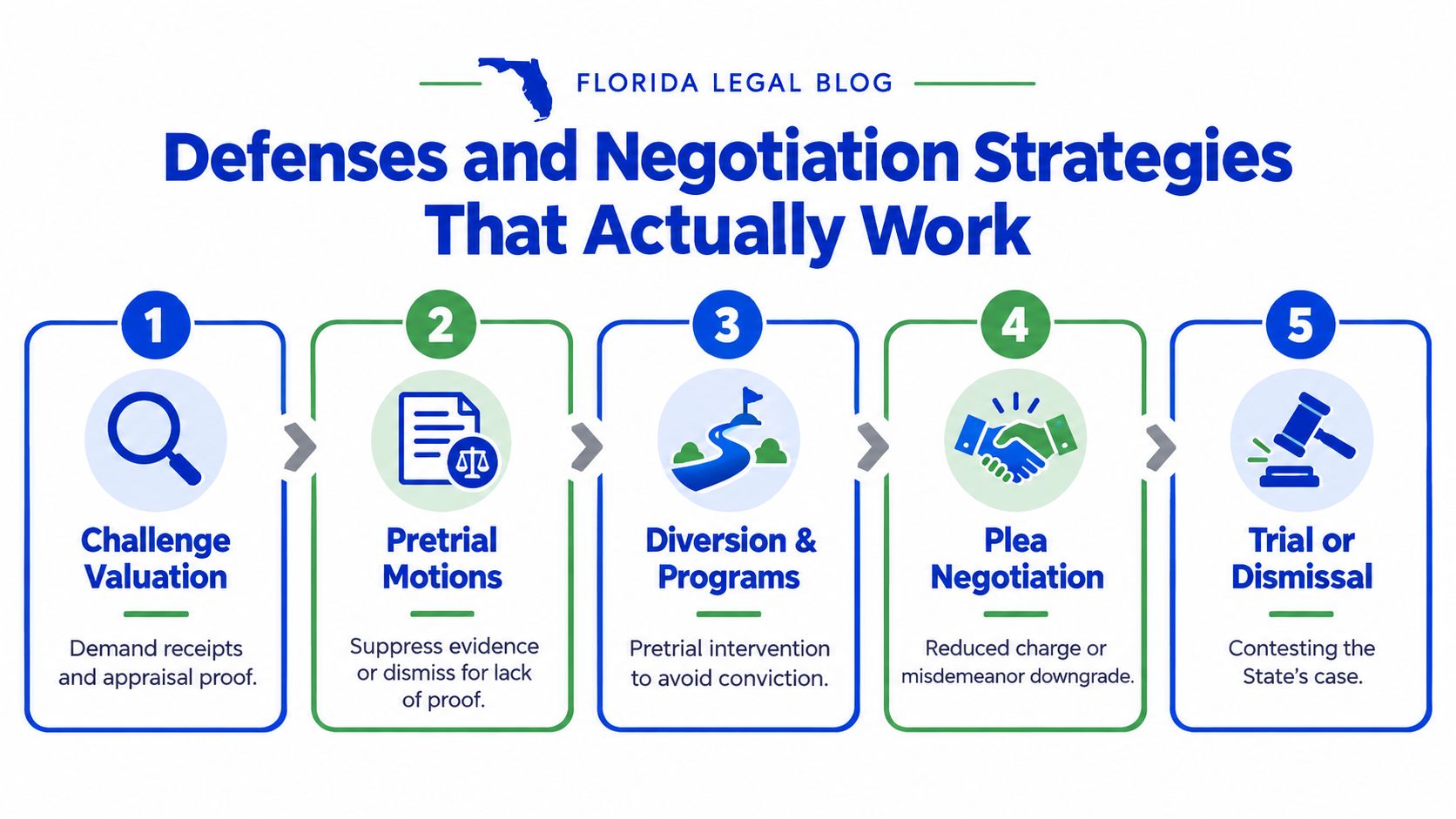
The strongest theft defenses attack the State's proof at its weakest point. In many cases, that means challenging valuation before arguing about punishment. If the State can't support the alleged amount, the felony degree may not survive even if the prosecution can prove an unauthorized taking.
Counsel should demand the documents behind the number, including receipts, inventory records, replacement-cost materials, and valuation witness information. Loss-prevention officers should be questioned about how they identified the item, calculated the amount, preserved the video, and separated the value of recovered property from any actual loss.
The defense should match the evidence
A claim of right, mutual mistake, abandonment, or lack of intent can defeat the mental-state element. A written receipt, payment record, returned merchandise, or immediate attempt to correct an error may support that defense. None guarantees a result, but each can change how a prosecutor evaluates the case.
Pretrial motions may target an unlawful search, an unreliable identification, a suggestive photo lineup, or incomplete discovery. The full loss-prevention video matters. A short clip showing the exit may omit the conversation, checkout confusion, return attempt, or conduct that explains what happened.
Negotiation should protect the record first
Possible paths can include misdemeanor diversion, a withheld adjudication where legally available, charge reduction after valuation problems, or a civil compromise analysis when the statutory requirements are met. A defense lawyer should rank the options by their effect on the record, not merely by the shortest path to closing the file.
For a first-time accused person, avoiding an adjudication may matter more than accepting a quick plea. For someone facing a disputed value near the felony boundary, a reduction to petit theft may be the central objective. For someone with qualifying priors or an enhancement allegation, the immediate priority may be preventing felony exposure while preserving every legal challenge. Florida theft-defense information is also available through this discussion of petit theft charges.
Where to Go From Here and Common Questions
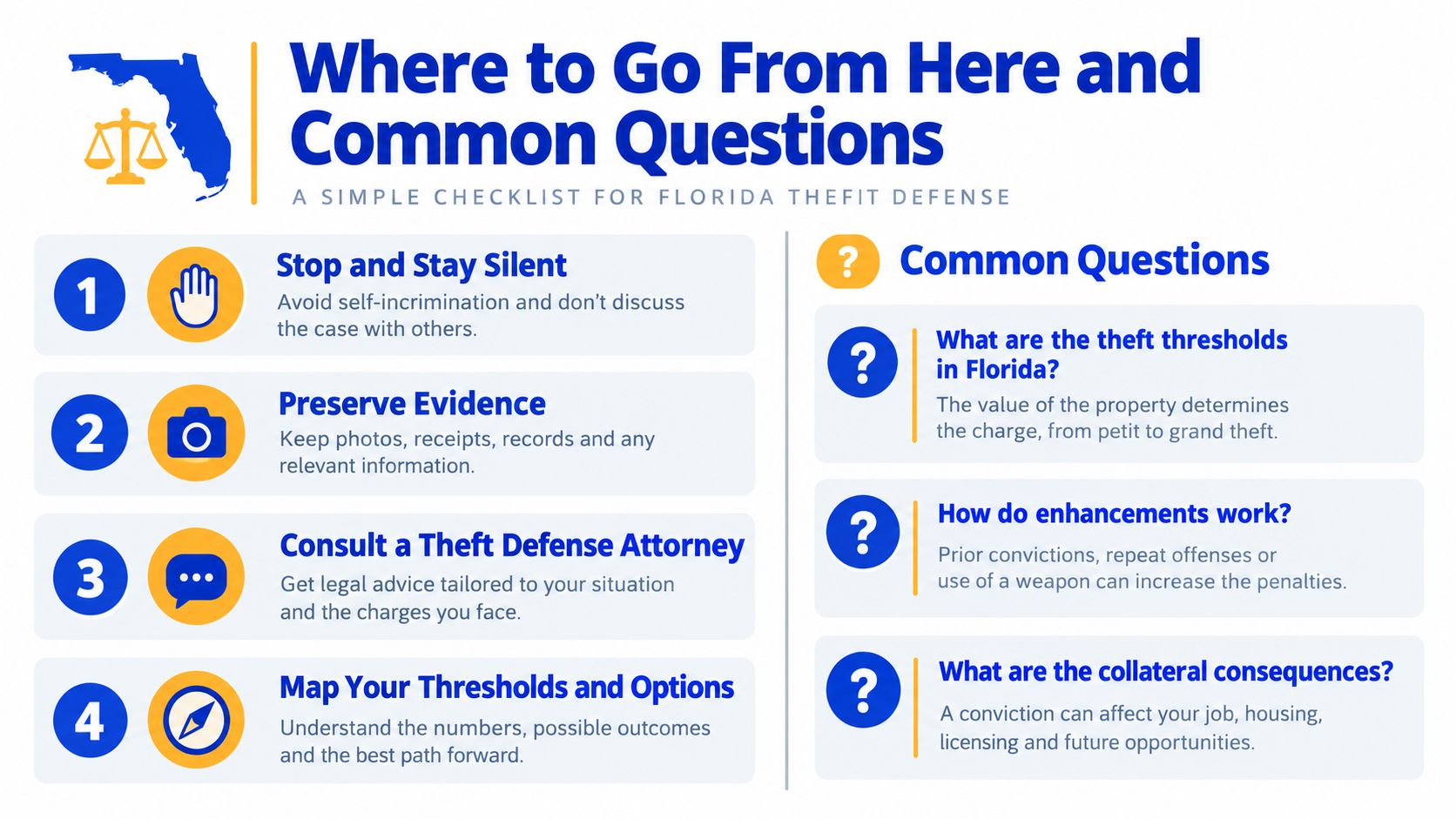
Take control of the first conversations. Don't argue with loss prevention, don't provide a recorded statement without legal advice, preserve receipts and messages, and avoid contacting the complaining store or alleged victim. Anything you say can become part of the evidence, even if you believe you're just explaining a misunderstanding.
Questions that deserve direct answers
Can a misdemeanor theft case disappear quickly? Possibly, but the answer depends on the disposition. Diversion, dismissal, and withheld adjudication can affect record-relief options differently. Sealing eligibility under Florida law must be evaluated against the exact charge and the person's prior record.
How long does grand theft remain on a record? An adjudicated felony can create long-term felony-record consequences. Don't assume restitution, probation completion, or a later employment background check will erase it.
How is restitution calculated? It should reflect the proven loss and legally permitted costs, supported by evidence. If value is disputed, the defense should challenge the calculation before agreeing to an order.
How long will the case take in Broward, Miami-Dade, or Palm Beach? Timelines vary with the charge level, court calendar, discovery, motions, negotiations, and whether the case proceeds to trial. Anyone promising a guaranteed resolution date is overstating what they control.
Use this decision framework:
No prior record: Explore diversion or another disposition designed to avoid an adjudication.
Contested value: Build the case around market value, replacement cost, ownership, and the State's supporting documents.
Prior theft convictions or enhancements: Treat the matter as potential felony exposure and verify every prior and circumstance allegation.
Immigration, licensing, or employment concerns: Obtain advice before entering any plea, because the lowest sentence may not be the safest overall outcome.
Ticket Shield, PLLC helps people facing Florida petit-theft and grand-theft accusations evaluate valuation disputes, intent defenses, record consequences, and charge-reduction options. Visit Ticket Shield, PLLC to request a consultation about protecting your record and building a defense in Broward, Fort Lauderdale, Miami-Dade, Palm Beach, or surrounding South Florida courts.