Petit Theft Florida Defense: Expert Legal Help in 2026
Jason Goldsmith, Esq
You leave a store in Fort Lauderdale, Davie, Miami, or West Palm Beach thinking the issue is a misunderstanding. A few minutes later, store security stops you. Police get called. Someone says “petit theft,” and suddenly a routine errand has turned into a criminal case.
That shock is real. So is the confusion. Many people charged with petit theft in Florida have never been arrested before and don't understand why something involving a low-dollar item is being handled like a real crime.
Florida treats theft charges seriously because theft is viewed as an offense involving dishonesty. From a defense standpoint, that matters. Prosecutors don't just look at the item. They look at what they believe they can prove about your intent, your statements, the store video, the receipt, and whether your version sounds believable when placed next to the evidence.
If you're facing a petit theft case in Broward County, Miami-Dade, Palm Beach, or nearby South Florida courts, the most important move is to treat it like a case that can affect your future. A careful defense can challenge the State's proof, protect your record, and sometimes position the case for dismissal instead of a conviction.
Table of Contents
A Simple Mistake Now a Criminal Charge
A common South Florida scenario looks like this. You're at a self-checkout. You scan most of the items, miss one, pay, and head toward the exit. Or your child puts something in the cart and you don't notice it until you're already outside. Or there's confusion over whether an item was double-bagged, left under the cart, or paid for in a separate transaction.
Then everything speeds up. A loss prevention employee approaches you. You're taken to a back office. Questions start. Someone asks for your ID. By the time police arrive, the store has already decided what story it's going to tell.

That's the moment many people make their first big mistake. They think if they explain enough, apologize enough, or offer to pay, the problem will disappear. Sometimes the store takes the money and still pushes the case forward. Sometimes your own statement becomes the strongest piece of evidence against you.
Practical rule: Once a retailer or officer starts treating the incident as theft, stop trying to talk your way out of it and start thinking about defense.
Petit theft in Florida can come from shoplifting allegations, self-checkout disputes, employee theft claims, or accusations involving borrowed property that wasn't returned when expected. The facts vary, but the pressure is the same. A charge that sounds minor can still mean court dates, exposure to jail, a permanent record if mishandled, and damage to your reputation.
In Broward County and surrounding courts, these cases move through the same criminal system as other misdemeanors. That means the State files charges, gathers evidence, and expects a response. The smart move is to understand what the prosecutor has to prove before deciding how to handle it.
Defining Petit Theft Under Florida Law
Florida law draws a sharp line based on the value of the property. Under Florida Statute 812.014, second-degree petit theft applies to property valued at less than $100, and first-degree petit theft applies to property valued at $100 to less than $750. The same statute sets the current felony theft threshold at $750.
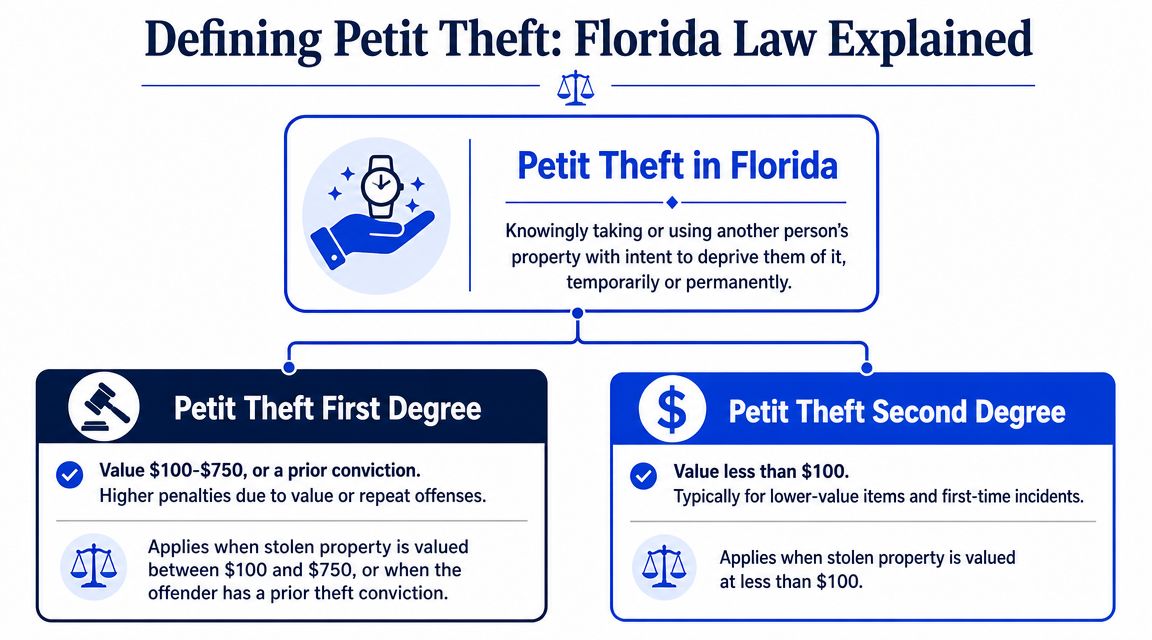
What the charge actually means
Those categories matter because the potential punishment changes with the degree of the offense.
Charge level | Property value | Classification | Maximum penalty |
|---|---|---|---|
Second-degree petit theft | Less than $100 | Second-degree misdemeanor | Up to 60 days in jail and a $500 fine |
First-degree petit theft | $100 to less than $750 | First-degree misdemeanor | Up to 1 year in jail and a $1,000 fine |
If you want a broader overview of related offenses, Florida theft classifications, and defense issues, this guide to Florida theft crimes is a useful starting point.
A lot of clients focus only on the dollar value. That's understandable, but it misses the most important issue. Theft cases are not just about whether property left a store or changed hands. They are about whether the State can prove a criminal state of mind.
Why intent is the real battleground
In plain English, the prosecution has to prove that you knowingly took or used property and intended to deprive the owner of it, even temporarily. That's why a real defense often starts with the difference between an accident and an intentional act.
A missed scan at self-checkout is not automatically theft. Forgetting an item under a cart is not automatically theft. Walking out while distracted is not automatically theft. Those facts can still lead to an arrest, but they don't end the analysis.
Here's what prosecutors usually look for when trying to prove intent:
Video behavior: Did you appear to conceal an item, bypass a register, switch tags, or look around before leaving?
Statements made on scene: Did you admit you “forgot” but also say something that sounds like knowledge?
Receipt comparison: Do the purchased items line up with what appears in the cart or bag?
Store witness testimony: What will the loss prevention officer say they observed?
In petit theft Florida cases, the strongest defense is often not “nothing happened.” It's “the State can't prove intent beyond a reasonable doubt.”
That distinction is where many cases are won or negotiated down. The charge may sound simple. The proof usually isn't.
The Hidden Penalties of a Theft Conviction
People often fixate on jail and fines. That's natural, but it's incomplete. A theft conviction can create damage that lasts much longer than the court case itself.
Florida law sets the direct misdemeanor exposure, but the bigger problem for many clients is that theft is seen as a crime of dishonesty. Employers, licensing boards, landlords, schools, and immigration authorities often read that type of offense differently than they would a traffic-related case or another low-level allegation.
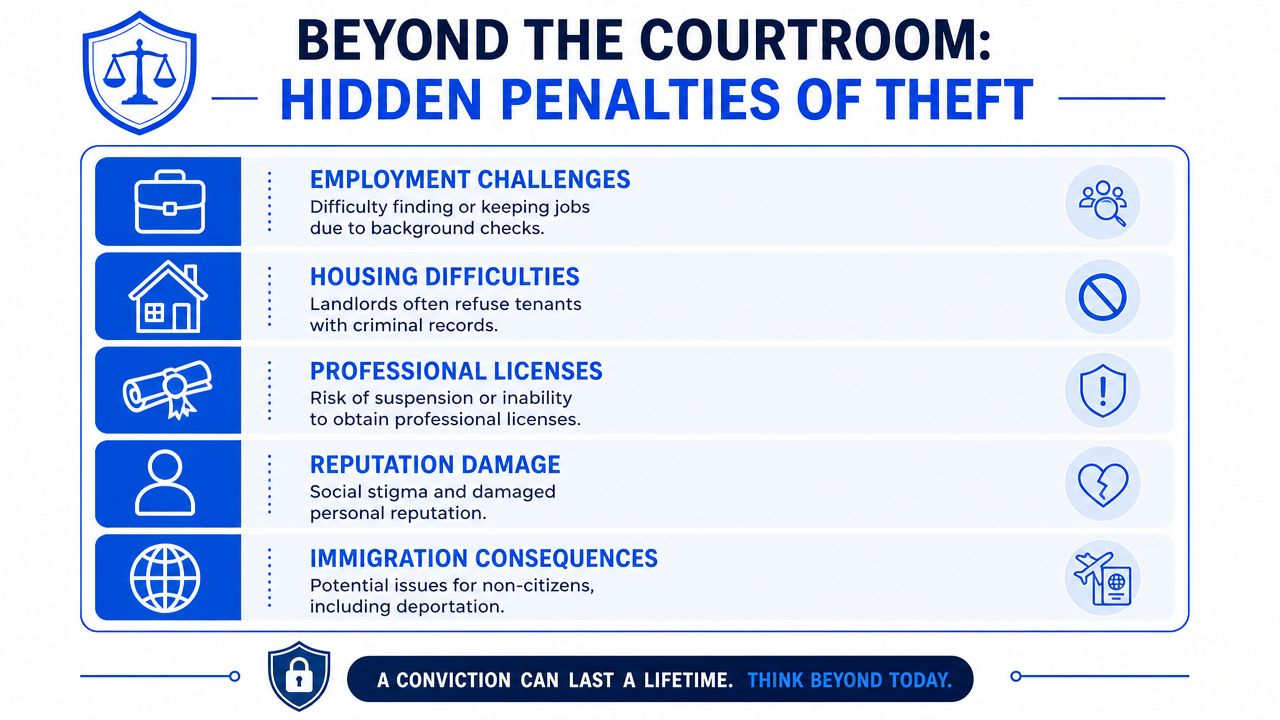
Why theft hits harder than many other misdemeanors
A conviction for theft can raise immediate concerns in any setting where trust matters. That includes jobs involving money, merchandise, client property, financial records, children, healthcare access, or secure facilities. Even when a charge involves a small item, the label can follow you long after the case ends.
This is one reason defense lawyers push back hard against “just take the plea” advice in these cases. A quick resolution isn't always a smart resolution.
Some related felony-level theft issues are discussed in this page on Florida grand theft defense, which helps show how quickly valuation and charging decisions can change the stakes.
The practical fallout clients usually don't expect
The collateral consequences usually show up in ordinary parts of life:
Employment screening: Many employers run background checks and may hesitate over a theft-related record.
Professional licensing: Applicants in regulated fields can face questions about honesty and fitness.
Housing applications: Landlords may treat pending charges or convictions as red flags.
Immigration concerns: Non-citizens should treat any theft allegation carefully because immigration consequences can be serious.
Reputation damage: Friends, family, coworkers, and schools may form opinions before the case is even resolved.
A short explanation of those broader life effects is worth watching here:
A theft case doesn't stay neatly inside a courtroom file. It tends to spill into hiring decisions, license applications, and personal reputation.
That's why the goal in many petit theft cases is not just reducing punishment. It's avoiding a conviction if the facts and the client's background make that possible.
How a Defense Attorney Fights a Petit Theft Charge
From the prosecution side, petit theft files often look routine. A store witness writes a report. Police take statements. Video gets summarized. A receipt is attached. The State assumes the story is clean because retail cases are common.
That assumption creates openings for the defense.
Florida's criminal justice data shows total arrests rose from 508,490 in 2020 to 543,138 in 2021, a 6.8% increase, and the system specifically tracks “Petit theft/3rd conviction” as a monitored category in statewide data, showing that even low-level theft remains part of a larger enforcement system in Florida's courts and data reporting, as reflected in the Florida criminal justice trends report.
How the State usually builds the case
In most South Florida petit theft prosecutions, the State tries to present a simple narrative: item selected, item not paid for, item taken past the point of sale, defendant confronted. Prosecutors like clean sequences and confident witnesses.
But “simple” cases often depend on weak building blocks:
Loss prevention testimony can be incomplete, biased, or based on assumptions.
Store video may lack angle, audio, or context.
Valuation evidence may be sloppy, especially when pricing is disputed.
Defendant statements may be ambiguous, especially after a stressful confrontation.
A former prosecutor knows what gets overlooked in fast-moving misdemeanor files. Missing footage. Inconsistent timelines. Report language copied from one case to another. Witnesses who didn't see the full event. Those flaws matter because the State still carries the burden.
Where strong defenses usually come from
A real defense is not a generic list of legal buzzwords. It's a targeted attack on the weakest part of the State's proof.
Some of the most effective approaches include:
Intent defense: Show that the event was a mistake, not a theft. Self-checkout cases often live or die here.
Identity challenge: If the video is unclear or the witness lost sight of the person, the State may not be able to prove who did what.
Value dispute: If the alleged value is shaky, charge severity can become negotiable.
Consent or ownership issues: In some disputes, the property relationship is more complicated than the report suggests.
Suppression issues: If police or security crossed legal lines during detention, search, or questioning, key evidence may be challenged.
Good theft defense work is usually detail work. The defense doesn't need drama. It needs contradictions, missing proof, and pressure on the State's weakest witness.
Not every case should be tried. Some should be negotiated toward dismissal programs, amended charges, or outcomes that protect the client's record. In eligible cases, a diversion path may make more sense than litigation. This overview of pre-trial intervention in Florida explains one common route.
What doesn't work is passivity. Waiting for the court date and hoping the prosecutor “understands” is rarely a plan. Early defense changes how the case gets evaluated.
Navigating the South Florida Court Process
For most clients, the court process is unfamiliar and stressful because they don't know what happens next. Once you understand the sequence, the case becomes easier to manage.
In petit theft cases across Broward County, Fort Lauderdale, Miami-Dade, Palm Beach, and nearby courts, the path is usually predictable even though the outcome is not.
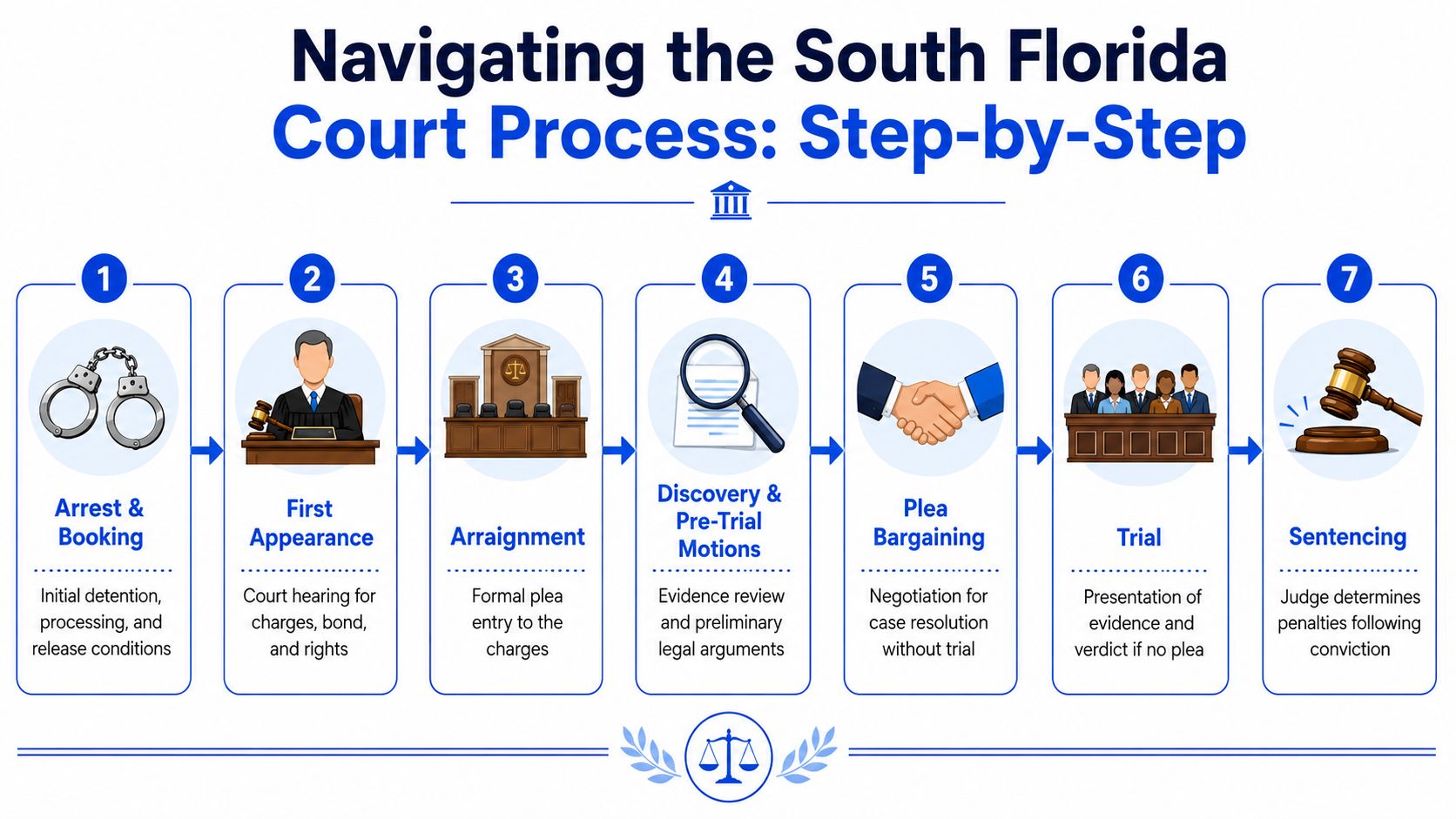
What usually happens after the arrest or notice to appear
Some people are arrested and booked. Others receive a notice telling them when to appear in court. Either way, the case has started, and ignoring it creates much bigger problems.
The basic flow usually looks like this:
First court date
The court addresses the charge and the case is formally placed on the criminal docket. In some cases, counsel can handle appearances for the client.Arraignment
A plea is entered, typically not guilty while the defense reviews the case.Discovery
The prosecutor provides the evidence. This can include reports, receipts, video, witness information, and any statements.Pretrial hearings Negotiation, investigation, and motion practice happen during this stage. If the evidence is weak, pressure often gets applied then.
Resolution or trial
The case may resolve through dismissal, diversion, plea, or trial depending on the facts and the client's goals.
Where cases often get resolved
Petit theft cases are often decided before trial, but that doesn't mean the result is automatic. The defense has to make a persuasive case for why the client deserves a better outcome than a theft conviction.
Florida sentencing exposure for petit theft remains significant. A second-degree misdemeanor carries up to 60 days in jail and a $500 fine, while a first-degree misdemeanor can carry up to 1 year in jail and a $1,000 fine. Prior history can increase pressure and change negotiations, as discussed in this explanation of Florida petit theft penalties and prior-record exposure.
In practice, negotiation usually turns on a few things:
Client history: A clean background is often treated differently from a repeat record.
Proof problems: Weak video or inconsistent witnesses help the defense.
Mitigation: Context matters. So does how the case is presented.
Program eligibility: Some clients may qualify for diversion or another structured resolution.
If the State offers a result that protects the client from the worst long-term damage, settlement may be smart. If the offer leaves a theft conviction in place without a strong reason, trial preparation may be the right pressure point.
The court process feels slow to clients because most of the important work happens between court dates, not during the few minutes your case is called.
That's especially true in misdemeanor theft cases, where quiet negotiation and careful evidence review often matter more than courtroom speeches.
Protecting Your Future with Record Sealing or Expungement
For many people, the end goal isn't just finishing the case. It's protecting the ability to move on without a public theft record following them.
That's where sealing or expungement becomes part of the strategy. These remedies are different, but both can matter after the criminal case ends. Whether you may qualify often depends on how the case is resolved.
Why the result of your case matters later
Some outcomes preserve future options better than others. A dismissal can create a very different record-clearing path than a conviction. Certain negotiated outcomes may also leave a person in a better position than a straight adjudication of guilt.
That's why the defense strategy on day one should account for day one hundred. If the lawyer handling the case doesn't think about later sealing or expungement issues, the client can lose opportunities that never come back.
A related example is a dismissal through a prosecutor's decision not to proceed. If that happens, this explanation of nolle prosequi in Florida helps show why that result can matter so much.
Early strategy protects later options
The practical lesson is simple. Don't make early decisions based only on convenience.
A rushed plea may close doors. A better-negotiated resolution may protect employment, housing, and future background checks. In many petit theft Florida cases, the best result is the one that avoids a conviction and keeps record-clearing options alive.
If you've been accused of petit theft in Fort Lauderdale, Broward County, Miami-Dade, Palm Beach, or elsewhere in South Florida, treat the case like it matters because it does. The right defense looks at the evidence, the legal issues, the prosecutor's likely arguments, and the long-term impact on your record.
A theft charge doesn't define you. But how you respond to it can shape what happens next.
If you need confidential guidance on a petit theft case anywhere in Florida, Ticket Shield, PLLC can evaluate the charge, explain your options, and build a strategy aimed at protecting your record, reputation, and future.
Petit theft may be a misdemeanor, but a conviction still follows you. Learn Florida's petit theft penalties and the defenses that work.