
Habitual Felony Offender Florida: Defense Strategies
Jason Goldsmith, Esq
You're sitting in a Fort Lauderdale courtroom when your lawyer tells you the State is seeking habitual felony offender, or HFO, status. You knew about your prior convictions, but you believed they were behind you. Suddenly, a new felony charge appears capable of carrying a substantially longer sentence, and your family wants to know whether the court has any choice.
Florida's HFO process is serious, but it isn't automatic. The State must establish statutory eligibility, follow required procedures, and obtain judicial findings. Even when eligibility is proven, the judge must still decide whether to impose the enhancement. That distinction often determines where effective defense work should focus.
Table of Contents
Understanding What Happens When HFO Charges Are Filed
A habitual felony offender allegation can change the pressure surrounding an otherwise familiar felony case. The prosecutor may point to prior convictions and ask the court to treat the new charge under Florida's repeat-offender statute. You may hear possible sentences discussed before anyone has fully verified the dates, records, or legal classification of those prior cases.
That's why the first response shouldn't be panic or an immediate plea. It should be a careful review of the State's position. A lawyer needs to determine what designation is being requested, which prior convictions the State is relying on, whether the statutory timing applies, and whether the required notice was properly served. The steps described in this guide to what happens after an arrest can affect how quickly those issues need attention.
Why the designation matters
HFO status is a sentencing classification, not a separate criminal charge that automatically proves itself. If imposed, it can increase the authorized sentencing range for the new felony. But a prior record alone doesn't answer the legal questions the judge must resolve.
The defense may have several opportunities to affect the outcome:
Challenge eligibility: The prior convictions may not satisfy the statute, may fall outside the relevant period, or may not be legally equivalent.
Challenge procedure: Notice, records, and the sentencing process must comply with statutory requirements.
Oppose imposition: Even if eligibility is established, counsel can present facts supporting a standard sentence.
Resolve the underlying case: A negotiated result before sentencing may avoid the requested designation or reduce the felony exposure.
Practical rule: Never treat an HFO notice as a final sentence. Treat it as a warning that the State is seeking a separate sentencing result that must be tested.
Families in Broward, Fort Lauderdale, Miami-Dade, Palm Beach, and other Florida communities should obtain the actual notice and prior-record documents, not rely on a prosecutor's summary or an online calculator. Small differences in conviction dates, release dates, supervision, and offense language can matter.
Florida Habitual Felony Offender Statute Explained
Florida's habitual felony offender framework is codified primarily in section 775.084 of the Florida Statutes. The statute generally requires at least two prior felony convictions, or other qualifying convictions from Florida or an equivalent jurisdiction. The State must connect those convictions to the current offense under the statute's timing and sequence requirements.
The eligibility questions
The analysis usually involves several separate questions:
Are there qualifying prior convictions? A lawyer should obtain certified or otherwise reliable records and examine the actual offenses, judgments, pleas, and dispositions. A label in a criminal-history printout may not establish every fact the State needs.
Does the timing qualify? The relevant prior conviction generally must fall within a five-year look-back period. The period is measured from the date of the last prior felony conviction or from release from imprisonment, probation, community control, parole, or another legally imposed form of supervision connected to that conviction, whichever date is later.
Was the sequence legally sufficient? Florida's Supreme Court has emphasized that sequence matters. Each later offense generally must have been committed after conviction for the preceding offense. Multiple charges resolved together may not automatically supply the sequence the statute requires.
Has the court made the required findings? HFO treatment requires a separate judicial determination. The court must decide whether the statutory criteria are met and whether an extended sentence is necessary for public protection.
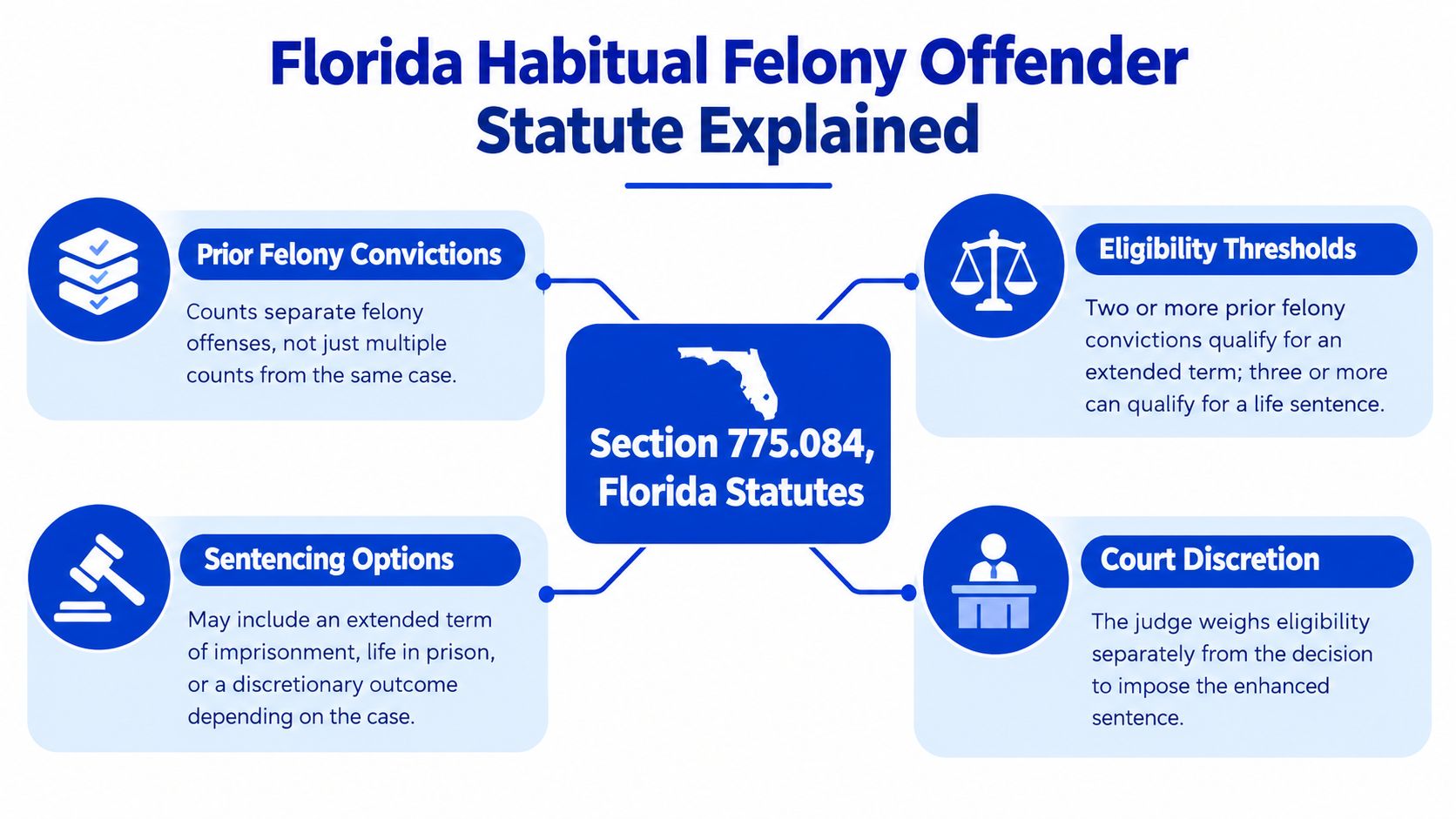
These questions prevent HFO sentencing from becoming a simple arithmetic exercise. Two convictions may appear on a record, yet the State still has to prove that they qualify under the governing law and satisfy the required timing and procedural rules.
A short educational overview may help you understand the terminology, but it can't replace examination of the court file. Prior convictions from another jurisdiction, old supervision records, and dispositions involving multiple counts often require document-by-document analysis.
Sentencing Enhancement Tiers and Maximum Penalties
A second-degree felony can expose a defendant to a substantially longer sentence if the court imposes HFO treatment. The available maximum depends on the degree of the current felony:
Felony Degree | Maximum Enhancement |
|---|---|
Life or first-degree felony | Up to life |
Second-degree felony | Up to 30 years |
Third-degree felony | Up to 10 years |
These are authorized maximums, not automatic sentences or HFO mandatory minimums. Florida's statutory framework permits the extended terms, but the judge still must decide whether to impose them and what sentence fits the case.
That decision can turn on the facts of the new offense, the defendant's actual criminal record, the circumstances surrounding earlier convictions, supervision history, treatment efforts, employment, family responsibilities, and compliance with court orders. Counsel should present those facts as a concrete sentencing record, not as general assurances.
Maximum exposure is not the sentence
A lawyer evaluating an HFO case should answer several practical questions:
Is the State seeking HFO status or another repeat-offender classification?
Can the State prove every qualifying prior conviction?
Does the current offense satisfy the statutory requirements?
Has the judge found that an extended sentence is necessary for public protection?
What sentence should the court impose if it declines the enhancement?
The difference between eligibility and imposition controls the defense strategy. Even if the record technically makes a defendant eligible, counsel can argue that the judge should decline the enhancement and impose a standard sentence. The strongest presentation connects mitigation to public safety, rehabilitation, and the defendant's conduct since the prior convictions.
The statutory maximums appear in Florida's current statutory text for section 775.084. A maximum sets the ceiling. It does not determine the result in a particular courtroom.
A Florida Senate fiscal analysis reported 1,241 prison admissions for habitual-offender categories in fiscal year 2024–25, including 1,020 classified as Habitual Felony Offenders and 237 as Habitual Violent Felony Offenders. The Florida criminal justice data snapshot places those figures in the broader sentencing context, but they cannot predict an individual judge's ruling.
For background on evaluating sentence exposure, see how much time in jail a criminal charge may involve. The charge, record, proof, and sentencing posture remain decisive.
Procedural Triggers From Notice Through Sentencing
An HFO request must follow a process. The State can't mention prior convictions at the last moment and expect the court to impose an enhanced sentence without giving the defense a fair opportunity to respond.
Written notice comes first
Florida law requires written notice to both the defendant and defense counsel sufficiently before a plea is entered or before sentencing. The notice should identify the State's intent to seek HFO treatment and give the defense time to investigate the alleged predicates.
That time has practical value. Counsel can request court records, compare dates, investigate whether convictions were entered in the required sequence, and determine whether the State has identified the correct person and offense. A rushed review can miss a defective record or a timing problem.

The court reviews proof and mitigation
The process generally moves from notice to proof of prior convictions, then to a sentencing proceeding where the judge determines whether the legal requirements are satisfied. The required findings must be established by a preponderance of the evidence, and the court must obtain and consider a presentence investigation before imposing an HFO sentence.
The presentence investigation can become an important defense document. It may contain errors, incomplete context, or descriptions that make old conduct appear more recent or more serious than the underlying records support. Counsel should review it carefully and correct inaccuracies before the judge relies on it.
A pretrial conference may also affect the timing of these decisions. Understanding what happens at a pretrial conference helps a defendant prepare for discussions about discovery, motions, negotiations, and future hearings.
The procedural hearing is not paperwork. It's where the defense can test the State's records and present a reasoned alternative to enhanced sentencing.
The Critical Distinction Between Eligibility and Imposition
Many defendants hear “you qualify as an HFO” and assume the judge must impose the enhancement. That assumption is wrong. A 2025 Fifth District Court of Appeal decision emphasized that HFO sentencing is permissive, not mandatory, and that the statute doesn't impose an HFO mandatory minimum. The governing statutory language is available through the Florida Senate's section 775.084 materials.
What the defense must do after eligibility
Once the State establishes eligibility, the defense should stop treating the hearing as only a records dispute. The argument must shift to whether an extended sentence is necessary for public protection in this particular case.
That requires facts, not general assurances. A lawyer may present:
A complete personal history: Treatment, employment, education, family support, medical needs, and stable housing can help the court evaluate the person beyond the conviction list.
A reliable account of prior cases: Old convictions may involve addiction, unstable housing, youthful decision-making, or circumstances that differ sharply from the current allegation.
Evidence of change: Completed treatment, educational work, lawful employment, counseling, or successful periods in the community can support a request for a standard sentence.
A specific sentencing proposal: Judges need a realistic alternative, not merely a request for mercy. The proposal may address supervision, treatment, restitution, employment, and conditions that reduce risk.
What usually fails
A mitigation presentation built on unsupported promises rarely carries much weight. So does minimizing every prior case, attacking the prosecutor personally, or presenting a stack of character letters without explaining how the information relates to public safety.
Eligibility answers whether the statute can apply. Imposition asks whether the court should use it. Defense counsel must address both questions separately.
A former prosecutor's perspective is useful here because judges generally want a concrete reason to choose the ordinary sentencing path. The strongest argument connects verified facts to a practical plan and explains why the requested enhancement is unnecessary, not merely harsh.
Recent Legislative Changes and Pending Reforms
Repeat-offender law can change while a case is pending. Older online articles may describe a version of section 775.084 that no longer controls, or they may discuss a proposal as though it were already law. Defendants should separate the statute currently in effect from legislation that has been filed or proposed.
In 2026, Florida Senate Bill 892 would revise repeat-offender sentencing provisions. The bill was assigned an effective date of July 1, 2026, and its fiscal analysis describes an amendment to section 775.084 that would change how enhanced sentencing operates. The filed SB 892 bill text identifies the proposal and its future effective date. A filed bill isn't automatically the law governing today's case.
Which law controls
The answer can depend on the offense date, the procedural posture, the plea, and the sentencing date. Counsel should examine the applicable law rather than assume that the newest online summary or the most favorable-sounding version applies.
That review matters because a change to repeat-offender provisions can affect eligibility, sentencing procedure, judicial discretion, or the relationship between classifications. It may also raise questions about whether a statutory amendment applies to a particular offense or only to future conduct.
Related classifications
HFO isn't the only repeat-offender category Florida uses. Habitual violent felony offender, violent career criminal, and three-time violent felony offender classifications are separately defined and tracked. Their eligibility rules and sentencing consequences may differ, so a defense lawyer must identify the exact designation the State is pursuing.
The right question isn't, “How many years could I receive?” It's, “Which classification, under which version of the statute, based on which prior convictions, and through what procedure?”
Defense and Mitigation Strategies That Work
Effective HFO defense combines legal objections with sentencing preparation. Focusing on only one side can leave a serious gap. A lawyer who challenges the record but has no mitigation plan may lose an opportunity to persuade the judge, while a lawyer who presents mitigation without testing eligibility may concede an enhancement the State can't legally prove.
Start with the State's paperwork
Obtain the written notice and identify every alleged predicate. Then compare the notice against certified judgments, plea documents, release information, supervision records, and the charging history. The defense should ask whether the documents prove the correct identity, offense, conviction date, sequence, and timing.
The five-year calculation deserves special attention. The relevant date may involve release from imprisonment, probation, community control, parole, or another form of legally imposed supervision, rather than the date a client remembers as the end of the case. A timeline should be built from records, not assumptions.
Separate the legal and human presentations
The legal challenge may involve:
Notice: Was written notice served on both the defendant and counsel with sufficient time?
Predicate proof: Do the prior convictions qualify under the statute?
Sequence: Did each later offense occur after conviction for the preceding offense?
Timing: Did the State calculate the look-back period from the legally relevant date?
Current offense: Does the new felony fit the statutory framework?
The mitigation presentation should then answer a different question. Why is an extended sentence unnecessary for public protection? The answer should include documented treatment, work history, family structure, medical information, educational progress, community support, and a concrete plan for compliance.
A useful defense may also involve negotiations before the hearing. The State may reconsider an HFO request when counsel exposes uncertainty in the predicate records, presents credible mitigation, or offers a resolution that addresses the prosecution's concerns without the enhancement.
For broader context on types of criminal defenses, remember that HFO litigation is only one part of the case. Motions, constitutional challenges, charge negotiations, trial preparation, and sentencing advocacy may all affect the final result.
Next Steps and Protecting Your Rights
If the State is pursuing HFO status, don't wait until the sentencing hearing to begin preparing. Gather every document you have about prior cases, including judgments, plea paperwork, probation or supervision records, release information, and correspondence from earlier attorneys. Tell new counsel about every prior case, even if you believe it's too old or unrelated. Surprises are harder to address when the court date is near.
During a consultation, ask which designation the State is seeking, how the five-year period was calculated, whether the prior convictions legally qualify, and whether the notice complied with Florida law. You should also ask how counsel plans to oppose imposition if eligibility is established. This list of questions to ask a criminal defense lawyer can help organize that conversation.
Don't accept “you qualify” as the end of the analysis. Ask what the State can prove, what the judge may still decide, and what evidence supports a standard sentence.
A lawyer serving Broward County, Fort Lauderdale, Miami-Dade, Palm Beach, and surrounding Florida communities can evaluate the underlying felony, the prior convictions, the notice, the applicable statute, and the mitigation record together. Early review may create options that disappear after an uninformed plea or an unprepared sentencing hearing.
Ticket Shield, PLLC defends Florida clients facing felony charges and habitual felony offender sentencing, with case evaluation focused on challenging prior convictions, testing the State's procedure, and presenting meaningful mitigation. Visit Ticket Shield, PLLC to request a consultation and discuss your case with a former prosecutor who understands how these sentencing requests are built.