
Florida Statute 812.014 Theft Law Explained and Penalties
Jason Goldsmith, Esq
A lot of people land on Florida Statute 812.014 after a bad afternoon that got out of control fast. A store stop in Fort Lauderdale. A misunderstanding with a roommate in Miami-Dade. An accusation that someone took tools, a package, or a gun that wasn't theirs in Palm Beach County. By the time family members start searching the law, the question usually isn't academic. It's practical. Is this a misdemeanor, or did this just become a felony?
That's the part that creates panic, and for good reason. In Florida, theft law doesn't just look at a price tag. It can also turn on where the property was taken, whether prosecutors claim multiple incidents can be grouped together, and what kind of item was involved. Those details can change the charge in ways that surprise people who assume only high-dollar theft leads to felony exposure.
Table of Contents
Defenses Procedural Issues and Plea Options to Discuss With Counsel
Related Statutes Next Steps and How Ticket Shield PLLC Can Help
Introduction to Florida Statute 812.014 and Why It Matters
Florida Statute 812.014 is the state's main theft law. Florida courts have long treated it as the state's “omnibus theft statute,” and the Florida Supreme Court recognized that label in a 1991 decision discussing section 812.014. In plain terms, this is the law that covers a wide range of accusations, from shoplifting to vehicle theft to major property cases.
That matters in South Florida because theft allegations often start small and feel manageable. Then the paperwork arrives, and the family realizes the accusation may carry a misdemeanor, a felony, or an enhanced charge depending on facts that weren't obvious at the scene. A person accused in Broward County may think the issue is only the item's value. Often, it's not that simple.
Why families get confused so quickly
Searching Florida Statute 812.014 is driven by a single urgent question: what happens next? The need isn't for abstract legal theory. The goal is to understand how police and prosecutors may classify the allegation, what the State has to prove, and where defenses usually begin.
A few pressure points come up again and again:
A low-dollar allegation can still become more serious if the location or item changes the grading.
A repeated retail accusation may be charged differently if the State tries to aggregate incidents.
Intent matters more than many people realize. Suspicion alone isn't supposed to be enough.
Early legal advice protects options before statements, screenshots, receipts, and surveillance issues are lost.
If you're dealing with a theft accusation anywhere in Broward, Fort Lauderdale, Miami-Dade, Palm Beach, or nearby South Florida communities, it helps to understand how Florida theft crimes are commonly charged and defended. A calm review of the facts early can make a real difference in protecting constitutional rights, avoiding admissions, and preserving defenses.
Practical rule: The label “theft” sounds simple. Under Florida law, it rarely is.
What Florida Statute 812.014 Actually Says in Plain English
A parent gets a late-night call. Their college-age son says the item at issue was only worth a little money, so it should stay minor. Under section 812.014, that is not always how Florida theft law works.
The statute gives prosecutors a broad starting point. In plain English, it says theft happens when someone knowingly obtains, uses, or tries to obtain or use property that belongs to another person, and does so with the intent to keep the owner from it or to treat it like their own. You can read the current statutory text in the 2026 version of section 812.014.
A person commits theft if he or she knowingly obtains or uses, or endeavors to obtain or to use, the property of another with intent to deprive the other person of a right to the property or a benefit from it, or to appropriate the property to his or her own use or the use of a person not entitled to it.
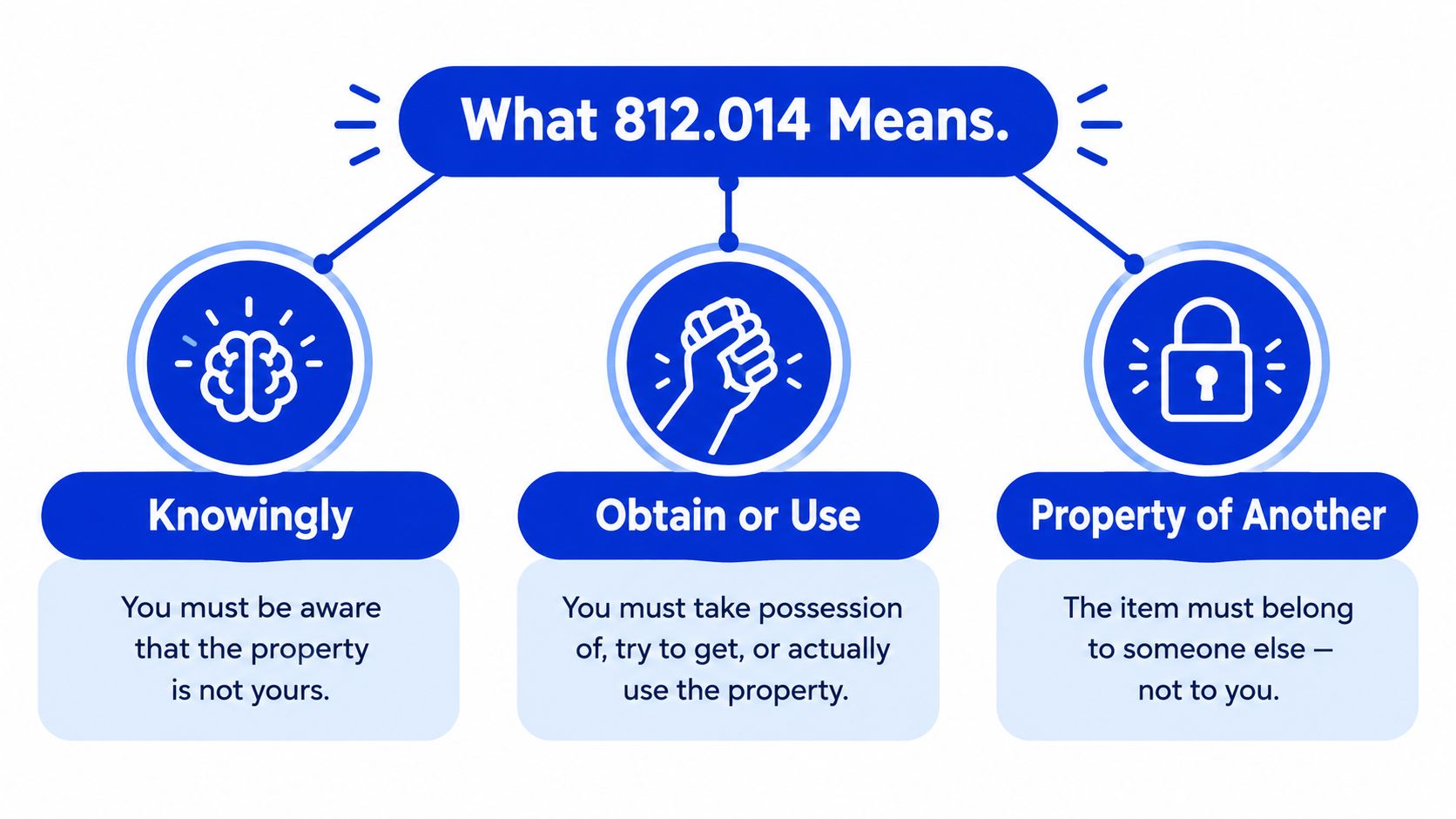
Breaking the statute into normal language
Start with the verb choices. Florida did not write this law to cover only the classic scene of someone stuffing merchandise into a bag and leaving a store. The wording is wider than that. "Obtains or uses" reaches many fact patterns, and "attempts" means the State may file a charge even if the person never made it out the door.
Then focus on the practical question families usually care about. Does the accusation stay small, or can it become a felony? Section 812.014 is where that question begins, because the same basic theft definition can lead to very different charge levels depending on value, the type of property, where it was taken from, or whether the State tries to group separate acts together. The definition is the front door. The grading rules decide how serious the case may become.
"Knowingly" matters because mistakes happen. A shopper grabs the wrong phone from a charging station. A roommate takes property believing it was shared. A contractor uses equipment believing the owner said yes. Those situations can look suspicious at first, but suspicion is not the same as proving a theft state of mind.
"Property of another" also sounds simpler than it is. In real cases, this phrase often creates the first real fight. Family members share cars. Business partners share tools. Former dating partners dispute gifts. Criminal court is a poor place to sort out a messy ownership disagreement unless the State can prove whose property it really was.
Why the intent language matters so much
Intent works like the difference between a wrong turn and a planned destination. Two people can leave with the same item. One made an honest mistake. The other meant to keep something that was not theirs.
That is why the final part of the statute matters so much. The State usually must show an intent to deprive the owner of the property or an intent to appropriate it to someone not entitled to it. In everyday terms, prosecutors are trying to prove more than contact with the item. They are trying to prove a decision about the item.
A few examples make that easier to see:
Accident: taking the wrong jacket from a restaurant is not automatically theft.
Permission dispute: borrowing a tool may not be theft if prior permission, shared use, or apparent consent existed.
Attempt: trying to leave with unpaid property can still be charged even if store staff stop the person before they get outside.
The broad wording of 812.014 is why the felony-threshold question can surprise families. A case that sounds like "it was only a small item" may still need a close review of the property category, the location, and the State's theory of the case before anyone assumes the charge level is settled.
Elements the State Must Prove Under Florida Theft Law
A theft arrest can feel conclusive. It isn't. In court, the State has to prove specific elements, and that burden matters. The Florida Supreme Court made clear in the 1991 case above that section 812.014 requires specific criminal intent, not mere presence or passive association with stolen property.

The four questions prosecutors have to answer
A solid theft analysis usually starts with four basic questions:
Did the accused act knowingly
If the event was accidental, mistaken, or based on confusion about ownership, the State may struggle on this point.Did the accused obtain, use, or attempt to obtain or use the property
Surveillance, receipts, witness statements, and recovery location all matter here.Was it the property of another
Shared property claims, consent defenses, and unclear ownership records can create reasonable doubt.Was there intent to deprive or appropriate
This is often the hardest part for prosecutors when the facts are incomplete.
Where theft cases commonly weaken
Families often focus on whether an item was found. Lawyers look deeper. Was the identification reliable? Did a witness see concealment? Was the statement voluntary? Did the police preserve video? Did the State overread ambiguous behavior?
Some cases also blur into related allegations involving possession, resale, or transfer of suspicious property. If that issue is part of the investigation, it helps to understand how dealing in stolen property charges can intersect with theft accusations.
A few recurring fault lines include:
Weak intent proof when the conduct can be explained innocently
Ownership disputes between former partners, relatives, employers, or roommates
Bad identification from rushed store stops or incomplete surveillance angles
Possession without context where the State can't show how the person acquired the item
Attempt theories that stretch conduct further than the facts support
Presence near property is not the same as theft. Association with someone else is not the same as intent.
That's where constitutional protections matter. The burden stays on the State. The accused doesn't have to prove innocence.
How Florida Grades Theft and What Penalties Apply
A parent hears, “It was only a small item,” and assumes the case must be minor. Under Florida Statute 812.014, that assumption can break down fast. In Florida theft cases, the dollar amount matters, but it is only one part of the grading question. The issue is often whether the allegation crosses a felony line because of the item, the place it was taken from, or a claim that separate events should be counted together.
Florida divides theft into petit theft and grand theft, then adds special rules for repeat convictions and certain fact patterns. In plain English, a low price tag does not always keep a case in misdemeanor territory.
Florida Theft Grading Under 812.014 by Value and Circumstance
Theft Classification | Value or Circumstance | Degree and Exposure |
|---|---|---|
Second-degree petit theft | Under $100 | Misdemeanor level theft offense |
First-degree petit theft | $100 to under $750 | Higher misdemeanor level theft offense |
Repeat petit theft | Second conviction | Can be reclassified as a first-degree misdemeanor |
Repeat petit theft | Third or subsequent conviction | Can become a third-degree felony |
First-degree grand theft | Property valued at $100,000 or more | First-degree grand theft |
First-degree grand theft | Cargo valued at $50,000 or more stolen in commerce | First-degree grand theft |
First-degree grand theft | Grand theft causing more than $1,000 in damage through use of a motor vehicle to cause more than $1,000 in damage | First-degree grand theft |
Enhanced first-degree felony category | Theft committed during a riot or in a county under a governor-declared state of emergency when facilitated by those conditions | Enhanced felony treatment |
The easiest way to understand the grading system is to picture three separate measuring sticks. Value is the one families expect. Location is the one many miss. Aggregation is the one that surprises people in store-related cases.
That practical felony-threshold question matters more than the generic definition of theft. A taking that sounds small in conversation can be charged much more seriously if prosecutors say it happened at a dwelling or its surrounding residential area, involved a specially treated item, or was part of a series of incidents grouped into one larger amount.
Recent changes to the law made that even more important. As noted earlier, Florida now treats some low-dollar property taken from a dwelling or unenclosed curtilage far more seriously than families often expect. Retail cases can also become more serious when the State argues separate incidents should be added together within the expanded charging window.
A good working analogy is a speed limit with hidden school-zone rules. The same driving speed can carry a very different consequence depending on where it happened. Theft law can work the same way. The same item value may lead to very different exposure depending on where the property was taken from and how the State frames the accusation.
That is why lawyers look past the receipt total. They ask: Was this tied to a home? Is the State combining dates? Is there a prior theft record that changes the misdemeanor level? Is there a special circumstance that shifts the charge into felony territory?
If you want a side-by-side explanation of charge level and exposure, this guide on misdemeanor vs felony theft in Florida can help. The short version is simple. Under Florida Statute 812.014, the felony question is no longer just about one price tag.
Common Examples That Show How 812.014 Works in Real Life
Law books use categories. Real cases come in stories. That's where families usually recognize what's at risk.
Example one with repeated store incidents
A teenager is accused of leaving a retail store in Miami-Dade with low-cost merchandise on one date. Standing alone, the family thinks the case looks minor. But investigators later claim there were additional incidents at related stores over time and try to aggregate them within the expanded charging window discussed earlier.
That can shift the case from “one shoplifting stop” to an argument about pattern-based retail theft. Public discussion around Florida retail loss has increasingly focused on repeated conduct, organized activity, and related fraud patterns rather than only isolated events, as described in this retail-theft trend summary discussing Florida reporting and aggregation concerns.
Example two with property taken from a home area
A person removes a package, tool, or decorative item from outside a residence and assumes the value is too low for a felony discussion. That may be wrong. Under the recent statutory change already noted, property taken from a dwelling or unenclosed curtilage can trigger felony exposure at $40.
That's why the same item can be charged very differently depending on where it was taken from.
Example three with a motor vehicle or firearm
Some property categories create immediate charging issues regardless of ordinary value analysis. Florida sources identify theft of a motor vehicle and theft of a firearm as examples that may be treated as grand theft even when value alone might suggest something lower, as explained in this Florida theft-law summary discussing listed items and circumstances.
If the allegation involves a gun, the defense analysis also changes quickly because prosecutors and judges tend to treat those cases with extra seriousness. This overview of theft of a firearm in Florida helps explain why those accusations often need immediate, careful attention.
Example four with cargo or emergency conditions
A theft accusation involving goods moving in commerce can trigger first-degree grand theft treatment when the cargo is valued at $50,000 or more under the statute cited earlier. The same is true for very high-value cases involving $100,000 or more, and for certain thefts committed during a riot or governor-declared emergency when those conditions facilitate the offense.
The amount still matters. But under section 812.014, location, pattern, and item type can matter just as much.
Defenses Procedural Issues and Plea Options to Discuss With Counsel
The strongest theft defenses usually start early, before a rushed explanation turns into evidence for the State. People often think they can talk their way out of a misunderstanding. In many cases, they only fill gaps the prosecutor would otherwise have to prove.
Start with the facts before the statements
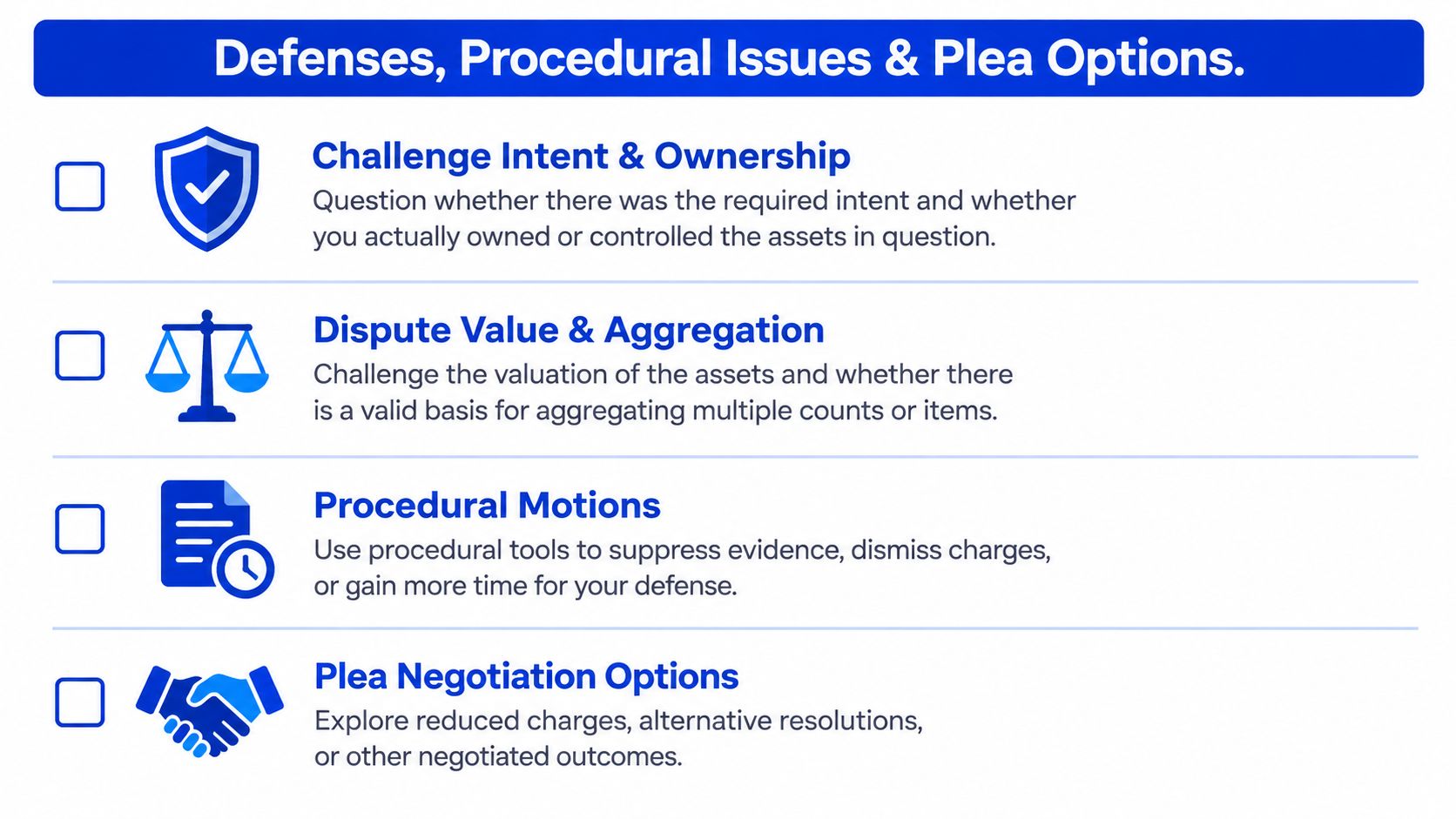
A careful defense lawyer usually looks first at the evidence trail:
Intent evidence
Was this a deliberate taking, or can the conduct be explained by mistake, permission, confusion, intoxicated misjudgment, or shared access?Ownership proof
Can the State prove the property belonged to someone else in the way charged?Value disputes
If grading depends on value, how is the State proving it? Receipts, depreciation, and condition may all matter.Aggregation claims
If prosecutors are grouping incidents, do the facts really support that theory?
Then look at police procedure
A theft case can also turn on constitutional issues. Was there an unlawful stop, search, or seizure? Was a phone searched properly? Did the accused make statements after pressure, confusion, or without understanding the consequences? Were surveillance videos preserved, or lost?
For a broader overview of common defense approaches, this page on types of criminal defenses in Florida cases gives a useful starting point.
Here's a short video that helps frame how criminal defense strategy often develops in Florida cases:
Plea options and practical resolutions
Not every case goes to trial. Depending on the facts, record, county practices, and proof problems, counsel may discuss options such as diversion, negotiated charge reduction, restitution-based resolution, or a plea structured to reduce long-term damage. No lawyer should promise a result, but early strategy often creates more room than people expect.
A good defense meeting should answer three things quickly: what the State can prove, what can be challenged, and what resolution paths may protect the client's future.
One option families in South Florida sometimes consider is Ticket Shield, PLLC, a Florida criminal defense firm led by former prosecutor Jason S. Goldsmith that handles theft charges and related criminal cases across the state. The key is not the brand name. It's getting counsel involved early enough to preserve evidence, protect rights, and avoid unnecessary admissions.
Related Statutes Next Steps and How Ticket Shield PLLC Can Help
Florida Statute 812.014 doesn't operate in a vacuum. Theft accusations can overlap with allegations involving stolen property, search issues, firearm-related facts, prior-record enhancements, and court decisions about intent. That's one reason generic online summaries often leave families more confused than reassured.
The practical trend is also important. Florida's theft law increasingly reflects concern about pattern-based conduct, not only one-time low-level taking. For someone facing accusations in Broward County, Fort Lauderdale, Miami-Dade, Palm Beach, or surrounding South Florida areas, that means the case review should look at the full picture, not just the arrest sheet.
What to do right away
If you or a family member is dealing with a theft investigation or charge, focus on a few immediate steps:
Save evidence
Keep receipts, messages, location data, screenshots, delivery records, and names of witnesses.Avoid direct contact
Don't try to “fix” the case by calling the store, alleged victim, or law enforcement.Stop explaining online
Social media posts, texts, and casual apologies are often misunderstood and later used against the accused.Get the charging documents reviewed early
A lawyer can spot grading issues, aggregation problems, and intent defenses that families often miss.
A former prosecutor's perspective can be useful here because it helps identify how the State is likely to build the case and where that theory may break down. In theft cases, the early goal is usually the same: protect constitutional rights, avoid a conviction if possible, reduce felony exposure where appropriate, and limit long-term damage to work, school, licensing, immigration, and reputation.
If you're facing a theft accusation under Florida Statute 812.014, Ticket Shield, PLLC offers direct attorney access, Florida criminal defense guidance, and case strategy built on the facts, not panic. For a calm review of the charge and your options in Broward, Miami-Dade, Palm Beach, or elsewhere in Florida, visit Ticket Shield, PLLC.