
Florida Post Conviction Relief: A Practical Client Guide
Jason Goldsmith, Esq
For noncapital cases, Florida post-conviction relief is governed primarily by Florida Rule of Criminal Procedure 3.850, and most motions must be filed within two years after the judgment and sentence become final. Missing that window usually bars the claims unless a narrow exception applies.
That rule matters to someone who has already been sentenced, finished probation, or lost a direct appeal and still believes the conviction or sentence was legally unsound. The hard part isn't just identifying an unfair event. A movant must use the correct procedure, meet the filing deadline, describe specific facts, disclose prior litigation, and show why the claim deserves review.
Table of Contents
When the Verdict Is In but the Case Is Not Over
Maria is a 34-year-old nurse in Tampa. She pleaded guilty to a felony because she believed her lawyer had never properly investigated a witness who could have changed the case. The judge sentenced her to probation. Maria completed probation, but the felony conviction remains on her record and now affects promotions she expected to receive.
Her situation raises a question many Florida defendants ask after sentencing: Can anything still be done?
Sometimes, yes. Florida post-conviction relief provides a way to challenge a conviction or sentence after the ordinary direct-appeal process has ended. In a noncapital case, the primary vehicle is Florida Rule of Criminal Procedure 3.850. A Rule 3.850 motion may address constitutional violations, ineffective assistance of counsel, qualifying newly discovered facts, and certain sentence problems.
The deadline is central. Most motions must be filed within two years after the judgment and sentence become final, as explained in Florida appellate authority on the Rule 3.850 deadline. If there was no direct appeal, finality typically occurs 30 days after sentencing. If there was a direct appeal, finality usually runs from the appellate mandate.
Practical rule: Finishing probation doesn't erase the filing deadline. The clock concerns when the judgment and sentence became final, not when the defendant finishes supervision.
Florida uses a firm deadline because courts expect defendants to raise challenges promptly, preserve reliable evidence, and avoid reopening cases indefinitely. The rule promotes finality and judicial economy, but it also creates a serious risk for people who don't understand when finality occurred.
A careful review starts with three questions:
What relief is legally available? A motion might seek correction of a sentence, a new trial, or another form of relief authorized by the applicable rule.
What claims survive the deadline? Most ordinary claims don't, but narrow exceptions can apply.
Can the motion survive initial screening? Courts may reject vague, incomplete, or successive filings before holding a hearing.
A conviction can carry consequences long after the sentence ends. Issues involving constitutional rights, plea advice, counsel's investigation, or an illegal sentence require prompt legal review. A separate explanation of constitutional protections, including what double jeopardy means, can also help identify whether a complaint concerns the conviction itself or a separate constitutional problem.
The Main Vehicles for Florida Post Conviction Relief
Choosing the right procedure is often the first major decision. A defendant may have a strong-sounding complaint but still lose by placing it in the wrong motion or asking the wrong court for relief.
Rule 3.850 for most noncapital challenges
Rule 3.850 is the main post-conviction vehicle for noncapital cases. It can address constitutional claims, ineffective assistance of counsel, certain plea problems, newly discovered facts, and challenges to a conviction or sentence that aren't limited to a facially illegal sentence.
The general deadline is two years after finality. The rule recognizes narrow exceptions involving newly discovered facts, retroactive fundamental constitutional rights, and illegal sentences. It also requires a movant to disclose relevant case history and prior collateral filings. A later motion raising grounds that could have been raised earlier may face a successive-motion bar.
Rule 3.800 for an illegal sentence
Rule 3.800(a) addresses a different problem. It is designed for a sentence that is illegal on its face or exceeds the lawful maximum. The Florida Supreme Court materials discussing sentence and jurisdictional claims recognize that a claim asserting a sentence exceeds the legal maximum may be filed at any time.
That doesn't mean every sentencing complaint qualifies. A disagreement with a discretionary sentencing decision isn't automatically an illegal-sentence claim. The defect must involve a genuine legal problem, such as a sentence beyond what the law permits.
Habeas corpus for jurisdictional defects
Habeas corpus is aimed at detention that is unlawful because the court lacked jurisdiction or another fundamental legal defect exists. Examples can include a sentence beyond the statutory maximum or a conviction for conduct that isn't legally a crime. The procedure is not a general substitute for Rule 3.850.
The appropriate filing may depend on timing, the nature of the defect, and whether the claim must first be presented to the sentencing court. Readers seeking a general explanation can review what habeas corpus means, but case-specific classification requires examining the judgment, sentence, appellate history, and prior filings.
Vehicle | Typical Claims | Deadline | Key Limitation |
|---|---|---|---|
Rule 3.850 | Ineffective assistance, constitutional violations, qualifying newly discovered facts, conviction challenges | Generally two years after finality | Specific pleading and successive-motion rules apply |
Rule 3.800(a) | A sentence exceeding the lawful maximum or otherwise illegal | An illegal-sentence claim may be filed at any time | The sentence must present a genuine legal defect |
Habeas corpus | Certain jurisdictional defects and unlawful detention | Depends on the claim and governing procedure | It isn't a general replacement for other post-conviction remedies |
Capital cases follow a separate framework under Rule 3.851. That rule generally requires filing within one year after finality, including after U.S. Supreme Court certiorari disposition if certiorari was sought. Capital procedure shouldn't be assumed to work like a noncapital Rule 3.850 case.
Common Claims That Win and Claims That Get Barred
The strength of a post-conviction claim depends on more than how unfair the result feels. Florida courts ask whether the claim is timely, legally recognized, factually specific, and supported by the record or evidence.
Ineffective assistance of counsel
Ineffective assistance is often the central claim after a trial or plea. Under Strickland v. Washington, the defendant generally must show that counsel's performance fell below the required standard and that the error caused prejudice.
“Your lawyer did a poor job” isn't enough. A viable motion identifies what counsel failed to do, when the failure occurred, what evidence would have been uncovered, and why the result could reasonably have changed. A claim that counsel failed to investigate a witness needs the witness's identity, expected testimony, availability, and an explanation of how that testimony would have affected the defense.
The prejudice analysis is also demanding. In a Florida decision discussing counsel's failure to object to prosecutorial argument and a general verdict form, the court emphasized that post-conviction prejudice asks whether there was a reasonable probability of a different outcome, not merely whether an error might have been fundamental on direct appeal. Related constitutional concerns may involve what prosecutorial misconduct can mean, but the motion still must connect the alleged misconduct to a legally recognized ground for relief.
Newly discovered evidence
Newly discovered evidence can support an exception to the ordinary deadline, but “new” has a demanding legal meaning. The movant must address when the evidence was discovered, why it couldn't have been discovered earlier with due diligence, and how it would probably change the result.
A witness recantation, for example, requires more than a new statement that conflicts with trial testimony. The court may examine the circumstances of the recantation, the witness's credibility, whether the information was previously available, and whether the evidence would likely produce a different result.
Illegal sentences and jurisdictional defects
These claims can be especially important because a true illegal-sentence claim may be raised at any time. The exception is narrow. A sentence exceeding the lawful maximum presents a different problem from an argument that the judge should have weighed sentencing factors differently.
Jurisdictional defects also require precision. A defendant must show a fundamental problem with the court's authority or the legal basis for detention, not relabel an ordinary trial complaint as “jurisdictional.”
Retroactive constitutional rights
A newly recognized constitutional right can provide a limited path around the ordinary deadline when the right applies retroactively. The motion must establish that the legal rule is applicable, retroactive, and connected to the defendant's case.
The screening lesson is straightforward:
Specific facts matter: Conclusory allegations can be denied without a hearing.
Timing matters: A late ordinary claim usually cannot proceed.
Prior filings matter: A successive motion may be barred if it repeats grounds or relies on facts that could have been raised before.
Evidence matters: Attachments and identified witnesses should support the factual allegations rather than merely repeat them.
Florida courts require an evidentiary hearing unless the motion, case files, and record conclusively show no entitlement to relief or the claim is legally insufficient. The written motion must therefore do enough to cross that initial threshold.
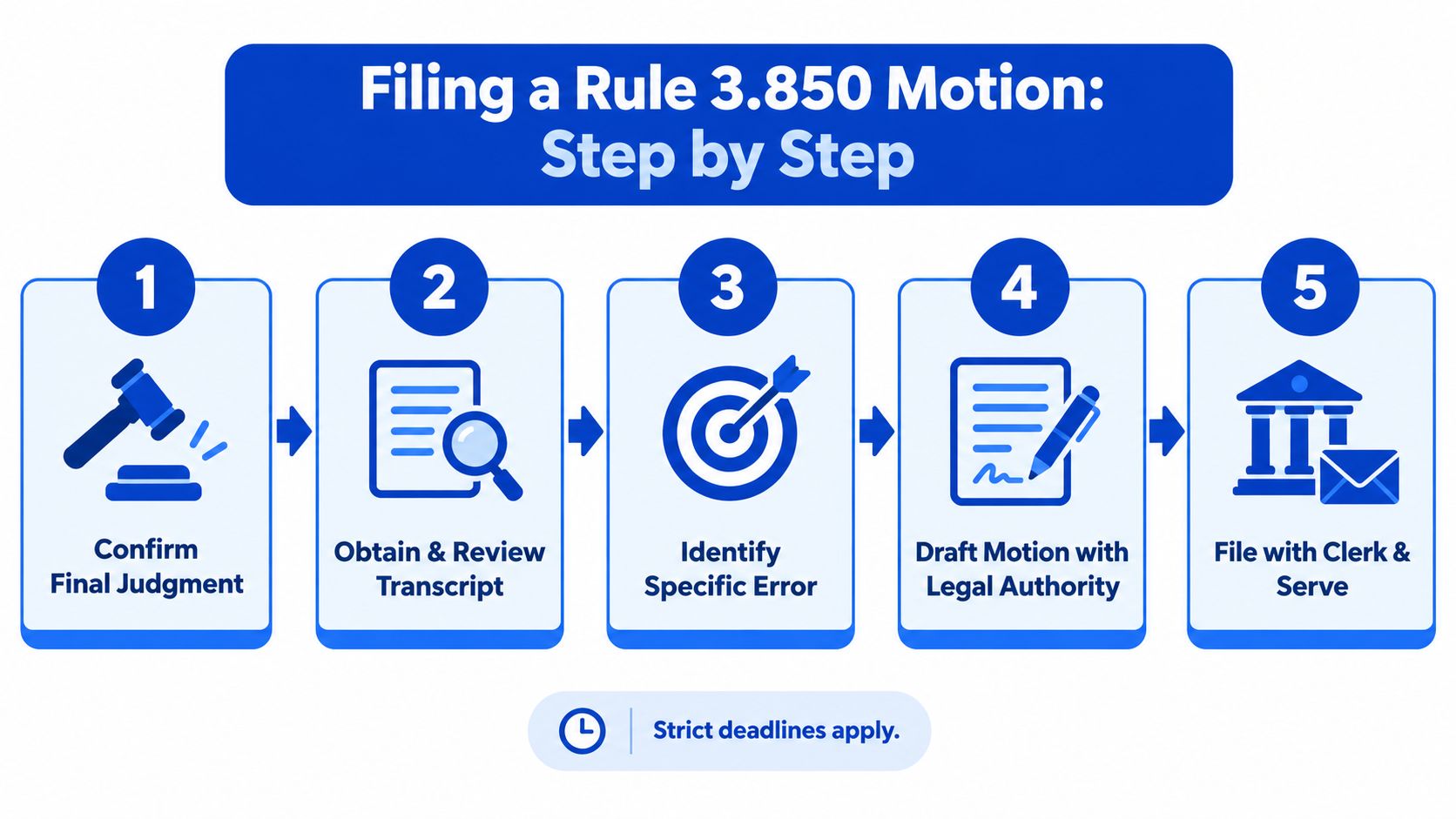
Filing a Rule 3.850 Motion Step by Step
A Rule 3.850 motion is not a letter to the judge explaining why the conviction feels wrong. It is a formal pleading that must fit the rule and the facts.
Confirm finality first
Start by locating the judgment and sentence, then determine whether a direct appeal was filed. If there was no appeal, finality is typically tied to the period after sentencing. If there was an appeal, the appellate mandate usually controls. An incorrect finality date can lead to a late filing or a mistaken exception argument.
Next, identify every prior post-conviction filing. Florida materials emphasize that the motion should include the case history, appeal history, and prior collateral proceedings. Leaving out an earlier motion can create a credibility problem and may prevent the court from evaluating whether a claim is successive.
Build the factual record
Gather the charging document, plea or verdict materials, judgment, sentence, appellate decision, mandate, and prior motions. Obtain relevant transcripts when the claim concerns what counsel, the judge, or a witness said. For an ineffective-assistance claim, identify the lawyer's specific act or omission and the evidence that would prove it.
The pleading should be short but detailed. Each ground needs facts, not labels. “Counsel was ineffective” is a conclusion. “Counsel knew a named witness could provide an alibi, never contacted the witness, and failed to present the witness despite the defendant's request” is the kind of factual framework that allows a court to analyze the claim.
Match the facts to the legal standard
A plea challenge should explain what advice was given, why it was inaccurate or incomplete, what the defendant understood, and why the defendant would have acted differently with accurate advice. A newly discovered evidence claim should explain the discovery date, prior diligence, authenticity, and likely effect on the verdict.
An illegal-sentence claim should identify the legal maximum or rule that makes the sentence unlawful. A jurisdictional claim should identify the specific defect in the court's authority. The label doesn't carry the claim. The facts do.
Understand the hearing stage
The court first reviews the motion, attachments, files, and existing record. If those materials conclusively defeat the claim, the court can deny relief without testimony. If the allegations are legally sufficient and the existing record doesn't resolve them, an evidentiary hearing may be required.
A hearing gives the parties an opportunity to present testimony and other evidence. It doesn't guarantee relief. The movant still must prove the elements of the claim, and the judge may find that counsel acted reasonably or that the alleged error didn't affect the outcome.
For a practical explanation of a court proceeding focused on a disputed issue, see what a motion hearing in court involves.
The filing also involves service, clerk processing, and a response from the State. Keep copies of every submission, attachment, order, and transcript. If the court denies relief after an evidentiary hearing, Florida appellate procedure requires the clerk to transmit the record within 50 days after the notice of appeal, and the court reporter must prepare the hearing transcript after receiving notice, as described in Florida appellate procedure materials on post-conviction records.
How Real Florida Cases Play Out
Consider three representative fact patterns. They show why the deadline alone doesn't determine the result.
A timely investigation claim
A defendant convicted of a noncapital felony files within the applicable two-year period. The motion identifies a key alibi witness, explains what the witness would have said, describes counsel's failure to investigate, and attaches supporting information. The allegations also explain why the testimony could have affected the verdict.
The court grants an evidentiary hearing because the existing record doesn't conclusively resolve the claim. At the hearing, testimony and documents support both deficient performance and prejudice, and the court grants relief. The critical feature isn't the accusation that counsel performed poorly. It's the detailed connection between the missing investigation and the outcome.
A late evidence claim without diligence
Another defendant learns of allegedly favorable evidence three years after finality. The defendant files a motion invoking newly discovered evidence but doesn't explain why the information couldn't have been found earlier through reasonable diligence.
The court denies the motion as untimely. The evidence may sound important, but the exception doesn't provide a broad reopening mechanism for information that could have been discovered before the deadline. A late filing must address both the evidence and the reason for the delay.
A genuine illegal-sentence problem
A third defendant discovers years after finality that the sentence exceeds the lawful maximum. That claim is different from an ordinary complaint about trial strategy or evidentiary rulings. A qualifying illegal-sentence motion may be filed at any time, and the court can correct the sentence if the legal defect is established.
The same timing principle can apply when the alleged defect is jurisdictional, but courts require a real jurisdictional problem. A defendant considering appellate consequences should also understand related concepts such as bond on appeal, which involves a different procedural question from proving post-conviction entitlement.
These examples produce a practical formula: timing, specificity, and classification. A timely motion can still fail if it is vague. A late motion can proceed only if it fits a recognized exception. A motion filed years later can survive when it presents a true illegal-sentence claim rather than an ordinary challenge dressed up in different language.
Why Early Legal Help Changes the Outcome
Early review matters because the most damaging defects often happen before a judge reaches the merits. A motion may fail because it omits prior litigation, miscalculates finality, relies on vague allegations, or raises a claim that a previous motion already resolved.
A lawyer with prosecutorial experience understands how the State may attack the filing. That perspective can help identify weaknesses in the factual record, anticipate arguments about prejudice and diligence, and separate a true illegal-sentence issue from a routine sentencing disagreement. It also helps keep the motion focused on provable facts rather than broad accusations.
A thorough review should include:
Court records: The lawyer obtains the judgment, sentence, transcripts, appellate materials, and prior post-conviction filings.
Witness investigation: Potential witnesses can be identified, contacted, and evaluated before their testimony becomes harder to locate or verify.
Pleading preparation: Each ground can be tied to dates, documents, legal standards, and the requested relief.
Deadline analysis: Finality and any claimed exception can be assessed before the filing window closes.
Florida cases are handled through different clerks, judges, and appellate districts. A statewide practice can help a client locate records from the appropriate county and coordinate filings where the conviction occurred. Availability also matters when a witness recants, a new document appears, or a family member discovers a problem outside ordinary business hours.
Ticket Shield, PLLC, led by former prosecutor Jason S. Goldsmith, offers statewide Florida criminal defense representation, direct communication by phone, text, or email, and free consultations. Those services don't guarantee a result, but they can give a defendant a timely opportunity to confirm the finality date, identify viable grounds, and preserve available options.
Key Takeaways and Your Next Step
Florida post-conviction relief begins with the correct procedural vehicle. For most noncapital cases, Rule 3.850 provides the primary path, and the baseline filing period is two years after the judgment and sentence become final. A direct appeal usually makes the appellate mandate important to the finality calculation, while a case without an appeal generally reaches finality after the applicable period following sentencing.
Late claims aren't automatically impossible, but the exceptions are narrow. Newly discovered facts must satisfy demanding diligence requirements. A retroactive fundamental constitutional right may provide another route. A genuine illegal sentence or jurisdictional defect can be treated differently from an ordinary claim of trial error.
The motion's presentation can decide whether the court ever reaches the merits. Assemble:
The case number and judgment: Include the judgment, sentence, and dates.
Charging and plea materials: Gather the information or indictment, plea paperwork, and plea transcript if available.
Trial records: Obtain verdict materials and relevant transcripts.
Appeal history: Include the appellate decision and mandate.
Prior collateral filings: Collect every earlier motion and order.
New evidence information: Preserve documents, witness names, contact information, and the date each item was discovered.
Your motion should state every ground with specific facts and supporting records. Successive motions are presumptively vulnerable when they repeat earlier grounds or raise issues that could have been presented before. Vague or conclusory allegations can be denied without an evidentiary hearing, while a properly supported claim may move forward when the existing record doesn't conclusively defeat it.
Don't wait for a deadline to become a guess. Contact Ticket Shield, PLLC for a free, confidential consultation, provide the documents listed above, and ask counsel to calculate finality and evaluate each possible claim.
Ticket Shield, PLLC can review Florida conviction and sentence records, assess potential Rule 3.850, Rule 3.800, or jurisdictional issues, and help identify procedural barriers before they eliminate an option. Visit Ticket Shield, PLLC to request a free consultation and connect with a Florida defense team available statewide, including 24/7.