Bond on Appeal in Florida: A Criminal Defense Guide
Jason Goldsmith, Esq
A guilty verdict lands hard. One moment you're standing next to your lawyer waiting for the judge to speak, and the next you're trying to understand whether you're going home, reporting to jail, or losing control of everything while your appeal is still just an idea.
In Florida criminal cases, many individuals encounter the term bond on appeal for the first time. This term is not related to the payment of a civil judgment. Instead, it refers to the process of requesting the court's permission to stay out of custody, or to delay the commencement of a jail or prison sentence. This allows a higher court to review the details and proceedings of your case before any sentence is carried out.
That matters because appeals take time. In some jurisdictions, a standard appeal can last around 18 months, and the legal system recognizes that delay can be significant while review is pending, as discussed in the Michigan bar guidance on appeal bonds. If you're dealing with a conviction in Broward County, Fort Lauderdale, Miami-Dade, Palm Beach, or anywhere else in South Florida, the practical question is simple. Can your sentence be paused while your appeal moves forward?
Sometimes the answer is yes. Sometimes it's no. Most often, it depends on the charge, the sentence, your record, the legal issues on appeal, and how the request is presented to the judge.
If you've just been convicted, this is the time to slow down, think strategically, and review every available option. If you need immediate guidance, start by contacting a Florida criminal defense attorney for a confidential case review.
Table of Contents
Your Conviction is Not the Final Word
A conviction starts a new phase of the case. The immediate question is not only whether to appeal, but whether you must begin serving the sentence while that appeal is pending.
In Florida criminal cases, that question matters fast. A defendant can be sentenced and taken into custody the same day, even while legitimate appellate issues still exist. I tell clients to treat the hours after sentencing as strategic time. Decisions made then can affect release, deadlines, and how the court views the case from that point on.
What this looks like in practice is straightforward. A person convicted of DUI, a felony drug charge, theft, or a violation of probation may leave the courtroom thinking every option has closed. That is often wrong. The conviction may be final in the trial court, but it does not end appellate review, and it does not automatically settle whether the defendant should remain jailed during that review.
For some clients, the pressure is financial. Missing work can cost a job or a business. For others, the bigger concern is children, immigration exposure, medical care, or the shock of being ordered into custody after months of appearing in court while out on bond.
Practical rule: An appeal challenges the conviction or sentence. A bond on appeal asks for release while that challenge is being decided.
Those are separate requests, and confusing them causes mistakes. Filing a notice of appeal does not by itself keep a client out of custody. A strong appellate issue also does not guarantee post-trial release. In Florida criminal defense, counsel has to assess both tracks at once and move quickly enough to protect them.
The useful questions after conviction are concrete:
Are there real appellate issues, not just general dissatisfaction with the verdict
Is bond pending appeal legally available in this case
What facts will help or hurt a release request right away
What needs to be filed first, and in which court
The answers depend on the charge, the sentence, the client's history, the trial record, and the judge who heard the case. Trade-offs are real. In some cases, pushing for immediate release makes sense. In others, the better course is to tighten the appellate record first and avoid filing a weak motion that gives the court an easy reason to deny relief.
That is why the period right after sentencing should be handled with discipline. If you need a South Florida defense lawyer to assess appellate options and post-conviction release strategy, request a confidential case review for a Florida criminal appeal bond matter.
What a Bond on Appeal Means in Florida Criminal Cases
In Florida criminal court, a bond on appeal is best understood as a request to pause incarceration while the appellate court reviews the conviction or sentence. It is not a reward for filing an appeal. It is not automatic. And it is not the same thing as the bond you may have posted before trial.
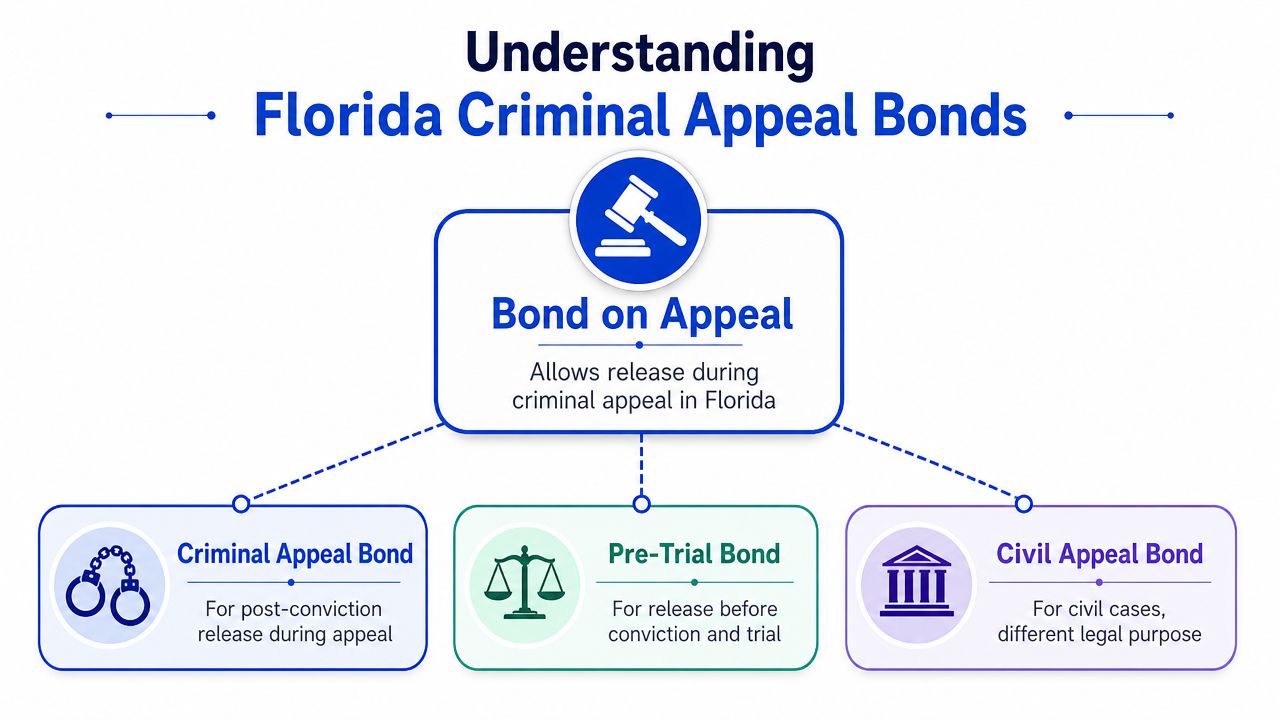
Three bond concepts people often confuse
The confusion usually comes from the word "bond" itself. Florida defendants often hear the same word used in very different settings.
Bond type | Main purpose | When it applies |
|---|---|---|
Pre-trial bond | Allows release while the case is pending before conviction | After arrest, before trial or plea |
Criminal bond on appeal | Seeks release after conviction while appellate review is pending | After conviction and sentencing |
Civil appeal bond | Secures payment of a money judgment during appeal | Civil lawsuits, not criminal prosecutions |
That last category causes the most misunderstanding. General online explainers often talk about supersedeas bonds in civil cases. Those are designed to protect the winning party's ability to collect money if the appeal fails. A criminal defendant facing jail, probation consequences, or a sentence in Florida is dealing with a different question entirely.
As one Florida-focused discussion notes, civil bonds secure a monetary judgment, while a criminal appeal bond focuses on custody, flight risk, and public safety. That distinction is critical.
What Florida courts are actually deciding
In practice, the court is asking whether you should remain free while the case goes up on appeal. The analysis is tied to post-conviction release, not to guaranteeing payment of a judgment debt.
Florida criminal lawyers usually frame this under the rules governing post-trial release, including Florida Rule of Criminal Procedure 3.691 and Florida Rule of Appellate Procedure 9.140(h). Those rules matter because they place the issue where it belongs. On the criminal side of the court system, not in the world of civil surety underwriting.
A bond on appeal in a criminal case acts more like a pause button on custody than a payment guarantee.
Why this distinction changes strategy
If a person convicted in Broward County thinks bond on appeal works like a civil bond, that person may focus on the wrong things. Money alone doesn't answer the central questions. The judge will want to know whether the defendant will appear, obey conditions, avoid new trouble, and present a real appeal rather than a delay tactic.
That changes how the defense prepares the motion. Instead of emphasizing assets, the defense often emphasizes:
Community stability, such as family support and a fixed residence
Employment history, especially a job waiting in Fort Lauderdale, Miami, or nearby
Court compliance, including prior appearances and respect for release terms
Legal merit, meaning an appeal that raises a genuine issue
If you understand that difference early, you avoid one of the most common mistakes in this area. Treating a Florida criminal bond on appeal like a civil finance problem instead of a liberty-and-risk problem.
Are You Eligible for Bond Pending Appeal
The first question often asked is direct. Can I get bond pending appeal?
The honest answer is that post-trial release is not a right in the way many people assume. A Florida judge has to decide whether your case qualifies, and that decision turns on legal standards and facts that need to be presented carefully.
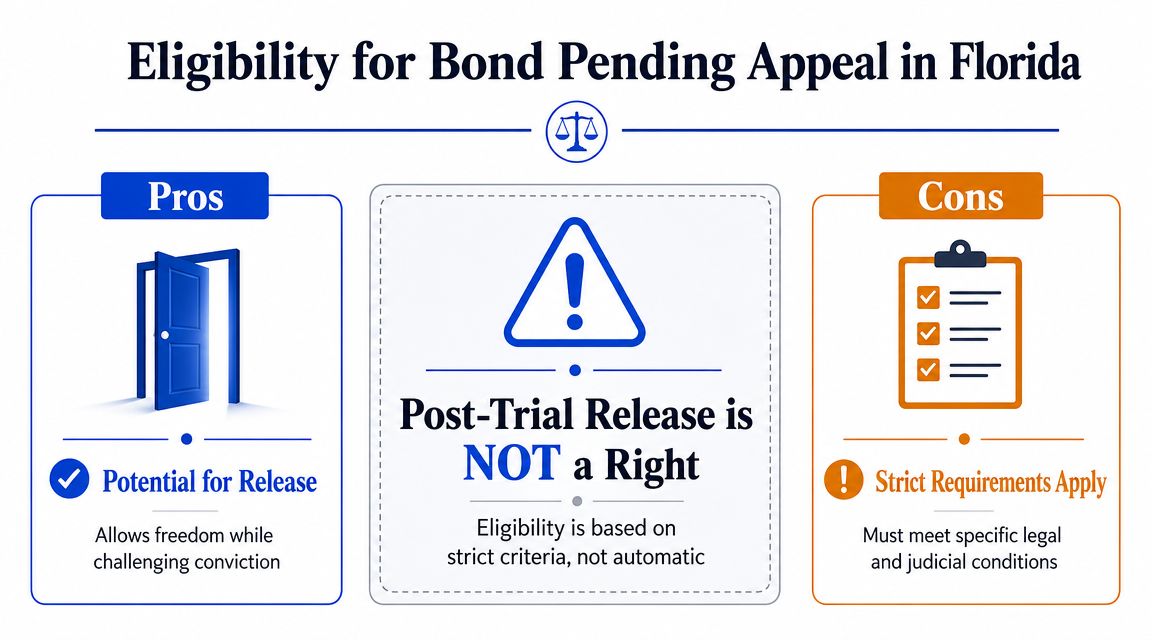
The broader bond environment varies sharply by jurisdiction and case type. Commercial surety guidance notes that criminal appeals operate under different rules focused on public safety and flight risk. For a Florida defendant, that means eligibility is a legal screening process, not a routine request.
What judges usually focus on
In practical terms, two themes dominate the hearing.
The appeal can't be frivolous
A judge is more likely to deny release if the appeal appears to be filed only to delay the sentence. The court wants to see a legitimate issue for appellate review. That doesn't mean your lawyer must win the appeal at the bond hearing. It means there must be a real legal question worth appellate attention.
A weak request often sounds like this: "We disagree with the verdict."
A stronger request identifies a specific issue, such as an evidentiary ruling, a legal error in the jury instructions, a sentencing problem, or another arguable issue preserved in the record.
You can't look like a flight risk or a danger
The second major issue is personal risk. Judges evaluate whether releasing you would create an unacceptable danger to the community or an unacceptable risk that you won't return if the appeal fails.
That evaluation is highly fact-specific. A person with strong family ties, consistent employment, stable housing, and a record of appearing in court presents a very different picture from a person with repeated violations, unstable circumstances, or a pattern of ignoring court orders.
A post-trial release request succeeds or fails on credibility. The judge has to believe both the legal argument and the person standing in front of the court.
Practical eligibility factors
These are the kinds of facts that tend to matter in Florida criminal court:
History of appearing in court. If you showed up throughout the case and complied with pretrial conditions, that helps.
Community connections. A spouse, children, long-term residence, and local work in South Florida can support release.
Nature of the conviction. Some offenses create tougher public-safety arguments than others.
Prior criminal history. Prior felony convictions or a history of noncompliance can make bond pending appeal much harder.
Conduct during the case. Judges notice whether the defendant followed orders, remained arrest-free, and took the process seriously.
Cases that often face steep resistance
Some convictions are poor candidates for bond on appeal. Serious violent offenses, cases involving a strong public-safety concern, and matters where the defendant has already shown disregard for court supervision often face an uphill fight.
That is especially true when the sentence follows a violation of probation, because the court may view the request through the lens of broken trust. A judge may conclude that prior leniency already failed.
None of this means a request is impossible. It means the defense has to assess the case realistically. In some matters, pursuing bond pending appeal is a strong and sensible move. In others, it may consume time and credibility without offering a realistic path to release.
The Process for Seeking Post-Trial Release in South Florida
The process starts with action, not assumptions. Filing an appeal does not automatically put your sentence on hold, and the request for release has to be made in a structured way.
A useful way to think about this is as a two-track response after conviction. One track protects your appellate rights. The other asks the court to decide whether you must remain in custody while those rights are being exercised.
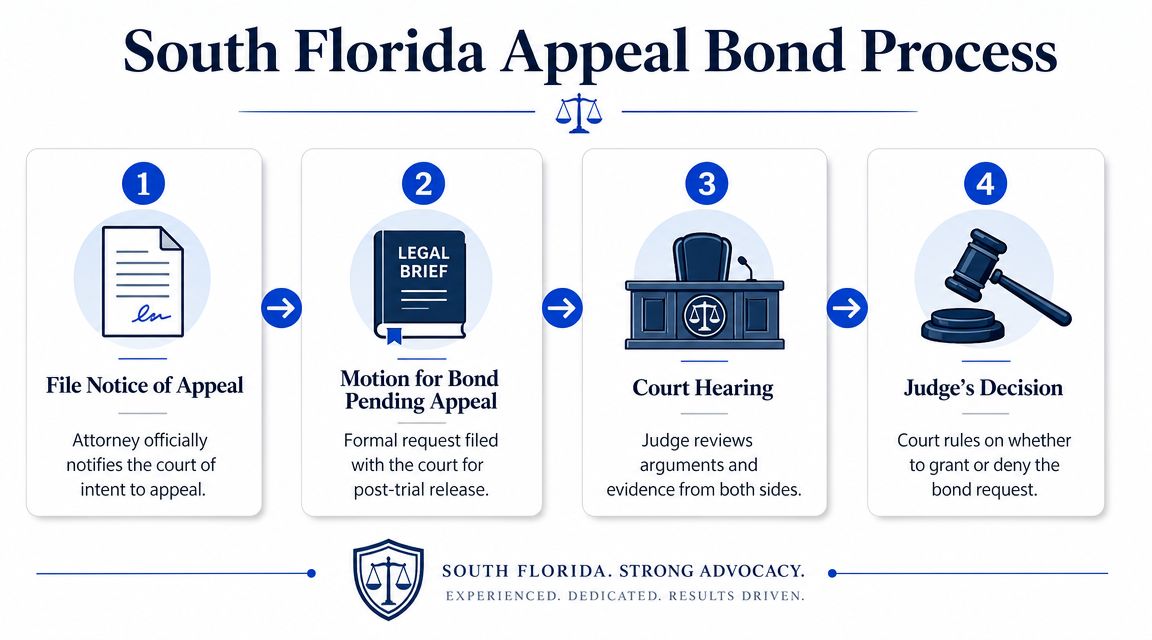
The typical sequence
In South Florida courts, including the Broward County courthouse in Fort Lauderdale and other trial courts across the region, the process commonly looks like this:
Notice of appeal is filed
This preserves appellate review and starts the higher-court process.Motion for bond pending appeal is filed in the trial court
The motion asks the sentencing judge to allow release during the appeal.The defense gathers supporting materials
That may include proof of employment, family support, residence, treatment history, and a focused explanation of the appellate issues.The court holds a hearing
The prosecutor argues against release. Defense counsel argues for it. The judge decides.
The legal logic is similar to a broader rule seen in stay practice. Relief isn't automatic. It is triggered by a formal request. The Tennessee rule addressing bond to stay enforcement illustrates that point in the civil context, and the same practical lesson applies here. In a criminal case, the motion triggers a liberty-versus-public-safety analysis.
A short video overview can help make the sequence easier to visualize.
What the motion should accomplish
A good motion does more than ask for mercy. It gives the court reasons to say yes.
That usually means the filing should show:
A legitimate appellate basis that isn't frivolous
Facts showing stability, such as residence and employment
Reasons the defendant is not a danger or flight risk
A practical release plan, including how conditions will be obeyed
A rushed filing often hurts more than it helps. Courts can tell when a motion is generic.
The judge is not looking for slogans. The judge is looking for a record-supported reason to trust both the appeal and the defendant.
Why timing matters
The first days after sentencing often shape everything. If the request is going to be made, it should be prepared quickly and carefully. Delay can complicate logistics, custody status, and the overall posture of the case.
If your family is trying to organize information for counsel, a fast way to start is to submit case details for immediate review. That helps counsel evaluate the record, the sentence, and whether a motion for post-trial release is worth pursuing.
Crafting a Winning Argument for Your Appeal Bond
Judges rarely grant bond on appeal because a defendant asks politely. They grant it when the defense gives the court a reasoned, credible basis to believe release is appropriate.
That requires more than legal conclusions. It requires a persuasive picture of the person, the case, and the appeal.
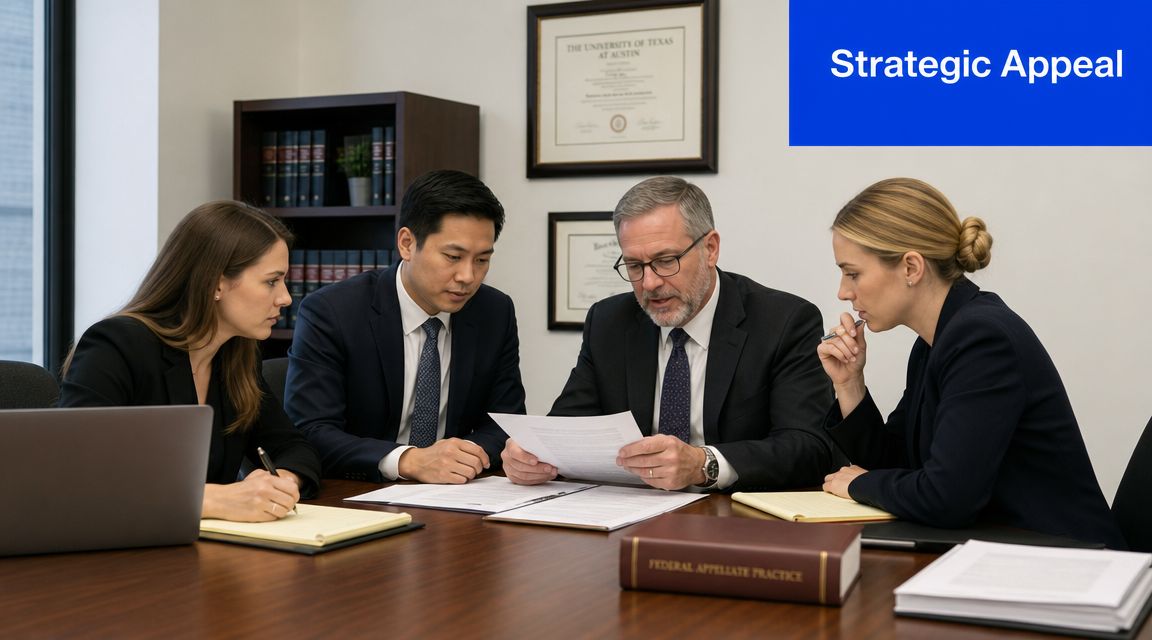
The strongest arguments usually combine law and biography
Commercial sureties evaluate risk by looking for collateral. In a criminal bond hearing, the court often looks for a different form of security. As one surety-focused explanation puts it, a judge scrutinizes your job, family, and community ties as a form of "life collateral".
That idea fits real courtroom practice. The defense has to show not just that the appeal has substance, but also that the defendant's life is anchored.
What tends to persuade
A strong presentation often includes several layers:
Stable employment
A judge is more likely to trust a defendant who can point to a real job, a supervisor, and a routine to return to.Family responsibilities
A spouse, children, elderly parents, or other dependents can help show that the defendant has reasons to remain in the community and comply.Residential stability
Long-term residence in Broward County, Fort Lauderdale, Miami-Dade, Palm Beach, or surrounding areas can make flight less plausible.Compliance history
If the defendant appeared for court, followed prior bond conditions, and didn't pick up new charges, that should be emphasized.A focused appellate issue
Judges respond better when counsel identifies a concrete legal issue rather than making broad claims that the case was unfair.
What doesn't work
Some arguments sound good to a defendant but fall flat in court.
Saying "I promise I'll come back" isn't enough. Saying "my family needs me" without supporting details isn't enough either. And arguing the entire trial all over again usually weakens the request unless the issue is tied to a specific appellate point.
A better approach sounds more like this:
He complied with every court date, remained employed throughout the case, lives with his family in South Florida, and the appeal raises a specific legal issue that is properly preserved for review.
That is concrete. Judges can weigh it.
Building a narrative the court can trust
The defense should present the defendant as a whole person, not just a case number. That doesn't mean minimizing the seriousness of the conviction. It means recognizing what the hearing is about.
The question isn't whether the defendant would like to stay out of custody. Of course he would. The question is whether the court has a sound basis to allow it.
When the record, the personal facts, and the appellate issue all point in the same direction, the request becomes much more credible. When those pieces conflict, the court usually sees the weakness quickly.
Understanding Bond Amounts, Conditions, and Revocation
If the court grants bond on appeal, the work isn't over. Release comes with conditions, and those conditions matter.
In criminal cases, bond amounts are not usually calculated the way civil appeal bonds are calculated. Civil practice often ties security to the judgment amount. In criminal court, the judge focuses on what amount and what restrictions are necessary to secure appearance, manage risk, and protect the public.
Common conditions after release
A judge may allow release but attach strict rules. Those can vary by offense, history, and local practice.
Typical conditions can include:
Reporting requirements. The defendant may need regular check-ins with the court, a supervising authority, or both.
Travel restrictions. Leaving Broward County, South Florida, or the state may be prohibited without permission.
No-contact orders. This is common in domestic violence, witness-related, or injunction-connected cases.
Substance-related conditions. A court may require sobriety compliance, testing, or treatment in DUI or drug-related matters.
Monitoring or confinement limits. Some defendants may face GPS monitoring, curfews, or house arrest.
These aren't suggestions. They are terms of release.
Revocation is the real risk
A bond on appeal is conditional freedom. If you violate the conditions, miss a required appearance, contact a prohibited person, pick up a new arrest, or otherwise break the rules, the court can revoke the bond and place you back in custody.
That risk is easy to underestimate. Some defendants treat post-trial release like a second chance to relax. Judges don't view it that way. After conviction, scrutiny usually increases, not decreases.
Once bond on appeal is granted, your best strategy is simple. Follow every condition exactly, even if it feels inconvenient or excessive.
Why this matters in probation-related cases
The revocation issue is especially important for anyone appealing after a supervision problem. Courts often see violations as signs that compliance is already shaky. If your case involves any history of supervision issues, it's worth reviewing how Florida courts handle probation violation allegations and noncompliance concerns.
In practice, successful post-trial release depends on two different wins. First, getting the judge to grant it. Second, keeping it by following the order without mistakes.
Frequently Asked Questions About Florida Appeal Bonds
The questions clients ask after a conviction are usually practical, immediate, and urgent. In Florida criminal cases, a bond on appeal is not a civil supersedeas bond that pauses payment or enforcement. It is a request to stay out of custody, or get out of custody, while the appellate court reviews what happened in the trial court. That difference matters because judges focus on public safety, compliance, and whether the appeal raises a serious issue.
Does filing an appeal automatically stop my sentence from starting
This is a common and costly misunderstanding. Filing a notice of appeal does not automatically stop a jail or prison sentence from beginning.
A separate motion for post-trial release is usually required, and the judge must grant it. If counsel does not move quickly, a defendant can be taken into custody even though the appeal has already been filed. Timing matters here.
Can I get a bond on appeal for a VOP sentence
Possibly, but these cases are harder to win. A violation of probation case starts with the court already concerned about whether prior conditions were followed, and that makes judges more cautious about releasing someone during the appeal.
That does not make release impossible. It means the argument has to be tighter. The motion usually needs both a legitimate appellate issue and facts showing the client is likely to follow every condition if released.
What if the trial court denies my motion for bond on appeal
A denial in the trial court can sometimes be reviewed by the appellate court. Clients should understand the trade-off. Review may be worth pursuing, but it is not a fresh hearing where everything starts over.
The appellate court usually looks at whether the trial judge applied the law correctly and acted within the court's discretion. In the right case, that review can matter. In a weak case, it can consume time without changing the result.
Is bond on appeal available in every criminal case
No. Eligibility depends on the offense, the sentence, the defendant's record, the risk of flight, community safety concerns, and whether the appeal appears to raise a genuine issue rather than serve as a delay tactic.
Some defendants are strong candidates. Others are not. Good advice starts with an honest assessment, not false reassurance.
Will the judge only care about money
Usually no. In Florida criminal cases, the amount of the bond is only part of the picture. Judges are often more focused on whether the defendant will appear, obey conditions, avoid new trouble, and present a manageable risk while the appeal is pending.
That is one reason criminal appeal bonds are often misunderstood. They are not mainly about posting money to protect a financial judgment. They are about release after conviction, under conditions the court expects to be followed exactly.
Should I wait to see what happens before talking to a lawyer
Waiting is rarely a good move. The period right after conviction is often the best chance to protect appellate rights, request release, and shape the record the judge and appellate court will review.
A short delay can close off options that were available immediately after sentencing. If you want a quick starting point, review the firm's Florida criminal defense FAQ page, then get advice about your specific conviction, sentence, and appellate posture as soon as possible.
Learn how bond on appeal works in Florida, who qualifies, and how an appellate bond can keep you out of custody while your conviction is challenged.