
Habeas Corpus Meaning in Florida: A Defendant's Guide
Jason Goldsmith, Esq
A call from jail usually sounds the same at first. Someone was arrested in Broward, Miami-Dade, or Palm Beach. Bond feels out of reach, the case isn't moving, and the family keeps asking the same question: Can they really keep me here like this?
Sometimes the call comes later. A person has already been convicted. They've filed an appeal, or they missed that window, and now they believe something more basic is wrong. Not just that the judge or jury got it wrong, but that the detention itself may be unlawful.
That's where Habeas Corpus meaning becomes more than a history lesson. It becomes a lifeline. Habeas corpus is the legal tool that lets a court ask a simple but powerful question: Is this detention legal? If the answer is no, the court can order relief.
For people under stress, this area gets confusing fast. Many clients mix up habeas corpus with bond motions, direct appeals, and post-conviction motions. They aren't the same. If you use the wrong tool, you can lose time you may not get back. If you're trying to understand what options exist while a loved one is being held, it also helps to understand how pretrial release works in Florida.
This guide is written the way I'd explain it to a concerned client in South Florida. Plain language. No academic fog. Just what habeas corpus means, when it matters, when it doesn't, and why that distinction can matter in a Fort Lauderdale courtroom as much as anywhere else.
Table of Contents
Introduction When Freedom Is on the Line
A man in Fort Lauderdale gets arrested on a felony. His family posts what they can, but he remains in custody. Days pass. Then more days. They don't understand why he's still there, whether the charge was filed correctly, or what can be done if the system is dragging its feet.
A woman in Miami-Dade has already been convicted. She's heard people talk about appeals, motions, and constitutional violations, but every explanation sounds like a different language. What she wants to know is simple: if the government violated the law in the process of holding me, is there a way to challenge that now?
That question sits at the core of habeas corpus. Not guilt. Not innocence. Not whether someone likes the outcome of the case. The issue is whether the government has lawful authority to hold a person where they are.
Why this matters to real people
In criminal defense, people often come in focused on the accusation. DUI. drug possession. domestic violence. probation violation. gun charge. theft. Those charges matter, of course. But detention creates its own emergency.
When someone is locked up, every day affects work, childcare, housing, immigration concerns, and the ability to help build a defense.
Practical rule: If the problem is unlawful detention, the question isn't “Who was right at trial?” The question is “What legal authority allows the government to keep this person in custody right now?”
The confusion most people have
In South Florida courts, I regularly see people blur together:
Bond issues
Appeals
Rule 3.850 motions
Habeas petitions
Motions attacking illegal searches or statements
They overlap in conversation, but legally they do different jobs. A motion to suppress challenges evidence. An appeal reviews certain legal errors. A Rule 3.850 motion addresses specific post-conviction claims. Habeas corpus focuses on whether confinement itself is lawful.
That distinction can decide whether a filing helps you or wastes precious time.
What Is Habeas Corpus The Great Writ Explained
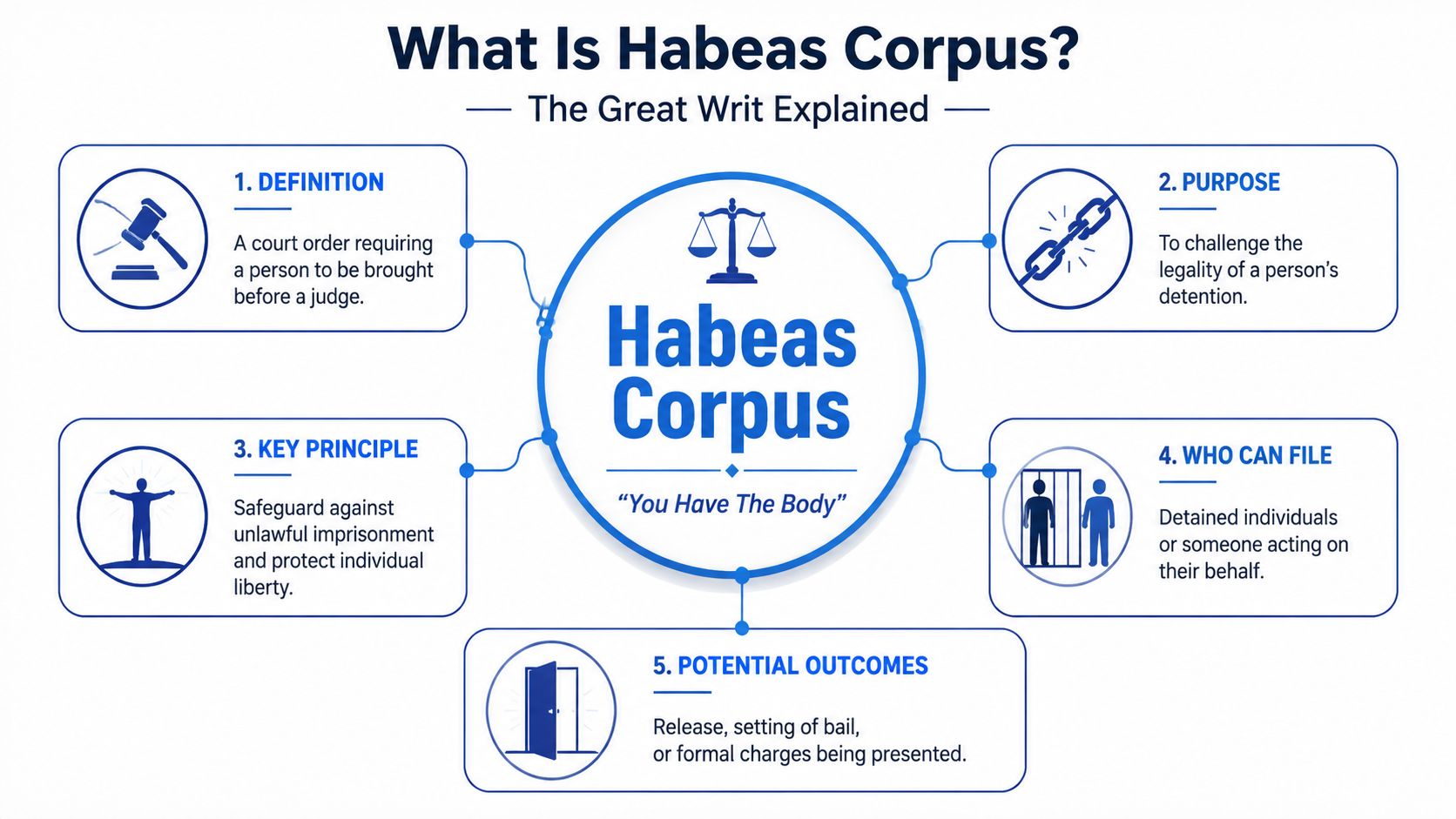
A habeas corpus case starts with a direct question to the government: what legal authority justifies holding this person right now?
The phrase habeas corpus comes from Latin and translates to “you have the body.” In practical terms, a court can order the jailer, sheriff, warden, or other agency holding someone to bring that person before a judge and explain the legal basis for the detention.
The plain English definition
Habeas Corpus meaning is straightforward. It is a legal challenge to unlawful confinement.
It also helps to define the boundaries clearly. Habeas corpus is an independent civil proceeding, not a criminal appeal, and it is used to challenge unlawful detention or illegal imprisonment rather than to review ordinary trial errors, as explained in the Jailhouse Lawyer's Manual chapter on habeas corpus.
That distinction matters in real Florida cases.
If you were convicted of DUI in Broward County, for example, habeas corpus is not a second trial. A judge is not deciding again whether the officer was convincing, whether the breath test was persuasive, or whether the jury should have believed you. The court is examining whether the law permits the custody itself.
Here's a short overview that helps frame the concept:
What the writ is designed to test
A better way to understand habeas corpus is to focus on its job. It checks the legal foundation for confinement, the way a building inspector checks whether the structure is standing on a valid base.
That means the court is looking for serious defects such as:
No lawful basis for custody
A jurisdictional problem
A constitutional violation affecting the legality of confinement
Detention continuing when the law no longer authorizes it
Habeas corpus tests the legality of detention. It does not decide whether the person is factually innocent.
Many people in South Florida often get these terms confused. Someone facing charges in Miami-Dade, Palm Beach, or Broward may use “appeal,” “post-conviction motion,” and “habeas” as if they mean the same thing. They do not. Habeas corpus is a narrower tool aimed at present unlawful restraint, which is exactly why it can be so effective when used for the right problem and so unhelpful when used for the wrong one.
The Historic Roots of Your Right to Challenge Detention
A deputy makes an arrest in Broward. Hours turn into days, and the family keeps asking the same question: who gets to make the government explain why this person is still being held? That question sits at the heart of habeas corpus.
The writ carries unusual weight because it grew out of a long struggle against unchecked detention. Its roots are commonly traced to the Magna Carta, where the basic principle was simple: the government could not jail someone just because it had the power to do so. It had to point to lawful authority.

Why this right carries so much force
Habeas corpus tackles a difficult but fundamental question: can the state hold a human being first and justify it later? The common law answer became no. A court could require the jailer to bring the person forward and show the legal basis for custody.
That idea matters because detention changes lives fast. A person can miss work, lose housing, fall behind on child care, and face pressure to make bad decisions just to get out of jail. The writ developed as a way to force a legal explanation instead of leaving liberty to official say-so.
English courts recognized the writ long before modern American criminal procedure existed, and Parliament later formalized protections around it. The history matters less as a museum piece than as a warning. Government power over custody must stay tied to law, procedure, and judicial review.
Why old history still matters in Florida
American law inherited that distrust of unchecked imprisonment. The U.S. Constitution protects habeas corpus through the Suspension Clause in Article I, Section 9, and the Federal Judicial Center's history of habeas corpus jurisdiction explains how that protection developed in federal law.
For someone facing charges in Miami-Dade, Palm Beach, or Broward, the practical point is clear. Habeas corpus is not just a historical phrase lawyers like to cite. It is the legal mechanism that requires the state to justify custody when the law may not support it.
That does not mean every unfair result calls for habeas. In Florida practice, the writ is best understood as part of a family of remedies, each with its own job. A direct appeal reviews certain trial court errors. A Rule 3.850 motion attacks specific post-conviction problems. Habeas focuses on unlawful restraint itself, which is why it remains so important when custody is the problem that needs immediate judicial attention.
If you have ever read about false imprisonment under Florida law, the theme will sound familiar. The law has long treated unlawful restraint as a serious wrong. Habeas corpus is one of the oldest court tools for correcting it when the government is the one doing the holding.
Common Types of Habeas Corpus Petitions
A family in Broward calls after a late-night arrest. Their first question is simple: “Can habeas corpus get him out?” Sometimes the answer is yes. Sometimes the better path is an appeal later, or a Rule 3.850 motion after conviction. The key is knowing which problem you are trying to fix.
In Florida practice, habeas petitions usually fall into three practical categories: pretrial habeas, post-conviction habeas, and federal habeas. Those labels matter because each one addresses a different stage of a case and a different kind of custody problem.
Pretrial habeas issues
Pretrial habeas is the form families ask about most often in Miami-Dade, Palm Beach, and Broward. It is used before trial, while a person is still being held, when the legal basis for that custody is seriously flawed.
A useful way to understand it is this. Pretrial habeas attacks the state's present authority to hold someone. It does not ask the court to review every mistake in the case. It asks a narrower question: is this detention lawful right now?
That can matter in situations involving:
Defective charging documents
Unlawful pretrial detention
Jurisdictional defects
Custody issues tied to bond or process problems
These petitions can arise in DUI, drug, domestic violence, juvenile, firearm, and other criminal cases. The charge itself is not what makes habeas appropriate. The issue is whether the state has a valid legal foundation for the restraint.
The concept overlaps, in a general sense, with concerns raised in cases involving unlawful restraint and false imprisonment under Florida law. The remedies are different, but the core concern is similar. Someone is being held, and the law may not justify it.
Post-conviction and federal habeas issues
Post-conviction habeas comes up after a conviction, leading to confusion for many people. They hear “challenge the detention” and assume habeas is just another appeal. In practice, it is a much narrower tool.
An appeal usually argues that the trial court made reversible legal errors. A post-conviction motion under Rule 3.850 targets specific problems after judgment, such as certain constitutional violations or newly discovered evidence. Habeas, by contrast, focuses on whether the custody itself is unlawful because of a fundamental defect that the law allows habeas to address.
Federal habeas is a separate layer. In the federal system, petitions may be filed under 28 U.S.C. § 2241 in the federal district court with jurisdiction over the detention facility, as explained in this discussion of federal habeas filing under Section 2241.
That same source discusses a strict filing deadline tied to when a state court judgment becomes final after direct review. In post-conviction work, deadlines and procedural rules can end a case before the court ever reaches the merits.
Here is the practical breakdown:
Type of petition | Typical setting | Main issue |
|---|---|---|
Pretrial habeas | Before trial | Whether the custody or charging basis is legally valid |
Post-conviction habeas | After conviction | Whether detention remains unlawful because of a fundamental defect |
Federal habeas | Federal district court | Whether detention violates federally protected rights |
Habeas is powerful, but it is also limited. Some federal detention contexts have included restrictions on access to the writ, as the Brennan Center explains in its report on ten things to know about habeas corpus. For Florida criminal defendants, the more immediate lesson is simpler. The right result often depends less on how serious the case feels, and more on choosing the correct procedural tool for the stage the case is in.
The Habeas Corpus Process and Hurdles in Florida
A family calls my office after a loved one has been sitting in jail in Broward or Miami-Dade, and their first question is usually simple: “Can we file habeas corpus and get this fixed?” The honest answer is, sometimes. Habeas can be the right tool, but only if the problem is the legality of the custody itself, not just that something in the case feels wrong.
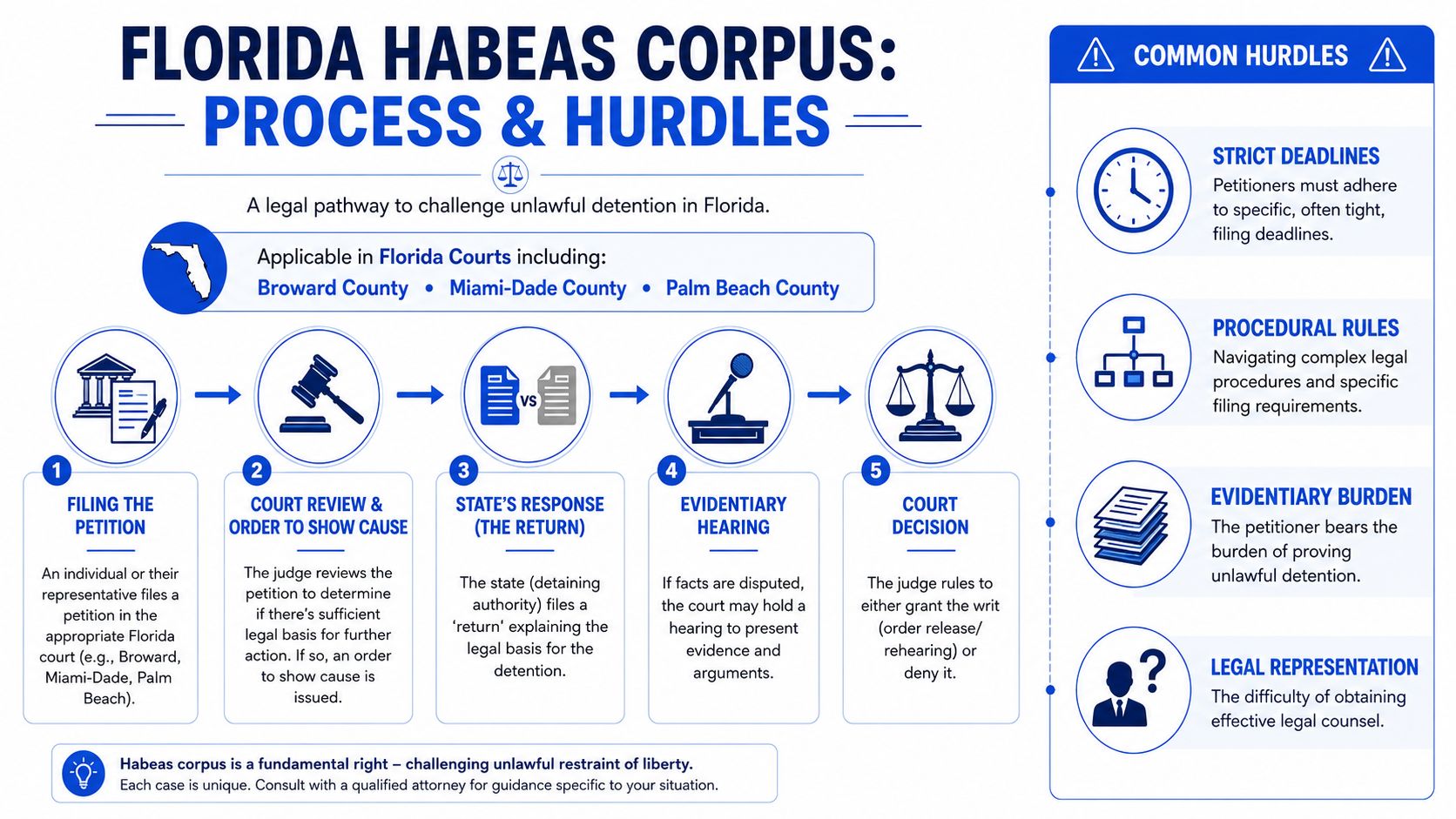
In Florida, a habeas petition has to do more than complain about unfairness. It must identify who is holding the person, what legal authority is being used to hold them, and why that authority is defective. Judges want a specific legal problem tied to the current detention.
That usually means gathering the papers that explain how the person got there. The petition often depends on arrest documents, charging papers, bond orders, custody records, prior rulings, and any transcript or filing that shows the detention is unlawful. Filing in the correct court matters too. A strong argument filed in the wrong place can still fail.
Procedure can move quickly. In some cases, the court reviews the written petition and the State's response without taking live testimony. In others, the judge may set a hearing if the papers show a real dispute that needs to be resolved.
Florida pretrial practice creates another point that families often miss. If someone has been held after arrest without the required progress in the case, there may be a separate remedy available inside the criminal case itself. That does not make habeas unnecessary in every case, but it does mean counsel has to choose the right procedural path instead of filing every possible motion and hoping one sticks.
That is where many petitions run into trouble.
The court is not asking whether the case feels serious or whether the person has suffered enough. The court is asking a narrower question: does the State currently have lawful authority to keep this person in custody?
Common problems include:
using habeas to argue issues that belong in a direct appeal
raising claims that fit a Rule 3.850 motion better than a habeas petition
filing in the wrong court or against the wrong custodian
relying on conclusions without attaching the orders or records needed to support them
confusing trial strategy problems with unlawful detention
A practical example helps. If the complaint is that police searched a car or phone illegally, the first fight is often inside the criminal case through a suppression motion, not through habeas. If you want to see how that issue is usually raised, read more about a motion to suppress evidence in Florida criminal cases.
That distinction matters because habeas is a custody challenge. It is not a catch-all fix for every constitutional problem.
Another hurdle is timing. Some habeas issues must be raised promptly, especially when the problem concerns present detention before trial. Waiting too long can undercut the argument that immediate court intervention is necessary. After conviction, delay can create a different problem. The court may decide the claim belongs in another post-conviction procedure instead.
Expectations also need to be realistic. Winning a habeas petition does not always end the prosecution. Sometimes the result is release from unlawful custody. Sometimes it is a new hearing, a corrected order, or a direction that the lower court address the problem under the proper legal standard. In other words, habeas can open the jail door in the right case, but it can also force the court system to follow the rules.
That is why the process in Florida is less about dramatic language and more about precision. The closer the petition stays to one clear point, unlawful detention, the stronger it usually is.
Habeas Corpus vs Direct Appeals and Rule 3.850 Motions
A lot of clients reach this point with the same question: “If something is wrong, why can't we just file habeas?” Fair question. In Florida, these remedies are different tools for different jobs. Using the wrong one can slow down relief, and in some cases it can get a filing denied without the court ever reaching the underlying problem.
The simplest way to sort them out is to ask one question first. What are you trying to fix?
If the argument is that the trial court made a legal mistake based on what is already in the record, that usually points to a direct appeal. If the argument depends on facts outside the record after conviction, such as a claim that prior counsel failed to investigate, that often points to a Rule 3.850 motion. If the argument is that the State or the court lacks lawful authority to keep someone in custody right now, that is the lane for habeas corpus.
A direct appeal works like a review of the trial transcript and rulings. Rule 3.850 works more like a post-conviction challenge that may require new factual development. Habeas is narrower and more urgent. It asks whether the detention itself is legally valid.
That distinction matters in South Florida courts. A person in Broward, Miami-Dade, or Palm Beach may know something feels unfair, but unfair and unlawful custody are not always the same issue. Habeas is not the general “fix what went wrong” filing. It is the remedy used when the custody itself is the problem.
Florida Post-Conviction Options Compared
Legal Tool | Primary Purpose | What It Challenges | Evidence Used |
|---|---|---|---|
Direct Appeal | Review legal errors shown in the trial record | Rulings, preserved legal issues, record-based trial errors | The existing trial and court record |
Rule 3.850 Motion | Raise certain post-conviction claims not limited to direct appeal issues | Claims such as matters requiring facts outside the record | Often materials outside the original record, depending on the claim |
Writ of Habeas Corpus | Test the legality of current detention | Unlawful confinement, jurisdictional defects, fundamental legality of custody | Materials relevant to whether the detention is lawful |
Here is how that plays out in real life.
Direct appeal: A defendant is convicted in Broward County and believes the judge admitted evidence that should have been excluded. If the issue was preserved and appears in the record, appeal is often the proper route.
Rule 3.850 motion: After conviction, a defendant learns trial counsel failed to uncover a key witness or failed to advise properly about a plea. That claim may depend on facts outside the transcript, which is why Rule 3.850 often fits better.
Habeas corpus: A person is being held and the legal basis for that custody is fundamentally defective. That is where habeas analysis begins.
A helpful way to view it is this: appeal asks whether the court got the case wrong on the record. Rule 3.850 asks whether a post-conviction claim requires the court to examine facts beyond that record. Habeas asks whether the jailer has lawful authority to hold the person at all.
Those are not small differences. They control where you file, what you must prove, and how fast the court may act.
That is also why case-specific advice matters. Someone facing detention issues in Broward should speak with a Broward criminal defense attorney with habeas and post-conviction experience before choosing a procedural path. The right argument in the wrong vehicle can waste time that a person in custody does not have.
Do You Need a Lawyer for a Habeas Petition in Florida
The honest answer is yes. You can file a habeas petition on your own, but in most cases you shouldn't.
You can file on your own but that doesn't mean you should
Habeas work punishes mistakes. Courts expect proper procedure, the right legal theory, the right forum, and a claim that fits habeas.
People who represent themselves often run into the same problems:
They use habeas corpus as a general fairness argument
They raise guilt-based arguments instead of detention-based arguments
They overlook deadlines or technical requirements
They attach the wrong documents or fail to create a usable record
They file something that belongs in a different post-conviction vehicle
That risk matters whether the underlying case involves a DUI arrest in Fort Lauderdale, a drug charge in Broward County, a theft case in Palm Beach, a domestic violence case in Miami-Dade, or a probation violation anywhere in South Florida.
What experienced counsel adds
A good lawyer does more than draft papers. Counsel identifies the core issue.
Sometimes the answer is that habeas is the right tool. Sometimes the answer is that the client needs a bond motion, a suppression motion, a direct appeal, a Rule 3.850 motion, or another targeted remedy. That judgment matters.
A lawyer with criminal courtroom experience also sees how the state is likely to respond. Former prosecutors, in particular, often understand where the record is thin, where the state may claim a procedural bar, and where a constitutional issue is stronger than it first appears.
If you're trying to evaluate post-arrest or post-conviction options in South Florida, it also helps to understand what an experienced Broward criminal defense attorney looks for early in a case.
Freedom can turn on procedure. The law may give you a remedy, but only if you use the correct one in the correct way.
For stressed families, the practical advice is simple. Don't guess. Don't rely on jailhouse summaries or generic internet answers. Get a lawyer to review the custody status, the procedural posture, and the exact legal defect being claimed.
If you or a loved one needs guidance on unlawful detention, pending charges, post-conviction options, DUI defense, drug crimes, violent offenses, probation violations, search and seizure issues, or other criminal matters in Broward County, Fort Lauderdale, Miami-Dade, Palm Beach, or surrounding South Florida communities, contact Ticket Shield, PLLC for a confidential consultation. An early legal review can clarify whether habeas corpus is the right tool, protect important rights, and help you avoid losing time on the wrong path.
Habeas corpus lets a court test whether detention is lawful. Learn what it means in Florida and when to use it.