Terms of Probation in Florida Complete Guide
Jason Goldsmith, Esq
You've just left a Florida courtroom with probation instead of jail. Your family is relieved, but the relief may fade when the probation order arrives and lists reporting dates, travel limits, treatment, testing, payments, and other requirements. A missed appointment or misunderstood restriction can create a new legal problem even when you haven't committed another crime.
The terms of probation in Florida control how you must live during supervision. This guide explains where those terms come from, how long probation can last, which conditions are common, what daily compliance requires, and what can happen after an alleged violation. Keep your written order nearby as you read. The language in that order, not a general internet summary, controls your case.
Table of Contents
Introduction to Probation in Florida
Probation is court-ordered supervision in the community. It can serve as an alternative to incarceration, but it isn't informal permission to move on from a criminal case. A person on probation remains subject to court conditions and supervision by a probation officer.
Community control is more restrictive than ordinary probation because it can limit where a person may go and when they may leave home. Incarceration requires confinement in a jail or prison. Probation generally allows a person to remain at home, work, attend school, and care for family, but only while following the court's conditions.
Consider a person sentenced in Broward County who receives probation and assumes that occasional travel for work is harmless. The written order may require advance permission, reporting, or residence approval. If that person leaves without authorization, the issue may become a technical violation even though no new criminal charge arose.
Practical rule: Read every page of the sentencing documents, including attachments and special conditions. If a term is unclear, ask the probation officer for clarification and obtain legal advice before acting.
The most important categories are easy to separate:
Standard conditions: Common requirements such as reporting, obeying the law, maintaining employment, allowing home visits, and paying restitution.
Special conditions: Requirements based on the offense or the person, including treatment, testing, community service, curfew, or house arrest.
Duration rules: The length of supervision depends on the offense, the judge's order, and statutory exceptions.
Violation procedures: Florida law distinguishes some technical violations from other violations and allows the court to revoke, modify, or continue probation.
A probation sentence can protect your freedom, but it also creates an ongoing legal obligation. Understanding the order from the first day gives you a better chance to avoid preventable mistakes and respond quickly if the State alleges noncompliance.
Legal Authority Behind Florida Probation Terms
Florida's probation system is primarily found in Chapter 948 of the Florida Statutes. The sentencing judge sets the term and conditions, while the probation officer monitors compliance and reports concerns to the court. The judge's order turns statutory authority into specific obligations for the individual defendant.
The process usually works in four stages:
The court imposes probation. The judge identifies the supervision term and conditions at sentencing.
The written order records the requirements. The order may include standard language plus special conditions tied to the offense or rehabilitation needs.
The probation officer administers supervision. The officer schedules reporting, receives documentation, monitors treatment or testing, and checks compliance.
The court handles disputes. A probation officer can report an alleged violation, but the judge decides what happens after the required court process.
Florida Statutes § 948.03 authorizes conditions involving reporting to an officer, home visits, employment, residence, obedience to law, and restitution. The statute also provides that a conviction isn't required for a law violation to count as a probation violation. That means an allegation or other legal finding can create risk before a separate criminal case ends.
For a broader overview of Florida criminal law, review Florida criminal laws and penalties. Probation terms must be read alongside the judgment, sentencing documents, and any later modification order.
A judge can tailor conditions to rehabilitation and public safety, but the practical question is always the same: What exactly does the order require, and can you prove that you complied? Keep copies of receipts, appointment confirmations, treatment records, travel approvals, and messages with the probation office. Documentation can help resolve misunderstandings before they become formal allegations.
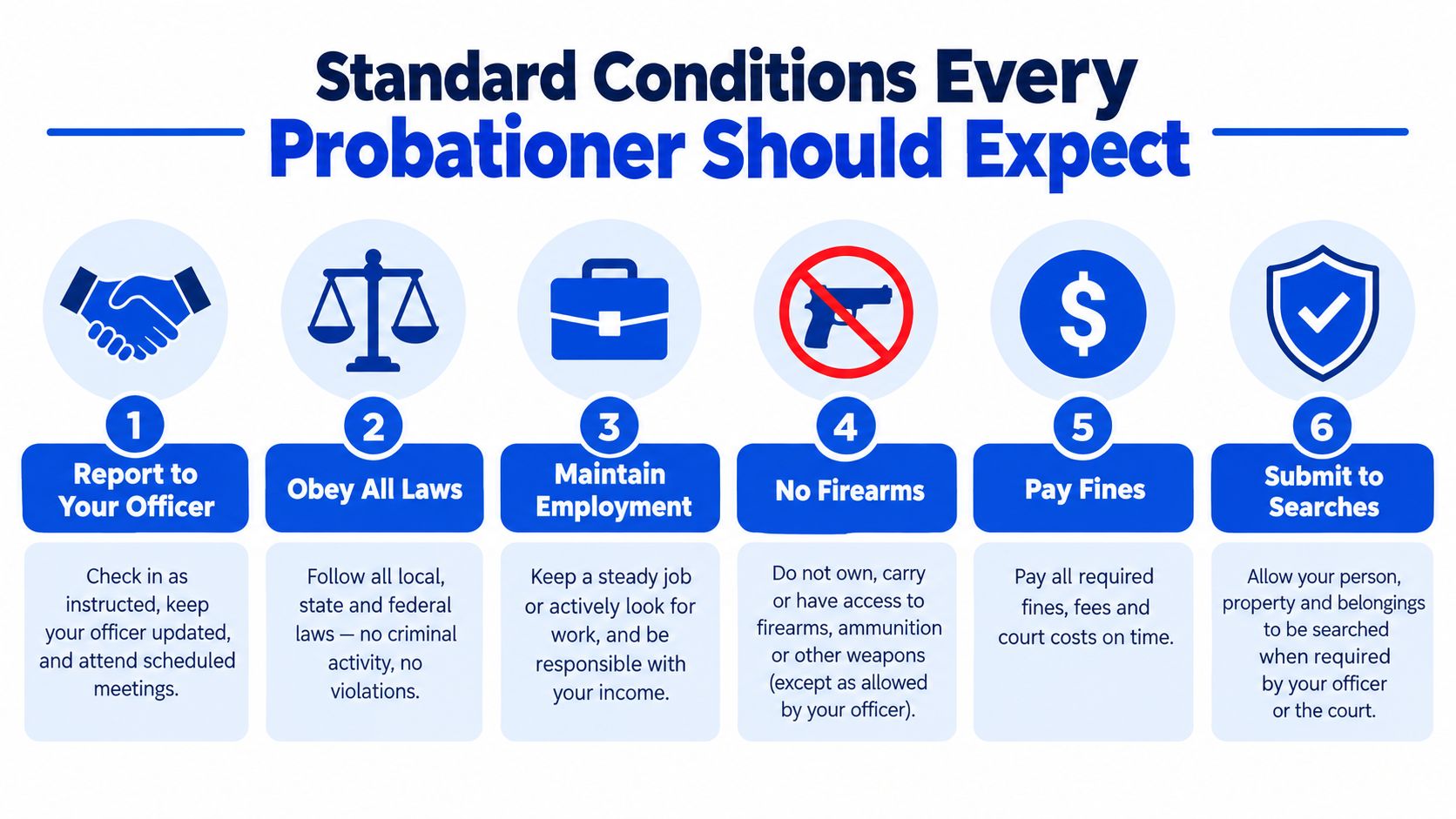
Standard Conditions Every Probationer Should Expect
Florida Statutes § 948.03 identifies standard conditions that commonly appear in probation orders. The wording may vary, and your judge may add requirements, so use the following as a practical guide rather than a substitute for your order.
Reporting to the probation officer
You'll usually need to report according to a schedule set by the probation office. Reporting may occur in person, by telephone, online, or through another method authorized by the officer. Missing a meeting, arriving late, or failing to respond can create a compliance problem.
Example: If the officer directs you to report on a specific date, confirm the appointment and keep proof of attendance. If transportation fails, contact the office before the appointment instead of waiting until afterward.
Permitting home visits
A probation condition may require you to permit reasonable home visits. The officer may use those visits to verify your residence, speak with you, or assess compliance with restrictions.
Your residence must remain known and approved when the order requires it. Don't move, add another resident, or change your living arrangement without checking the order and contacting supervision first.
Maintaining employment or an approved lawful activity
Employment conditions encourage stability, but the order may also recognize school, job training, caregiving, or another approved activity. If you lose a job, promptly document your search and notify the officer.
A person who stops working may appear noncompliant even when the underlying reason is legitimate. Written communication and employment records can show that you're taking the condition seriously.
Remaining within a specified place
Some orders restrict where you may live or require you to remain within a specified place unless you receive permission to leave. This can overlap with curfew, house arrest, or community control.
A short trip across county lines may still matter if the order requires approval. Read geographic terms carefully and ask before traveling.
Obeying all laws
The statute authorizes a condition requiring you to obey all laws. Florida also states that a conviction isn't required for a law violation to count as a probation violation. An arrest doesn't automatically prove a violation, but a new allegation can create immediate supervision risk.
Don't discuss a new criminal allegation with law enforcement before speaking with a defense attorney. You may have constitutional rights that need to be protected in both proceedings.
Paying restitution and other court-ordered obligations
Restitution can be a condition of probation. Keep proof of every payment and raise financial hardship through the proper legal channel rather than stopping payments.
The exact obligations may include restitution, court costs, fines, or other amounts listed in the judgment. A probation officer can't privately rewrite a judge's order, so seek a formal modification when circumstances change.
The Florida probation rules for DUI cases address a separate offense category. The same core lesson applies across criminal cases: follow the written order, communicate early, and preserve records.
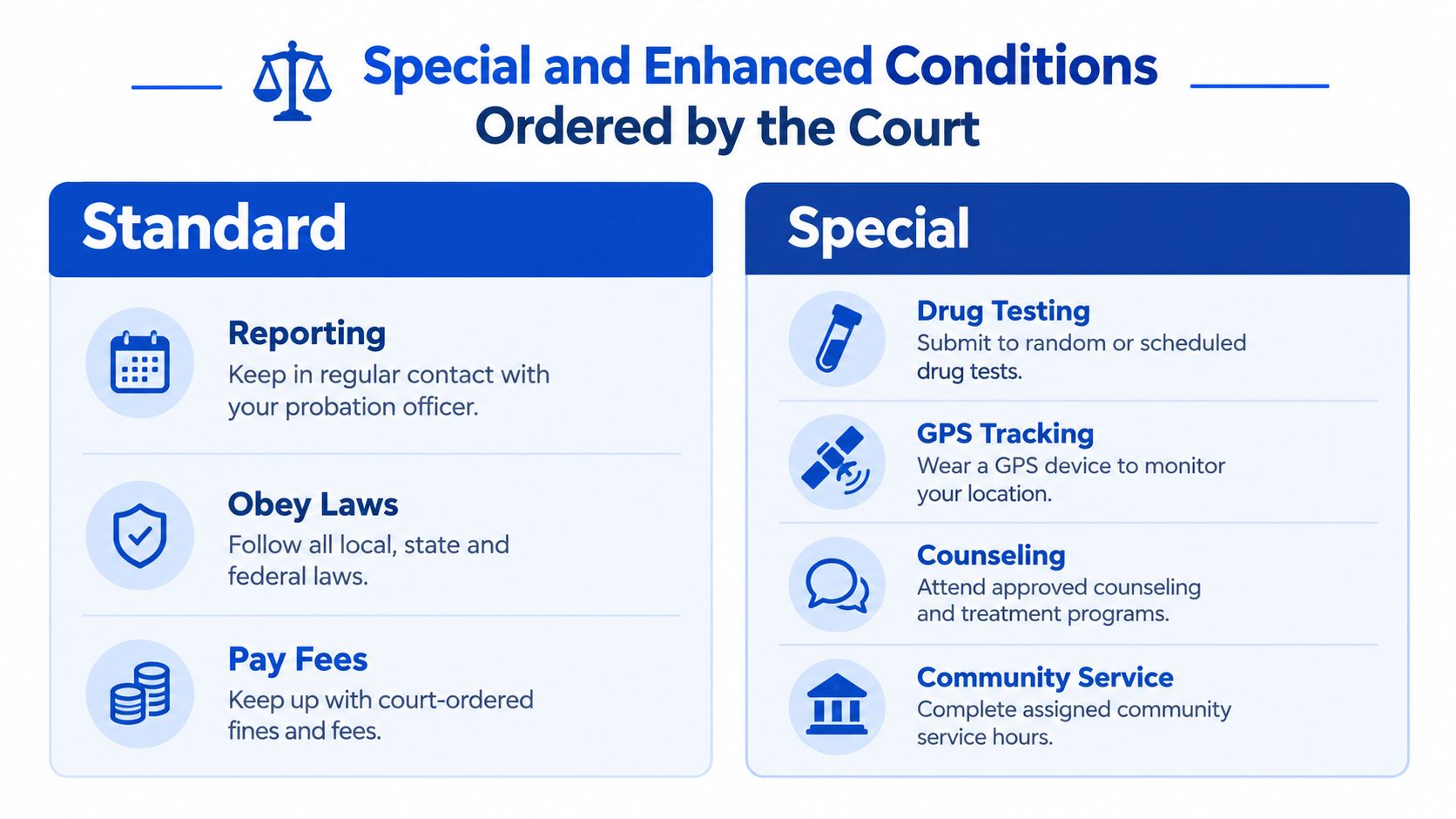
Special and Enhanced Conditions Ordered by the Court
Standard conditions apply broadly. Special conditions address the facts of a particular offense, the person's assessed needs, or a specific public-safety concern. A judge should identify these requirements in the written sentencing order, and the probation officer generally administers them rather than inventing them independently.
The difference matters because a person may comply with every standard condition and still violate a special one. For example, someone could report on time but miss required counseling, fail a drug test, violate a no-contact order, or leave home during an unauthorized period.
Common special conditions
Special condition | What it may require |
|---|---|
Drug or alcohol testing | Testing according to the schedule and method stated in the order |
Counseling or treatment | Attendance, participation, and proof of completion |
Community service | Completion of court-ordered service hours through an approved provider |
Curfew | Remaining at an approved location during specified hours |
House arrest | Staying at home except for expressly permitted activities |
No-contact order | Avoiding direct and indirect contact with a protected person |
Weapons restriction | Not possessing firearms, ammunition, or other prohibited weapons |
Electronic monitoring | Wearing and maintaining an approved monitoring device |
Offense-specific requirements | Completing a program or restriction connected to the charged conduct |
A drug-related case may involve testing and treatment. A domestic-related case may include no-contact restrictions and counseling. A case involving weapons may impose restrictions that affect possession, storage, or access. These examples are illustrative, not automatic rules for every case.
Read the attachments: Special conditions often appear on a separate page from the general probation language. Missing that page can lead to an avoidable violation.
The order may also require permission before changing treatment providers, residence, employment, or travel plans. If a provider discharges you, a test site closes, or an appointment conflicts with work, notify supervision promptly and keep evidence of the problem.
A defense lawyer can examine whether a condition is lawful, clear, related to the sentence, and properly imposed. If a condition is impossible to follow, overly broad, or inconsistent with another part of the order, seek clarification or modification through the court rather than ignoring it.
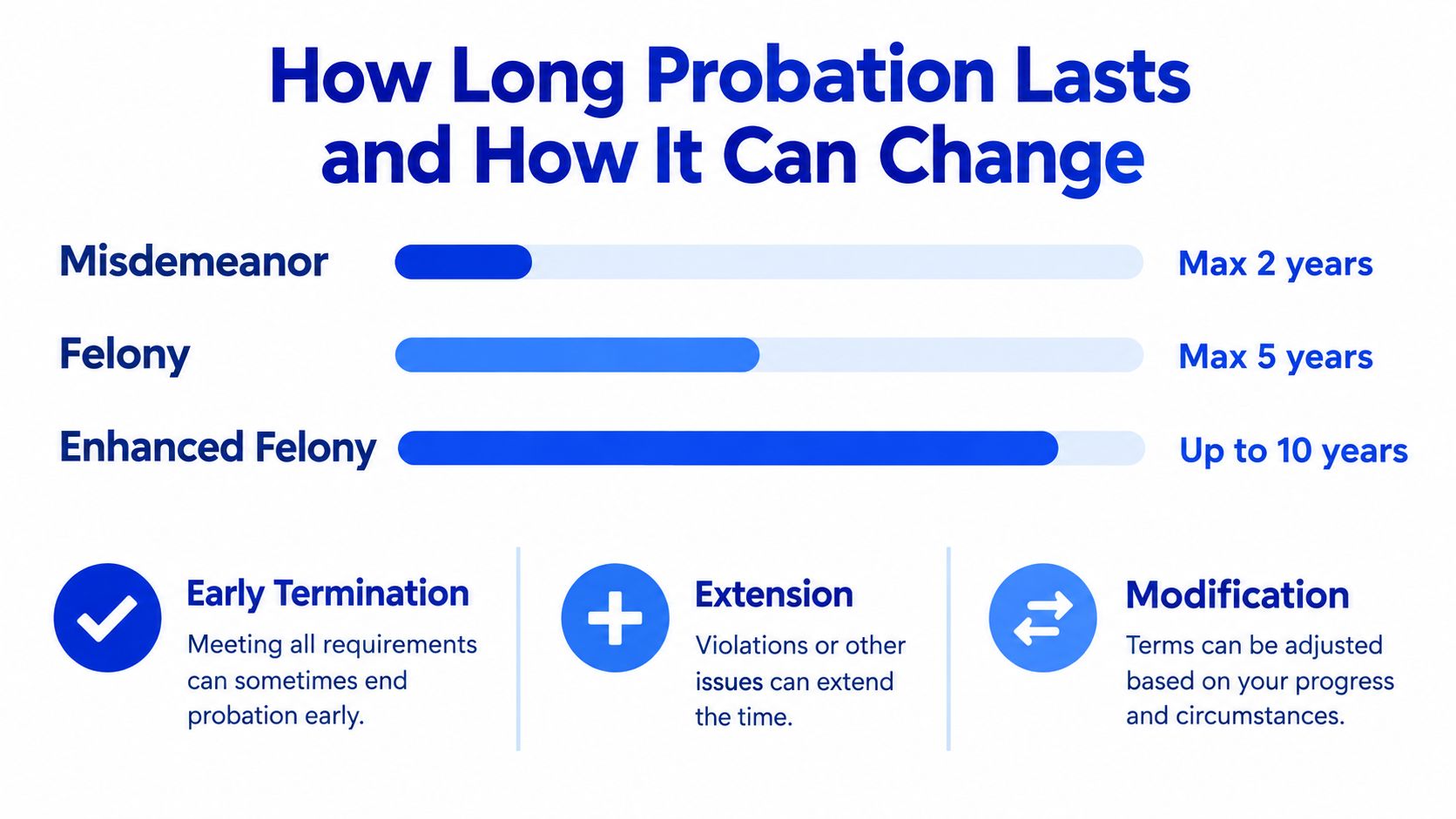
How Long Probation Lasts and How It Can Change
The length of probation depends on the offense classification, the judge's order, statutory exceptions, and later court action. The commonly repeated idea that every Florida probation sentence has the same fixed duration is wrong.
Under the Florida Statutes in effect for the cited statutory framework, a felony probation term is generally limited to two years unless the court specifies otherwise, while misdemeanor probation is generally capped at six months unless otherwise specified. The statute includes exceptions. For offenses other than felonies where alcohol is a significant factor, probation may run for up to one year. Probation for offenses under chapters 794 or 827 follows the maximum level of supervision provided by the supervising agency for the full court-imposed term. See the Florida statutory probation duration rules.
The order controls the actual term imposed in your case. A felony sentence may be shorter than the general baseline, or the court may specify a longer period when the law permits it. The offense, sentencing facts, and statutory exception can all matter.
What practice data shows
A statewide public-data analysis of 952,740 Florida charge dispositions reported a median probation term of 365 days, with the middle half of terms ranging from 365 to 1,096 days. The analysis is linked through the statutory discussion of Florida probation practice and helps explain why many people experience probation as a one-year obligation, while higher-severity matters can involve longer supervision.
The practical question isn't only, “What is the maximum?” Ask instead:
What term did the judge impose?
Does a statutory exception apply?
Does the order permit later modification?
Has a violation stopped the supervision clock?
Can early termination or conversion be requested?
Florida law allows early termination and conversion in some circumstances. A request normally requires attention to the written order, completed obligations, compliance history, and the court's authority to grant relief. The Florida early termination of probation process can involve a motion and proper notice, not merely an informal request to the probation officer.
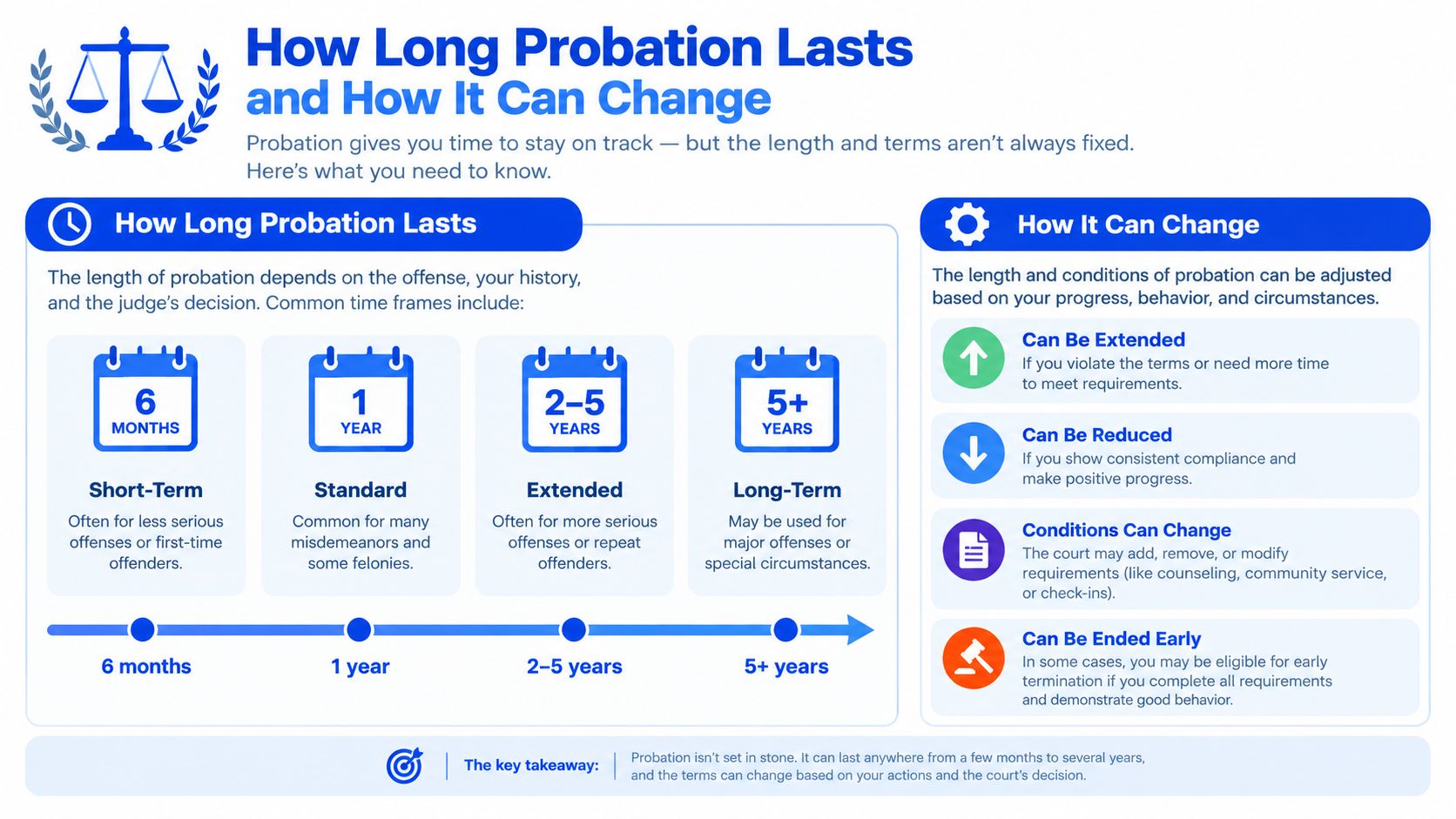
Daily Compliance Requirements for Reporting and Restrictions
Probation succeeds or fails through ordinary daily decisions. The safest approach is to treat the order as a calendar, a travel policy, a financial checklist, and a recordkeeping system.
Build a compliance routine
Start with a written schedule. Enter every reporting appointment, treatment session, testing date, payment deadline, curfew, and community-service commitment into a calendar. Set reminders early enough to account for traffic, work, childcare, and transportation in Broward, Miami-Dade, Palm Beach, or another county.
Keep a physical and digital folder containing:
Reporting confirmations and officer communications.
Treatment attendance records and testing receipts.
Pay stubs, job-search records, or school documentation.
Restitution and cost-payment receipts.
Travel requests and written approvals.
Residence and employment updates.
If you're unemployed, document applications, interviews, staffing-agency contacts, and other approved efforts. If you're employed, tell supervision about schedule changes before they cause a missed appointment.
Travel and residence
Never assume that a short trip is automatically allowed. Ask for approval in writing, provide the destination and dates requested by the probation office, and wait for a clear response if the order requires advance permission. Moving without approval can create a separate compliance concern even when the new residence is stable.
Home visits and residence rules also affect roommates, guests, and household changes. Discuss sensitive issues with counsel before giving broad explanations to law enforcement or signing anything you don't understand.
Money and treatment
Pay what the court ordered, but don't conceal financial hardship. A person who can't meet restitution or another obligation may need to request a formal adjustment, a payment plan, or other relief permitted by the court.
Treatment is another area where silence creates risk. If an approved provider denies admission, has no available appointments, or ends services, notify the probation officer and preserve the documentation. For a focused explanation of missed appointments, travel, testing, and other issues, review technical probation violations in Florida.
Probation Violations and What Happens After an Allegation
A probation violation can involve a new law violation or a technical violation, such as missed reporting, unauthorized travel, failed testing, or failure to follow treatment requirements. A technical violation doesn't necessarily mean the person committed a new crime, but it can still place the sentence at risk.
Florida's violation framework under § 948.06 distinguishes material violations from certain technical violations eligible for alternative sanctions. A probation officer may initiate action when the officer has reasonable grounds to believe a violation occurred. The court then determines whether probation should continue, change, or end.
The timing rule is especially important. Once an affidavit alleging a violation is filed and a warrant is issued, the probation period is tolled. The supervision clock stops until the court rules on the alleged violation, so a person generally can't wait for the original end date and assume the matter disappears.
Potential responses
Violation category | Example | Possible response |
|---|---|---|
Low-risk technical violation | Missed reporting, curfew issue, or other eligible compliance failure | Up to 5 days in county jail, up to 50 hours of community service, counseling or treatment, drug testing, curfew, or house arrest |
First moderate-risk technical violation | A first violation classified as moderate risk | Up to 21 days in county jail as an alternative sanction |
Material violation | A serious or repeated breach of probation requirements | The court may revoke, modify, or continue probation |
New law violation | Conduct that may constitute a separate criminal offense | A probation case plus a separate criminal investigation or prosecution |
These are potential statutory responses, not automatic outcomes. The court may consider the allegation, compliance history, risk classification, available evidence, and arguments from both sides.
Florida practice also shows why people shouldn't treat technical allegations as minor. A criminal justice snapshot reported that 42% of probation violation admissions in 2021 involved technical violations (Florida Criminal Justice Data Snapshot). Statewide case-data reporting for 12,956 cases from 46 counties in 2023 through 2025 showed a 78.6% guilty rate and a 4.3% dismissal rate, while county outcomes varied substantially. Those figures don't predict an individual case, but they show why prompt legal review matters.
If you receive a warrant, affidavit, notice, or call about an alleged violation, don't explain the facts casually before getting advice. A lawyer handling a felony probation violation in Florida can examine the order, the allegation, the evidence, tolling, and possible sanctions.
Quick Reference Lookup for Common Probation Terms
Use this glossary to locate the detailed explanation quickly.
Alternative sanction: A statutory response available for certain eligible technical violations, including jail, service, counseling, testing, curfew, or house arrest. See Probation Violations and What Happens After an Allegation.
Community control: A more restrictive form of supervision that can limit movement and approved activities. See Introduction to Probation in Florida.
Curfew: A special condition requiring you to remain at an approved location during specified hours. See Special and Enhanced Conditions Ordered by the Court.
Early termination: A request to end probation before the ordered term expires when the law and circumstances permit. See How Long Probation Lasts and How It Can Change.
Home visit: A supervision contact at your residence, when authorized by the order. See Standard Conditions Every Probationer Should Expect.
Material violation: A violation that may not qualify for an alternative technical sanction and can expose probation to broader court action. See Probation Violations and What Happens After an Allegation.
Modification: A court-approved change to probation's term or conditions. See How Long Probation Lasts and How It Can Change.
No-contact order: A restriction on direct or indirect communication with a protected person. See Special and Enhanced Conditions Ordered by the Court.
Report to officer: The requirement to communicate with the assigned probation officer according to the authorized schedule and method. See Standard Conditions Every Probationer Should Expect.
Restitution: Money ordered to compensate a victim, with payment requirements controlled by the judgment and related orders. See Daily Compliance Requirements for Reporting and Restrictions.
Technical violation: A failure to follow probation conditions that doesn't necessarily involve a new crime. See Probation Violations and What Happens After an Allegation.
Tolling: The stopping of the probation clock after the required violation filing and warrant process until the court rules. See Probation Violations and What Happens After an Allegation.
Travel restriction: A requirement to remain within an approved area or obtain permission before leaving. See Daily Compliance Requirements for Reporting and Restrictions.
The glossary can help you find a topic, but only your own judgment and probation order identify the conditions that apply to you.
Frequently Asked Questions About Florida Probation
Can Florida probation end early?
Sometimes. Florida law permits early termination or conversion in certain circumstances, but approval isn't automatic. A lawyer can review your sentence, completed conditions, payment history, treatment records, and compliance before determining whether a motion is appropriate.
What happens if I miss one probation appointment?
Contact the probation office as soon as possible, explain the problem accurately, and ask how to reschedule. Don't ignore calls or assume one missed appointment can't matter. Save proof of transportation problems, illness, work conflict, or any other reason that affected attendance, then speak with counsel if the officer mentions a violation.
Can I move or travel for work while on probation?
Possibly, but the order may require advance approval, residence authorization, or geographic limits. Submit the request through the probation office in the manner required by your paperwork and wait for written confirmation when possible. Traveling first and asking later can create a technical violation.
Is a probation violation hearing the same as a new criminal trial?
No. A violation hearing addresses whether you breached the probation order and what consequence should follow. A separate criminal case concerns whether the State can prove a new offense. The procedures and strategic issues differ, and statements about one matter can affect the other, so get legal advice before discussing the facts.
Should I hire a lawyer before responding to an allegation?
You're entitled to understand the allegation and protect your rights before making avoidable statements. Gather the judgment, probation order, notices, messages, receipts, and relevant records. A Florida defense attorney can assess whether the condition was clear, whether the evidence supports the allegation, whether tolling applies, and whether continuation, modification, or an alternative sanction may be available.
Ticket Shield, PLLC handles Florida probation matters, including technical and new-law violation allegations, by reviewing the probation order, the claimed breach, and available court responses. Visit Ticket Shield, PLLC to request a confidential consultation about your situation in Broward County, Fort Lauderdale, Miami-Dade, Palm Beach, or another Florida jurisdiction.