Florida Manslaughter Statutes Penalties and Defenses Guide
Jason Goldsmith, Esq
A phone call from a Broward County jail can make Florida's homicide law feel impossible to understand. One family member may hear “manslaughter,” another may hear “murder,” and no one may know whether the case involves a confrontation, a vehicle, alleged negligence, or a claimed act of self-defense. The charge alone doesn't answer the most important questions.
Florida manslaughter statutes create a decision tree. Investigators and prosecutors examine what the accused did, the mental state involved, whether the killing was justified or excusable, how the death was caused, and whether the victim's category changes the felony level. Those details can affect the charge, the available defenses, pretrial litigation, and sentencing exposure in Broward, Fort Lauderdale, Miami-Dade, Palm Beach, and other Florida courts.
This guide is for education, not a substitute for advice about a specific case. For broader context, readers can review this overview of Florida criminal laws. If law enforcement is asking questions, preserve counsel's role and avoid discussing the facts with anyone except a defense lawyer.
Table of Contents
Introduction to Florida Manslaughter Law and How This Reference Works
Florida Manslaughter Statute 782.07 Elements and Classifications Explained
Voluntary and Involuntary Manslaughter Distinctions Under Florida Law
Penalties Sentencing and Aggravated Manslaughter Reclassification in Florida
How Manslaughter Differs From Murder Excusable Homicide and DUI Manslaughter
Case Law Jury Instructions and Historical Roots of Florida Manslaughter Statutes
Defense Strategies Court Procedures and Protecting Your Rights in South Florida
Quick Reference Lookup Cross References and Next Steps for Your Case
Introduction to Florida Manslaughter Law and How This Reference Works
Consider a South Florida driver involved in a fatal collision, a person who fired during a confrontation, or a homeowner whose actions during an apparent threat resulted in death. Each situation may produce very different legal questions, even if the accusation is described with the same word. A family searching “Florida manslaughter statutes” often needs a quick way to separate the definition, the penalty, the defenses, and the procedure.
The central statute is Florida Statute 782.07(1). It addresses a killing caused by an act, procurement, or culpable negligence, without lawful justification, and not amounting to excusable homicide or murder. The statute's surrounding subsections also address aggravated forms involving protected victim categories. The exact theory matters because a prosecutor must prove the applicable elements beyond a reasonable doubt.
How to use this guide
Use the statute section to identify the alleged conduct and classification. Use the penalties section to understand felony exposure. Use the comparison section when the case involves murder, excusable homicide, or impaired driving. The defense section focuses on evidence, jury instructions, causation, searches, and the steps that can shape a case before trial.
Practical rule: A manslaughter arrest is not the same as a manslaughter conviction. The State still has to prove every required element and defeat any properly supported justification or excuse.
A former prosecutor turned defense attorney will usually begin by testing the State's theory rather than accepting the charging label. That means examining reports, witness accounts, video, medical and forensic evidence, toxicology, vehicle data, firearm evidence, and the sequence of events. Early legal advice can also protect constitutional rights before statements or searches create avoidable problems.
Florida Manslaughter Statute 782.07 Elements and Classifications Explained
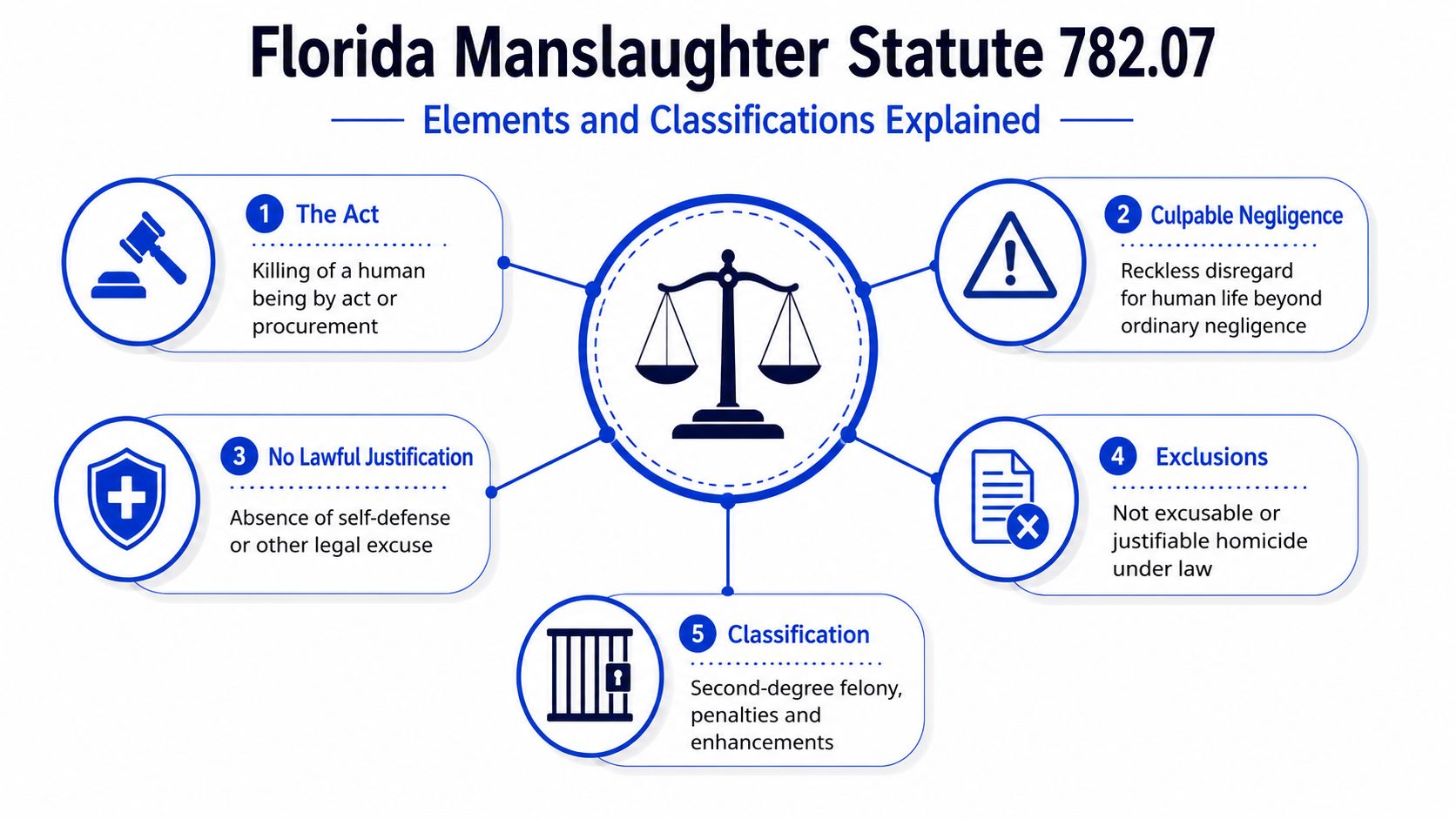
A fatal incident can look like one charge on paper while raising several separate legal questions. Florida Statute 782.07 works more like a decision tree. The facts must show a qualifying act or negligence, causation, no lawful justification, and a killing that is neither excusable homicide nor murder. The Florida Legislature's text of section 782.07 identifies the general offense as a second-degree felony.
The State's basic proof
The prosecution generally must establish five points:
Did a human being die?
Did the accused cause that death through an act, procurement, or culpable negligence?
Was the killing without lawful justification?
Was it not excusable homicide?
Was it not murder?
These questions separate manslaughter from other homicide outcomes. Culpable negligence requires more than ordinary carelessness, a mistake, or poor judgment. The alleged conduct must show a serious disregard for human life, and the State must connect that conduct to the death.
Consider a fatal firearm discharge. The prosecution may argue that handling the weapon in a highly reckless manner created the deadly risk and caused the shooting. The defense may contend that the discharge was unintended, that the evidence does not prove culpable negligence, or that another event caused the death. The jury's instructions matter because they define which facts must be found and under what legal theory.
Aggravated classifications
The statute also creates aggravated classifications involving an elderly person or disabled adult, a child, or certain protected personnel. Those circumstances can raise the offense to a first-degree felony, as reflected in the Florida Senate's statutory reference. The victim's category therefore adds another branch to the analysis after the State identifies the alleged conduct, causation, and fault.
Voluntary and Involuntary Manslaughter Distinctions Under Florida Law
Florida's statute uses one general manslaughter framework rather than creating separate statutory offenses called “voluntary manslaughter” and “involuntary manslaughter.” Lawyers and courts still use those terms as shorthand because they describe different factual theories.

Act-based and negligence-based theories
An act-based theory may involve an intentional physical act during a heated confrontation, without proof of the mental state required for murder. The person may have intended the strike or other act, while the State cannot prove an intent to kill or the circumstances required for a murder conviction. Provocation and sudden combat can become important, but they don't automatically eliminate criminal liability.
A negligence-based theory involves an unintentional killing that the State attributes to culpable negligence. The question isn't whether the person behaved imperfectly. The question is whether the conduct showed such a reckless disregard for human life that it meets Florida's legal standard.
Theory | Conduct examined | Central dispute |
|---|---|---|
Act-based, sometimes called voluntary | An intentional act that causes death | What did the person intend, and did the circumstances support justification or a lesser homicide theory? |
Culpable-negligence, sometimes called involuntary | An unintentional death allegedly caused by reckless conduct | Did the conduct rise above ordinary negligence, and did it legally cause the death? |
A confrontation may require close analysis of who initiated force, what each person reasonably perceived, whether the response was proportionate, and whether a self-defense instruction was supported. A firearm case may instead turn on handling, visibility, warnings, distance, and forensic reconstruction.
Readers dealing with a related allegation should also understand how Florida treats attempted manslaughter. The absence of a death changes the legal analysis, but intent, conduct, and statutory requirements still matter.
Penalties Sentencing and Aggravated Manslaughter Reclassification in Florida
A manslaughter case can change direction at sentencing. The court first identifies the offense level, then considers victim status, criminal history, scoring rules, and any mandatory minimum. The same basic decision tree therefore produces different results depending on the act, the victim, and the facts proved at trial.
General manslaughter is a second-degree felony. The sentencing framework allows up to 15 years in prison, up to 15 years of probation, or a $10,000 fine. Those are maximum possibilities, not an automatic sentence. The final outcome can depend on the sentencing score, negotiated resolution, and facts established in court.
Offense Category | Felony Degree | Maximum Exposure |
|---|---|---|
General manslaughter | Second-degree felony | Up to 15 years in prison, up to 15 years of probation, or a $10,000 fine |
Aggravated manslaughter involving a protected victim category | First-degree felony | Up to 30 years of punishment, depending on the applicable victim category |
DUI manslaughter | Statutory treatment can include second-degree felony treatment, with aggravation affecting classification | Mandatory minimum prison term of 4 years upon conviction, with other exposure controlled by the applicable statute |
Why reclassification matters
Aggravated manslaughter may apply when the victim is an elderly person or disabled adult, a child, or certain protected personnel. The victim's category does not remove the State's burden to prove causation and the required culpability. It can, however, raise the felony level and expand the sentencing range.
DUI manslaughter carries a mandatory minimum prison term of 4 years upon conviction under Florida's DUI statute. That floor makes the investigation of impairment, causation, testing, and conduct after the crash especially important. The sentencing rules are discussed in this guide to DUI manslaughter penalties.
Prior record and supervision
A prior record may affect sentencing analysis, scoring, negotiations, and supervision. Someone already on probation may also face a separate violation case. Florida law permits a warrantless arrest when there are reasonable grounds to believe a probationer or community-control offender materially violated supervision, followed by return to the court that granted probation or community control (Florida probation-violation law). Reviewing the alleged violation and the new homicide case together helps protect against decisions based on an incomplete picture.
How Manslaughter Differs From Murder Excusable Homicide and DUI Manslaughter
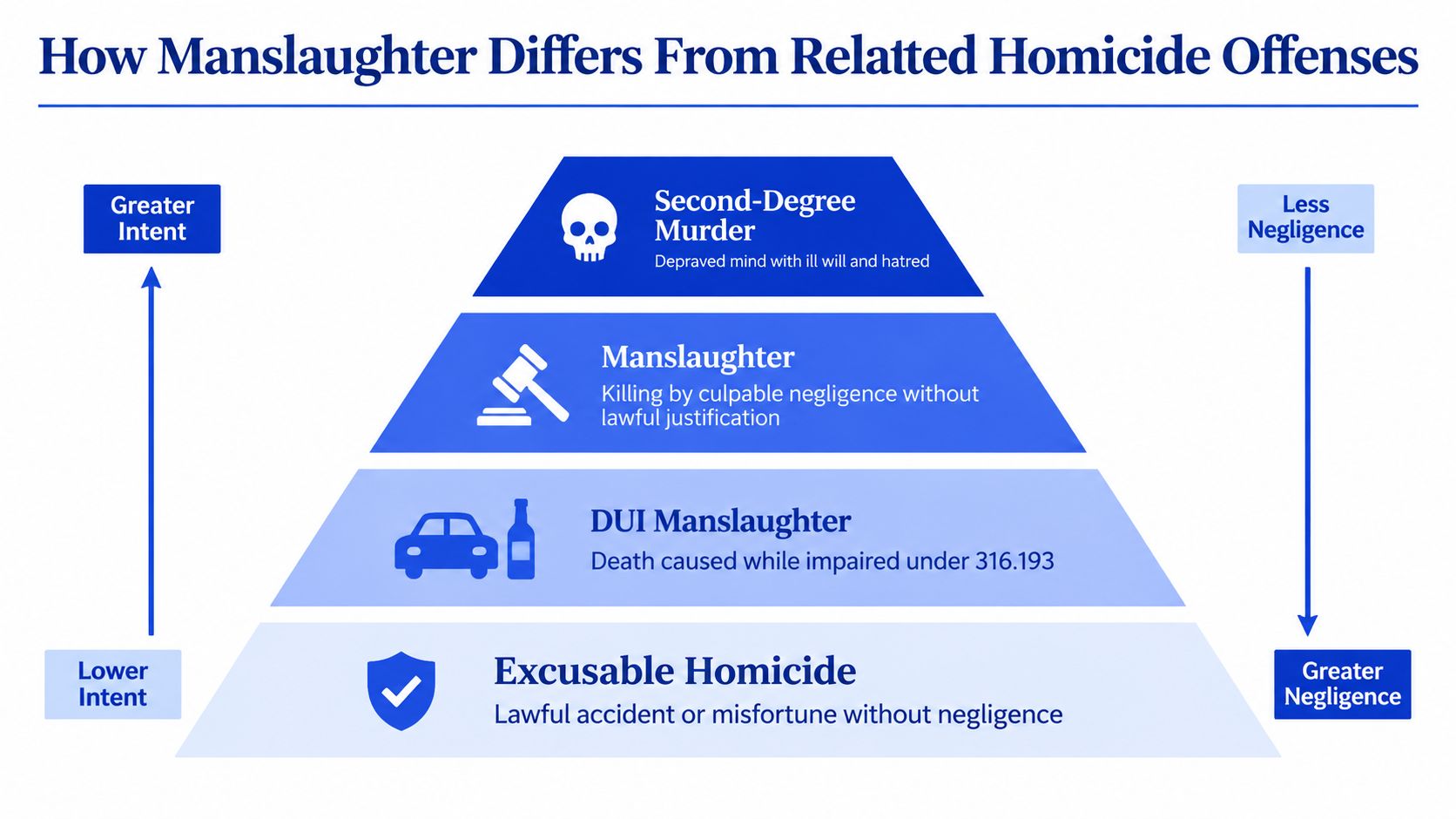
Manslaughter sits between several legally distinct homicide concepts, but the boundaries depend on mental state, justification, excuse, and the facts proving causation. A prosecutor may evaluate whether the evidence supports murder, manslaughter, a DUI-related homicide charge, or no criminal homicide at all.
The practical distinctions
Second-degree murder involves a more extreme mental-state theory, generally centered on an imminently dangerous act showing a depraved mind and indifference to human life. Manslaughter does not require the State to prove that murder-level theory, but it still requires proof of an unlawful killing and the applicable act or culpable-negligence theory.
Excusable homicide can apply when death occurs by accident and misfortune during a lawful act performed with ordinary caution and without unlawful intent. It can also arise in narrowly defined provocation or sudden-combat circumstances. The question is whether the evidence removes the killing from criminal liability under the legal definition of excuse.
DUI manslaughter involves a death connected to impaired driving and unlawful alcohol or controlled-substance-related conduct under Florida's DUI law. Florida law uses a 0.08 blood-alcohol or breath-alcohol threshold as prima facie evidence of impairment and an unlawful alcohol level, as stated in section 316.1934. A test result doesn't by itself resolve causation, identity of the driver, testing reliability, or every required element.
For a separate discussion of lawful killings, see justifiable homicide in Florida. In a South Florida case, the defense may need to address several categories at once, especially where a confrontation and a vehicle or toxicology issue overlap.
Case Law Jury Instructions and Historical Roots of Florida Manslaughter Statutes
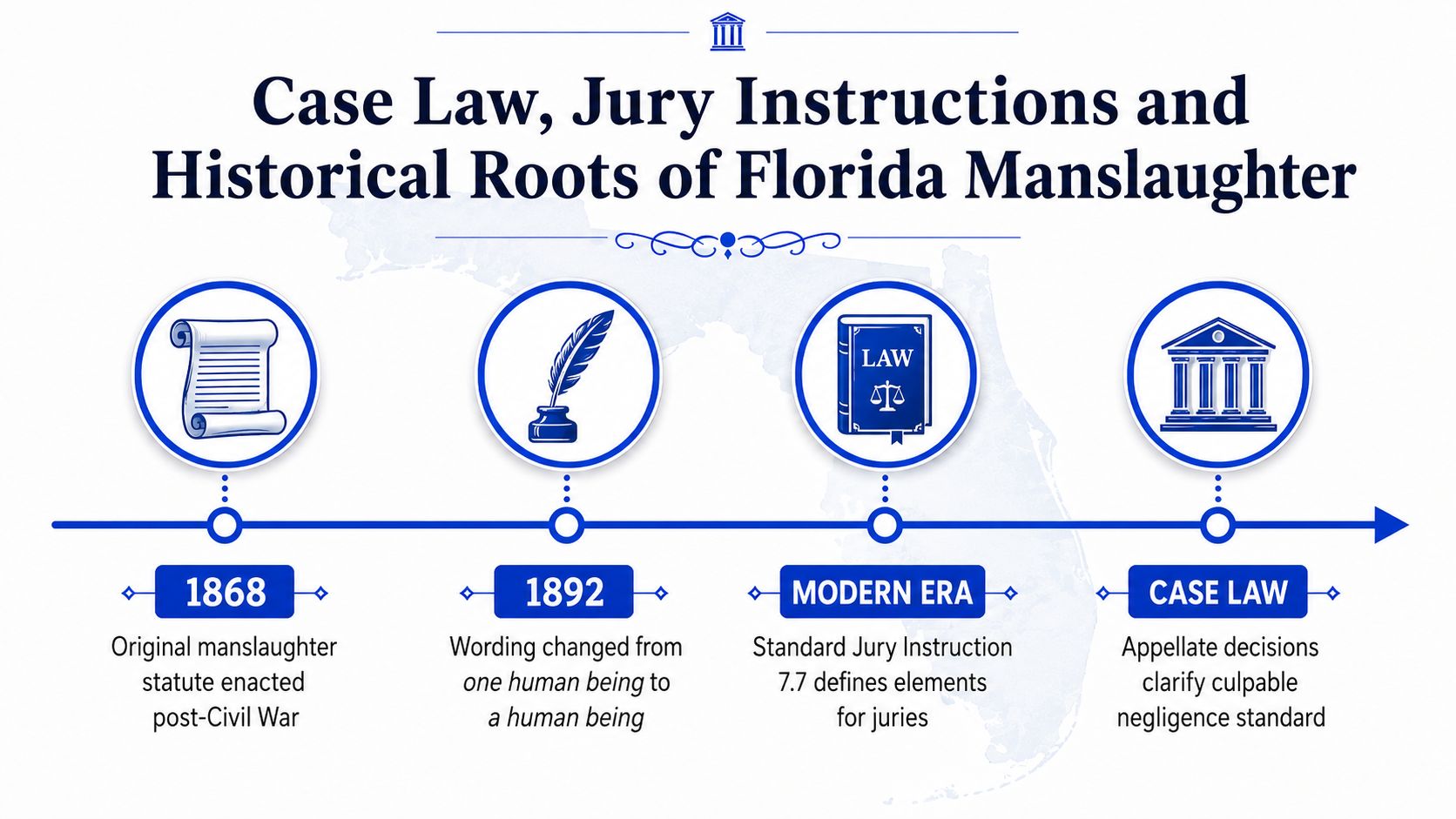
Florida's manslaughter law has unusual historical continuity. The Florida Supreme Court explained that the first manslaughter statute was enacted in 1868, using the phrase “one human being.” When Florida revised its homicide statute in 1892, the wording changed to “a human being.” The Court described the general manslaughter statute as existing in its present form since 1868, a history exceeding 150 years (Florida Supreme Court historical discussion).
Jury instructions can control the legal question
A jury doesn't decide a homicide case using ordinary moral judgment alone. The judge must explain the legal standards the jurors apply. Florida courts treat excusable and justifiable homicide concepts as critical threshold issues, and standard jury-instruction practice requires those instructions to be read in homicide cases when supported by the case.
That matters because a jury may view the same event differently depending on whether it receives a complete explanation of excuse, justification, self-defense, causation, and culpable negligence. Defense counsel can object when an instruction omits a supported theory or inaccurately frames the State's burden.
Self-defense and firearm cases
Appellate decisions continue to scrutinize whether trial judges properly instruct juries on self-defense in manslaughter-with-a-firearm cases. The issue is practical, not academic. If evidence supports a claim that the accused reasonably perceived an imminent threat, the jury may need legal guidance on how that defense interacts with the manslaughter charge.
The Florida Supreme Court's discussion of excusable homicide illustrates why jury framing deserves careful attention. A defense may challenge the State's proof of culpable negligence, dispute causation, establish justification, or show that the death falls within an excusable category.
Defense Strategies Court Procedures and Protecting Your Rights in South Florida
A manslaughter defense starts with the evidence, not a canned argument. Counsel may investigate the event independently, test the State's forensic conclusions, identify inconsistent witnesses, and examine whether police obtained statements or physical evidence lawfully.
Common defense questions
Culpable negligence: Did the conduct rise above ordinary negligence, or is the State trying to turn a mistake into a felony?
Causation: Did the accused's act legally cause the death, or did another event, medical condition, or intervening cause contribute?
Excusable homicide: Did the death occur accidentally during a lawful act performed with ordinary caution?
Self-defense: Did the accused reasonably believe force was necessary to prevent imminent death or great bodily harm?
Evidence suppression: Did officers conduct an unlawful search, seizure, interrogation, blood draw, vehicle search, or firearm examination?
Mental state: Does the evidence support manslaughter rather than murder, or does it fail to prove criminal culpability at all?
The broader framework of criminal defenses in Florida helps place these issues in context. The defense may file motions to suppress, seek additional discovery, retain experts, request appropriate jury instructions, and negotiate based on weaknesses in the proof. No lawyer can promise a particular result, but a careful defense can identify legal and factual problems before they become trial assumptions.
What the procedure may look like
A case may begin with an arrest, including a warrantless arrest related to an alleged probation violation. The person then faces first appearance and bond decisions, formal charging, arraignment, discovery, depositions or witness preparation, pretrial motions, negotiations, and trial if no resolution is reached.
In Broward County, Miami-Dade, and Palm Beach courts, timing and local procedure can affect how quickly counsel addresses evidence, release conditions, preservation requests, and expert review. A defense lawyer should also explain restrictions on contacting witnesses, travel, firearms, alcohol, and social media.
Ticket Shield, PLLC, led by former prosecutor Jason S. Goldsmith, evaluates Florida criminal cases by reviewing the State's evidence, protecting constitutional rights, and developing a defense plan for clients facing serious charges. A confidential consultation should happen before the accused gives a detailed statement or attempts to investigate witnesses personally.
Quick Reference Lookup Cross References and Next Steps for Your Case
The key Florida manslaughter statutes and related issues can be reduced to a practical checklist:
Definition: Section 782.07 addresses a killing by act, procurement, or culpable negligence, without lawful justification and not amounting to excusable homicide or murder.
General classification: Standard manslaughter is a second-degree felony with substantial prison, probation, and fine exposure.
Reclassification: Aggravated forms may become first-degree felonies when the victim falls within a protected category.
DUI cases: The alcohol threshold, testing, impairment, causation, and mandatory minimum all require separate analysis.
Defenses: Self-defense, excusable homicide, lack of culpable negligence, causation challenges, and suppression issues may change the case.
Jury instructions: The judge's legal instructions can determine whether jurors consider a supported excuse or justification.
Before a consultation, preserve photographs, messages, videos, medical records, vehicle information, witness names, insurance materials, and court paperwork. Don't delete social media, contact the family of the deceased, post about the incident, or discuss the facts with other witnesses. If police or prosecutors request an interview, ask for a lawyer first.
Families in Fort Lauderdale, Broward County, Miami-Dade, Palm Beach, and surrounding South Florida communities should also gather the arrest affidavit, charging document, bond conditions, and any probation paperwork. Those documents help counsel identify the State's theory and urgent deadlines.
Is intent required for manslaughter? Not always. Florida's statute includes act-based and culpable-negligence theories, and the State must prove the theory charged.
Can self-defense defeat manslaughter? It can, when the evidence supports the defense and the jury receives the correct legal instruction. The State must still prove an unlawful killing after properly raised issues are considered.
Does a prior record automatically determine the sentence? No. Criminal history can affect sentencing analysis and negotiations, but the outcome depends on the charge, facts, statutory rules, and court decisions.
What should I do after an arrest? Don't explain the incident publicly or to investigators without counsel. Contact a Florida criminal defense lawyer promptly and preserve evidence.
If you or a loved one is facing a manslaughter, DUI manslaughter, violent-crime, weapons, or probation-related investigation in South Florida, early advice can protect important rights and preserve defenses.
Ticket Shield, PLLC offers confidential consultations for people facing Florida manslaughter charges, including cases involving alleged culpable negligence, self-defense, firearms, fatal collisions, and DUI-related allegations. Visit Ticket Shield, PLLC to discuss the evidence, court process, and immediate steps with a defense team serving Broward County and surrounding Florida communities.