
What Is Attempted Manslaughter: Florida Legal Guide
Jason Goldsmith, Esq
A heated argument can turn into a criminal case before anyone has time to calm down, call a lawyer, or explain what really happened. If you're searching for what is attempted manslaughter, you're probably dealing with fear, confusion, and a stack of questions about arrest, bond, court dates, and whether the charge even makes legal sense.
In Florida, people often hear labels like attempted manslaughter, attempted murder, aggravated assault, or domestic violence and assume they all mean the same thing. They don't. The difference often comes down to intent, the actual act, and whether the law sees the conduct as a near-fatal step or something less serious. That distinction matters in Broward County, Fort Lauderdale, Miami-Dade, Palm Beach, and throughout South Florida because it affects how prosecutors charge the case, what the judge sees at arraignment, and what defense counsel can attack early.
Table of Contents
Understanding Attempted Manslaughter in Florida
A person charged with attempted manslaughter in Florida is usually facing an allegation that a confrontation went far beyond ordinary violence. The State's theory is that the accused took a direct step toward a killing, but the facts do not fit a completed homicide, and the mental state is not treated the same way as attempted murder. In plain English, prosecutors are saying the case involved an almost-deadly act, but the law sees the blameworthiness differently.
Why this charge confuses people
The phrase itself sounds simple, but the legal meaning isn't. People often think “attempted manslaughter” just means “trying to kill someone,” yet Florida-style instructions can allow the charge without proving a separate intent to kill in the way attempted murder requires. That's why defense lawyers focus on what happened, what was said, what weapon or force was used, and whether the State can show a real step toward death rather than a heated argument or reckless conduct.
Practical rule: If the facts stop at anger, threats, or a scuffle, the charge may be overstated. The State still has to connect the conduct to a near-fatal act.
For families in Fort Lauderdale, Pembroke Pines, Hollywood, or anywhere in Broward County, the first reaction is often panic. The better approach is to slow the case down, preserve the evidence, and make the State prove every piece of its theory. That can shape bond, arraignment strategy, and whether the charge belongs in a homicide category at all.
Defining Attempted Manslaughter Under Florida Law
Florida does not define attempted manslaughter by borrowing the federal rule in 18 U.S.C. § 1113. In a Florida case, lawyers usually have to read the charge through the state's attempt statute, § 777.04, together with the manslaughter statute, § 782.07. That matters because Florida juries are instructed on the crime from those state provisions, and the wording of the instruction can shape whether the facts look like an attempted killing, a reckless act, or something less serious. For a Florida-specific overview of how practitioners describe the charge, see the Florida manslaughter practice page.
A Broward County case often turns on a simple but hard question. Did the person only engage in a heated encounter, or did the person cross into conduct that the law can treat as an attempted homicide offense? Defense lawyers in Fort Lauderdale and the rest of South Florida focus on that line early, because it affects bond arguments, charging decisions, and the way the jury instruction should be framed if the case goes to trial.
Where the label fits and where it doesn't
The phrase attempted manslaughter is awkward because Florida law does not use it the same way people use everyday language. In practice, the label is usually discussed in connection with an attempt theory and a manslaughter theory, not as a simple synonym for “almost killed someone.” That distinction matters in Florida because the jury may hear language about a substantial step, but the charge still has to fit the state statutes and the facts proved in court. Florida courts and practitioners often focus on whether the conduct belongs in a homicide category at all, or whether it is really better described as aggravated assault, battery, or another lesser offense.
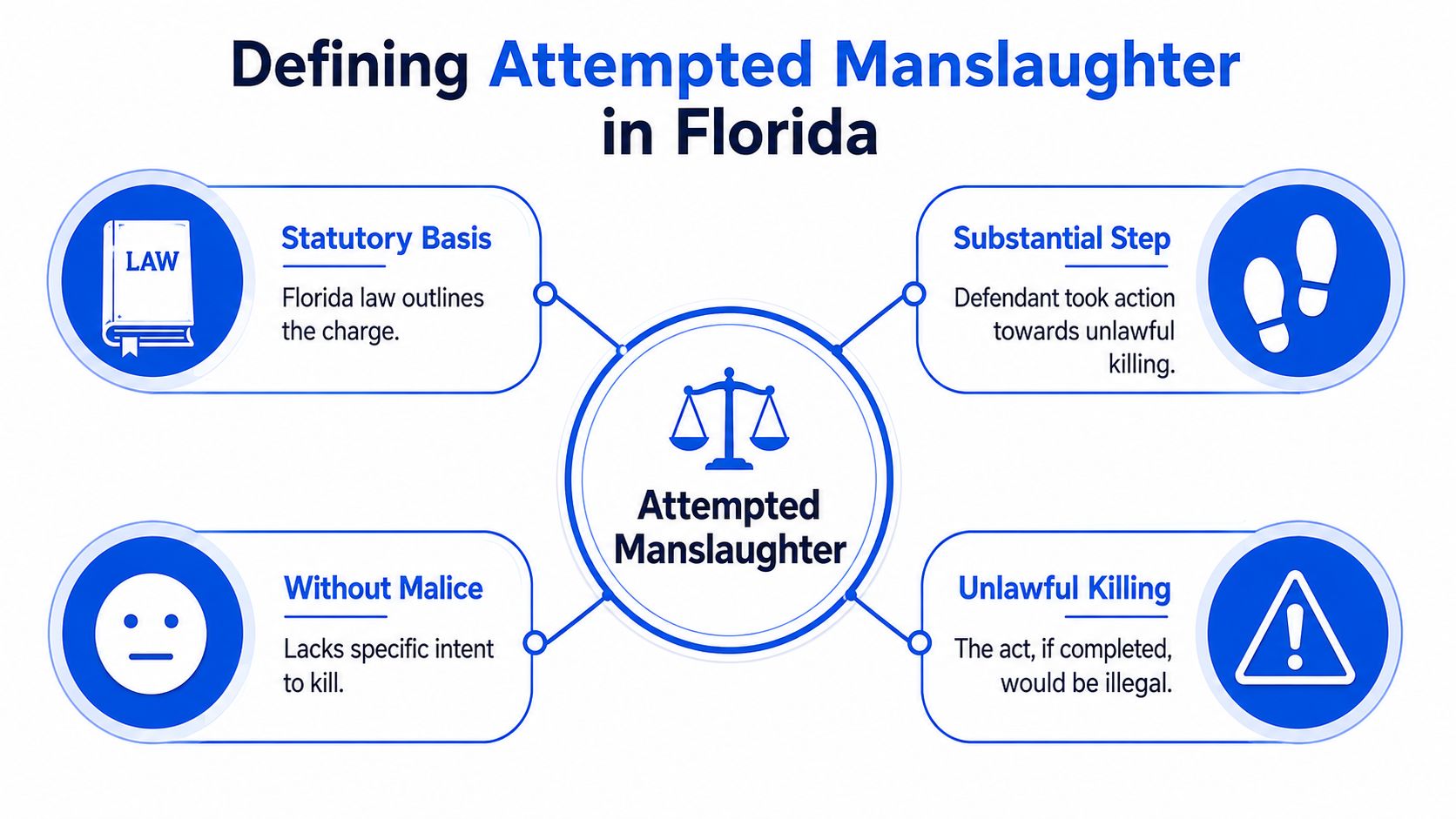
The Florida instruction issue is where many families get confused. A charge can sound like “almost murder,” yet the legal analysis still depends on what the prosecutor can prove about the act, the surrounding facts, and the mental state the jury is told to look for. If the evidence shows a sudden fight, a weapon displayed without a clear move toward death, or a shooting argument that never resulted in a direct lethal act, the defense will often argue that the State is stretching the label beyond what the statute and jury instructions allow.
The state-law framework is the key point. Florida practitioners usually treat the charge as a question of whether the accused crossed from preparation into an act that the law can view as part of an attempted unlawful killing, while still recognizing that the completed offense would have been manslaughter rather than murder. For a closer look at how Florida attorneys describe that distinction in practice, the Florida manslaughter practice page is a useful starting point.
Legal Elements and Mens Rea Requirements
The legal fight in these cases usually turns on two things, the act and the mental state. In jurisdictions that recognize attempted manslaughter, the charge still requires a direct act toward causing death even if the underlying completed offense would have involved recklessness or heat of passion. Federal Criminal Defense Advocates on attempt, murder, and manslaughter
What prosecutors have to show
The proof usually centers on a small set of facts:
An act that moved beyond preparation: Talking about violence is not the same as taking a step that could have caused death.
A link between the act and possible death: The conduct has to be close enough to a killing that the law treats it as an attempt.
A mental state that explains the charge: In Florida-style instruction, that mental state may be different from attempted murder, which is why the charge can be argued in provocation cases.
A factual basis showing blameworthiness lower than murder: That's where defense counsel may push for a lesser offense.
A useful analogy is a relay race. Holding the baton and lining up for the exchange is preparation. Reaching the exchange point and extending the hand at the exact moment of handoff is the completed move. Attempt law focuses on that second stage, the point where the person has crossed from planning into a decisive act.
Why intent fights matter so much
Florida defense work often starts with a simple question, did the person mean to kill, or did the person act recklessly, impulsively, or defensively? That question can determine whether the case belongs in homicide law at all. If the evidence shows injury risk but not a lethal act, the defense may argue the facts fit aggravated assault or another non-homicide offense instead.
The earliest motions often aim at the gap between what happened and what the State says happened.
That gap matters because prosecutors can overcharge when the scene was chaotic. A split-second decision in a fight can look different after the fact than it did in the moment, and a careful attorney will use that difference to challenge the State's theory.
Differences Between Attempted Manslaughter and Similar Charges
The biggest source of confusion is the line between attempted manslaughter, attempted murder, and non-homicide offenses like aggravated assault. Public discussions often flatten them into “someone tried to kill somebody,” but the legal test is more technical than that. Florida instructions may allow attempted manslaughter without proving intent to kill, while attempted murder usually depends on a stronger intent theory. Reddit discussion on Florida-style attempted manslaughter instructions
Side-by-side differences that matter
Charge | What the State focuses on | Mental state issue | Why it matters |
|---|---|---|---|
Attempted manslaughter | A direct act toward a killing | Can be argued without the same specific intent to kill as attempted murder | Often appears in provocation or heat-of-passion situations |
Attempted murder | A direct act toward killing | Stronger intent theory | Usually the harsher homicide attempt theory |
Voluntary manslaughter | Completed killing | Heat of passion or sudden quarrel | It is a completed death, not an attempt |
Why prosecutors pick one charge over another
The choice often depends on the facts they think they can prove. If the evidence suggests a heated confrontation but not a cold, deliberate plan, the State may lean on a lesser homicide theory. If the facts point to a targeted attack and a clear intent to kill, the charge can shift toward attempted murder.
For readers comparing this to assault cases, the difference is not just about injury. It is about how close the act came to death and whether the evidence supports a homicide frame at all. A defense lawyer handling a Broward County case may also compare the homicide charge to Florida aggravated assault law to argue that the State has charged too high.
Florida Case Examples and Court Procedures
A common Broward County sequence starts with a fight in Fort Lauderdale, an arrest after witnesses call police, and a booking photo before the defendant ever sees a judge. From there, the case usually moves to bond review, arraignment, discovery, and pretrial hearings. In Miami-Dade and Palm Beach, the rhythm is similar, even if courtroom calendars and local procedures differ.
What a real courthouse path can look like
At the first court appearance, the judge looks at the charge, the bond recommendation, and any safety concerns. Defense counsel then begins requesting discovery, reviewing witness statements, and checking whether the conduct was capable of producing death. That last point matters because the doctrine requires the plan and means to be objectively capable of producing death. If the conduct was not life-threatening, the act may fall outside attempted homicide altogether. Iberley on attempted homicide doctrine
A charge can sound severe and still be legally weak if the facts do not support a true lethal attempt.
After arraignment, the file usually moves into negotiations and motion practice. A defense lawyer may file a motion to dismiss, push for better discovery, or challenge the State's characterization of the event. In South Florida, those early moves matter because the case can change shape long before trial if counsel exposes problems with the evidence or the charging theory.
Typical Penalties and Common Defenses
Florida penalties are tied to the charge as it is filed under attempt and the underlying manslaughter statute, not to a federal example. In a Florida case, that usually means the court looks at the second-degree felony range and the facts the prosecutor says show a real attempt to commit the offense. For many defendants, that matters more than the label on the arrest report, because the label can sound final even while the legal fight is still about what the evidence proves.
Defense themes that often matter most
No direct step: The conduct may have been threatening, but still short of a true attempt under Florida law.
No proof of a lethal act: The State may prove a fight or injury, not conduct showing a genuine attempt to cause death.
Heat of passion or provocation: The facts may point to a sudden argument or emotional flare-up, which can affect how the charge is evaluated.
Self-defense: The accused may have acted to stop an imminent threat. For a plain-language overview, see Florida justifiable homicide guidance.
Wrong charge, wrong label: The facts may fit aggravated assault or another offense instead of an attempted homicide theory.
Florida jury instructions matter here because they shape what jurors are told to look for. In Broward County, for example, a defense lawyer may focus on whether the State can prove the specific intent element the instruction requires, not just that a violent event happened. That distinction is like separating a shouted threat from a completed act. The first can support a charge, but it does not automatically prove attempted manslaughter.
How defense lawyers use the charge itself
The charge affects bargaining pressure. If the evidence points to a lesser offense, defense counsel can press for reduction before the case hardens into a trial posture. That can change bond terms, court dates, and what the client has to explain to family, employers, or landlords.
A Florida defense lawyer also looks at procedure, not just the headline charge. In South Florida courts, that often means checking whether the arrest affidavit matches the State's theory, whether the discovery supports the jury instruction the prosecutor wants, and whether a lesser-included offense fits the facts better than attempted manslaughter. In Broward, Miami-Dade, and Palm Beach cases, those early decisions can shape how the case is framed long before a jury ever hears it.
One option for people facing this kind of accusation is to work with a Florida criminal defense firm that handles violent felony cases and communicates directly with clients throughout the process. Ticket Shield, PLLC does that work statewide, including Broward County and South Florida courts. The value of that kind of representation is not a promise of a result, it is having a lawyer who can read the charging document, spot weak points in the State's theory, and respond quickly while the case is still fluid.
Next Steps After an Attempted Manslaughter Arrest
The first move is to protect the case, not to explain it on your own. Don't give statements to police, don't post details online, and don't assume the paperwork will “clear itself up.” Collect names, texts, photos, video, and anything that shows what happened before and after the incident.
Then focus on bond, arraignment, and discovery. If you're helping a loved one, this guide to how to bail someone out can help you understand the early release process, but the bigger priority is setting up a defense review right away.
The sooner a lawyer can review the scene, the witness list, and the police narrative, the more options usually exist.
Bring every document to your consultation, including the arrest paperwork and any no-contact order. If the case is in Broward, Miami-Dade, or Palm Beach, clear communication with counsel matters because early deadlines can shape the rest of the case.
Frequently Asked Questions
How long does an attempted manslaughter case take?
It depends on discovery, motions, bond conditions, and whether the case resolves or goes to trial. Some cases move quickly, others take much longer if the facts are disputed.
Can a juvenile face this kind of charge?
Yes, juveniles can face serious violent allegations, and the court process can be different from adult court. The exact path depends on the charging decision and the age of the accused.
Will it show up on a background check?
A criminal charge can appear on background checks, and a conviction can create long-term record problems. That's why people often ask about sealing or expungement after the case ends, depending on the outcome.
Can I seal or expunge the record later?
Sometimes, but not always. The outcome of the case matters, and so does the specific charge. A lawyer can tell you whether record relief is even available once the matter is resolved.
Should I talk to police before hiring counsel?
No. Speak to counsel first. Even a short statement can change how prosecutors frame intent, self-defense, or causation.
If you're facing an attempted manslaughter charge in Fort Lauderdale, Broward County, or anywhere in South Florida, Ticket Shield, PLLC can review the arrest, explain the charge in plain English, and build a defense plan around the facts that matter. Visit Ticket Shield, PLLC to request a confidential consultation and get help before the case moves another step forward.