
Improper Exhibition of a Firearm in Florida Explained
Jason Goldsmith, Esq
Improper exhibition of a firearm in Florida is a first-degree misdemeanor when someone displays a firearm in a rude, careless, angry, or threatening manner in front of others. Unless the display was necessary self-defense, the charge can carry up to 1 year in jail and a $1,000 fine.
A heated road-rage encounter on a Fort Lauderdale street can change quickly. Someone lifts a shirt to reveal a holstered pistol, raises a firearm during an argument, or moves a weapon where a neighbor can see it. Nobody fires a shot, yet police may still make an arrest and prosecutors may file an improper exhibition charge.
That reaction often leaves first-time defendants confused. They may ask, “Wasn't I legally allowed to possess the gun?” or “How can showing a holstered firearm be a crime?” The answer usually depends on how the weapon was displayed, what witnesses observed, and whether the circumstances support necessary self-defense.
This distinction matters throughout Broward County, Fort Lauderdale, Miami-Dade, Palm Beach, and the rest of South Florida. The charge isn't merely about the presence of a firearm. It concerns conduct and context. The State must prove specific elements, and the defense can challenge the reliability of witnesses, video interpretations, police reports, and the decision to search or arrest.
Ticket Shield, PLLC, led by former prosecutor Jason S. Goldsmith, approaches weapons cases by examining how prosecutors build their theory and where that theory may fail. If you're looking for a Florida weapons defense lawyer, understanding the statute is the first step toward making informed decisions.
Table of Contents
Introduction to Improper Exhibition of a Firearm in Florida
A typical case may begin with an argument outside a business, in a parking lot, or during a traffic dispute. One person says the other reached toward a waistband. Another says a shirt was lifted and a gun became visible. A third witness may remember only that people were yelling and that a firearm appeared briefly.
Those accounts don't automatically establish guilt. They do explain why law enforcement treats the situation seriously. Florida law reaches certain displays even when no one is shot, struck, or physically injured because displaying a weapon during an angry or threatening encounter can escalate a conflict and place another person in fear.
The legal question isn't just whether you owned, carried, or possessed the firearm. Florida's improper exhibition statute focuses on the manner of exhibition and whether another person was present. A lawful owner can still face a charge if the State claims the display was rude, careless, angry, or threatening. At the same time, a visible firearm isn't automatically improper exhibition. Prosecutors must prove the required elements beyond a reasonable doubt.
Why the surrounding circumstances matter
The same movement can look different depending on what happened before and after it. Reaching toward a firearm after a verbal disagreement may be described as threatening. Showing a firearm while responding to an immediate danger may support a self-defense argument. A witness who saw only the final seconds may not know what prompted the display.
That makes early evidence important. Surveillance footage, doorbell video, 911 recordings, body-camera footage, text messages, and witness accounts can establish the timeline. They may show whether the accused initiated the confrontation, whether another person made a threat, and whether the weapon was displayed at all.
This guide explains Florida Statute 790.10 in plain English, identifies the three proof elements, distinguishes the charge from related gun offenses, and outlines defenses that may apply. It also explains what someone arrested in Broward County should do before making statements or consenting to additional searches.
What Florida Law Says About Improper Exhibition
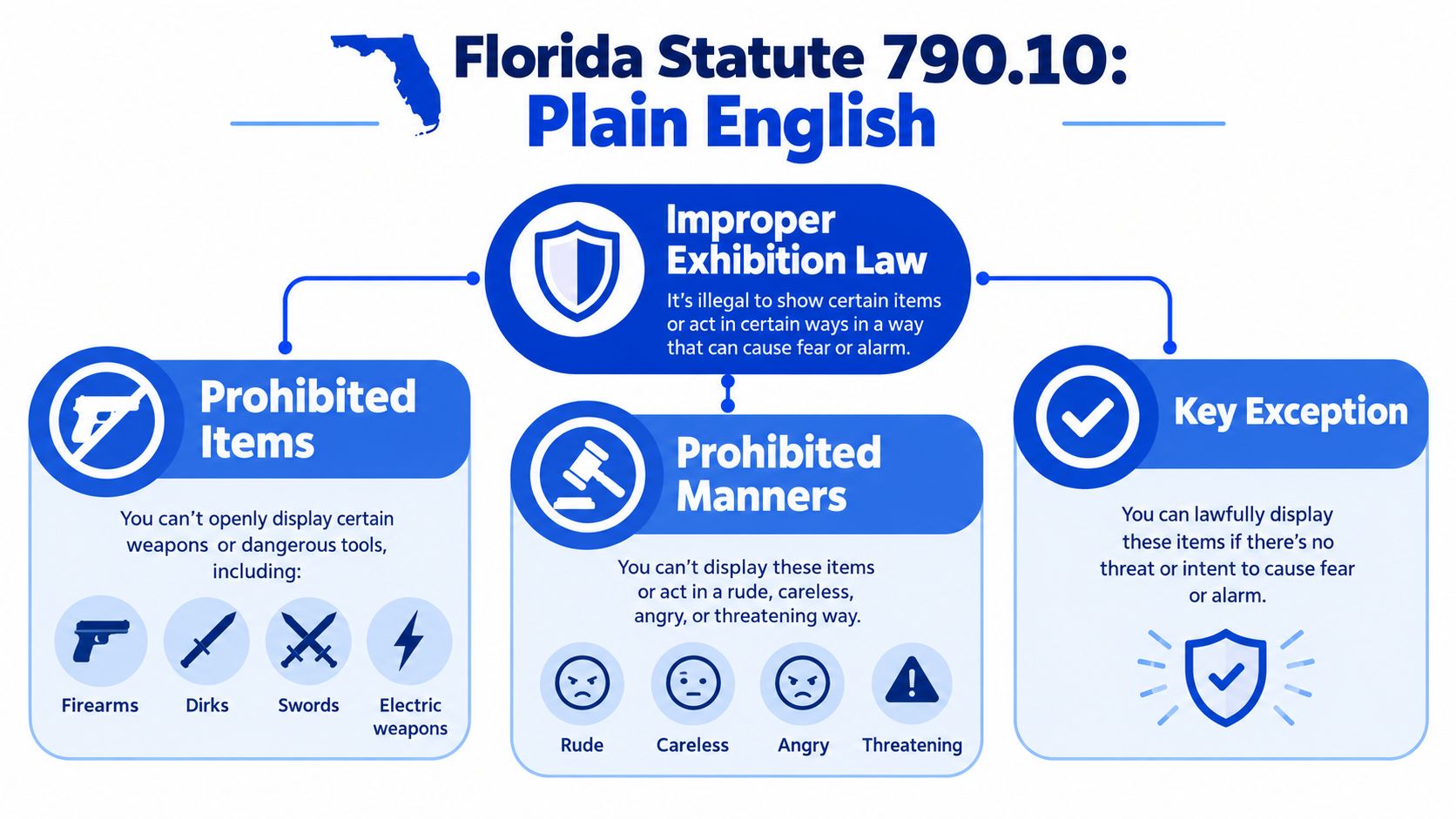
Florida Statute 790.10 makes it a first-degree misdemeanor to carry or possess certain weapons and exhibit them in the presence of one or more people in a rude, careless, angry, or threatening manner, unless the display was necessary self-defense. The current statutory text covers firearms and several other categories, including dirks, swords, sword canes, electric weapons or devices, and other weapons. The Florida statute on improper exhibition provides the operative language.
Whoever, having or carrying any dirk, sword, sword cane, firearm, electric weapon or device, or other weapon, exhibits the same in the presence of one or more persons in a rude, careless, angry, or threatening manner, and not in necessary self-defense, shall be guilty of a misdemeanor of the first degree.
That sentence contains several separate ideas. Breaking them apart helps explain why prosecutors and defense lawyers focus so closely on the facts.
The weapon must fall within the statute
The law isn't limited to a particular handgun or rifle. It reaches the listed weapons and other weapons covered by the statute. The issue isn't limited to whether the item was loaded or fired. The State's theory generally concerns the accused's possession or carrying of the item and the way it was exhibited.
The manner of display is central
The words rude, careless, angry, or threatening describe conduct, not ownership. A prosecutor may argue that a person pointed a weapon, lifted clothing to reveal it during an argument, waved it, or otherwise displayed it in a way that communicated hostility or created an unreasonable risk.
Context matters. A firearm secured in a holster during lawful activity may not present the same facts as a weapon revealed during a confrontation. A jury may consider statements, gestures, distance, movements, tone, and what happened immediately before and after the display.
Florida has treated this offense as a distinct weapons charge for many years. The statute was enacted in 1897 and carried forward through later recodifications, including amendments noted in 1969 and 1971, as reflected in the statutory history for Florida Statute 790.10. A 1985 Florida Supreme Court decision also recognized improper exhibition as a lesser included offense in a homicide case, confirming that the offense had an established place in Florida criminal law.
For residents of Broward County, Miami-Dade, and Palm Beach, the practical lesson is straightforward. Lawful possession doesn't answer the entire case. The court will examine the display, the setting, the witnesses, and any claim that the conduct was necessary self-defense.
Readers who want to understand the broader rules governing firearm possession and carrying can also review this explanation of Florida Statute 790.06 and concealed weapon licensing.
Elements Prosecutors Must Prove Beyond a Reasonable Doubt
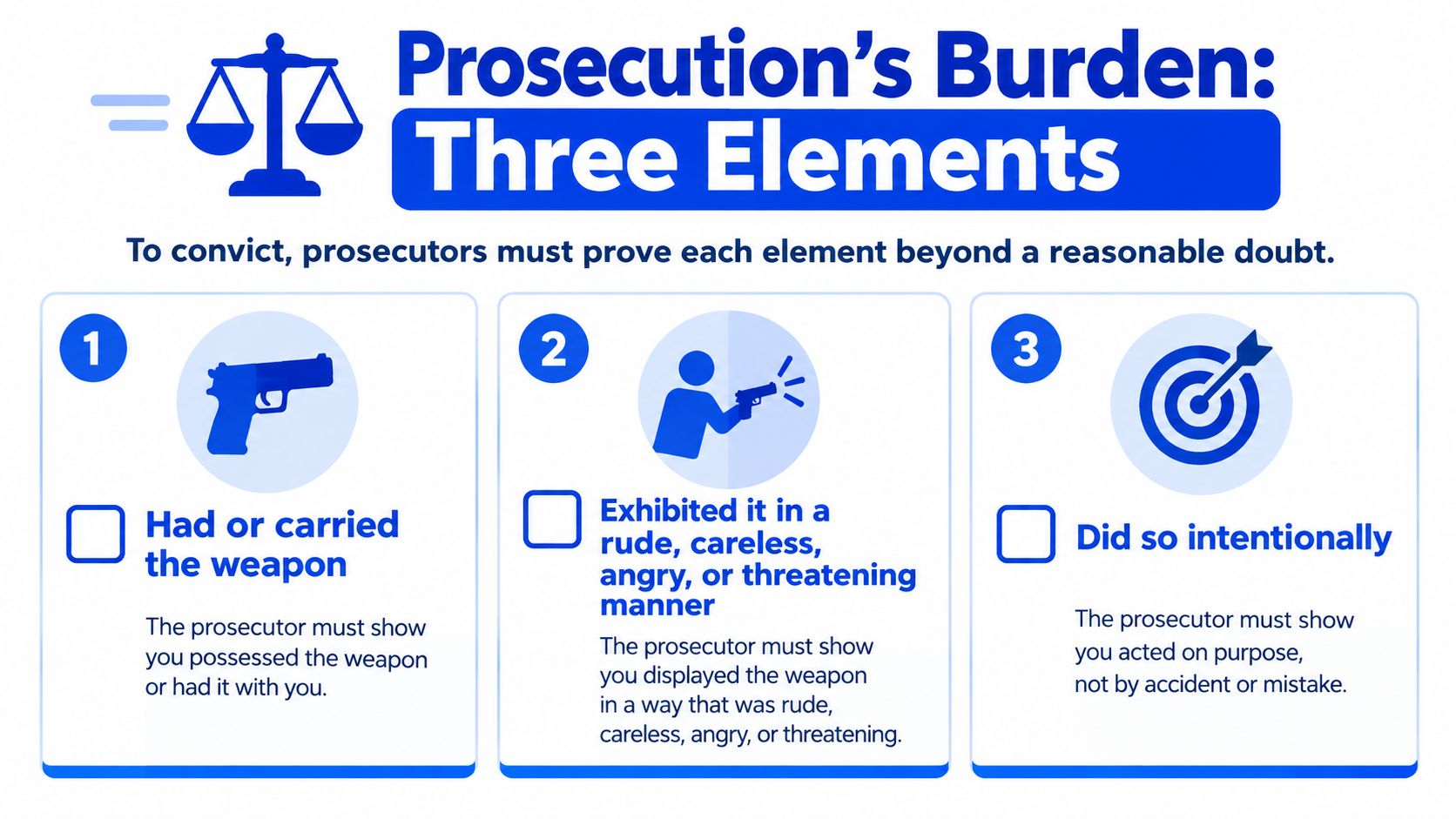
The standard Florida jury instruction identifies three elements the State must prove beyond a reasonable doubt. These requirements keep the case focused. The prosecutor can't obtain a conviction merely by showing that the defendant owned a gun or that someone felt uneasy.
The defendant had or carried the weapon.
The defendant exhibited it in a rude, careless, angry, or threatening manner.
The display occurred in the presence of one or more people.
The Florida Bar jury instruction for improper exhibition frames these elements as matters for the State to prove. Each one can become a contested issue at trial.
Possession or carrying
This element usually concerns whether the accused had the firearm or another listed weapon. Police reports may rely on an officer's observation, a witness's description, photographs, or the location where the weapon was found. A defendant's statement can also become evidence, which is one reason casual explanations to officers can create problems.
The defense may challenge the identification of the object, the reliability of the observation, or the legality of the search that produced the firearm. If the police found the weapon after an unlawful detention or search, a suppression motion may affect whether the State can use it.
The manner of exhibition
This is often the most disputed element. Witnesses may agree that a gun was present but disagree about what the accused did. One person may describe a threatening display. Another may say the defendant merely adjusted clothing or moved away from a confrontation.
Body-camera video, surveillance footage, 911 calls, photographs, and text messages can help test those accounts. Prosecutors may use the defendant's words, gestures, tone, and movements to argue that the display was angry or threatening. The defense may show that the video doesn't support the witness's description, that the witness couldn't see clearly, or that the display occurred while the defendant responded to an immediate danger.
Presence of another person
The statute requires the exhibition to occur in the presence of one or more people. The State may rely on an alleged victim, a bystander, a responding officer, or a recorded call. A defense lawyer should examine whether the witness observed the firearm, whether the person was close enough to see the conduct, and whether later statements changed.
Practical rule: A charge is not proof that every element can be established. The State still carries the burden from beginning to end.
How Improper Exhibition Compares to Related Weapons Charges
People often use “brandishing” as a general description, but Florida prosecutors must select a specific offense. Improper exhibition focuses on the display and its manner. Other charges may require proof of a threat, an underlying felony, a prohibited location, or the firing of a weapon.
The distinctions can affect whether a case is filed as a misdemeanor or felony and what evidence becomes important.
Charge | Key Conduct Required | Classification |
|---|---|---|
Improper exhibition | Possessing or carrying a listed weapon, displaying it in a rude, careless, angry, or threatening manner, and doing so in another person's presence | First-degree misdemeanor |
Aggravated assault with a firearm | Alleged intentional threat of violence creating a well-founded fear of imminent harm, involving a firearm | Felony offense |
Weapon during commission of a felony | Possessing or using a firearm while committing a qualifying felony | Felony-related offense with potentially severe consequences |
Open-carry violation | Carrying a firearm in a manner prohibited by a particular statute or applicable legal rule | Depends on the alleged conduct and charge |
Discharging a firearm in public | Firing a weapon in a prohibited or unlawful public setting | Classification depends on the applicable statute and facts |
The table isn't a charging prediction. A prosecutor may file more than one count when the facts support separate theories. In other cases, the State may use improper exhibition as a lesser included offense or alternative theory. Florida's judicial history recognizes the offense as distinct from possessing a firearm.
Why the distinction matters
A person accused of improper exhibition shouldn't assume the case is equivalent to aggravated assault. The State must prove different facts for each offense. Conversely, a misdemeanor label doesn't make the matter harmless. A conviction can affect a criminal record, employment, firearm-related rights, and future charging decisions.
The best defense analysis starts with the actual charging document and evidence, not a description used during an arrest. A person facing a felony weapons charge in Florida needs counsel to examine whether the allegations support the charged offense, a lesser offense, or no conviction at all.
Penalties and Collateral Consequences in Florida
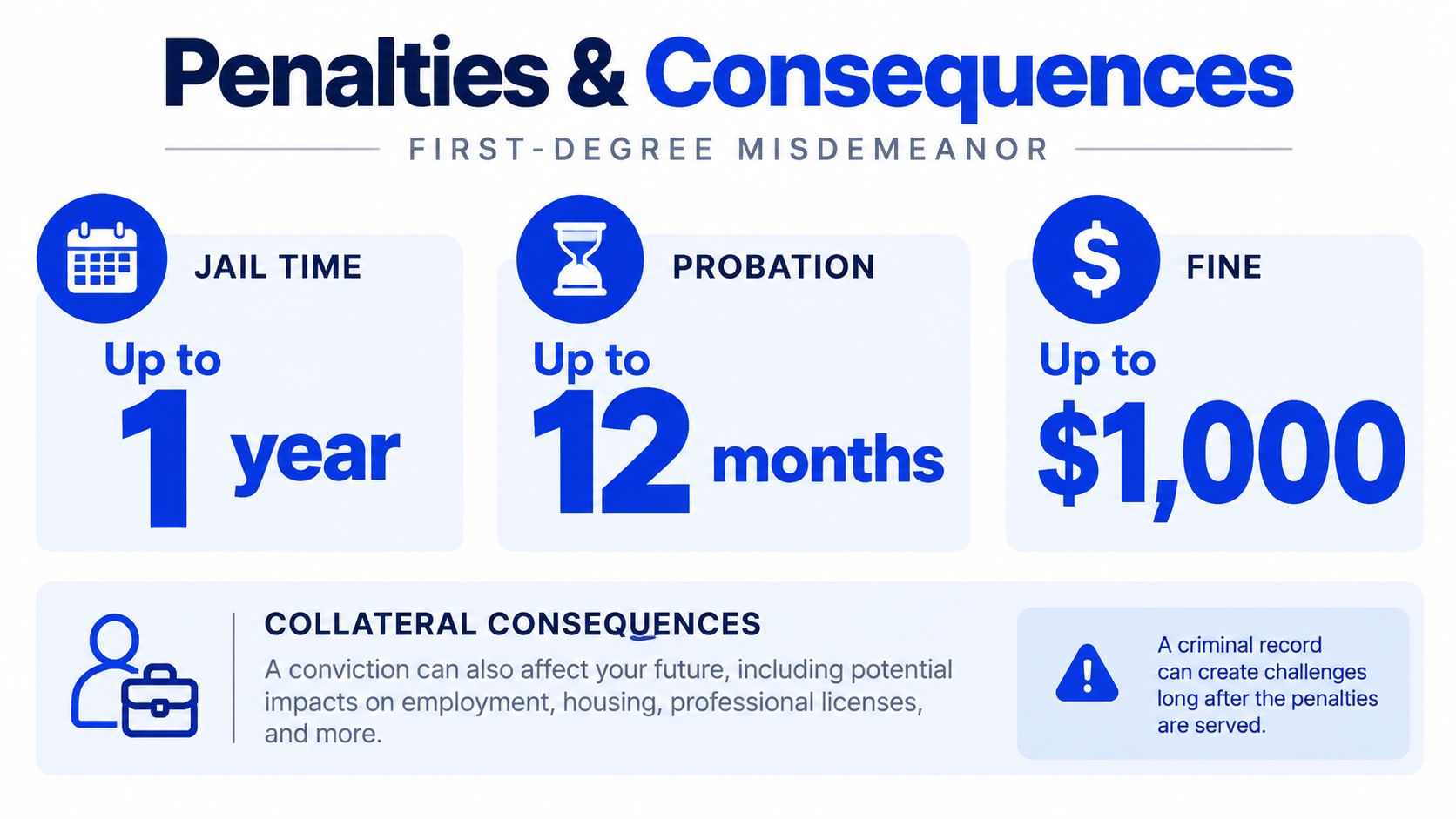
Improper exhibition is a first-degree misdemeanor, not a felony. Florida's standard first-degree misdemeanor exposure is up to 1 year in jail or 12 months of probation and a fine of up to $1,000, as summarized in the Florida penalty reference for improper exhibition.
Those are maximum statutory consequences, not an automatic sentence. A judge may consider the facts of the incident, criminal history, compliance with release conditions, injuries or threats alleged by the State, and the defendant's presentation in court. A negotiated resolution may involve a reduction, dismissal, diversion, probation, or another outcome, but no attorney can guarantee a particular result.
A misdemeanor conviction can follow you
The direct sentence is only part of the concern. A conviction may create a lasting criminal record that appears during employment, housing, licensing, and background-check reviews. Firearm-related consequences can also become important, particularly for someone who carries a weapon for work, owns firearms, or expects to apply for a concealed-carry license.
Immigration consequences require separate care. Even a misdemeanor can create problems depending on a person's status, prior record, and the precise disposition. Anyone who isn't a United States citizen should consult criminal defense counsel and qualified immigration counsel before accepting a plea.
A conviction may also influence how prosecutors view later allegations. Future weapons, domestic violence, violent crime, or probation cases can become more difficult when the record contains a prior firearm-related offense. That doesn't mean a prior conviction automatically determines the next case. It does mean the present charge deserves a defense aimed at protecting more than just the immediate court date.
Release conditions and civil consequences
An arrest may also lead to no-contact conditions, restrictions on returning to a location, or separate proceedings affecting firearm access. Those matters can move on a different track from the criminal prosecution. A defense lawyer should identify each active order and explain what conduct could create a new violation.
Legal Defenses and Why Evidence Matters Early
A defense begins with the facts, not a checklist. Necessary self-defense may exclude conduct from the statute when the display occurred in response to an immediate threat. The analysis can turn on who started the confrontation, what the accused reasonably perceived, how close the other person was, and whether the firearm was shown to stop danger rather than intimidate.
Other defenses may focus on the State's failure to prove the manner of exhibition. A person may have lawfully carried a firearm without displaying it in a rude, careless, angry, or threatening way. An accidental exposure, a clothing adjustment, or a movement misinterpreted by a witness can create reasonable doubt.
Common factual and constitutional challenges
Self-defense: The firearm was displayed because the accused faced an immediate threat and the action was necessary for protection.
No improper manner: The evidence shows possession or visibility, but not a rude, careless, angry, or threatening display.
Mistaken identity: The witness or video doesn't reliably establish who held or displayed the weapon.
Contradictory accounts: Witness statements, 911 calls, body-camera footage, or surveillance video conflict with the allegation.
Illegal search or detention: Officers obtained the firearm or statements after violating constitutional protections.
Incomplete timeline: The State presents the final moments but omits threats, pursuit, physical aggression, or other events that explain the display.
A lawful license or lawful ability to carry may provide context, but it doesn't automatically defeat an improper exhibition charge. The question remains whether the State can prove the specific conduct alleged. Conversely, an officer's belief that a firearm was displayed improperly doesn't eliminate the need to test the stop, search, seizure, and identification evidence.
Why the first hours matter
Video systems overwrite footage. Witnesses forget details or speak with other participants. Social-media posts and text messages can be misunderstood when removed from their original context. A lawyer may need to send preservation requests, identify surveillance locations, obtain dispatch records, and reconstruct the timeline before evidence disappears.
Don't explain the incident to police, the alleged victim, or witnesses without legal advice. Don't consent to a search just because an officer asks. If the search or seizure was unlawful, a defense attorney may evaluate a motion to suppress evidence.
The following video provides general educational background and isn't a substitute for advice about a specific arrest:
What to Do If You Are Charged in Broward County and South Florida
The first priority is to stop making the case harder. Don't discuss the facts with police, the complainant, witnesses, or people posting about the incident online. Ask for a lawyer and use your right to remain silent.
A practical response plan
Protect your silence: Give basic identifying information when required, then avoid explaining the firearm, the argument, or your intent before speaking with counsel.
Don't consent to searches: State calmly that you don't consent. Never physically resist an officer, but preserve the issue for your attorney.
Write a private timeline: Record what happened before, during, and after the display, including names, locations, threats, injuries, and possible cameras.
Preserve evidence: Save messages, photographs, receipts, location information, and contact details for witnesses. Don't delete or edit anything.
Contact defense counsel quickly: Early counsel can examine probable cause, release conditions, evidence preservation, and potential defenses before positions harden.
In Broward County, a case may move from arrest or charging to an initial appearance, arraignment, pretrial hearings, negotiations, motion practice, and trial if necessary. Depending on the evidence and the defendant's history, counsel may pursue dismissal, diversion, reduction, or a contested hearing. The correct path depends on the discovery and the legal weaknesses in the State's case.
A Broward County criminal defense attorney can also explain how local court procedures affect timing and appearances. South Florida cases often involve multiple witnesses, business surveillance, traffic cameras, 911 recordings, and body-camera evidence, so preserving the complete record matters.
Ticket Shield, PLLC provides confidential consultations and direct attorney communication for people facing improper exhibition and other Florida weapons charges. Visit Ticket Shield, PLLC to request an early case evaluation in Broward County, Fort Lauderdale, Miami-Dade, Palm Beach, or elsewhere in Florida.