
What Is Justifiable Homicide in Florida? a Clear Guide
Jason Goldsmith, Esq
A knock on the door after a shooting, a phone call that your son or husband has been arrested, or a detective asking for “your side” can leave you shaking and unsure what to say. In that moment, people often hear the phrase justifiable homicide and assume it means the same thing as self-defense, immunity, or “the police will figure it out.” In Florida, those are different legal ideas, and the differences matter fast.
If you're in Broward County, Fort Lauderdale, Miami-Dade, Palm Beach, or anywhere in South Florida, the first question is usually simple: did the law treat the force as a narrow legal exception, or as a crime that just hasn't been charged yet? A defense lawyer has to answer that by looking at the facts, the timeline, and the words said in the first hours after the incident. That's especially true in violent-crime cases, where the State may build its theory long before a family understands what happened. violent-crimes practice area
Table of Contents
What Justifiable Homicide Really Means in Florida
The cleanest way to understand what is justifiable homicide is to start with what it is not. It is not a moral verdict, and it is not a blanket license to use deadly force whenever someone feels threatened. It is a narrow legal result that removes criminal liability only when the facts fit a recognized justification. Under the U.S. Uniform Crime Reports definition, the category is tiny compared with all homicide totals, which is one reason the law treats it as an exception, not a general rule FBI expanded homicide reporting.
For a frightened family member, the practical question is usually this. Did the person act within the law, or are they about to be treated like a homicide defendant? That distinction matters because justification can erase criminal liability, while an acquittal is only the result of a trial or hearing. Florida also has pre-trial immunity rules in some self-defense cases, so a lawyer has to know whether the issue is justification, immunity, or a jury fight later.
Practical rule: the first version of the story often becomes the hardest one to change later.
A lot of confusion comes from the public use of the words “self-defense” and “justifiable homicide” as if they mean the same thing in every setting. They don't. One is a broad lay phrase, the other is a legal conclusion reached only after the facts line up with a narrow category recognized by law Cornell Legal Information Institute on justifiable homicide. That's why a defense lawyer will care about who started the confrontation, whether danger was immediate, and whether anything happened after the threat had already passed.
The FBI's own crime-reporting definition is even narrower for reporting purposes. It historically counted justifiable homicide as the killing of a felon by a peace officer in the line of duty or the killing of a felon during the commission of a felony by a private citizen FBI murder topic page. That reporting category is not the full Florida defense, but it shows why the public's language and the legal system's language often don't match.
The Legal Definition and Core Elements
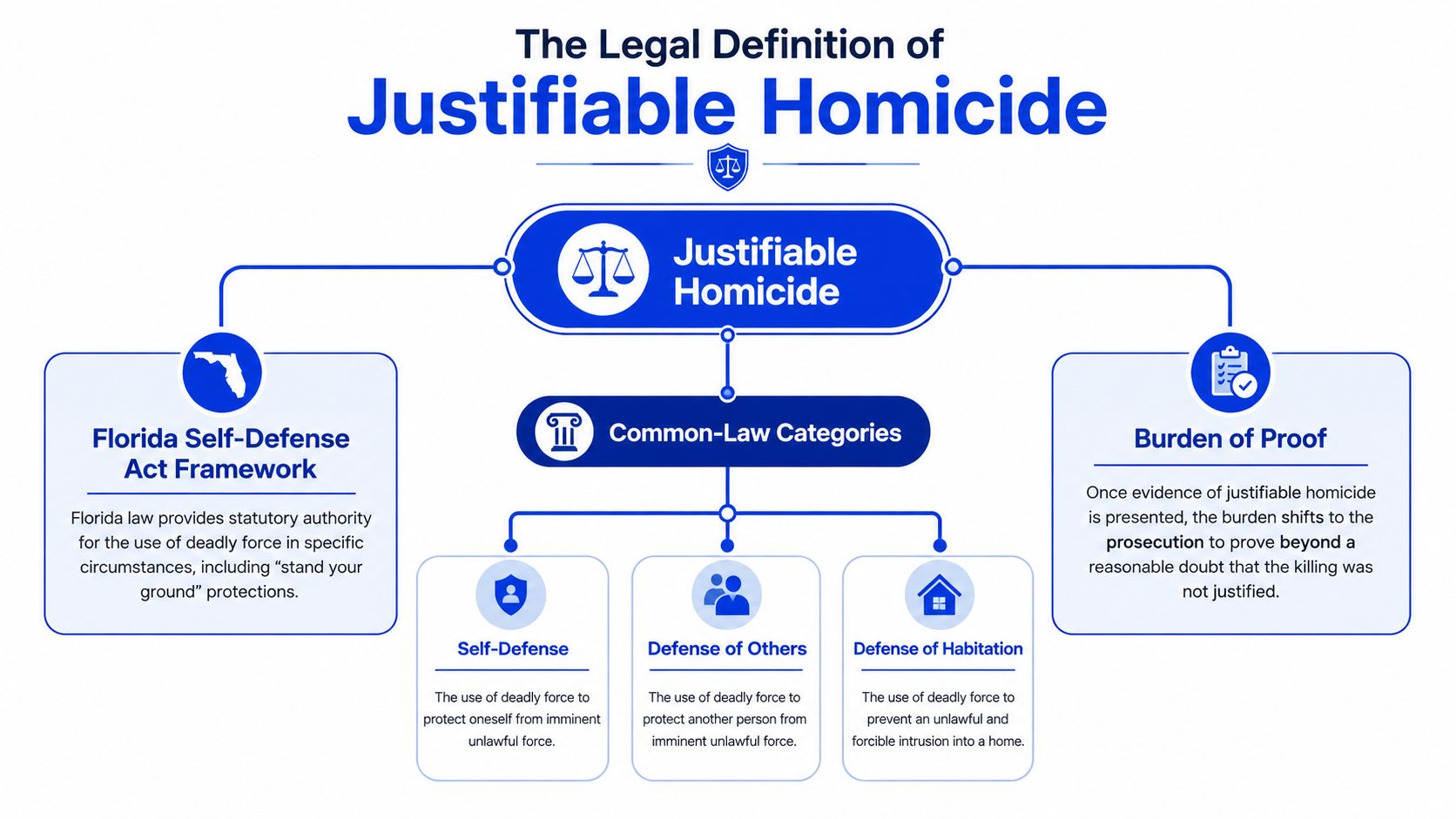
At the center of the doctrine is a complete defense. If the killing fits the law's narrow categories, criminal liability can disappear because the law treats the act as justified rather than unlawful Cornell Legal Information Institute on justifiable homicide. That usually means self-defense, defense of others, or a killing specifically authorized by law. It also means the person claiming justification usually must not have provoked the confrontation and must have faced a threat serious enough to justify deadly force.
The legal checklist defense lawyers look at
The analysis usually starts with a few basic questions. Was the defendant without fault in starting the fight. Did the person reasonably think deadly force was needed. Was the perceived danger immediate and serious. Those questions come from the legal structure described in the common-law and statutory materials, including Florida's self-defense framework Cornell Legal Information Institute on justifiable homicide.
Florida's statutory language is also fact-sensitive. It can protect force used to stop a violent felony or repel unlawful entry into a dwelling, business, or vehicle, but only if the other legal elements line up Louisiana statutory example of necessity and proportionality. Even though that link is from Louisiana, it illustrates the kind of precision these statutes use. Courts and investigators look closely at timing, escalation, available alternatives, and whether the threat was still active when force was used.
A prosecutor trying to defeat a justification claim usually focuses on one of three issues.
Provocation: the defendant started or escalated the encounter.
Proportionality: the response went beyond what the threat called for.
Immediacy: the danger had already passed when the force was used.
The law cares less about fear in the abstract and more about whether the facts made deadly force necessary at that exact moment.
One more point causes a lot of confusion. The federal crime-reporting definition of justifiable homicide is not the same thing as the criminal-defense doctrine FBI murder topic page. Police reports, prosecutor decisions, and courtroom defenses all use the facts differently. A defense lawyer has to work with the legal definition, not the shorthand that gets repeated on the news.
Reasonable Belief and Imminent Threat
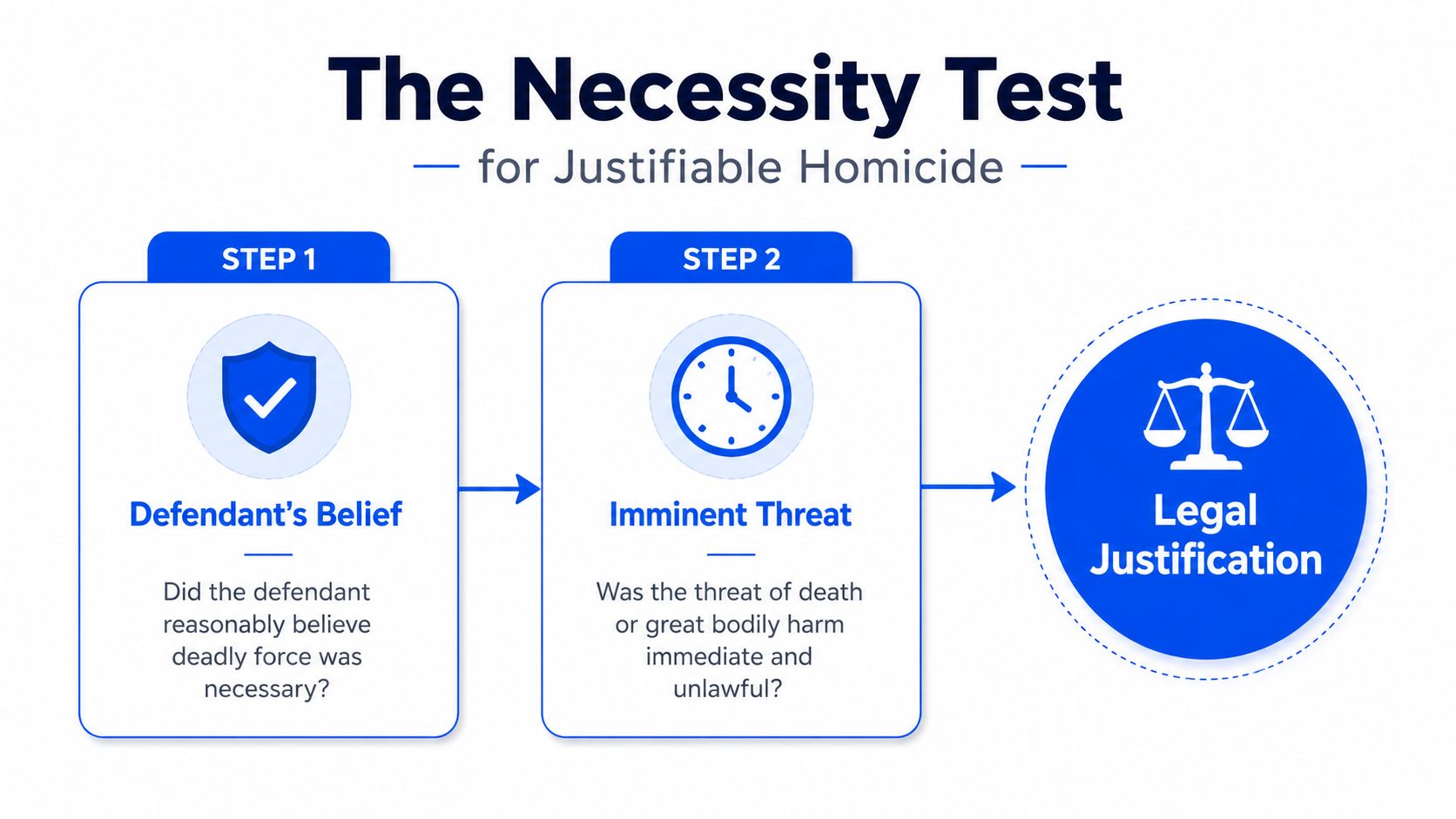
The heart of any justification claim is a two-part necessity test. First, did the defendant reasonably believe deadly force was needed. Second, was the threat imminent, meaning immediate and otherwise unavoidable Louisiana statutory example of necessity and proportionality. Those are separate questions, and both have to hold up.
A simple Florida example
A stranger trying to break a bedroom window at 2 a.m. is very different from a neighbor who insulted you that morning. In the first situation, a lawyer can argue that the threat was immediate, unlawful, and moving toward the protected space. In the second, the law sees anger, not imminent deadly danger. Timing changes everything.
Investigators and judges also look at what happened in the moments before force was used. Did the person have time to leave. Did the confrontation escalate gradually. Did the defendant keep arguing after the danger had cooled. Those details matter because the law asks whether deadly force was the only reasonable way to avoid grave harm. The more time there was to think, walk away, or call for help, the harder justification becomes to prove.
Useful way to think about it: fear alone is not enough. The fear has to match an immediate threat that a reasonable person would also see as deadly.
A defense lawyer will also study whether the location matters. Florida law, like the statutory example above, can treat homes, businesses, and vehicles differently from open public spaces. That means the same confrontation may look legally different depending on where it happened and whether unlawful entry was involved.
For a deeper look at how officers and lawyers separate legal standards, see reasonable suspicion versus probable cause. The concepts aren't the same as self-defense, but the same habit of careful fact analysis shows up in both areas. In a homicide case, that analysis can decide whether the State treats the event as a justified act or a chargeable death.
Common Florida Scenarios
Florida clients usually don't ask about abstract doctrine. They ask whether what happened in their home, car, or neighborhood can qualify. The law turns on those details, and the setting can change the analysis even when the fear feels the same.
Home, car, and bystander situations
A home intrusion during a burglary often gives a stronger factual basis for justification than a street argument, but it still isn't automatic. The law still asks whether the threat was unlawful and immediate, and whether the response fit the danger. Being on your property helps the defense only if the rest of the facts support it.
An occupied vehicle case can turn on whether the person inside reasonably believed force was needed to stop unlawful violence or unlawful entry. The vehicle setting matters because people are often boxed in, frightened, and unable to leave safely. Even so, the State will still look at whether the threat was real, active, and serious.
Defense of others comes up often in domestic violence, family, and bar-fight cases. A person may act to protect a spouse, child, or friend, but the justification still depends on what the defender reasonably believed at the time. If the original threat was already over, the law becomes much less forgiving.
The street version of Stand Your Ground is the one commonly discussed, but it's also the one most likely to be misunderstood. Standing your ground does not mean you can use deadly force because you felt disrespected. It means the legal conditions for justification still have to be met, and in Florida the pre-trial immunity question can become a major battleground before a jury ever hears the case.
The best way to sort through those scenarios is to ask three questions.
Where did it happen: home, car, business, or public place.
Who was threatened: you, someone else, or a bystander.
What was happening right then: active danger, retreat, or a past argument.
That kind of comparison is what defense counsel uses to map the facts onto the law. In practice, the scene, the timing, and the witnesses often matter more than the label people attach to the incident afterward.
Justifiable Homicide vs Manslaughter and Other Outcomes
People usually want a simple answer, but homicide cases rarely fit neatly into one box. A killing may be justified, excused, reduced, or still charged as a homicide offense depending on the facts and the prosecutor's view of the evidence. If the law doesn't fully justify the act, it may still treat the case more leniently than an intentional murder charge.
How the outcomes differ
Justifiable homicide is a complete defense. Excusable homicide is different, because the law treats it as a killing that happened under circumstances that reduce blame, rather than erase it entirely. Voluntary manslaughter and involuntary manslaughter are also different outcomes, because they involve unlawful killing with some reduction from murder, depending on intent and circumstances.
Category | Force Used | Typical Result |
|---|---|---|
Justifiable homicide | Deadly force deemed lawful under a narrow defense | Criminal liability removed |
Excusable homicide | Killing occurs under mitigating circumstances | Reduced legal blame |
Voluntary manslaughter | Unlawful killing in a heat-of-passion type setting | Serious felony exposure, but less than murder |
Involuntary manslaughter | Unlawful killing without the same level of intent | Serious felony exposure, often tied to recklessness or negligence |
Acquittal | Depends on the evidence at trial | Not guilty verdict, but not the same as a legal justification finding |
A prosecutor may still charge a higher offense first, then let the justification question play out later. That happens because the State wants a jury to decide whether the facts fit the defense. A defense lawyer's job is to make the justification or mitigation story believable from day one, not after the case has already hardened into a murder indictment.
For readers trying to understand the lower end of the homicide spectrum, Florida manslaughter defense information can help show how prosecutors think about charging choices. The key point is simple. Once force is used, the legal system doesn't just ask whether someone died. It asks whether the death was lawful, excusable, mitigated, or criminal.
How the Doctrine Is Really Applied
The law on paper is one thing. The way justification gets applied in real cases is messier, and the data show that clearly. Existing coverage often stops at definitions, but the harder question is whether the same facts are treated the same way for different people.
The answer is not always comfortable. Urban Institute researchers found that homicides with a white perpetrator and a Black victim were ten times more likely to be ruled justified than cases with a Black perpetrator and a white victim, and 281% more likely than white-on-white cases Urban Institute research on race, justifiable homicide, and Stand Your Ground laws. The gap was larger in Stand Your Ground states, even after controlling for whether the parties were strangers. That doesn't prove every case is biased, but it does show why race and context can't be ignored.
Why the numbers are hard to read cleanly
There's also a measurement problem. Public-health researchers have concluded that reliable national estimates of police justifiable homicides don't exist from the two main systems alone because cases are misclassified or omitted National reporting gap in police justifiable homicides. That matters because readers often want a clean trend line, but the reporting system itself is incomplete.
The FBI's own justifiable-homicide reporting also shows how small the category is in practice. In 2019, law enforcement reported 726 justifiable homicides, split between 340 by officers and 386 by private citizens FBI expanded homicide reporting. Earlier FBI data show private-citizen cases stayed in the low hundreds from 2012 to 2016, ranging from 270 to 338 cases annually, and in 2016 firearms were used in 276 of 331 private-citizen justifiable homicides, or 83.4% FBI expanded homicide reporting.
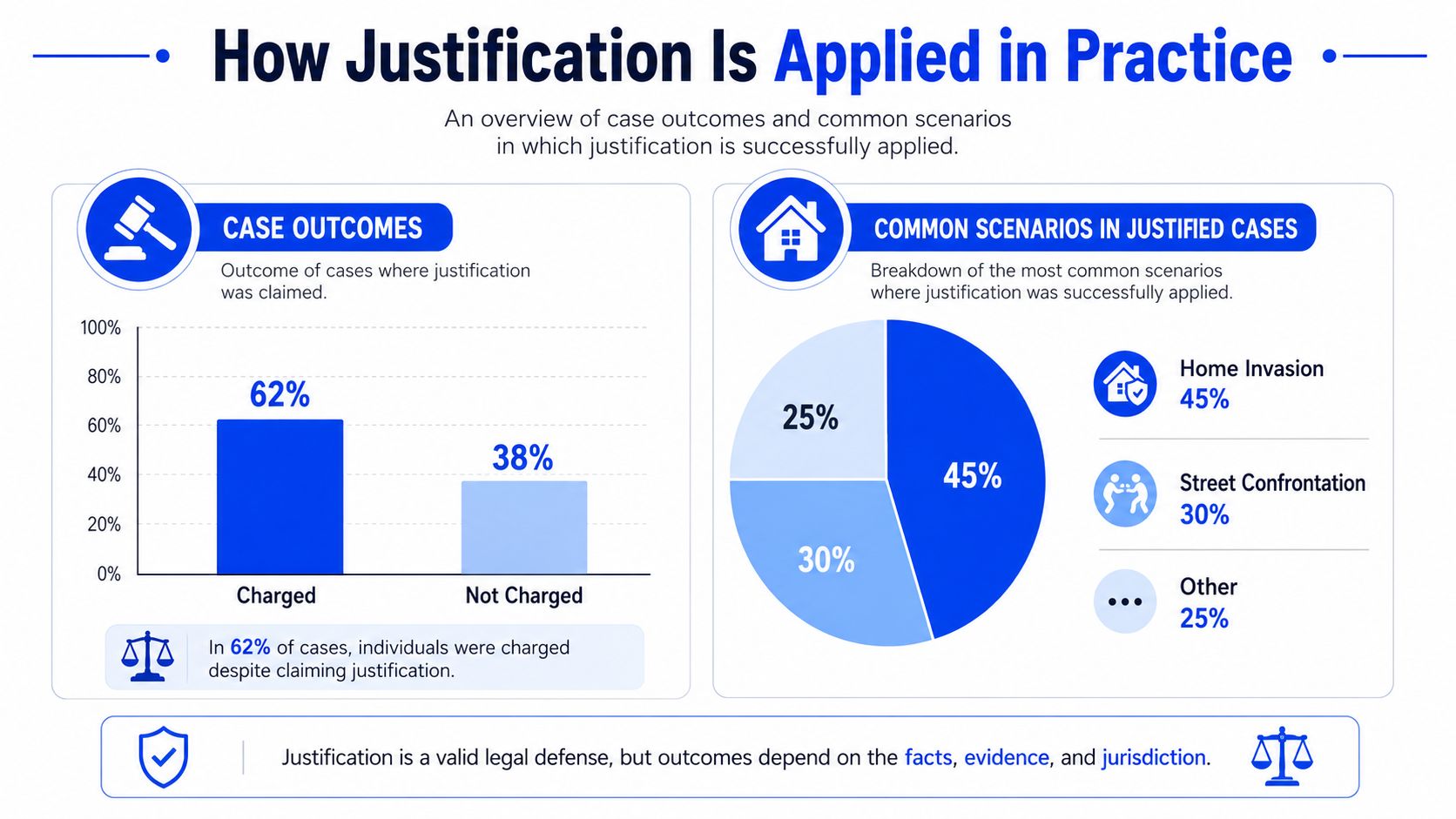
The practical takeaway for a Florida defendant is blunt. Charges can still be filed even when the defense believes the facts are strong. The strength of the justification story at the investigative stage often decides whether the case gets dropped, reduced, or sent to a jury.
What to Do If You Are Charged or Under Investigation
If police are asking questions after a fatal use-of-force incident, slow everything down. Don't give a long statement just to “clear it up.” A defense lawyer can't undo a bad first interview, and the State will often use those words for months.
Start with the basics.
Invoke your right to remain silent: say you want a lawyer before detailed questioning.
Preserve evidence: keep texts, photos, doorbell video, 911 calls, and anything showing the sequence of events.
Get witness names quickly: people forget details fast, and contact information can disappear.
Avoid post-incident explanations online: social media posts can become evidence.
Call counsel early: early intervention often matters more than a later explanation.
Florida Stand Your Ground cases can involve an immunity hearing, which is a separate fight from trial. The defense may try to show that the use of force was legally justified before the case ever reaches a jury. That's one reason prompt legal help matters so much in Broward, Palm Beach, Miami-Dade, and the surrounding counties.
A lawyer with prosecutorial experience knows what investigators look for and where the State's story is weakest. That can make the difference between a case that hardens into charges and a case that gets challenged while the facts are still fresh. For a plain-English overview of what defense counsel does in criminal cases, see Florida criminal defense lawyer guidance.
The goal is to protect your rights, preserve the strongest facts, and stop avoidable damage before it spreads. If the police are already involved, the clock is running.
Ticket Shield, PLLC helps Florida clients facing violent-crime investigations, homicide allegations, weapons charges, and other high-stakes cases with calm, strategic defense. If you need a clear plan and direct communication from a former prosecutor who understands how these cases are built, visit Ticket Shield, PLLC for a confidential consultation.