
Petty Theft vs Shoplifting: Florida Law Differences
Jason Goldsmith, Esq
You leave a store in Fort Lauderdale after a routine shopping trip, only to be stopped by loss prevention and told you're being accused of theft. The paperwork may say petit theft, while the officer, store employee, or prosecutor calls it shoplifting. That wording can feel interchangeable, but it can affect the legal theory, charge level, plea negotiations, diversion eligibility, and long-term record exposure.
If you're facing a retail-theft accusation in Broward County, Miami-Dade, Palm Beach County, or elsewhere in South Florida, don't assume a low-dollar allegation is harmless. Florida law looks at the property's alleged value, your prior record, what you intended, where the conduct occurred, and whether the State can prove each required element. The right response is to preserve evidence, avoid unnecessary statements, and have a Florida criminal defense lawyer review the charge before you accept any offer.
Table of Contents
Introduction to Petty Theft vs Shoplifting in Florida
A client might tell a lawyer, “The store says it was shoplifting, but my arrest paperwork says petty theft. Which one am I charged with?” That confusion is common because shoplifting describes retail conduct, while petit theft generally describes a theft offense classified by the value of the property and other statutory facts.
The difference matters in South Florida courts. A prosecutor may view a first-time, low-value incident as a candidate for diversion, but the alleged value, prior convictions, store evidence, and the exact charging language can change that conversation. A case involving repeated conduct may receive a very different response from a case involving a single disputed transaction.
Practical rule: Don't plead guilty simply because the merchandise was inexpensive. A conviction can create consequences beyond the immediate sentence.
Florida also uses the word petit theft, although people often say “petty theft.” Before you discuss the facts with law enforcement or sign a store document, speak with counsel. The objective is to protect your constitutional rights, challenge weak proof, and pursue an outcome that avoids a conviction whenever the evidence and your history support it.
Florida Law Overview of Theft Offenses
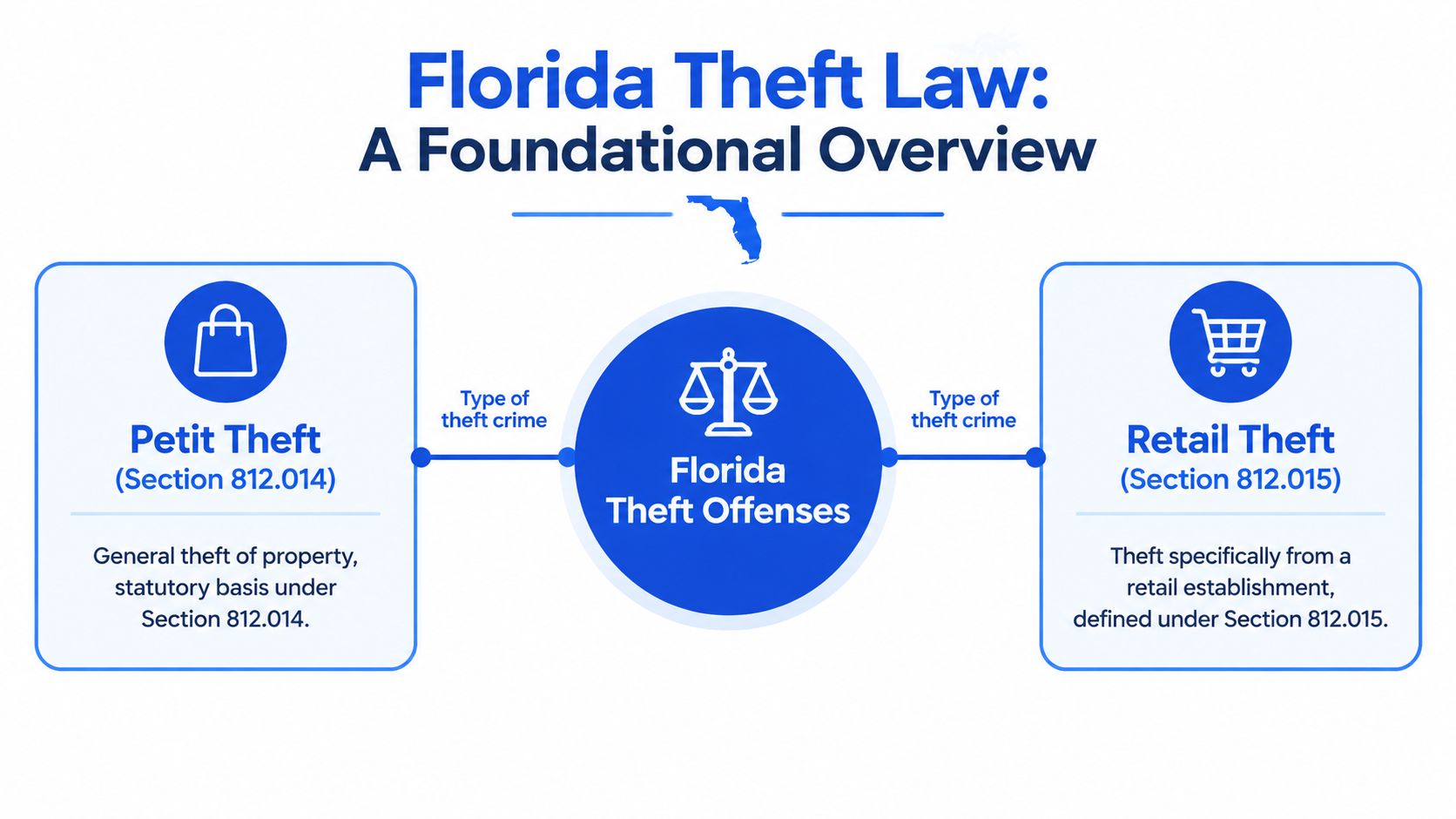
Florida's basic theft statute is Section 812.014. It addresses the unlawful taking or obtaining of property with the required criminal intent. The offense classification depends heavily on the alleged value, the type of property, and the accused person's record. In ordinary language, the State must prove more than possession of merchandise. It must establish the required intent and the facts that place the conduct within the charged offense.
Section 812.015 separately addresses retail theft and conduct involving merchants. That statute matters in store cases because the alleged conduct occurred in a retail setting and may involve merchant-specific rules or repeat-offense consequences. The label “shoplifting” may appear in everyday conversation, but the formal charging document controls what the State must prove.
How to read the charging framework
Start with four questions:
What statute appears on the paperwork? Look for Section 812.014, Section 812.015, or another statute based on the alleged facts.
What value does the State claim? The alleged value may affect whether the charge is second-degree petit theft, first-degree petit theft, or a more serious theft offense.
What conduct does the State identify? The accusation might involve concealment, bypassing payment, possession, a completed taking, or conduct after a prior store ban.
What does the record show? Prior theft convictions can alter the charge or sentencing exposure even when the new allegation involves low-value property.
Local court practice also matters. Cases move through Florida courts in Broward County, Fort Lauderdale, Miami-Dade, Palm Beach County, and neighboring jurisdictions, but prosecutors evaluate each file based on its evidence and history. A defense lawyer should obtain the arrest affidavit, incident reports, surveillance materials, receipts, inventory records, and any statements attributed to you.
Shoplifting is tracked separately from broader larceny in crime reporting, and the trends don't always move together. The Brennan Center's retail-theft analysis reports shoplifting rates ranging from 37.9 offenses per 100,000 people in February 2018 to 48.1 in December 2019, with an average rate of 552.2 per 100,000 in 2025. That distinction reinforces a practical point: a retail-theft allegation should be analyzed as its own category, not assumed to reflect the entire larceny picture.
For additional Florida theft information, review the firm's Florida theft crimes defense resource. Don't rely on a generic definition from another state. Florida's statutory language and local prosecution practices control your case.
Comparing Key Elements of Petty Theft and Shoplifting
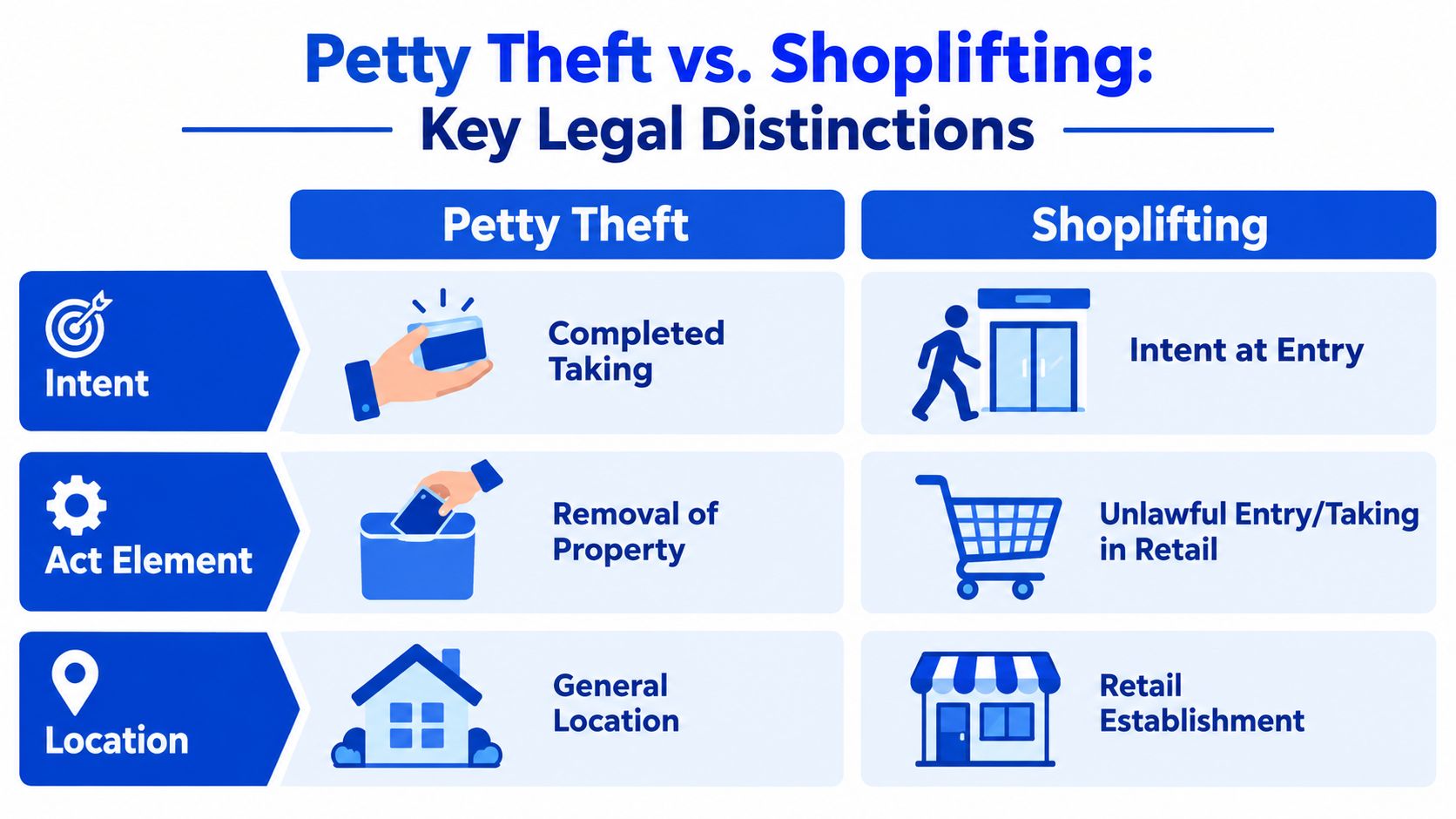
The central difference in petty theft vs shoplifting is the act the State must prove. Petit theft generally focuses on the completed taking or obtaining of property and the property's value. Shoplifting focuses on retail conduct, including what a person allegedly intended when entering or acting inside a commercial establishment.
Florida clients should be careful with comparisons drawn from other states. A California explanation, for example, describes shoplifting as entering a commercial establishment during business hours with intent to steal property valued at $950 or less, and notes that Proposition 47 made that offense a misdemeanor punishable by up to six months in jail. The California Legislative Analyst's report is useful for showing why terminology varies, but it doesn't replace Florida law.
The differences that matter in court
Issue | Petit theft | Shoplifting or retail theft |
|---|---|---|
Core focus | The alleged taking or obtaining of another person's property | Conduct connected to merchandise or a retail establishment |
Intent | The State generally focuses on intent associated with the taking | The State may focus on intent at entry, concealment, bypassing payment, or another retail act |
Location | The conduct can involve property in a general setting | The retail setting is central to the accusation |
Value | Value commonly controls the degree of petit theft | Value can still affect the related theft classification |
Evidence | Possession, ownership, value, witnesses, and statements | Surveillance, point-of-sale records, employee observations, entry conduct, and store policies |
The act element can determine whether an early defense is available. If the State can't prove a completed taking, that weakness may matter in a petit-theft prosecution. If the State alleges intent at entry or another retail-theft theory, the defense may instead focus on whether the conduct and mental state satisfy the applicable statute.
Intent is often the battleground. A missed scan, an item left beneath other merchandise, confusion at a self-checkout, or a misunderstanding about payment may look suspicious on video without proving beyond a reasonable doubt that you intended to steal. The State must connect the conduct to the required criminal intent, not merely show that the store suffered an unpaid loss.
For retail-theft defense information, review Florida retail theft and shoplifting defense. Don't give a detailed explanation to store security or police before receiving legal advice.
Value Thresholds and Charge Classifications
Florida's value thresholds can change a case from a lower-level misdemeanor to a more serious misdemeanor. The State's valuation must be examined, not accepted automatically. Retail price, condition, receipts, ownership records, and the way prosecutors calculate multiple items can all affect the alleged loss figure.
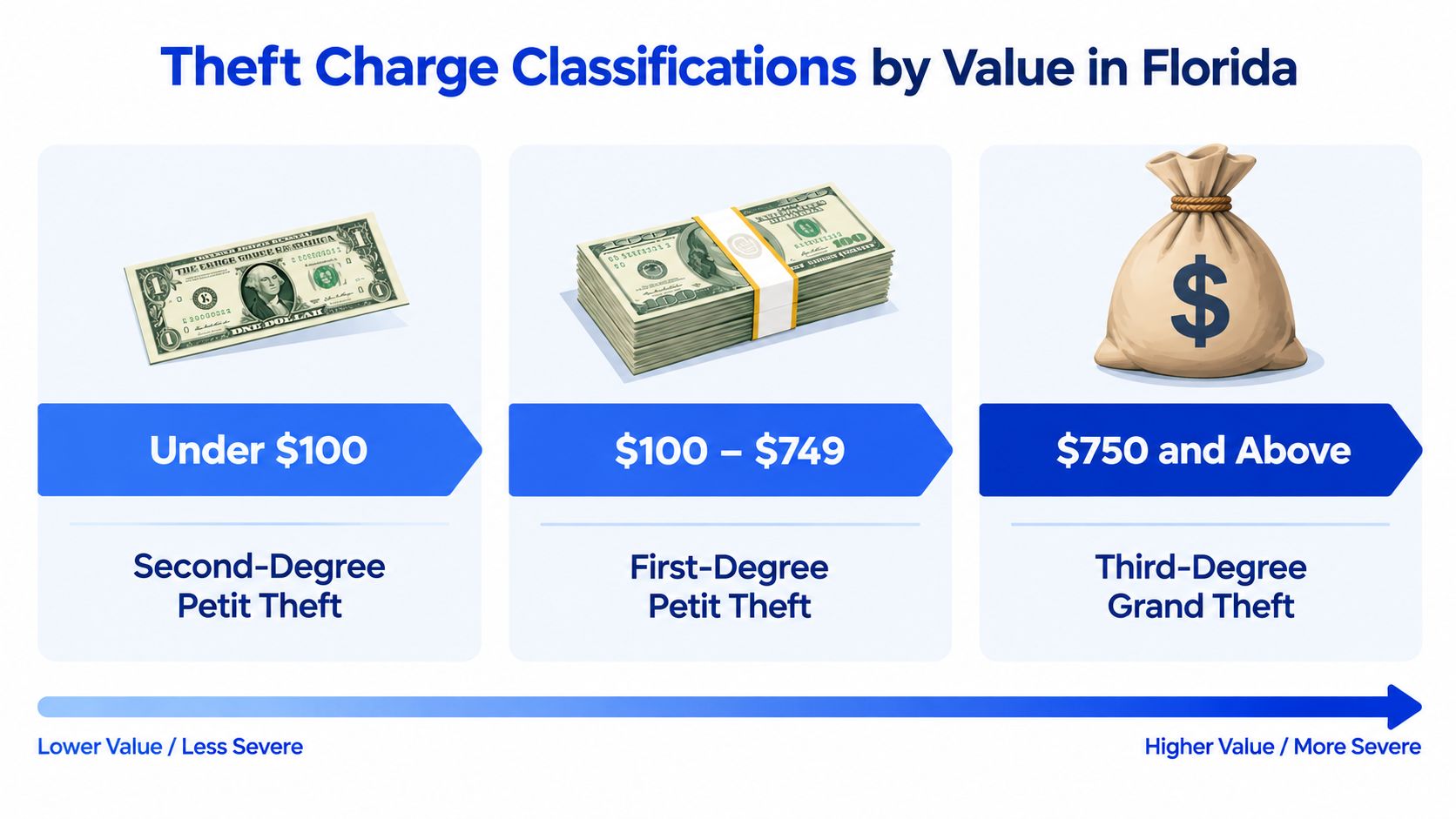
Florida law treats property valued at under $100 as second-degree petit theft, punishable by up to 60 days in jail and a $500 fine. Property valued at $100 to less than $750 falls within first-degree petit theft, punishable by up to one year in jail and a $1,000 fine, as explained in this Florida theft penalties overview.
Why the alleged value deserves scrutiny
A single retail incident can produce different charging exposure depending on the State's valuation. A disputed price, returned item, damaged product, or calculation involving several articles may provide a basis for negotiation. The defense should request the supporting documentation and determine whether the alleged value is legally and factually reliable.
The statute also creates a serious repeat-offender issue. A second conviction can be treated as a first-degree misdemeanor regardless of value, while a third or subsequent conviction can be charged as a third-degree felony, according to the Florida theft statute text. That is why a “minor” new allegation can carry major consequences for someone with prior theft convictions.
Value range | Offense | Penalty |
|---|---|---|
Under $100 | Second-degree petit theft | Up to 60 days in jail and a $500 fine |
$100 to less than $750 | First-degree petit theft | Up to one year in jail and a $1,000 fine |
Third or subsequent conviction | May be charged as a third-degree felony | Felony exposure based on repeat-offender status |
The charge should also be reviewed for errors. The arrest affidavit may use a value that doesn't match the store's records, describe conduct that doesn't satisfy the statute, or omit facts needed to establish intent. A Florida theft defense lawyer should address those issues before you make admissions or accept a plea.
For a broader explanation of the statute, see the firm's Florida theft statute guide. The strongest negotiations usually begin with a precise review of value, intent, prior record, and proof.
How Charges Are Filed and Prosecuted in Florida Courts
A South Florida theft case usually begins with a store report, loss-prevention detention, police response, or an arrest. The first account can shape the entire file, so don't try to “talk your way out of it” after law enforcement arrives. Polite silence is safer than an improvised explanation that investigators later characterize as an admission.
The early court process
After arrest, the case may involve:
Booking and processing: Law enforcement records the allegation, personal information, and arrest details.
Release or bond review: The court determines release conditions under the applicable local procedures.
Charging review: The prosecutor evaluates the report, evidence, alleged value, prior history, and applicable statute.
Arraignment: The defendant receives formal notice of the charge and enters a plea.
Pretrial litigation: Counsel may request discovery, review video, challenge statements, address motions, and negotiate resolution.
Disposition or trial: The case may end through dismissal, diversion, a negotiated plea, or trial.
Broward County, Fort Lauderdale, Miami-Dade, and Palm Beach County courts can differ in scheduling and program availability. The exact date on your notice matters. Missing an appearance can create additional problems, including a warrant or release consequences.
Why the prosecutor's label matters
Many public explanations stop with definitions and overlook how prosecutors may frame similar conduct as petit theft, retail theft, or burglary-related conduct based on the facts and the defendant's history. A discussion of retail-theft enforcement in this retail crime analysis illustrates why public descriptions can blur distinct legal theories, although Florida counsel must apply Florida statutes to the actual file.
Store policies can influence the evidence. A loss-prevention officer may document the route through the store, concealment, payment attempts, exit behavior, statements, and the recovery of merchandise. Those records aren't automatically conclusive. Video can be incomplete, witnesses can misinterpret conduct, and an internal report may contain assumptions rather than firsthand observations.
Your lawyer should request discovery early and compare every version of events. The objective isn't merely to change the label. It's to identify whether the State can prove every element and whether a diversion or nonconviction resolution is available.
Penalties and Collateral Consequences
A theft case can affect more than jail and fines. The formal disposition, prior record, driver-license consequences, immigration status, employment plans, and professional licensing history all matter when evaluating a plea offer.
Florida theft penalties by value
Value range | Offense | Penalty |
|---|---|---|
Under $100 | Second-degree petit theft | Up to 60 days in jail and a $500 fine |
$100 to less than $750 | First-degree petit theft | Up to one year in jail and a $1,000 fine |
Second conviction | First-degree misdemeanor treatment may apply regardless of value | Increased misdemeanor exposure |
Third or subsequent conviction | Third-degree felony treatment may apply | Felony exposure |
The repeat-offender rule is often the most important issue for a returning client. A first-time allegation and a new allegation involving prior theft convictions shouldn't be evaluated the same way. Counsel must verify the prior convictions, confirm whether they qualify for the enhancement, and determine how the prosecutor intends to use them.
Florida law also contains a merchant-specific penalty rule for second or subsequent petit-theft convictions. The statute provides for a fine between $50 and $1,000, or public service instead of the fine, with the public service tied to the state minimum wage rate. Review the Florida retail-theft statute before assuming the ordinary penalty summary tells the whole story.
Consequences outside the sentence
A conviction can remain visible on background checks and may affect employment, housing, school opportunities, or a professional license. It can also create immigration concerns for noncitizens, so immigration counsel may need to review the proposed disposition before any plea.
Driver's-license consequences deserve separate attention. Florida's petit-theft statute provides for suspension of the convicted person's driver license for specified petit-theft convictions, as stated in the Florida statute governing petit theft. A client who drives to work, cares for family, or attends school shouldn't treat that consequence as a footnote.
A plea that avoids jail can still be a poor result if it creates a conviction, triggers license consequences, or blocks future record relief.
Diversion, adjudication withheld, dismissal, sealing, and expungement aren't interchangeable. Eligibility depends on the facts, criminal history, prosecutor policies, and the final disposition. Ask about those consequences before agreeing to any resolution.
Common Defenses and Real-World Scenarios
A Fort Lauderdale client may be stopped after a self-checkout transaction where one item wasn't scanned. The State may have video showing the unpaid item, but video alone may not prove intentional theft. Counsel would examine the full transaction, payment history, placement of the item, statements, and whether the evidence supports an accident rather than a deliberate act.
A different client in Miami might be identified through a crowded store video. The loss-prevention report may describe a person wearing similar clothing, but a similar shirt isn't proof of identity. The defense should compare the footage with receipts, phone location evidence when available, witness descriptions, and the timing of the alleged conduct.
Defenses that can change leverage
Lack of intent: An accidental missed scan, confusion about a payment, or misunderstanding about ownership can undermine the required mental state.
Mistaken identity: Poor lighting, obstructed video, crowded aisles, and inconsistent descriptions can create reasonable doubt.
No completed taking: If the charge requires a completed taking, the State must prove that act, not merely suspicious behavior.
Consent or authorization: Permission from an employee, a return arrangement, or an ownership dispute may defeat the theft theory.
Unreliable valuation: The State must support the alleged value with credible evidence.
Improper search or seizure: Evidence obtained through an unconstitutional search may be subject to suppression.
A Palm Beach County case may involve a client who was accused after merchandise was placed in a bag by another person. Mere presence isn't automatically proof of participation. The State must connect the individual to the required intent and conduct.
Florida separately addresses theft from a merchant and creates special rules for repeat petit-theft convictions in those cases, including possible public service instead of a fine. That detail can matter during negotiations, particularly where the State emphasizes a prior retail incident. A lawyer handling Florida petit theft defense should evaluate the statute, the evidence, and the proposed disposition together.
Don't contact the alleged victim to argue about the accusation. Don't delete messages, alter receipts, or post about the case. Preserve what you have and let counsel decide how to obtain additional evidence.
Strategies to Avoid a Permanent Record and Reduce Charges
The best strategy starts before a plea. Once a client accepts a conviction, later record relief may become more limited, and the negotiating power often disappears. A South Florida defense lawyer should investigate the file immediately and ask the prosecutor about nonconviction options, diversion, or a reduction supported by the client's history and the evidence.
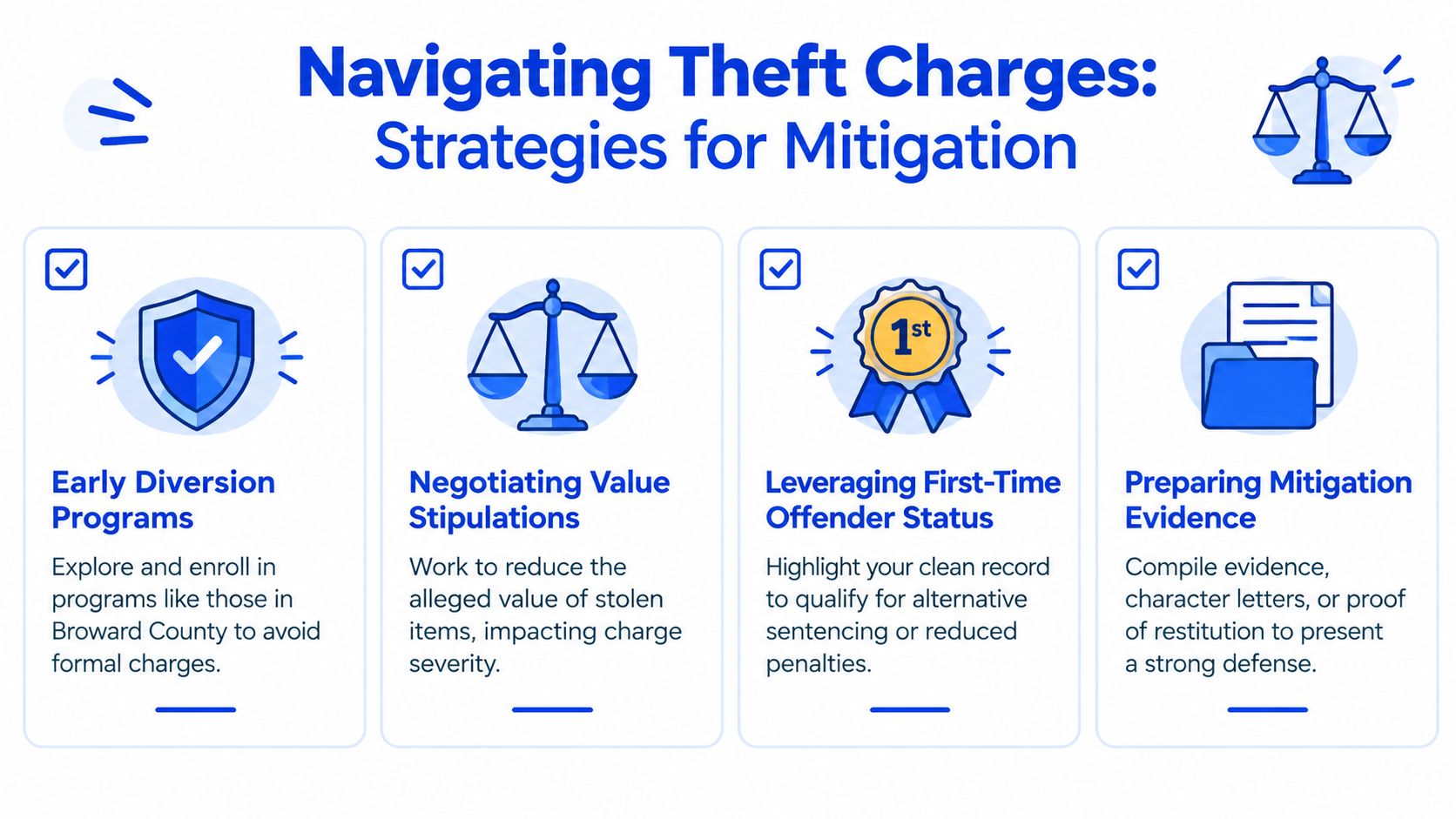
Four practical priorities
Ask about early diversion. Broward County and other jurisdictions may offer programs or negotiated alternatives, but availability depends on the charge, prior record, facts, and current prosecution policy. Apply early rather than waiting until the case is set for trial.
Challenge the value calculation. Compare the alleged value with receipts, inventory records, discounts, product condition, and the exact items attributed to you. A lower supported value can affect the charge level.
Use first-time status carefully. A clean record can support a request for diversion, community supervision, restitution, or another alternative. It doesn't guarantee acceptance, and the final terms must be reviewed before signing.
Prepare mitigation evidence. Character letters, employment information, treatment records when relevant, restitution proof, and evidence explaining an accidental transaction can give the prosecutor a fuller picture. Mitigation should support the legal defense, not replace it.
Record relief requires precision. A disposition that ends the case may still produce a public record, while sealing or expungement depends on Florida eligibility rules and the specific outcome. Review the firm's Florida record sealing information, but obtain case-specific advice before making a plea decision.
If you're facing a petit-theft or shoplifting allegation in Fort Lauderdale, Broward County, Miami-Dade, Palm Beach, or elsewhere in Florida, Ticket Shield, PLLC can review the charge, evidence, and available defense options in a confidential consultation. Visit Ticket Shield, PLLC to discuss a strategy focused on protecting your rights, reducing the charge when possible, and avoiding unnecessary long-term consequences.