
Felonies in Florida: Penalties, Classes, and Defense
Jason Goldsmith, Esq
Your phone rings after an arrest in Broward or Miami-Dade. You hear a charge described as a felony, and suddenly you're thinking about jail, your job, your family, and what will show up on a background check. That reaction is understandable, but the word felony by itself doesn't tell you what sentence you'll face or how the case will end.
Florida's felony classifications, charging statutes, evidence, and sentencing rules all matter. So do the decisions made early in a case, including whether to speak with investigators, challenge a search, or accept a plea before the evidence has been tested. The practical point is simple: don't treat an arrest allegation as proof, and don't make case decisions before you understand the specific charge and its consequences.
Table of Contents
What Facing a Felony Charge Really Means in Florida
A South Florida resident might leave an arrest hearing with a list of unfamiliar terms: a felony degree, a court date, release conditions, and a warning not to contact someone involved in the case. Those terms can make the outcome feel settled. It isn't. An arrest is an allegation, and the prosecution still has to prove the charged offense.
The word felony identifies a broad category, not a guaranteed prison sentence. The relevant statute and subsection, the facts the State alleges, any sentencing enhancements, and your record can all affect what happens. A charge involving a weapon, for example, may turn on whether the State can prove the weapon was present and used as alleged. In a theft case, the value and ownership of the property may be contested. The exact facts matter more than a headline label.
This guide explains Florida's five felony classifications, the general statutory maximums for lower-degree felonies, and the procedural decisions that can affect a case from arrest through trial. It also covers collateral consequences, probation violations, and the requirements for seeking record relief. For people in Broward, Fort Lauderdale, Miami-Dade, Palm Beach, and surrounding South Florida communities, those details can shape choices about work, family, and a defense strategy.
The sound first move is to avoid discussing the facts with investigators before getting legal advice. Don't delete messages or ask witnesses to change what they say. Preserve potentially useful information and have the charging statute reviewed. A careful early assessment starts with the actual allegations and evidence, not the fear attached to the word felony.
The Five Felony Classes Florida Uses
Florida organizes felony offenses into five statutory classifications: capital felony, life felony, first-degree felony, second-degree felony, and third-degree felony. The framework originated in legislation enacted in 1971 and 1972, and the current structure is reflected in Florida's felony-classification statute.
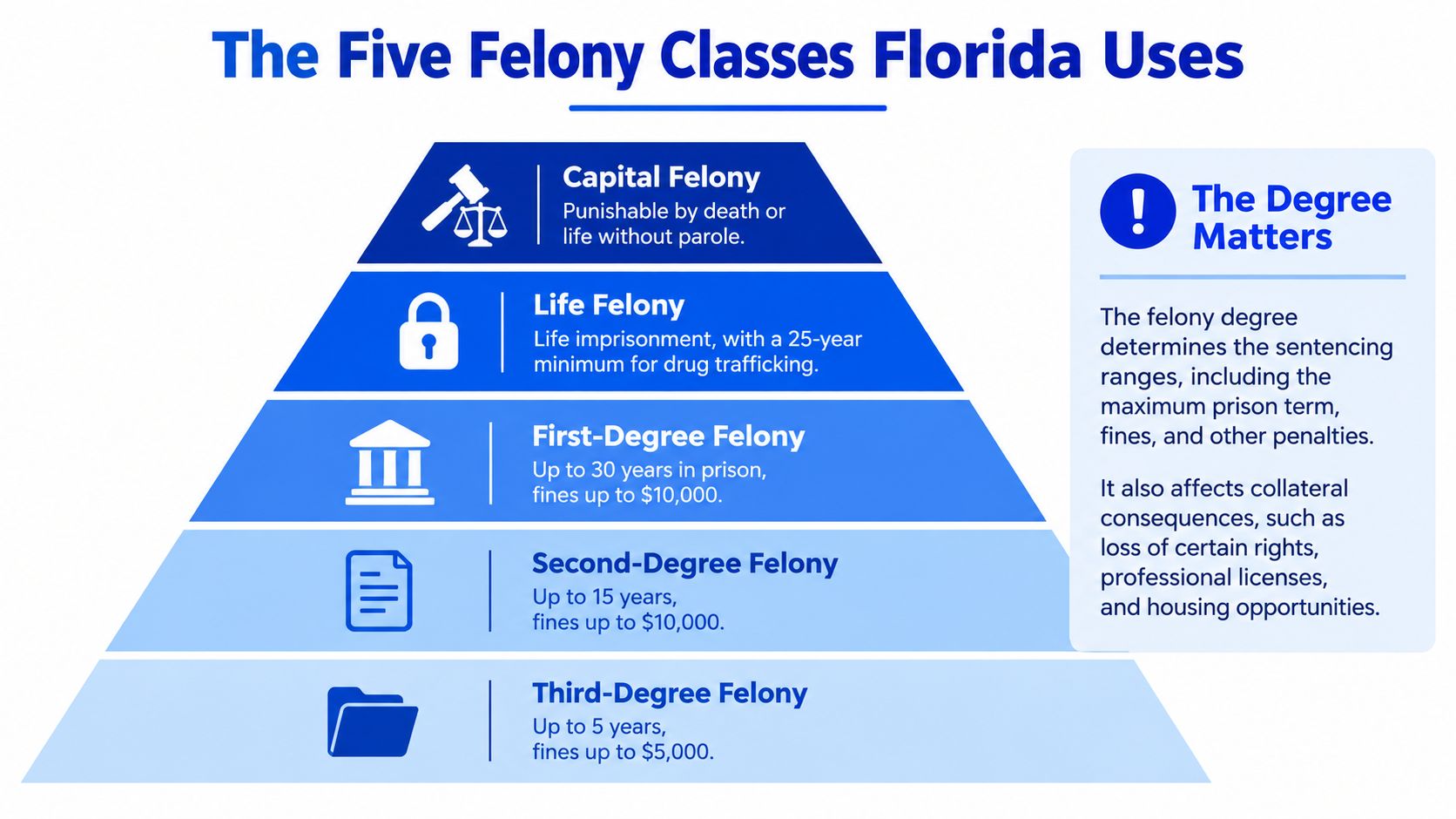
The classifications work as a hierarchy, but the charge's exact statute still controls. Capital and life felonies are separately designated by law. Below them, a statute identifies an offense as a first-, second-, or third-degree felony. If a statute says conduct is a felony but doesn't specify its degree, Florida law generally treats it as a third-degree felony, subject to statutory exceptions.
To identify the degree in a charging document, look for the statute number and subsection, then check how that provision classifies the alleged conduct. Don't rely only on the name of the charge. One offense may be divided into different degrees based on facts such as property value, weapon use, injury, or the circumstances of the alleged conduct.
Practical rule: Confirm the charged subsection before making assumptions about sentencing or negotiating a plea. A small factual distinction can change the degree, and the degree can change the stakes.
This classification affects sentencing exposure and other legal consequences, but it doesn't answer every question about the case. The State must still prove the elements of the specific offense, and separate sentencing rules may affect the ultimate result. A felony label is a starting point for analysis, not a prediction.
Sentencing Exposure and Maximum Penalties by Degree
For lower-degree felonies, Florida law generally authorizes maximum prison terms of up to 30 years for a first-degree felony, 15 years for a second-degree felony, and five years for a third-degree felony, as set out in Florida's felony-classification statute. Life felonies and capital felonies have separate statutory consequences. A maximum is a ceiling under the relevant law, not an automatic sentence.
A practical case review starts with the exact statute and subsection. Then the defense needs to check whether the allegation carries a mandatory minimum, a firearm enhancement, a habitual-offender or repeat-offender provision, consecutive-sentence exposure, or scoresheet sentencing consequences. A higher degree doesn't explain all of those rules, and the same degree can lead to different results depending on the charge and the person's circumstances.
What a maximum does and doesn't tell you
A defendant may face far less than the statutory maximum, or additional exposure under a separate provision. Plea negotiations, admissible evidence, criminal history, mitigation, and the sentencing rules that apply can all matter. The statutory cap is important, but it isn't a forecast.
For readers charged with a third-degree offense, this overview of Florida third-degree felonies can help clarify the category. Still, a general explanation can't replace checking the specific subsection filed in your case. Two charges described with similar everyday language may have different elements and different sentencing consequences.
Don't evaluate a plea by comparing it only to the maximum penalty. Ask what the State can prove, what sentencing provisions apply, and what consequences the proposed plea would carry beyond the immediate sentence. A strong defense assessment should put those questions in writing before you decide how to proceed.
Real Offenses Within Each Felony Class
The degree becomes easier to understand when you compare charges, but examples shouldn't be mistaken for a legal classification of every case with a similar label. The statute, subsection, and alleged facts control. A prosecutor may also allege an enhancement that changes the charge or potential sentence.

Here's the broad comparison:
Capital felony: Certain first-degree murder charges may carry capital-felony exposure when the statute and alleged circumstances permit it. The State must prove the legally required elements.
Life felony: A statute may classify an offense as a life felony, with life imprisonment authorized. Drug-trafficking allegations can carry separate penalties and enhancements.
First-degree felony: Some armed robbery, aggravated child abuse, or trafficking offenses may fall in this class, depending on the charged provision and facts.
Second-degree felony: Certain home-invasion robbery allegations and aggravated assaults involving protected victims or specific circumstances may be charged at this degree.
Third-degree felony: Some burglary, theft, drug, or weapons offenses may fall here. For example, whether an alleged possession offense is a felony depends on the substance, statute, and facts.
The examples are not interchangeable. A theft allegation can turn on the property's value and other statutory details. A weapon allegation may depend on what the person possessed, where it was found, and whether the State can establish knowing possession. A drug charge may depend on the substance, the evidence linking it to the accused, and whether the prosecution alleges possession or intent to distribute.
Watch the accompanying video for a general discussion of felony classifications:
The defense should begin with the charged subsection and work backward through its elements. Don't accept the charge's everyday description as proof that the State can establish every required fact.
How a Felony Case Moves Through Florida Courts
A felony case usually moves through several stages, but the sequence and issues vary with the charge, court, and evidence. The State Attorney's Office reviews allegations and decides whether to file formal charges in many cases. Some matters may involve statewide prosecution authority or specialized jurisdictions, so the charging office depends on the case.

From arrest to pretrial litigation
After arrest, a judge addresses release and conditions at first appearance. Arraignment is where the defendant is formally advised of the charge and enters a plea. The defense then reviews discovery, which may include reports, recordings, physical evidence, and witness information, and identifies what needs further investigation.
Pretrial motions can challenge whether the State may use certain evidence. A motion to suppress, for instance, can ask the court to exclude evidence obtained through an unlawful search or seizure. Defense counsel may also examine identification procedures, statements, and whether the evidence supports every element. Plea discussions can occur while those issues are being investigated, but a quick offer shouldn't substitute for understanding the discovery.
Resolution or trial
Some cases resolve through negotiation; others go to trial. At trial, the State must prove the charged offense, and the defense can challenge the evidence and present its position. If there's a conviction, the court considers the applicable sentencing rules. A person may also have grounds to challenge a conviction or sentence through the appropriate appellate process.
Early decisions can shape what evidence the court considers and what options remain. Do not testify or agree to a plea because the process feels intimidating. The steps after a Florida arrest can help orient you, but case-specific legal advice should guide decisions about statements, release conditions, and motions.
Collateral Consequences That Follow a Felony
A felony case can affect more than the sentence. The practical impact depends on the disposition, the offense, and the rules that govern the specific right or opportunity. A conviction or even an arrest record may matter in employment, housing, licensing, and other screenings, though the legal effect isn't identical in every setting.
Firearm restrictions can apply under state or federal law, and a felony disposition may have serious consequences for a person who owns or handles firearms. Professional licensing boards may review criminal matters, especially in fields such as healthcare, education, or security. Noncitizens should get advice that accounts for immigration consequences before entering a plea, because criminal dispositions can affect immigration status in ways that aren't obvious from the sentence alone.
Look beyond the courtroom
Housing providers and employers may conduct background checks. A criminal record can also create reputational and family strain even when a person isn't sentenced to prison. For students, financial aid eligibility may depend on applicable rules and circumstances. Driver-license consequences may arise in particular cases, but they shouldn't be assumed for every felony.
A plea decision should account for the life you'll return to after court, not just the immediate penalty.
The right time to raise collateral concerns is before a plea or trial decision, when counsel can review the proposed disposition and identify which consequences may apply. Don't assume a withheld adjudication or a favorable resolution automatically protects every right or clears every record. Ask for the effects of the specific outcome, including what may still appear in a lawful background check.
How Felonies Differ From Misdemeanors in Florida
A misdemeanor and a felony differ in classification, potential punishment, court procedure, and long-term effects. Florida felonies use the five classifications described above. Misdemeanors are handled under separate rules, and their maximum penalties depend on their statutory level and the charged provision. Don't infer the consequences of a particular misdemeanor from its label alone.
Issue | Felony | Misdemeanor |
|---|---|---|
Classification | Capital, life, or a degree designated by statute | Classified under misdemeanor statutes |
Potential consequences | Can include prison exposure and significant collateral consequences | Can include jail, probation, and a lasting record |
Case strategy | May involve extensive discovery review, suppression motions, and felony sentencing rules | Still requires careful review of evidence and consequences |
Some conduct can be charged more seriously when specific facts or prior history meet statutory requirements. Conversely, a felony charge may be reduced through negotiation when the evidence, statute, and circumstances support a lesser charge. Neither result is automatic.
A misdemeanor isn't harmless, and a felony charge doesn't prove guilt. To understand the practical difference in a case, compare the exact statute, the potential sentence, the evidence, and the consequences of each proposed outcome. This guide to Florida misdemeanor charges provides additional context.
Defense Strategies That Attack Felony Charges
A defense should test the State's case, not accept its version of events as settled. The right strategy depends on the charge and evidence, but several questions recur: Did police search lawfully? Is the identification reliable? Can the State prove intent, knowledge, or possession? Do the statements and physical evidence support the charge?
Constitutional challenges may include motions to suppress evidence from an unlawful search or seizure, or challenges to statements obtained in violation of a person's rights. Element-based defenses focus on what the prosecutor must prove. In a drug or weapons case, for example, the State may need to establish knowing possession; presence near an item doesn't automatically answer that question.
Match the defense to the evidence
Self-defense, necessity, and other affirmative defenses may apply to some allegations, but they require a careful review of the facts and governing law. Florida's stand-your-ground procedures may also be relevant in an appropriate case. The defense should assess the evidence, witnesses, and legal standards before deciding whether to pursue a hearing or raise the issue at trial.
Other options may include pretrial diversion or intervention programs, treatment-oriented court tracks where eligible, and negotiations for a reduced charge. Eligibility and availability depend on the case and local procedures. None should be promised before counsel reviews the circumstances.
At an initial legal meeting, ask which elements the State must prove, what evidence supports each one, whether any evidence can be challenged, and how a plea would affect your record and rights. Ticket Shield, PLLC provides criminal defense consultations and early case review for people facing Florida felony charges. A useful defense plan explains the evidence and the choices, not just the possible outcomes.
Probation, Supervision, and Violation Allegations
Probation is court-ordered supervision with conditions. A violation allegation may involve a technical issue, such as an alleged failure to follow a condition, or new criminal conduct. The distinction matters, but the court's authority and the potential result depend on the facts and governing sentencing provisions.
Under Florida's probation-violation statute, when probation is modified, the court may impose up to 90 days in county jail as a special condition. In specified circumstances, including when a probationer has fewer than 90 days of supervision remaining and meets statutory criteria for mandatory modification or continuation, the court may revoke probation and sentence the person to a maximum of 90 days in county jail. The specific requirements matter; those limits shouldn't be applied without reviewing the case.
A violation proceeding is distinct from the original felony case. The alleged violation, supervision history, and available evidence can shape the strategy. Read more about Florida probation violation proceedings, and don't assume the State's description settles what happened.
Record Sealing, Expungement, and What Comes After
Florida record-clearing requires more than a dismissal or favorable disposition. The applicant generally must first seek a Certificate of Eligibility from the Florida Department of Law Enforcement (FDLE), then petition the court. The certificate confirms eligibility to petition; it doesn't require the judge to grant relief.

The process depends on the case disposition, prior adjudications, prior sealing or expungement, and whether the offense is excluded under Florida law. An adult adjudication of guilt generally blocks the ordinary eligibility pathway. A withheld adjudication may qualify in some circumstances, but exclusions still apply. FDLE must receive the certified court order before the relief takes effect.
Sealing limits public access, but it doesn't erase information from every governmental or related entity. Keep certified disposition documents, verify prior cases, and confirm that probation has ended when relevant. Don't tell an employer, licensing body, or other screening entity that a record has been cleared until you know what relief was granted and what disclosure rules apply.
Florida generally limits court-ordered sealing or expungement under the applicable statutes to one during a person's lifetime, so the choice and eligibility review deserve care. This overview of Florida record sealing explains the process. Treat the certificate as a prerequisite, not a guarantee.
Protecting Your Rights and Building the Defense
If police or investigators want to discuss a felony allegation, clearly assert your right to remain silent and ask for counsel. Don't try to talk your way out of an arrest or guess what the State knows. You may refuse consent to a search, though officers may still conduct a search when they claim legal authority; don't physically interfere.
Preserve texts, photographs, videos, contact information for witnesses, and records that may help explain your whereabouts or circumstances. Don't delete, edit, or circulate evidence. Avoid discussing case facts on social media or with people who may be interviewed.
At a first consultation, ask what statute and subsection are involved, what the State must prove, what evidence is available, and whether any search, statement, or identification can be challenged. Ask how a plea could affect sentencing, employment, licensing, immigration, or record-clearing eligibility if those issues apply to you.
Felony cases reward preparation. Get advice before making statements or accepting a resolution, and preserve information that may disappear. Prosecutors and investigators may begin building a case before formal charges are filed, so waiting to understand the allegations can cost valuable time.
Frequently Asked Questions About Florida Felonies
Can a first-time felony avoid prison? It may be possible, but the charge, evidence, sentencing rules, and proposed resolution control. Review the sentencing section above.
Can a felony charge be reduced without trial? Yes, when the evidence and negotiations support a lesser outcome. No reduction is guaranteed.
How long does a felony stay on a record? It depends on the disposition and eligibility for sealing or expungement. A dismissal doesn't automatically clear a record.
What if I'm accused of violating probation? Treat it as a separate court risk and get the alleged violation and supervision history reviewed promptly.
Ticket Shield, PLLC offers early case review and criminal defense representation for people facing felony allegations across Florida, including South Florida. Contact Ticket Shield, PLLC to discuss the charge, evidence, and defense options before making decisions about your case.