Can Lie Detector Tests Be Wrong in a Florida Case?
Jason Goldsmith, Esq
A polygraph can label a truthful person deceptive and a deceptive person truthful, and Florida courts still treat that result as something other than proof. That's not a defense slogan. It's the starting point for understanding why police, prosecutors, probation officers, and employers lean on these tests even when a jury may never hear the outcome. If you've been asked to take one, or you've already failed one, you're not looking at a verdict. You're looking at an examiner's interpretation that a good defense lawyer can take apart piece by piece.
Table of Contents
What a Polygraph Actually Measures and Why That Matters
A polygraph doesn't detect lies. It records your body while someone questions you, and an examiner later decides what those recordings mean. That gap between recording and interpretation is where Florida cases are won and lost, and it's why the question can lie detector tests be wrong has a straightforward answer. Yes, because the machine never measured truth in the first place.
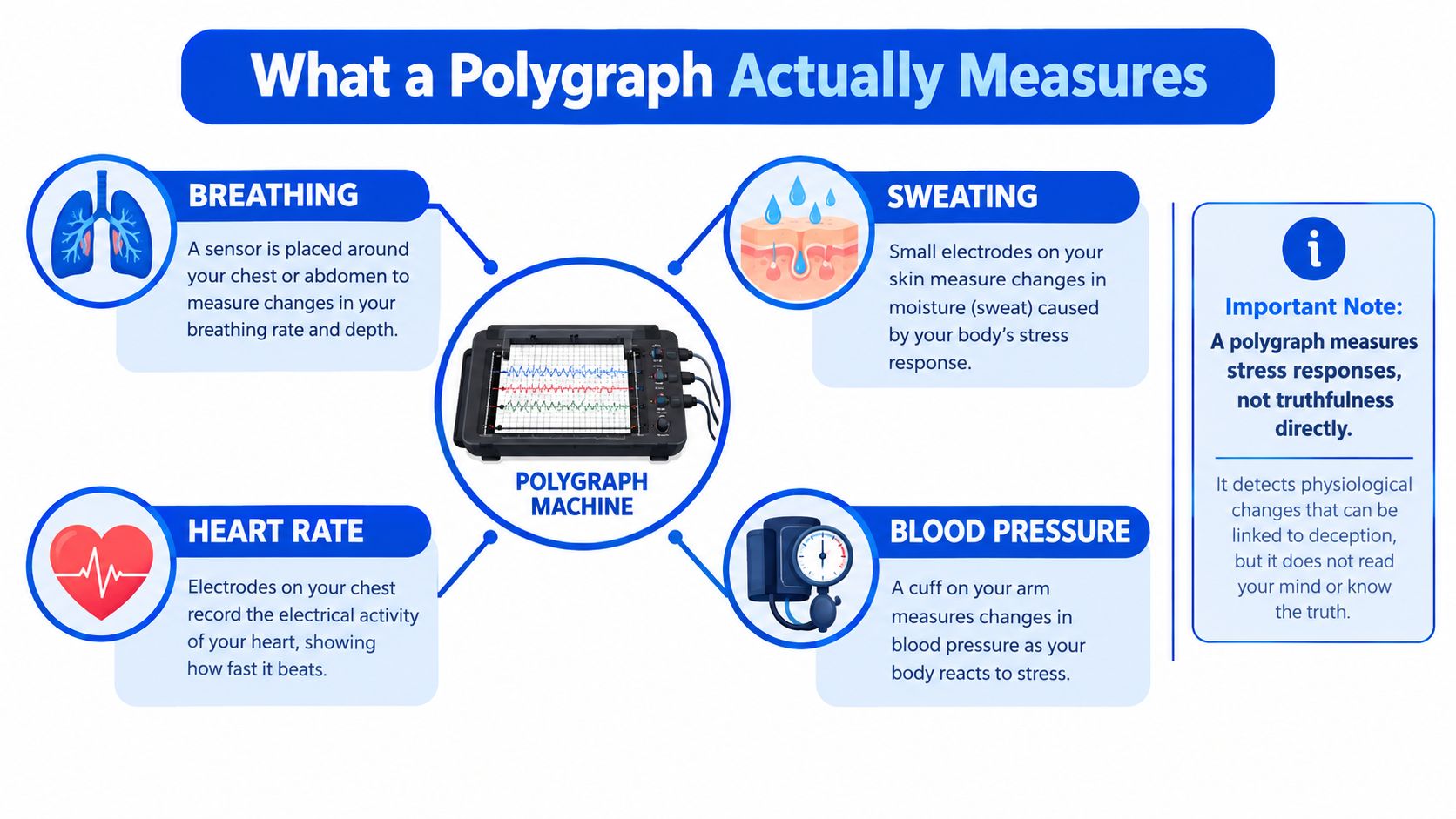
The sensors track breathing, sweating, heart rate, and blood pressure. Chest straps record respiration. Finger sensors record skin conductance, which changes with sweat. A cuff tracks cardiovascular activity. None of those signals is unique to deception. Fear of being disbelieved, anger at being accused, embarrassment, confusion about a question, pain from the cuff, or a medical condition can move the same needles.
How a Typical Examination Unfolds
Many people imagine the chart is the test. It isn't. The encounter usually starts with a pretest interview, where the examiner explains the process, asks background questions, and reviews the exact questions you'll hear. That interview shapes everything that follows, because the examiner learns what makes you anxious and frames the issues in specific words.
Next come different categories of questions. Relevant questions address the alleged conduct directly, such as whether you took property, possessed a weapon, or violated a condition of supervision. Comparison or control questions are broader and designed to provoke a reaction, often about past mistakes or general honesty. Neutral questions fill space between them. The examiner compares your physiological responses across those categories and reaches an opinion.
That opinion isn't a readout. Two examiners can look at similar charts and disagree about scoring, question quality, or whether the data are even suitable for interpretation. Courts scrutinize that kind of human judgment in other contexts too, which is why understanding how courts scrutinize other physiological tests helps you see the pattern. Whenever the State relies on an officer's interpretation of a bodily response, the defense should ask what was measured, what was assumed, and what else could explain the result.
Practical rule: Treat every polygraph result as an opinion about stress data, not as a finding that you lied or told the truth.
Why the Distinction Controls Your Defense
If a device directly detected false statements, challenging it would be mostly a technical fight about calibration. Because it doesn't, your lawyer gets far more to work with. The attack can target the question wording, your physical and mental condition that day, the examiner's training, the scoring method, and the decision to test you at all.
That matters in both misdemeanor and felony investigations across Broward County, Miami-Dade, and Palm Beach. A failed test during a theft, drug, weapons, or violent crime investigation can push detectives to seek charges, push prosecutors to file, or push a probation officer to allege a violation. None of that makes the result reliable. It makes early, informed pushback essential.
False Positives and False Negatives Explained
A false positive means a truthful person is classified as deceptive. A false negative means a deceptive person is classified as truthful. Those aren't rare theoretical possibilities. They're built into the published accuracy figures, and translating those figures into human consequences shows why no single result should decide a Florida case.
The National Academies review of event-specific polygraph accuracy found accuracy-index values in scientifically acceptable studies ranging from 0.711 to 0.999, with a median of 0.89, while cautioning that the commonly reported range of 0.81 to 0.91 probably overstates real-world performance. One reviewed study estimated about 85% sensitivity and 78% specificity. Put plainly, that study's test detected most deceptive subjects but missed others, and it correctly cleared most truthful subjects while wrongly flagging a substantial share of them.
What Polygraph Accuracy Numbers Mean in Practice
Test Outcome | What It Means | Approximate Rate |
|---|---|---|
True positive | Deceptive person correctly classified as deceptive | About 85% sensitivity in one reviewed study |
False negative | Deceptive person incorrectly classified as truthful | Roughly 15% of deceptive subjects missed |
True negative | Truthful person correctly classified as truthful | About 78% specificity in that study |
False positive | Truthful person incorrectly classified as deceptive | About 22% of truthful subjects wrongly flagged |
Read the last row again if someone's pressuring you to test. Under those figures, more than one in five truthful people could be told they showed deception. In a job application, that can end a career path. In a probation setting, it can trigger an alleged violation and possible jail or prison exposure. In a criminal investigation, it can turn you from a witness or person of interest into the State's primary target.
The research base itself deserves skepticism. Across the reviewed datasets, the median sample size was only 49 participants, and just nine studies included at least 100 participants. Results also varied with the people tested, the examiner, the questions, the stakes, and how closely the setting resembled a laboratory. A college laboratory exercise with low consequences doesn't replicate a Fort Lauderdale interrogation room where you're facing a felony arrest.
Defense lawyers see the same reliability problem with other shortcut tools law enforcement treats as conclusive, and the analysis of whether drug field test kits are reliable follows a similar logic. A presumptive tool can justify further investigation. It shouldn't substitute for proof, corroboration, or your constitutional right to make the State prove its case with admissible evidence.
A test that can wrongly flag truthful people at that rate is an investigative lead at best. It is not a verdict, and you should never let an examiner talk you into treating it like one.
Why Innocent People Fail and Guilty People Pass
Statistics explain that errors happen. Real examinations explain how. The image below captures what television usually edits out, which is a stressed person attached to equipment while being judged on reactions he can't fully control.
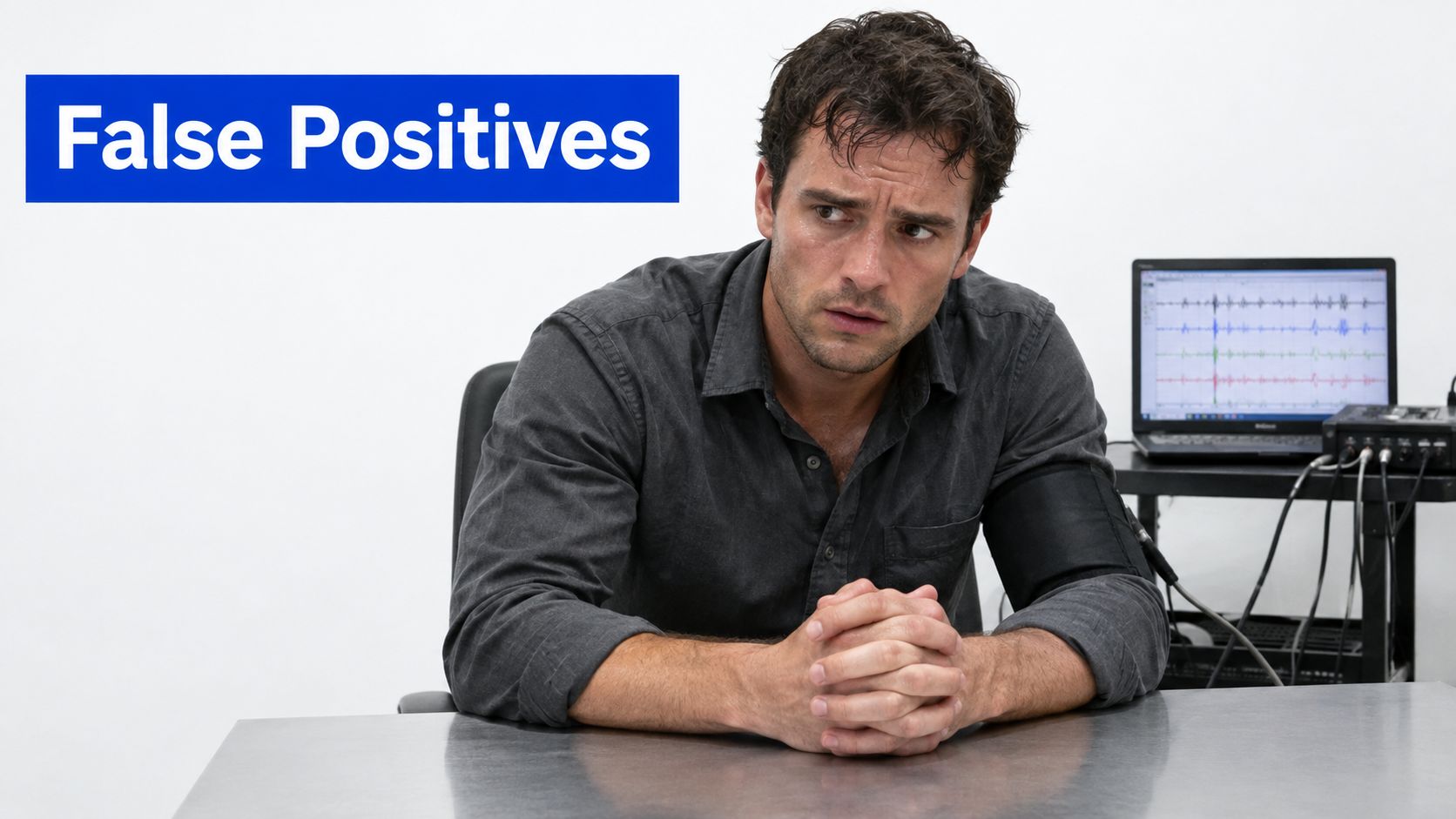
Start with the obvious. You're being accused of a crime. You're afraid of arrest, jail, losing your job, or being separated from your family. That fear doesn't switch off because an examiner tells you to relax. A truthful person who desperately needs to be believed may react strongly to the relevant questions precisely because those questions carry the highest stakes.
Conditions and Circumstances That Distort Results
Several ordinary factors can undermine a chart before the first relevant question is asked.
Anxiety and prior trauma: Past arrests, victimization, or hostile police contact can heighten reactions to authority and accusatory wording.
Medical and mental health conditions: Asthma can affect breathing patterns. Cardiovascular issues, chronic pain, ADHD, and other conditions can affect the signals being recorded or the ability to sit still and process questions consistently.
Medications and fatigue: Prescription drugs, sleep deprivation, illness, caffeine, and withdrawal can change alertness and physiology. An examiner who doesn't document them has built the opinion on incomplete information.
Question wording: Vague time frames, legal labels you don't understand, compound questions, and words with more than one meaning invite confusion. A reaction to confusion looks like a reaction the examiner may score against you.
Each item on that list is also a discovery target. Your lawyer should demand the exact question list, the pretest interview notes, any medical screening forms, the original charts, and the scoring worksheets. If the examiner never asked about medication, sleep, or health conditions, that omission weakens the opinion. If the questions were sloppy, the comparison underlying the whole test is compromised.
This short video is worth watching before you agree to sit for any examination, because seeing the setup makes the pressure of the room easier to understand.
Guilty people pass for the mirror-image reasons. A deceptive person who isn't particularly reactive, who misunderstands the narrow wording favorably, or who stays calm during relevant questions may not produce the pattern an examiner expects. Examiners also claim they can spot countermeasures, meaning deliberate attempts to alter breathing or create reactions during comparison questions. That detection is itself an interpretation, not a certainty, and examiners can wrongly accuse a nervous but truthful person of manipulation.
Don't try to beat a test you've been pressured into taking. The smarter move is to avoid creating the test in the first place, and if one already exists, to force everyone relying on it to defend the examiner, the protocol, and the scoring in detail.
Florida and Federal Admissibility Rules
Even if a polygraph were far more accurate, the State would still have to get the result past a judge. In Florida, that's where polygraph evidence usually dies. The legal history matters because it gives your lawyer established authority, not just scientific criticism, to keep the result away from a jury.
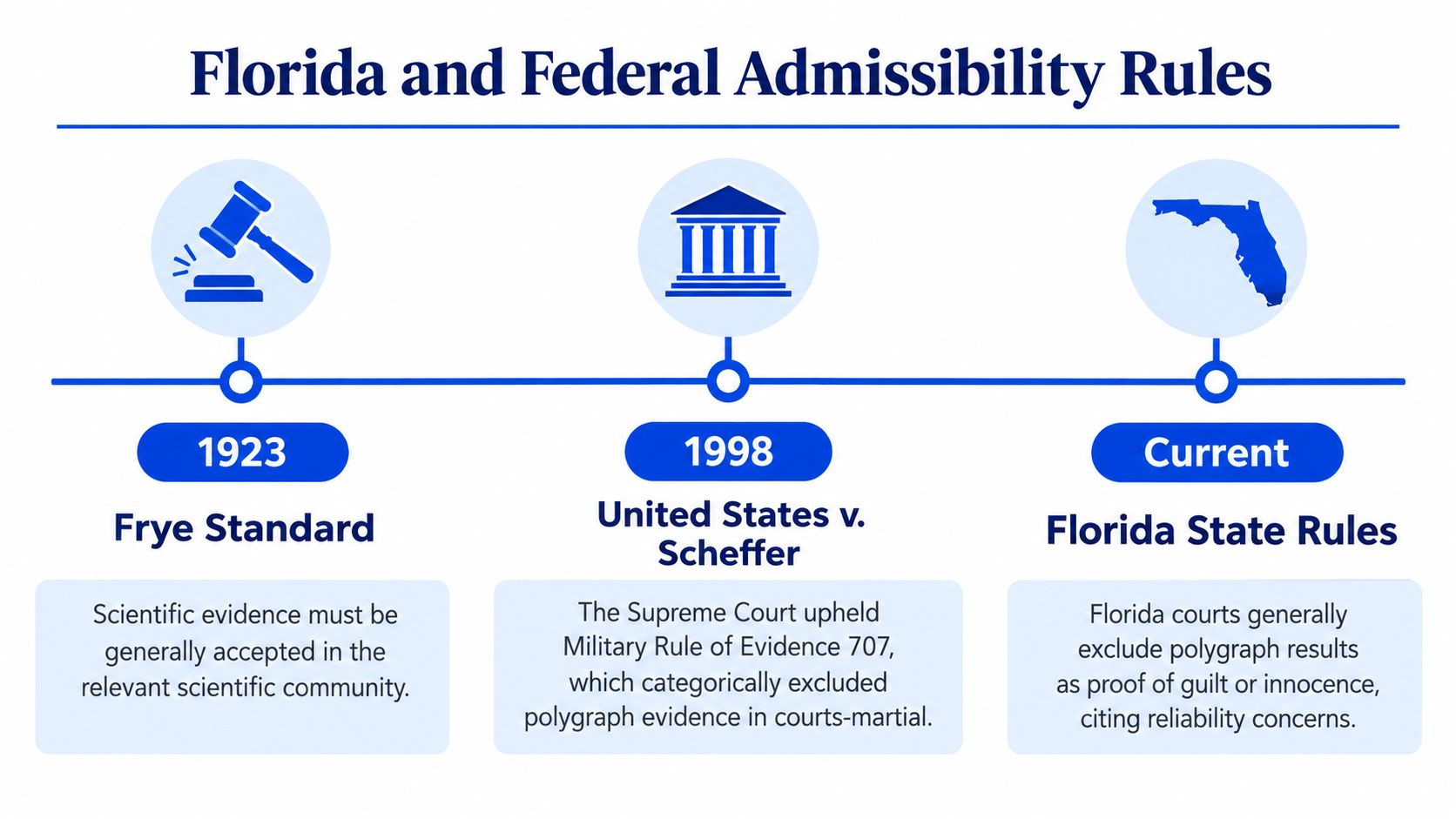
The starting point is Frye v. United States from 1923, which established a general-acceptance approach for scientific evidence. For many years, federal and state courts commonly excluded polygraph evidence under that standard. The core idea is simple enough for any juror to grasp. Before a court lets a jury hear a scientific technique, the technique should be sufficiently reliable and accepted, not merely popular with investigators.
The Federal Picture After Scheffer
In United States v. Scheffer, decided March 31, 1998, the U.S. Supreme Court upheld a military rule categorically excluding polygraph evidence against a constitutional challenge. The Court noted that polygraph evidence was controversial, that expert views differed, and that the test could have a high potential rate of error. Federal evidence law contains no single rule automatically admitting polygraph results. Admissibility depends on the governing rules, judicial decisions, and the circumstances of the examination.
That framework connects directly to the broader question of what reliability testing requires before evidence reaches a jury. A prosecutor can't bridge the gap by saying a detective trusted the examiner. The proponent of scientific evidence has to justify the method.
How Florida Courts Treat Polygraph Results
Florida applies a general rule that polygraph evidence is inadmissible as ordinary proof of guilt in criminal trials, a position reflected in Florida appellate authority on polygraph admissibility. Florida Supreme Court precedent requires scientific tests to be admitted only when their reliability is widely recognized and accepted among scientists. Polygraphy has never comfortably cleared that bar.
There are limited situations where polygraph-related information can still matter, and it is in these situations that people get hurt by bad assumptions.
Agreement by the parties: The defense and prosecution may agree to admission under specific conditions. Never let anyone suggest such an agreement casually or without understanding the downside.
Statements during or after the exam: Admissions you make in the pretest interview, between charts, or in a post-test interrogation can create separate evidentiary fights even if the chart result stays out.
Investigative and supervision decisions: Police, prosecutors, employers, and probation officers may act on a result long before any judge rules on admissibility.
Defense warning: An inadmissible result does not make the encounter harmless. What you said in that room may matter far more than the chart.
That last point drives my advice to every client. Examiners often use the announcement of a failed result to launch an interrogation. If you then explain, apologize, speculate, or try to talk your way out, the State may not need the polygraph at all. It has your words.
Base Rates and Why Screening Uses Are Especially Risky
A test can sound impressive in isolation and still produce mostly wrong accusations when it's used to search for something rare. That's the base rate problem, and it's the strongest mathematical argument against broad polygraph screening. It also explains why a positive result means different things in a focused investigation versus a fishing expedition.
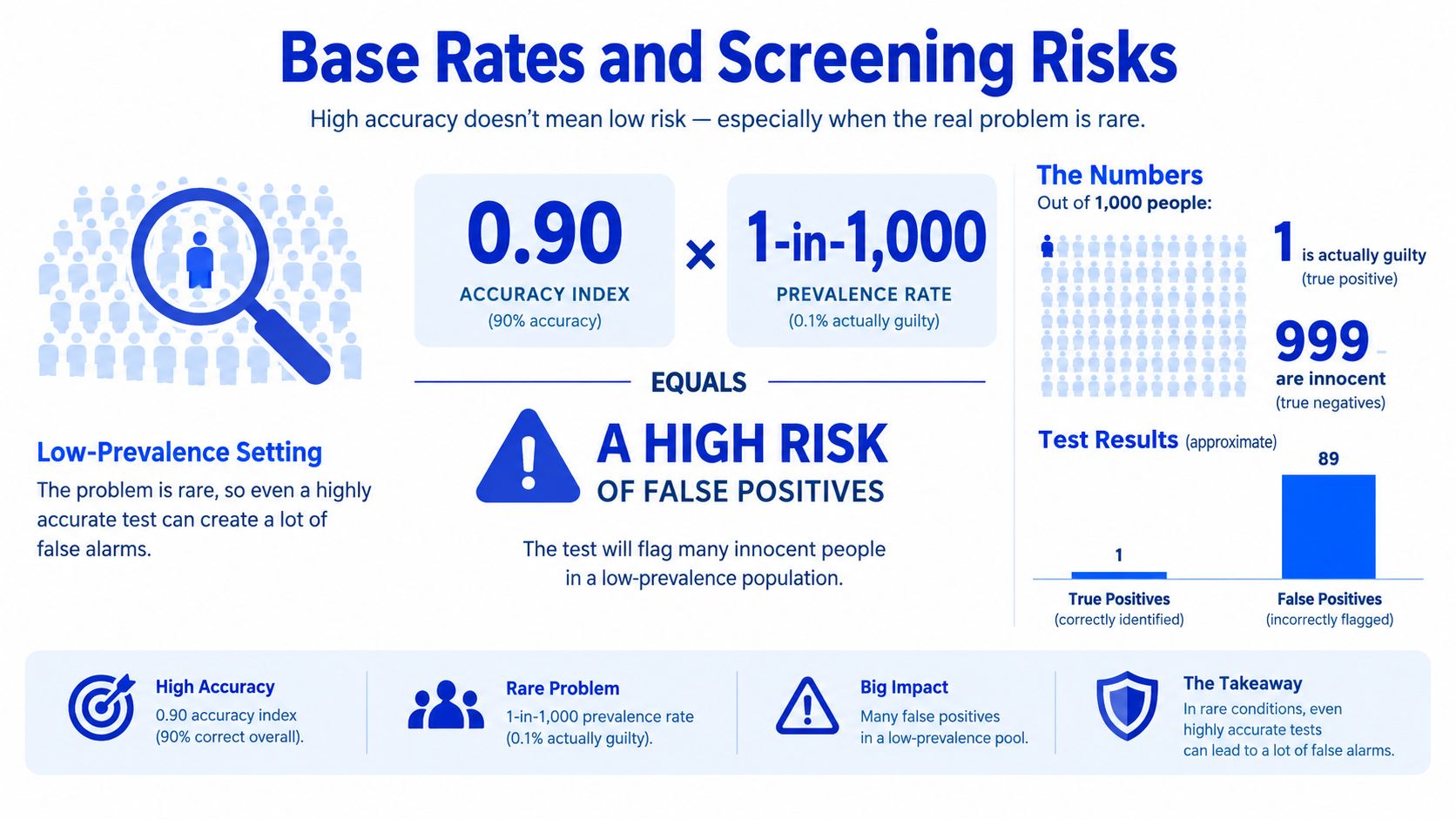
The National Academies analysis of polygraph screening and base rates modeled a test with an accuracy index of 0.90 used to detect 80% of serious security risks. If the underlying risk rate were only 1 in 1,000, the test could falsely classify at least 100 nondeceptive people as deceptive for every genuine threat identified. The test didn't suddenly become worse. The population changed, so false positives swamped true positives.
The Employment Screening Model
In another model involving 10,000 government employees, only 10 were presumed to be spies. The polygraph identified about 1,606 people as deceptive, but only 8 of those were actually spies. That means the overwhelming majority of people flagged in that model were not the threat the test was hunting. Predictive value depends on sensitivity and specificity, but it also depends on how common the target behavior is in the group being tested.
Apply that logic to situations South Florida clients face.
Probation and community control: Broad questions about compliance, contact, travel, substance use, or new law violations can sweep in many truthful people who are terrified of revocation.
Employment and licensing screening: Applicants for sensitive positions may be tested about uncommon misconduct, which is exactly the low-prevalence setting where false accusations multiply.
Exploratory police questioning: When detectives lack a specific, corroborated theory and use a polygraph to decide whom to pursue, a failed result may say more about the math than about you.
Family and custody disputes: A privately obtained result can poison negotiations even though it was generated outside the safeguards of a courtroom.
Context cuts both ways, and a credible defense acknowledges that. In a case involving a known, specific incident where independent evidence already creates a higher prior probability, the balance differs from a broad screening sweep. Prosecutors will make that argument. Your lawyer's job is to force them to prove it with validated error rates for the exact population and protocol used on you, not with a generic claim that polygraphs are usually right.
Ask who was tested, why you were selected, what the examiner knew beforehand, and whether independent evidence confirms the result. If the State's confidence comes mainly from the chart in a low-prevalence setting, the base rate problem isn't an academic footnote. It's a direct attack on the weight anyone should give that result.
Practical Defense Strategies a Florida Lawyer Can Use
You don't beat polygraph evidence by arguing about lie detection in the abstract. You beat it with motions, discovery, cross-examination, and early decisions that stop a bad test from defining the case. As a former prosecutor, I know the State values a failed polygraph most before trial, when it can pressure pleas and shape charging decisions without ever surviving a judge's scrutiny.
Defense Toolkit Against Polygraph Evidence
Defense Move | What It Targets | Best Used When |
|---|---|---|
Motion to exclude | Admissibility of the result and examiner opinion | The State hints it may offer the result or reference the test |
Discovery demand | Charts, questions, notes, scoring, examiner credentials | Any test has been conducted or relied upon |
Reliability hearing | Method, protocol, qualifications, and error rates | The court considers admitting any polygraph-related evidence |
Motion to suppress statements | Admissions made during or after the examination | You were questioned before, between, or after charts |
Independent expert review | Scoring errors and alternative explanations | The examiner's opinion is influencing charges or supervision |
Refusal advice before testing | Creation of the result itself | Police, an employer, or probation requests a voluntary exam |
Start with exclusion. A pretrial motion should invoke Florida's general inadmissibility rule and reliability requirements, and it should ask the court to bar not only the result but also indirect references designed to tell the jury you failed. Prosecutors sometimes try to get the benefit of the test through phrasing about investigative steps or your demeanor afterward. A carefully drafted motion in limine closes those side doors and preserves the issue for appeal if the judge errs.
Discovery comes next, and it should be aggressive. Your lawyer needs the examiner's qualifications and training history, the equipment and protocol used, the original charts and data, the precise question wording, all pretest and post-test notes, any audio or video, and the scoring worksheets. Understanding what a motion to suppress evidence can accomplish also matters here, because the statements surrounding a polygraph often present the best suppression target in the entire encounter.
Attacking the Examiner and the Encounter
Cross-examination should make the examiner own every judgment call. Why were those comparison questions chosen. What medical screening occurred. How were inconclusive responses handled. What scoring system was applied, and whether another qualified examiner reviewed the charts blindly. If the examiner served as both tester and interrogator, that dual role deserves scrutiny, because pressure to produce an admission can distort how results are presented to you.
Statements require separate analysis under your constitutional rights. Were you free to leave. Were Miranda warnings required and given. Did the examiner falsely tell you the machine proved deception and then keep questioning you. Did you ask for a lawyer or try to stop. Those facts can support suppression even when the chart itself never becomes an exhibit.
Finally, never take a voluntary police-initiated polygraph without counsel. Passing rarely ends an investigation in any binding way, failing intensifies it, and everything you say can be used to build the State's case. The goal isn't to win a debate about polygraph science. It's to keep unreliable opinion out, suppress what shouldn't have been obtained, and force the State back onto admissible, independently verified evidence for any misdemeanor or felony it wants to pursue.
What to Do Before Any Polygraph Comes Up in Your Case
Don't take a polygraph for police, an employer, or probation without calling a criminal defense lawyer first. That single decision can prevent the test entirely, or at minimum ensure someone is protecting your rights before you walk into a room designed to produce admissions. Once a result exists, it can influence charging, plea offers, bond arguments, and supervision decisions even if a jury never hears it.
Early intervention lets your lawyer contact investigators, assert your rights in writing, evaluate whether any examination serves a legitimate defense purpose, and start building the exclusion and suppression motions from day one. The same urgency applies after any arrest, which is why knowing what to do when arrested protects you before small decisions become major evidence problems. Being asked to take a lie detector test feels final. In a Florida courtroom, it usually isn't, provided you act before you answer.
If police, probation, or an employer is pressuring you to take a polygraph anywhere in Broward County, Miami-Dade, Palm Beach, or elsewhere in Florida, Ticket Shield, PLLC can intervene before you sit down, challenge a result that already exists, and fight to keep unreliable evidence and coerced statements out of your case. Attorney Jason S. Goldsmith brings a former prosecutor's perspective to that fight, and the firm offers a free consultation with 24/7 availability. Call before you test, and put an experienced Florida defense lawyer between you and the machine.