Florida Probation Violation: What Happens and How to Defend
Jason Goldsmith, Esq
The call usually comes first. A probation officer says you missed a test, changed jobs without reporting it, stopped paying, or picked up a new case. Sometimes the next sign is harder. A knock at the door, a call from the jail, or a family member saying there's a hold.
If you're dealing with a Florida probation violation, the fear is usually the same. People assume the judge will revoke probation automatically and send them straight to jail or prison. That isn't how these cases work.
Florida probation violation cases are serious, but they aren't all the same. A missed appointment is not the same as a new arrest. A nonpayment allegation is not handled the same way as a positive drug test. And the defense that works in one violation hearing can fail badly in another. The difference usually comes down to classification, proof, and preparation.
Table of Contents
When a Probation Officer Knocks What You Are Facing
A probation officer at your home or job can make the situation feel finished before it has even started. It's not finished. What happens next is structured, and structure creates defense opportunities.
In real practice, these encounters fall into two broad categories. Sometimes the officer is doing contact and compliance work. Other times the officer is acting because a violation is already being investigated or a pickup has been authorized. The mistake people make is treating every contact like an informal conversation they can talk their way through.
What that moment does and doesn't mean
If an officer shows up, stay calm and don't argue facts on the spot. Don't try to fill silence with explanations. People often talk themselves into a willfulness finding by making rushed statements that sound careless, inconsistent, or evasive.
A probation hold or arrest also doesn't mean you can just wait for your term to expire and avoid the case. Florida law tolls the probationary period once an affidavit of violation is filed, so the clock stops while the court decides the allegation, as explained in this discussion of how Florida probation tolling works.
Practical rule: The first bad conversation after an alleged violation often becomes the cleanest evidence for the State.
The system has checkpoints
Before a court revokes probation, Florida law still requires process. The allegation has to be brought into court, and the judge decides what happens. A probation violation warrant also can't be dismissed in the dark. Under Florida Rule of Criminal Procedure 3.790, there must be a hearing, and if the violation isn't admitted, the accused has the right to be heard, present evidence, and cross-examine witnesses.
That matters because panic causes bad decisions. Preparation creates options.
Focus on a few immediate points:
Save records now. Keep text messages, reporting logs, treatment paperwork, payment receipts, and drug-test documents.
Don't freestyle your explanation. If there's a real defense, it needs to be presented in an organized way.
Treat every officer contact as part of the evidence trail. Judges often learn about your conduct after the alleged violation through officer testimony and reports.
A Florida probation violation case starts with pressure. It should move quickly into documentation, damage control, and a defense plan.
Technical Violations Versus New Crime Allegations
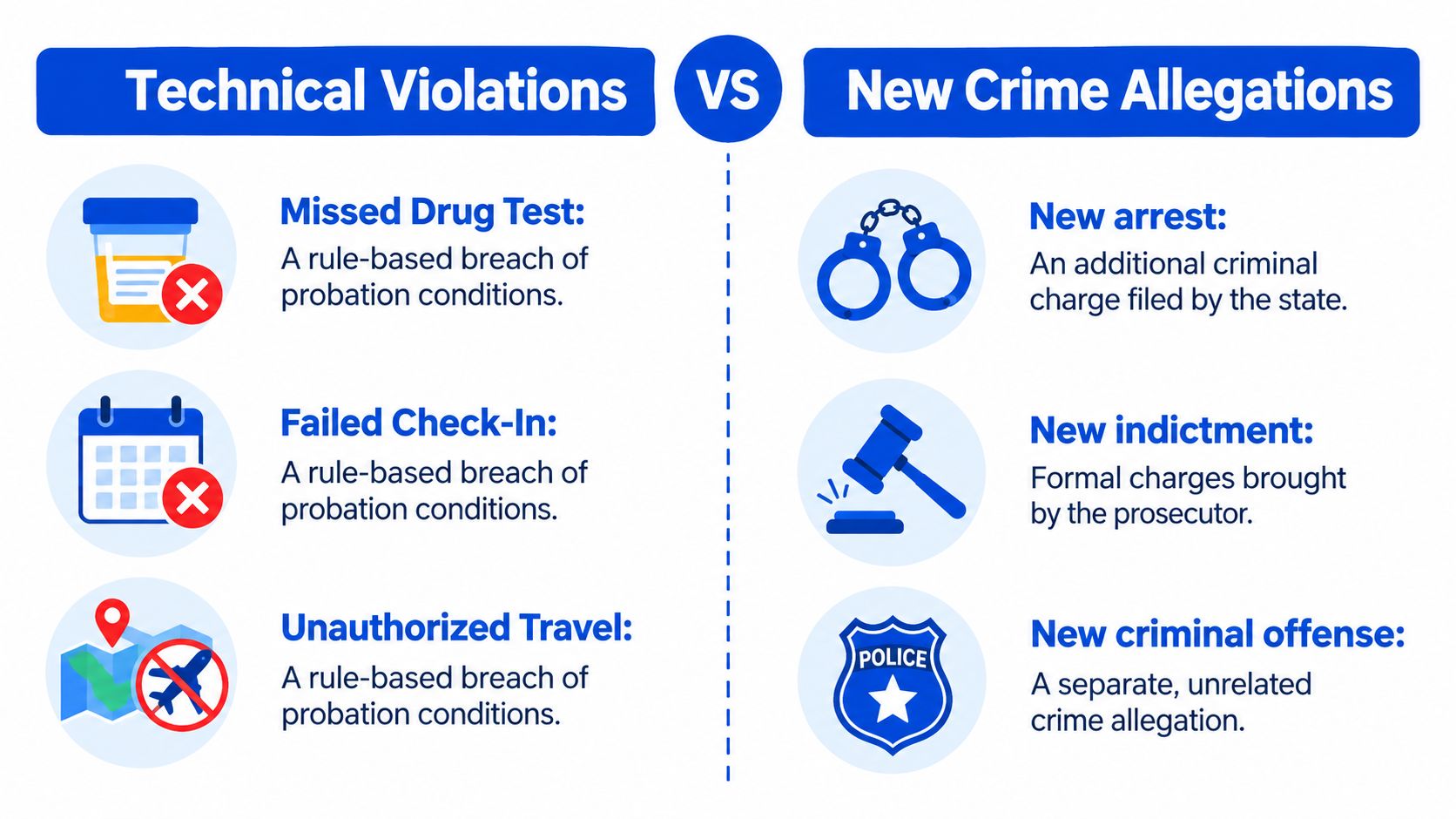
Most bad advice in this area starts by lumping everything together. That's a mistake. The first question is simple. Are you accused of a technical violation or a new-law violation?
What counts as a technical violation
A technical violation is a breach of supervision rules rather than a separate criminal offense. Florida law identifies technical violations to include missed drug tests, missed appointments, curfew issues, unpaid restitution, and unreported address or job changes, and for a first low-risk technical violation the court generally must modify or continue probation rather than send the person to state prison, with jail capped at 90 days in county jail under section 948.06.
That category matters because Florida has moved toward graduated responses for lower-risk conduct. Under section 948.06(8), a probation officer may offer alternative sanctions for a first or second low-risk violation within the same term, and statewide reporting showed that 42 percent of probation-violation admissions in 2021 were for technical violations, as summarized in this review of Florida probation violation law and practice.
If your allegation involves missed reporting, a failed test, travel without permission, or another rule-based issue, defense planning should start there. This overview of technical probation violations is useful background, but the work is matching the facts to the exact probation condition and showing whether the violation was willful and substantial.
What changes when there's a new arrest
A new-law violation is different. The State claims you committed a new criminal offense while on supervision. That doesn't mean the prosecutor has to win the new criminal case first.
Florida appellate law recognizes that a probation violation can be found under the lower hearing standard even where the conduct would not support a criminal conviction beyond a reasonable doubt, as discussed in this Florida appellate decision. That's why a defense built only around “the new case isn't proven yet” often falls short.
How to classify your case fast
Use these questions:
Was there a new arrest or only a rule breach?
Which written probation condition does the officer say was violated?
Is the allegation about conduct, or about money owed?
Is this the first low-risk issue in the current term, or a repeat problem?
A Florida probation violation defense gets stronger when the case is categorized correctly on day one.
From Arrest to First Appearance How the Process Moves
Once a violation pickup is authorized, the case can move fast and feel confusing. Families often hear fragments. There's a warrant. There's no bond. He's waiting to see a judge. All of that may be true at once.
The usual sequence
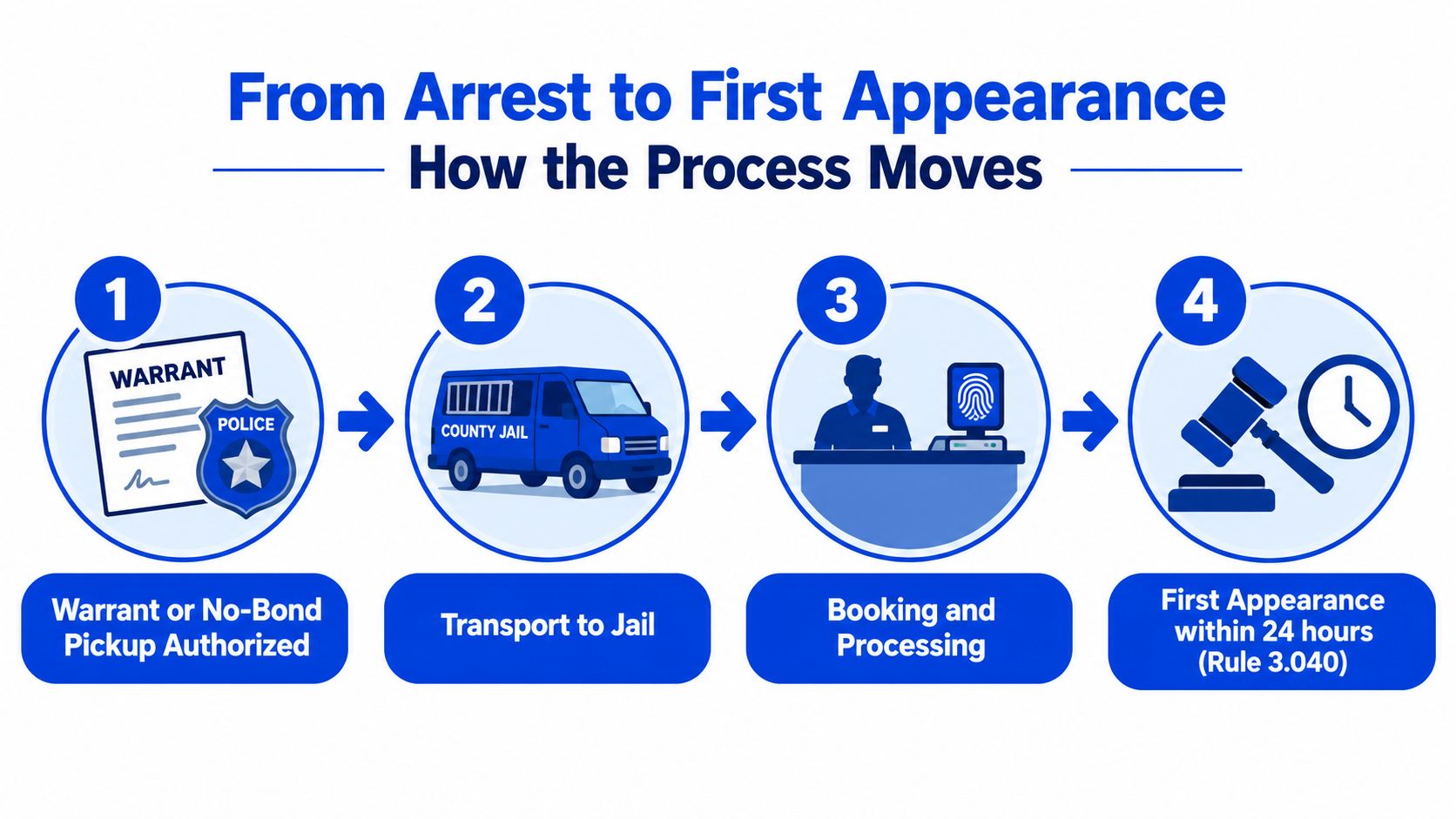
In practice, the path usually looks like this:
Pickup authority is issued. That may be based on an affidavit of violation and a warrant, or a no-bond hold tied to the supervision case.
Transport and booking follow. The person is taken to jail, processed, and held for first appearance.
The court addresses status early. First appearance is where the judge reviews the matter and the custody issue becomes immediate.
The violation hearing is set later. That later hearing is where the evidentiary fight happens.
If you want a broader overview of the custody side, this guide on what happens after arrest helps place the probation hold in context.
This visual gives a quick sense of the timeline many families are trying to understand in the first hours after pickup.
What matters early
The first appearance isn't the final hearing on guilt. It's the point where a lawyer starts shaping the court's view of the case, the client, and the risk. Early bond review arguments can matter, especially when the alleged violation is technical, the client has community ties, or there's immediate documentation showing compliance efforts.
The document that drives the case is usually the affidavit of violation. Read it carefully. Dates, wording, and the exact condition cited all matter. Small errors don't automatically end the case, but vague allegations often create room to push back.
Early review changes cases. A weak affidavit looks stronger after the officer has time to clean up the story.
A Florida probation violation case often turns on what counsel does before the hearing date hardens. Waiting usually helps the State.
Inside the Violation Hearing Burden of Proof and Your Rights
A probation violation hearing is a judge-run evidentiary hearing. There is no jury, and that changes how cases are won.
The State's burden is lower, but it still matters
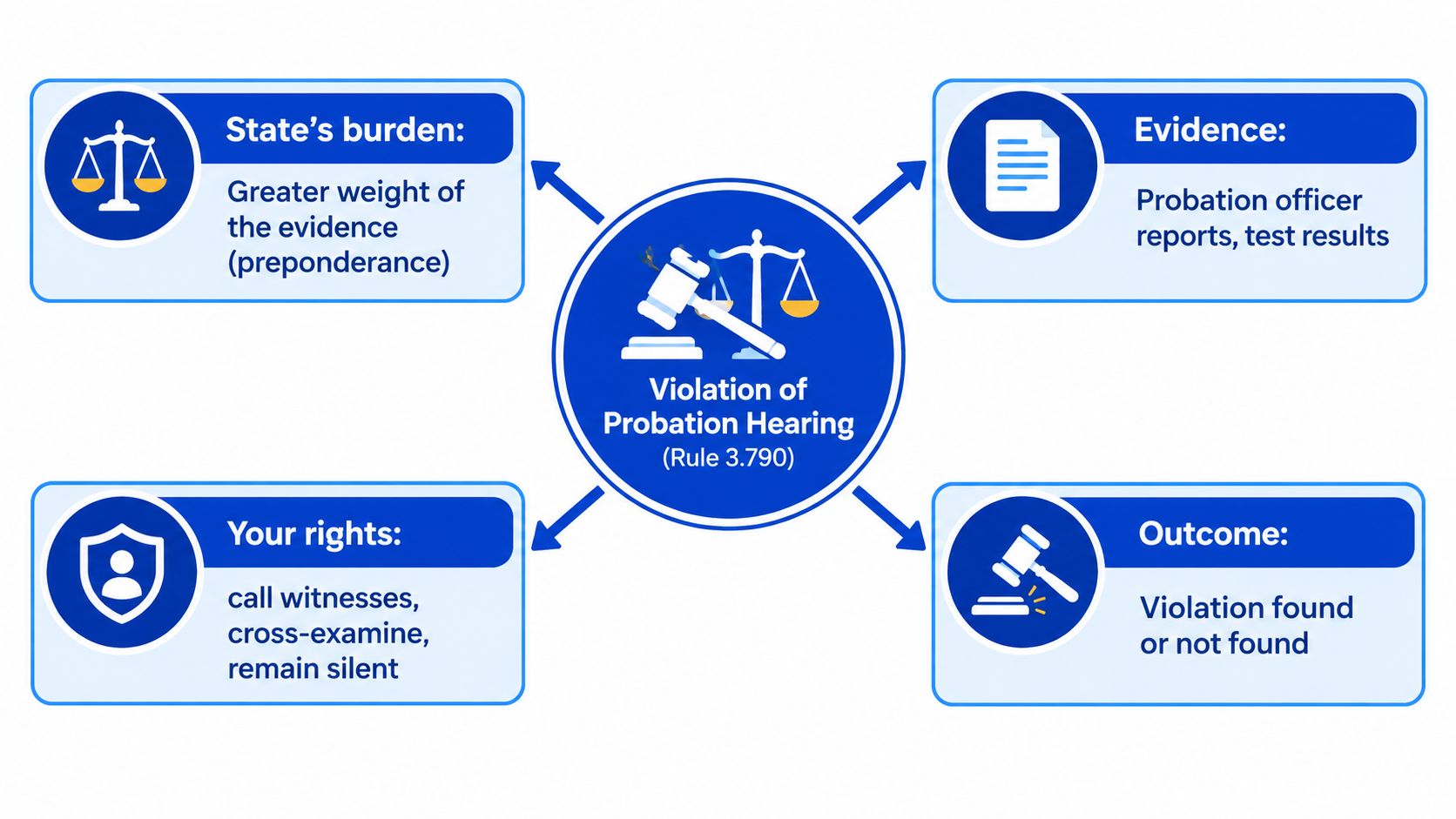
In a Florida probation violation hearing, the State must prove a willful and substantial violation by the greater weight of the evidence, as recognized in Florida appellate authority on probation revocation. That is a lighter burden than beyond a reasonable doubt, which is why many people underestimate the danger.
Still, lower burden does not mean easy win for the State. On a technical violation, the fight is often over willfulness. Did the person choose not to report, refuse treatment, or skip payment despite having the ability to comply? Or was there a hospital stay, a transportation failure, a bad address on file, or a genuine inability to pay? Those facts matter.
New law allegations follow a different path. A fresh arrest may trigger the violation, but the revocation hearing is still about whether probation was broken under the lower standard, not whether the new criminal case can be proven at trial.
Your hearing rights matter if you use them
As noted above under Rule 3.790, if the violation is denied, the defense can be heard through counsel, present witnesses and documents, and cross-examine the State's witnesses. Many probationers are surprised by that. They expect a quick administrative decision. The hearing is more formal than that, and preparation shows.
If you need a plain-English overview of how a court hearing works, this guide on what a motion hearing in court involves gives useful background, even though a violation hearing follows its own rules.
One caution from practice. Rights that are not backed by records rarely carry much weight. Judges hear explanations every day. They respond better to treatment intake letters, payment histories, text messages, work schedules, GPS data, and live witnesses who can answer questions without guessing.
What moves the judge
Judges usually start with the affidavit, the officer's testimony, and whether the violation looks deliberate or fixable. In many courtrooms, the central question is simple. Is this person refusing supervision, or struggling with a condition that can be corrected?
Several points tend to carry real weight:
A defect in proof. The wrong condition is cited, the dates do not match, or the witness lacks firsthand knowledge.
A non-willful explanation. The client missed a requirement, but the reason is documented and credible.
A technical violation with a correction plan. Treatment is already scheduled, missed costs are being paid, or reporting problems have been fixed.
The difference between a new crime allegation and a true technical breach. Judges often treat those tracks differently, and defense counsel should too.
Credibility. A focused admission with a concrete plan can beat a weak denial that falls apart on cross-examination.
Judges want proof, not promises.
That leads to one of the hardest calls in these cases. Sometimes the right move is to contest the violation and force the State to prove willfulness. Sometimes the better move is to admit a narrow technical violation, reject overstatements in the affidavit, and present a structured mitigation package that gives the court a safe reason to continue or modify probation instead of revoking it.
That choice is case-specific. A new-law allegation, a repeat noncompliance pattern, or a bad hearing witness can change the calculus fast. A good defense lawyer does not treat every violation the same, because Florida courts do not treat them the same either.
Graduated Sanctions and Possible Penalties in Florida
Florida does not treat every probation violation as a one-way trip to prison. The statute and the practice are more layered than that, especially for lower-risk technical issues.
A 2022 justice-reinvestment analysis reported that Florida's revocation rate had consistently hovered near 48 percent since 2012, and from 2010 through 2019, 57 percent of all revocations were driven by technical violations rather than new criminal offenses. The same analysis noted that substance use-related violations were the largest revocation-linked category in 2019 at 13 percent of all violations among revoked people, according to this summary of Florida revocation patterns and section 948.06. Those numbers explain the stakes, but they also explain why the system has shifted toward more specific responses.
What the sanction ladder looks like
For lower-level technical problems, the response may include:
Warning or counseling. Sometimes the first goal is correcting the conduct.
Added supervision conditions. More reporting, tighter curfew terms, or treatment requirements.
Short jail exposure. For a first low-risk technical violation, county jail may be in play, but the statute limits how far that can go.
Modification or continuation. Judges often look for a way to keep supervision in place with stricter terms.
Revocation and resentencing. This becomes more likely with repeated, serious, or poorly explained violations.
For a practical look at custody risk, this article on probation violation jail time gives useful context.
Florida Probation Violation Sanction Ranges
Violation Type | Low-Risk Offender | Moderate-Risk Offender | High-Risk or Repeat Violator |
|---|---|---|---|
Technical violation | Continued probation, modification, alternative sanctions, short county jail exposure if permitted | Stricter supervision, added treatment, more restrictive conditions, possible jail sanction | Higher revocation risk, longer jail exposure, resentencing risk |
New-law violation | Case-specific review, possible hold, strong scrutiny from the court | Serious revocation exposure, especially if facts suggest danger or repeated noncompliance | Highest revocation and resentencing risk |
Nonpayment allegation | Ability-to-pay litigation can block revocation if nonpayment wasn't willful | Court often demands records showing effort, resources, and expenses | Revocation risk rises if the court finds deliberate refusal rather than inability |
What judges usually weigh
Not every circuit handles these cases in exactly the same way. Some judges rely heavily on structured sanction practices. Others exercise broad discretion.
The practical factors tend to be familiar:
Original offense matters. A probationer on a serious felony starts from a tougher position than someone on a lower-level case.
History matters. Repeat violations are harder to explain away.
Supervision performance matters. Long stretches of compliance can help.
Risk category matters. Florida's statutory framework recognizes lower-risk technical violations differently from more serious conduct.
A Florida probation violation defense gets better when it presents the judge with a sanction short of revocation that still protects the court's authority.
Defense Strategies That Actually Move Judges
A violation hearing usually turns on one question. Can the defense give the judge a reason to keep control of the case without revoking probation?
Judges hear apologies all day. What changes outcomes is a theory that fits the allegation, documents that back it up, and a sanction plan that addresses the court's concern. The strongest defense in a Florida probation violation case is rarely a general plea for mercy. It is a targeted answer to the specific pipeline the case is in: technical violation, new-law allegation, or nonpayment.
Technical violations need a willfulness defense or a correction plan
For a technical allegation, I look first at whether the conduct was willful and substantial, and second at whether the problem has already been corrected. Those are different arguments, and good defense work often uses both.
A missed appointment caused by an ER visit is different from skipping reporting for weeks. Confusing instructions, transportation failures, work conflicts, and treatment intake delays can matter, but only if the record proves them. Judges usually want to see that the person tried to comply, notified someone, or fixed the issue before coming to court.
Helpful proof includes:
Medical records tied to the missed date
Work records showing hours, schedule changes, or out-of-town assignments
Phone logs, texts, or voicemails showing attempts to report or reschedule
Program intake records showing treatment or classes started before the hearing
Receipts or confirmations for completed make-up conditions
The practical choice is whether to fight the allegation outright, concede a lapse but contest willfulness, or present a correction plan that gives the judge a workable middle ground. A vague promise to do better usually goes nowhere.
New-law violations call for a two-file strategy
A new arrest changes the posture fast. The probation case may move before the new criminal case is resolved, and the rules are different enough that a weak criminal case can still create real revocation risk if handled carelessly.
The defense has to evaluate both files together. Sometimes the right move is to attack the underlying facts early, especially if probable cause is thin or the witness history is bad. Sometimes the better move is to protect the client's statements, slow the violation hearing where possible, and avoid locking in testimony that hurts the new case.
Judges tend to focus less on broad mitigation here and more on whether the alleged conduct shows danger, disregard for supervision, or a pattern. That means the hearing strategy should be disciplined. Loose explanations can do more harm than silence.
Nonpayment cases are won or lost on records
Financial violations are often defended poorly because people assume inability to pay speaks for itself. It does not. Once the State proves nonpayment, the probationer must prove by clear and convincing evidence that he or she lacked present resources despite bona fide efforts to obtain them, and revocation requires an inquiry into ability to pay and a finding of willfulness under Florida Statute 948.06.
That shifts the work to documentation. Judges want to see what money came in, what necessary expenses had to be paid, what efforts were made to find work, and whether any partial payments were attempted. A person who paid something, kept records, and can show job searches stands in a much better position than someone who arrives with a bare claim of hardship.
The file should usually include:
job applications, interview records, and rejection emails
pay stubs, termination notices, or reduced-hours documentation
rent, utility, medical, childcare, and transportation expenses
proof of partial payments, borrowed funds, or attempts to make arrangements
Organization matters. Inability can be defended. Indifference is much harder to sell.
Credibility and a realistic ask often decide the close cases
Many hearings are not won by dramatic cross-examination. They are won by making the judge comfortable with a narrower response than revocation. That can mean tightening conditions, extending probation, adding treatment, imposing community service, or addressing a short lapse with a specific compliance plan.
That is where experience matters. An experienced practitioner will review the probation order, the alleged violation, and the supporting records before mapping out a hearing strategy. That includes counsel at Ticket Shield, PLLC, when that office is being considered for representation.
The goal is simple. Give the judge a lawful, documented reason to choose control over revocation.
Immediate Steps to Protect Yourself Before Your Hearing
The days right after an alleged violation matter more than most realize. Violation hearings often turn on documents that clients could have preserved easily but didn't.
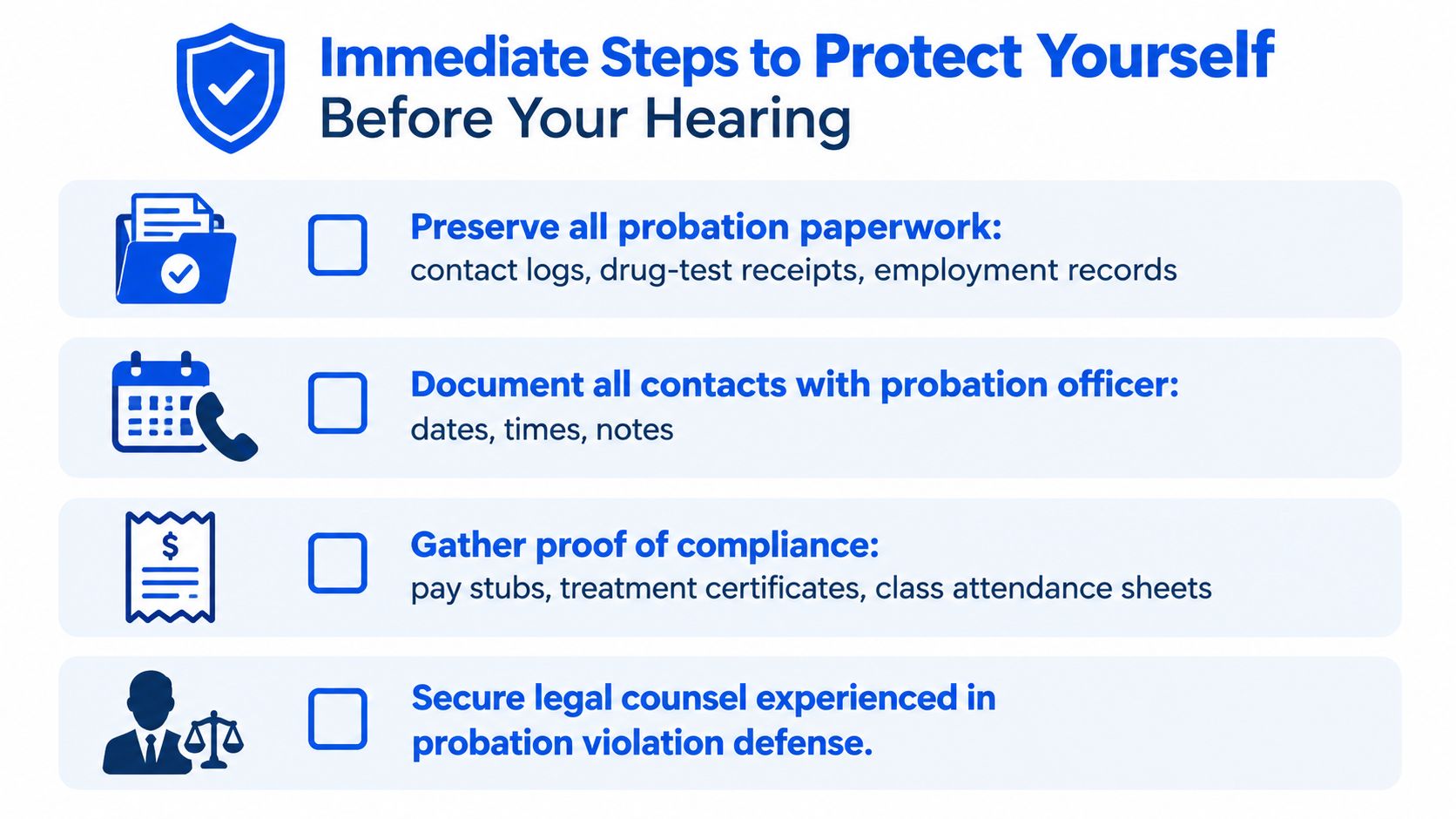
First things to do
Start building your file immediately.
Preserve every probation record. Save reporting instructions, payment receipts, treatment attendance sheets, test results, screenshots, and call logs.
Write a clean timeline. Dates, times, locations, and who said what. Keep it factual.
Stop casual talking. Don't try to explain the case to the officer, friends tied to the case, or alleged victims.
If the issue involves testing, this page on a probation violation drug test can help you think about the records and explanations counsel will want to review.
A short pre-hearing checklist
Use the time window wisely:
In the first 24 hours
Get booking information, preserve your phone records, and notify family where paperwork can be found.During the first week
Collect letters from employers, treatment providers, or family members who can speak to stability and compliance.In the week before court
Review the affidavit line by line with counsel, organize exhibits, and avoid any new police contact at all costs.
Bring your lawyer the probation order, violation paperwork, criminal case documents, proof of residence, proof of work, and any treatment records. A Florida probation violation case usually gets stronger when the defense file is built before the hearing instead of during it.
What a Strong Defense Can Realistically Achieve
A strong defense does not promise miracles. It aims for the best realistic outcome the facts will support.
In many technical cases, that may mean continued probation, added conditions, tighter reporting, treatment, or a structured modification instead of revocation. In a nonpayment case, it may mean proving inability to pay rather than letting the court mistake poverty for defiance. In a new-law violation, the goal may be limiting the damage, coordinating the underlying criminal defense, and presenting a safer alternative to full resentencing.
What usually shapes the outcome is straightforward. The judge looks at the original offense, prior compliance, the quality of the probation officer's testimony, the strength of the documents, and whether the defense offers a credible plan the court can live with.
The best next step is also straightforward. Stop talking about the facts casually. Start gathering records. Get legal advice before the hearing date locks your options into a weaker posture.
Ticket Shield, PLLC represents people facing Florida probation violation allegations in Broward County, Fort Lauderdale, Miami-Dade, Palm Beach, and surrounding South Florida courts. If you need a lawyer to review the violation affidavit, assess defenses, and prepare for the hearing quickly, visit Ticket Shield, PLLC to request a confidential consultation.