
RICO Charge Meaning: What It Really Means in Florida
Jason Goldsmith, Esq
You're at your kitchen table in South Florida, rereading a text from someone you used to know. Then you learn investigators are asking about that person, your messages, and a group you haven't spent time with in years. Someone mentions racketeering, and suddenly you're searching for RICO charge meaning while trying to figure out whether you need a lawyer.
You need a clear answer, not a movie reference. A RICO accusation concerns how prosecutors connect people, an alleged enterprise, and criminal conduct. Your defense starts by separating what investigators say the group did from what they can prove about you.
Table of Contents
When a RICO Charge Actually Shows Up in Florida
Consider a hypothetical Fort Lauderdale resident who occasionally drove an acquaintance to meet other people. Investigators later suspect those meetings involved drug transactions. They want to know whether the driver understood the purpose, received money, or helped coordinate what happened.
The resident remembers giving rides. Investigators may interpret messages and payments differently. That difference is exactly why you shouldn't try to resolve the investigation through an informal conversation at your front door.
A racketeering investigation might come to your attention through questioning, an arrest, charging paperwork, or a subpoena. If someone mentions a sealed filing, don't guess about its contents. Ask counsel to determine what information is available and what remains unknown.
Start with the paperwork, not the rumor
If you receive a grand jury subpoena, preserve the document and get advice about its demands before responding. Don't assume receiving it means you've been charged, and don't assume it means you have no exposure.
For a first attorney meeting, gather:
Official documents: Bring subpoenas, charging papers, search paperwork, and any release conditions.
Contact details: Record which agency contacted you and what the investigator requested.
Original communications: Preserve messages and accounts without deleting, editing, or coordinating explanations with anyone else.
Florida's racketeering framework requires attention to the alleged enterprise or prohibited activity, not merely a collection of unrelated accusations. The governing provisions appear in Florida's RICO chapter.
Practical rule: Preserve what exists. Don't create new evidence by arguing about the investigation in a group chat.
Whether you're in Broward County, Miami-Dade, or Palm Beach, start with the same question: What exactly do prosecutors allege I did? Fear won't answer it. The charging documents and evidence review will.
What RICO Actually Means Under Federal Law
RICO stands for the Racketeer Influenced and Corrupt Organizations Act. In plain English, the federal law addresses certain ways people use an enterprise, its operations, or criminal proceeds in connection with racketeering activity. It isn't another name for committing several crimes.
Think of a sports team. The team is the organization, individual plays are separate events, and each participant has a role. For the analogy to help explain RICO, prosecutors must connect qualifying criminal acts to the enterprise and the legally prohibited conduct. Wearing the same jersey isn't the whole case.
Congress enacted federal RICO on October 15, 1970, as Title IX of the Organized Crime Control Act, primarily to combat organized criminal enterprises. Its reach extends beyond traditional Mafia cases, as reflected in Cornell's overview of the federal RICO Act.
Translate the vocabulary before evaluating the accusation
Enterprise: The organization or associated group involved in the alleged conduct.
Predicate act: An underlying offense that qualifies under the statute, rather than just any alleged wrongdoing.
Prohibited participation: The particular way prosecutors claim someone conducted enterprise affairs, acquired interests, invested proceeds, or joined a prohibited agreement.
This visual provides a vocabulary guide, not a substitute for the statutory requirements.

The phrase corrupt influence in a diagram shouldn't distract you from the actual charge. Counsel needs to identify the specific statutory theory, not defend against a general impression of wrongdoing.
Federal RICO also permits civil claims for qualifying injuries to business or property. Successful plaintiffs may recover three times their actual damages, plus costs and attorney's fees, under the federal Act linked above. That's separate from the criminal prosecution discussed here.
The useful takeaway is straightforward: ask which enterprise, which qualifying conduct, and which form of participation prosecutors allege. Those questions turn a frightening label into an accusation your attorney can evaluate.
The Five Elements the Government Has to Prove
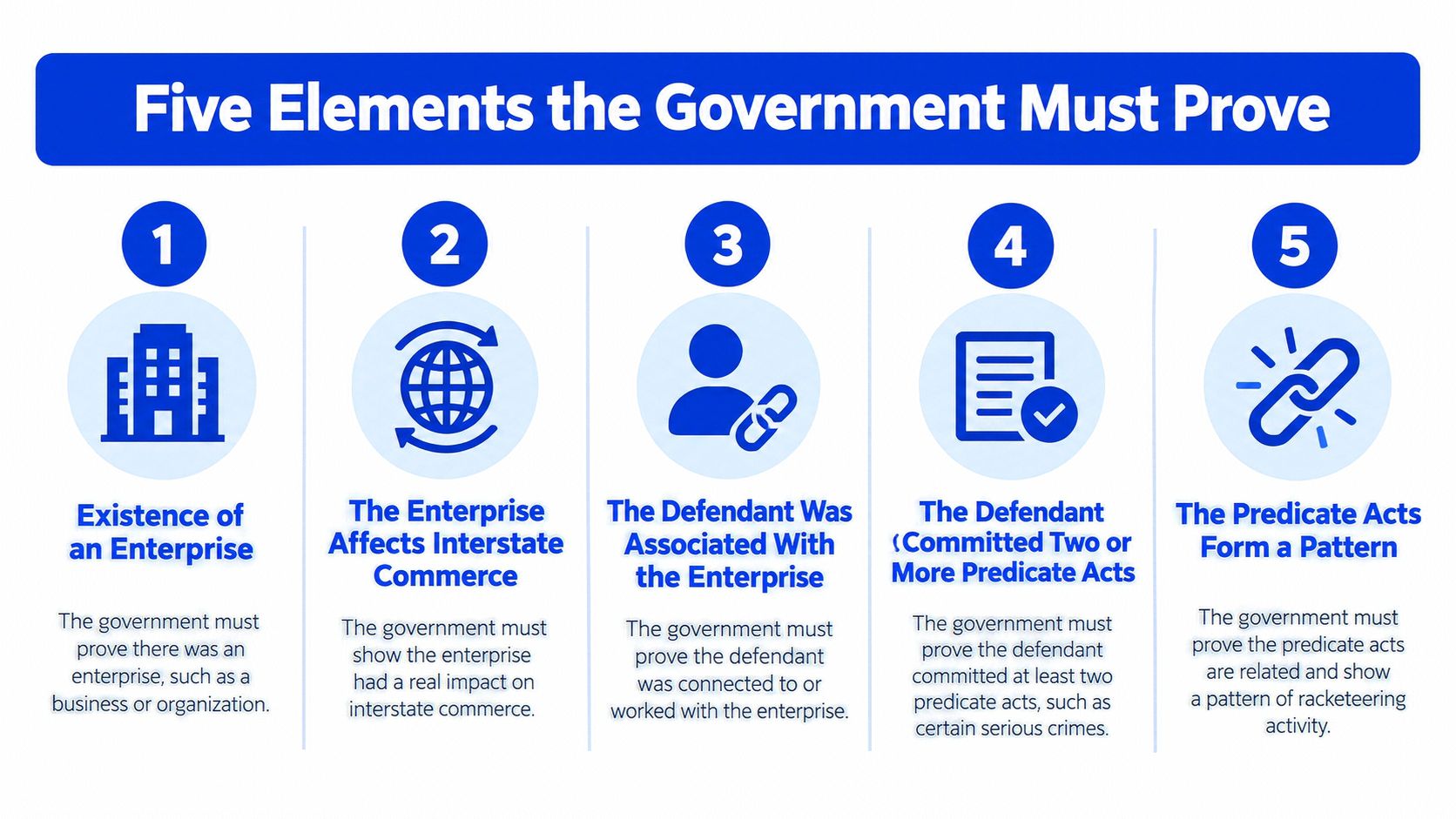
For the central federal participation theory under 18 U.S.C. § 1962(c), the Department of Justice identifies the required enterprise, commerce connection, association, participation, and supporting racketeering acts. Its explanation requires at least two racketeering acts within ten years of one another, as described in the DOJ's RICO charging guidance.
These are federal requirements. Don't automatically substitute them for the elements of a Florida state charge.
Examine each requirement separately
An enterprise existed. Prosecutors must identify the enterprise they claim existed. A defense review should ask what evidence establishes the alleged group's relationships and operation, rather than accepting a label attached to everyone named in the case.
The enterprise affected interstate or foreign commerce. This is a distinct federal requirement. Counsel should identify the government's actual commerce evidence instead of assuming that a serious accusation supplies the connection.
The defendant was employed by or associated with the enterprise. Records, testimony, or communications might be offered to establish association. The defense should distinguish what those materials show from what prosecutors infer.
The defendant participated in conducting its affairs through a racketeering pattern. Ask what conduct supposedly establishes your role. Being acquainted with someone and participating in enterprise affairs are different propositions.
Qualifying acts supported the alleged pattern. Counsel should examine the underlying offenses, dates, identification evidence, and connection to the charged theory. The threshold described above doesn't eliminate the need to establish a legally sufficient pattern.
The checklist helps organize the issues, but the indictment's exact theory controls the analysis.
Match evidence to an element
A useful defense worksheet pairs each allegation with the supporting evidence and the unanswered question. A message might establish that you knew another defendant without establishing what you knew about a transaction.
Likewise, a payment needs context. Was it reimbursement, legitimate business income, or proceeds prosecutors connect to alleged criminal conduct? Counsel should demand the records necessary to test that interpretation.
Don't let the size of a case substitute for element-by-element proof. A lengthy indictment still needs a defensible explanation of your alleged conduct. Ask your lawyer to identify the strongest evidence against you, the weakest required connection, and what additional material is needed before discussing resolution.
How Florida's RICO Statute Compares to the Federal Law
The first distinction is practical: a Florida RICO prosecution isn't a federal prosecution because everyone calls it RICO. Your lawyer needs to identify the court, charging authority, statutory subsection, and alleged underlying conduct.
Florida uses Chapter 895. Its definitions, prohibited activities, penalties, and related remedies must be read together. Don't apply a federal internet checklist to a state accusation and assume you've found either a complete defense or an inevitable conviction.
Federal RICO vs Florida RICO at a Glance
Issue | Federal RICO (18 U.S.C. §§ 1961–1968) | Florida RICO (Chapter 895) |
|---|---|---|
Governing framework | Federal racketeering statute | Florida's separate racketeering chapter |
Principal focus | Prohibited enterprise-related conduct, racketeering activity, and conspiracy | Prohibited activity under section 895.03, including racketeering activity or collection of unlawful debt |
Definitions | Federal statutory definitions | Section 895.02 |
Commerce analysis | Federal enterprise-commerce requirement | Analyze Florida's own statutory requirements rather than importing the federal test |
Penalty provision | Federal criminal penalty framework | Section 895.04 |
Related proceedings | Federal forfeiture and civil remedies | Civil remedies, investigative subpoenas, lien notices, and forfeiture-related procedures |
Florida's reference to unlawful debt matters. If that's the prosecution's theory, the attorney should analyze that allegation directly rather than treating every case as an identical predicate-act prosecution.
Your address doesn't identify the governing law
A Broward resident can't determine the forum merely from where they live. Nor should a Miami-Dade or Palm Beach family assume a locally investigated accusation will necessarily remain a state case. Read the actual paperwork and ask counsel to confirm the charging authority.
For federal analysis, an enterprise can include a corporation, partnership, association, or informal group, and the defendant's specific role needs separate examination. Cornell's explanation of federal RICO requirements describes that framework.
Ask your attorney to explain the charge using the statute printed on your paperwork, not the version of RICO you've seen in headlines.
The practical recommendation is to request a written charge summary. It should identify the alleged prohibited activity, the underlying conduct, the applicable definitions, and the remedies prosecutors seek. That gives you a reliable basis for decisions about motions, negotiations, and trial.
Penalties You Should Understand Before You Negotiate
Don't evaluate a plea by the prison term alone. Ask for a complete explanation of incarceration, financial penalties, forfeiture, and the treatment of every remaining charge.
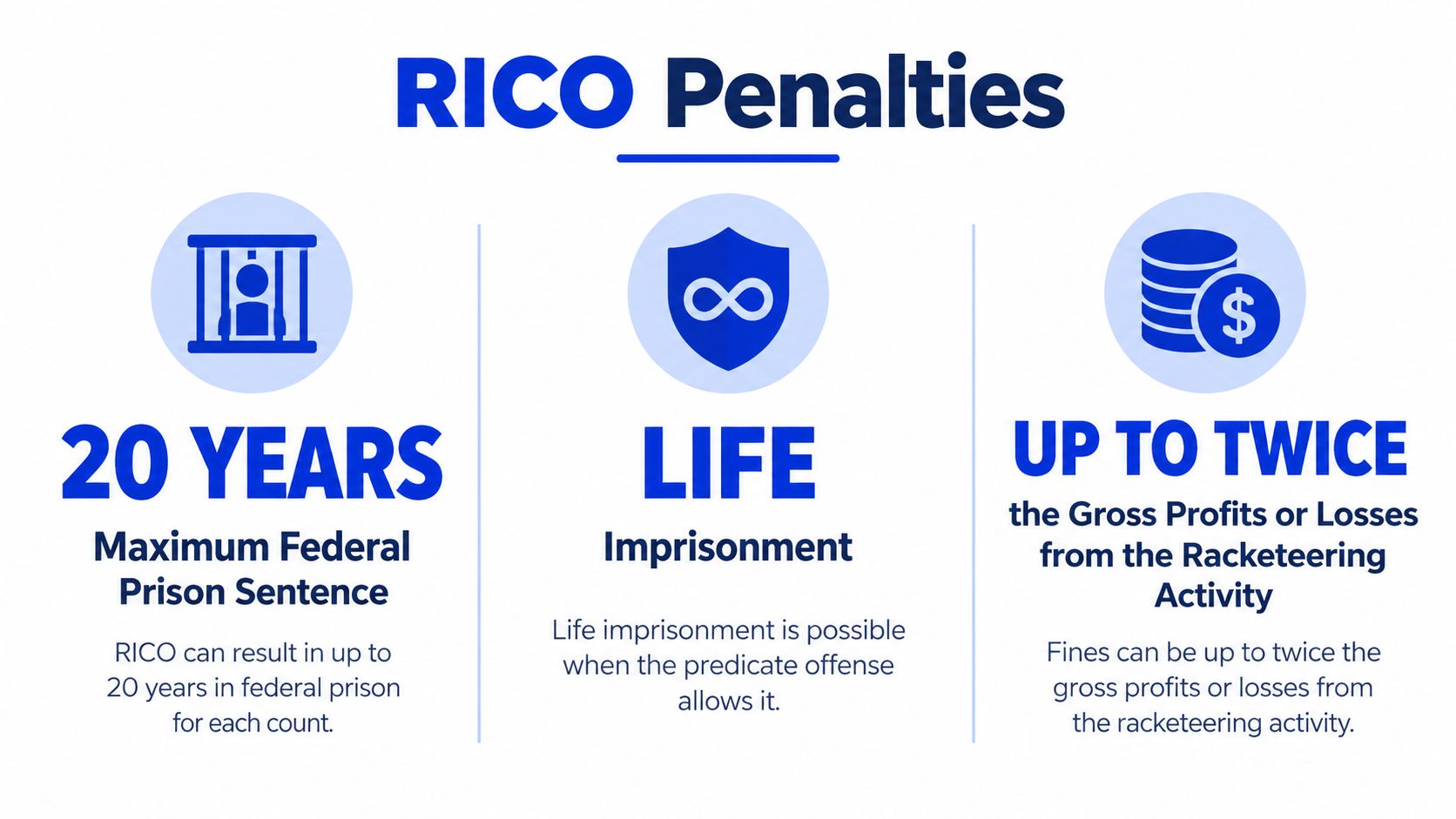
The federal penalty framework permits up to twenty years in prison, or life imprisonment when the qualifying predicate offense allows a life sentence. It also provides for forfeiture and monetary penalties that can reach the greater of twice the gross gain or twice the gross loss, with statutory fine amounts commonly identified as $250,000 for an individual and $500,000 for an organization, as explained in Congress's federal RICO legal overview.
The graphic summarizes federal exposure. It doesn't calculate an individual sentence.
Keep Florida's penalties separate
A violation of Florida section 895.03 is a first-degree felony, not a misdemeanor. Florida also authorizes an alternative fine reaching three times the gross value gained or three times the gross loss caused, whichever is greater, along with reasonably incurred court costs and investigation and prosecution expenses under Florida's RICO penalty provision.
For broader context on offense classifications, review how felonies work in Florida. Your attorney should still calculate exposure from your actual charges rather than a general summary.
Before accepting an offer, request:
A charge-by-charge explanation: Identify what would be dismissed, amended, or left pending.
An asset review: Identify the property sought and the alleged connection to the conduct.
A complete financial calculation: Examine the claimed proceeds, losses, and supporting records.
For a business owner, that means reviewing accounts and ownership records. For someone on probation, it means discussing the existing case alongside the new accusation. For a young adult, it means considering the whole proposed disposition, not just the earliest possible release date.
Use the video as a discussion prompt, not a substitute for individualized advice.
Why Two Crimes Do Not Automatically Mean RICO
Counting accusations isn't the same as proving a pattern. The meaningful federal questions are whether qualifying acts are related and whether they establish continuity or a threat of continued criminal activity. Congress's summary of RICO explains that distinction between a legally connected pattern and isolated events.
Consider these hypothetical South Florida fact patterns. They illustrate questions to investigate, not conclusions about anyone's guilt.
Coordinated conduct versus disconnected incidents
In the first scenario, investigators allege that people working through a Fort Lauderdale business repeatedly used a shared fraudulent method, divided responsibilities, and directed proceeds to a common destination. Counsel would examine whether the records support those claimed connections and an ongoing operation.
In the second, acquaintances allegedly commit separate offenses in Broward and Palm Beach. They know each other and appear in the same photographs, but the incidents have different purposes and no demonstrated operational connection. Those facts demand a different analysis.
Neither description resolves a Florida case without applying Florida's statutory definitions. But the comparison exposes the flaw in treating a list of accusations as self-proving.

Ask counsel:
What connects the conduct? Identify evidence of shared purpose, methods, participants, or operation.
What supports continuation? Examine the alleged ongoing activity rather than assuming repetition proves everything.
What connects me personally? Separate your conduct from the prosecution's description of everyone else.
An organized scheme to defraud allegation deserves its own analysis. Don't assume that label automatically establishes racketeering.
A conspiracy allegation also changes the inquiry. Federal RICO conspiracy can create exposure without proof that the accused personally committed every alleged predicate act, but prosecutors still must establish the legally required agreement and objective.
Defense priority: Challenge the alleged agreement on its own terms. Don't rely solely on saying someone else committed the underlying crimes.
Defense Strategies a Skilled Attorney Will Actually Use
A useful defense begins with an allegation chart, not a promise. Your lawyer should organize the asserted enterprise, your alleged role, the underlying conduct, the witnesses, and the records prosecutors rely on.
The first task is to test the organizing theory. If prosecutors describe a social circle as an enterprise, counsel should examine what evidence supports that description. If they combine separate incidents, counsel should test the alleged connections rather than argue only about whether you were present.
Build motions from specific defects
Challenge the charged theory: Identify missing allegations or unsupported connections. A drug accusation shouldn't escape scrutiny merely because prosecutors place it inside a larger racketeering narrative.
Review the evidence's legality and reliability: Examine search materials, device extractions, identification evidence, and witness accounts. Ask whether the records support the interpretation offered.
Evaluate separation or dismissal arguments: Counsel should assess whether the law and case record support severance, dismissal, or challenges to particular allegations.
Test financial tracing: Compare the property prosecutors seek with the transactions they attribute to criminal conduct. Don't concede that every deposit or jointly held asset belongs in the same category.
For a violent-crime or weapons allegation, the factual priority might be identity, possession, or the asserted connection to the group. For a theft allegation, it might be authorization, intent, or transaction records. Those priorities should come from the evidence, not a stock defense script.
Negotiate only after identifying leverage
Federal RICO's pattern requirement involves relatedness and continuity, while conspiracy requires analysis beyond personal commission of every act. Cornell's RICO legal overview) explains why those distinctions matter.
Your attorney should assess whether demonstrated weaknesses support seeking dismissal, a reduced charge, a narrower financial demand, or a trial defense. None is automatic.
Reviewing different types of criminal defenses can help you prepare questions. The recommendation is simple: ask which defense fits your evidence, what could undermine it, and what work remains before making a plea decision.
Questions Floridians Ask After Hearing the Word RICO
Can I face RICO allegations without being a mob boss?
Yes. The enterprise framework isn't limited to traditional organized crime. Your next step is to ask counsel to identify the enterprise alleged in your case and explain your supposed role, without accepting the prosecution's label as proof.
What if I'm already on probation?
Tell your lawyer immediately and provide the probation order, conditions, and any violation paperwork. Ask for coordinated advice about both matters before discussing the facts with investigators or making decisions in the new case.
Don't assume resolving the racketeering accusation will answer every question about your existing supervision. Have counsel address each pending matter expressly.
Can a RICO charge be dropped or reduced?
Counsel can evaluate whether the evidence and applicable law support seeking dismissal or negotiating a reduced accusation. No responsible attorney can promise that result before reviewing the case.
If negotiations are appropriate, understand how plea bargaining works and request a plain-English explanation of the proposed disposition. Ask what you're admitting and what remains unresolved.
What should I do immediately after learning I'm a target?
Preserve evidence and get legal advice before discussing the allegations. Keep your phone, messages, account records, and paperwork intact. Don't delete conversations, contact witnesses to compare stories, or ask someone else to clean up an account.
Ask for counsel before answering substantive investigative questions. Don't discuss case facts on recorded calls or assume a conversation with another accused person will remain private.
Make a factual timeline for your lawyer and identify records that might supply context. The objective isn't to construct a story. It's to help counsel test the accusation against the original evidence.
Ticket Shield, PLLC offers free consultations, direct attorney access, and defense planning informed by former prosecutor Jason S. Goldsmith's experience. If you're facing a RICO investigation or charge in Broward County, Fort Lauderdale, Miami-Dade, Palm Beach, or surrounding South Florida communities, visit Ticket Shield, PLLC to arrange a review of your paperwork, alleged role, and immediate defense options.