
Can You Refuse a Breathalyzer Test in Florida?
Jason Goldsmith, Esq
Yes, you may technically refuse a requested breath or blood test after a lawful Florida DUI arrest, but a first refusal generally causes a one-year administrative license suspension, a prior refusal causes an 18-month suspension, and Florida law also treats refusal as a separate misdemeanor offense. Refusing is not a clean way out of a DUI case.
Why do so many drivers assume that refusing automatically defeats the prosecution? The machine may not produce a blood-alcohol number, but Florida can still pursue your driving privileges, prosecute the refusal, and use other evidence in the underlying DUI case. After an arrest in Fort Lauderdale, Broward County, Miami-Dade, Palm Beach, or elsewhere in South Florida, those consequences move on separate tracks.
The immediate priority is not to argue with the officer or try to explain what happened. It's to identify the deadlines, preserve the evidence, and have a Florida criminal defense attorney evaluate the arrest, the warning, the alleged refusal, and the DUI evidence together.
Table of Contents
The Direct Answer for Florida Drivers
An officer has just told you to blow into a testing machine or face a longer suspension. You want a simple answer: can you refuse a breathalyzer test in Florida?
Yes, but refusal carries serious consequences. Florida treats a first refusal after a lawful DUI arrest as grounds for a one-year administrative license suspension. A second or subsequent refusal generally produces an 18-month suspension. Florida law also makes refusal a separate criminal misdemeanor, apart from the underlying DUI charge. The statutory framework appears in Florida's implied consent statute.
That means you aren't choosing between “take the test and get a DUI” or “refuse and go home.” You're choosing how the State may build several parts of its case. A refusal may deprive prosecutors of a breath-test result, but it doesn't erase the officer's observations, field sobriety evidence, video, statements, or other proof. It also doesn't prevent the Department of Highway Safety and Motor Vehicles from pursuing an administrative suspension.
Two cases begin at once
The license case is handled administratively. It can move quickly, often before you've had meaningful contact with the criminal court. The criminal case is prosecuted separately and may include both the DUI count and a distinct refusal charge.
A first refusal is a second-degree misdemeanor. A later refusal is a first-degree misdemeanor, which can expose a driver to up to one year in jail and a $1,000 fine, as explained in this Florida DUI law overview.
Practical rule: Treat the suspension deadline and the criminal charge as separate emergencies. Protecting one doesn't automatically resolve the other.
The most important fact after a refusal is the date of arrest. Florida drivers generally have 10 days from that date to request a formal review of the administrative suspension. Missing that deadline can make the suspension automatic, regardless of whether the criminal DUI charge is eventually reduced or dismissed.
How Florida Implied Consent Works
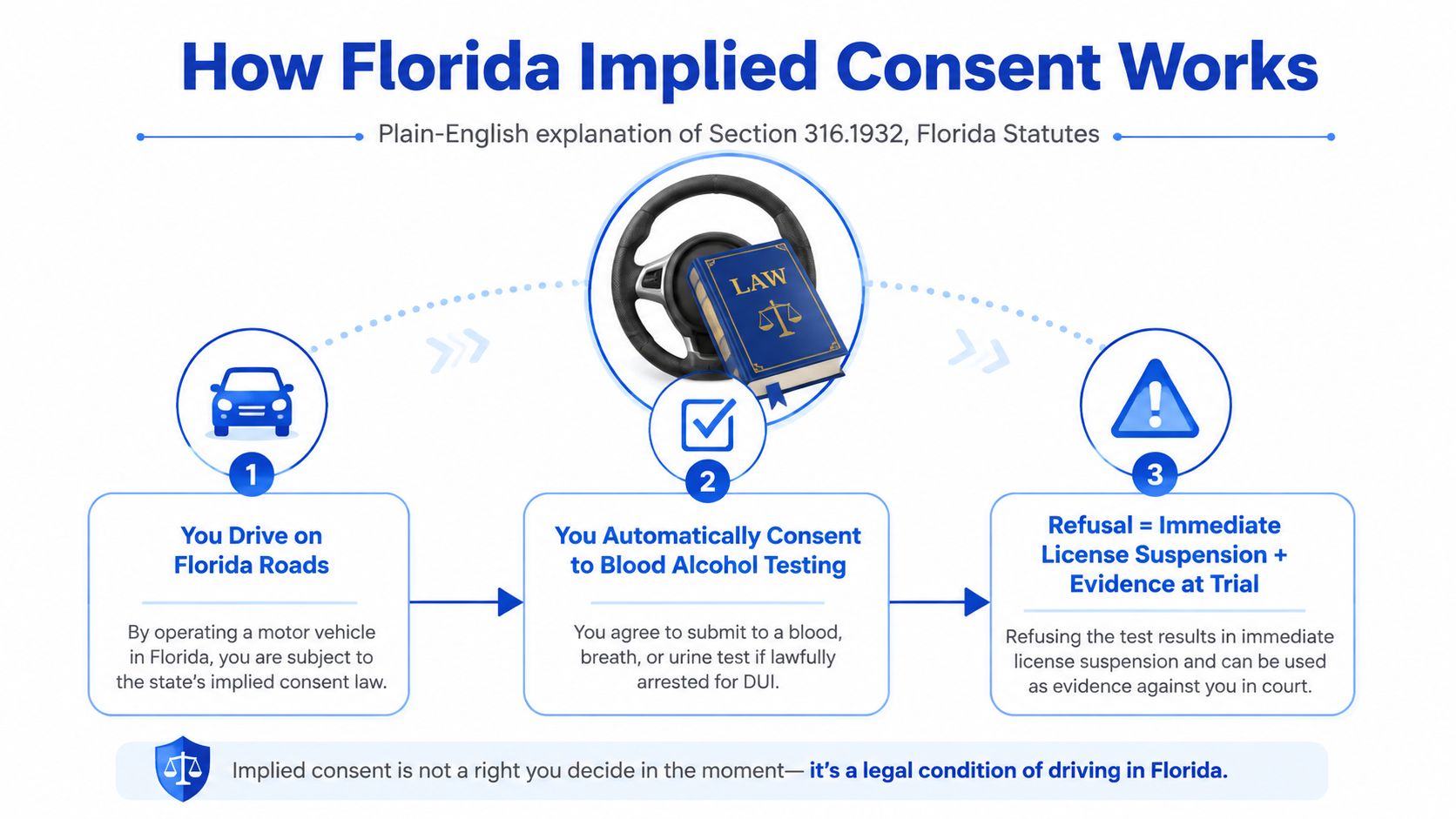
The phrase “implied consent” doesn't mean an officer can demand any test at any time. It means Florida makes chemical testing a legal condition of driving for a person who has been lawfully arrested for DUI under the circumstances defined by statute.
Florida's law provides that a driver has consented to testing of breath, blood, or urine when an officer has the required basis and makes a lawful request after arrest. The consent comes from using the privilege of driving on Florida roads. It isn't a contract you signed at the roadside, and it doesn't eliminate the need for the officer to follow constitutional and statutory rules.
The timing of the request matters
A roadside encounter and a post-arrest chemical test aren't the same event. Before arrest, an officer may ask you to perform field sobriety exercises or blow into a portable roadside device. Those requests raise different legal questions and aren't automatically governed by Florida's post-arrest implied-consent penalties.
The official chemical test requested after a lawful DUI arrest is the critical point. A lawful arrest generally requires probable cause to believe the person drove or was in actual physical control of a vehicle while impaired. If the officer lacked a legal basis for the stop, lacked probable cause for the arrest, or requested the test before the required arrest, the defense may have grounds to challenge the refusal consequences.
Blood testing requires separate analysis. A blood draw may involve a warrant or a recognized statutory exception, especially where medical treatment, serious injury, or other urgent circumstances are involved. A driver's physical ability to refuse doesn't answer whether officers may later seek judicial authorization or rely on an exception.
The warning is part of the case
Before requesting the sample, the officer must advise the driver of the consequences of refusal. The exact wording, timing, and delivery matter. A warning that was incomplete, inaccurate, rushed, or given after the request may become important at the administrative hearing and in the criminal case.
Don't assume the officer's report settles the issue. Body-camera footage may show what the officer said, when the warning occurred, whether you appeared able to understand it, and whether the officer treated confusion or a medical problem as a refusal.
Administrative and Criminal Consequences
Florida's refusal system creates two parallel proceedings. They may involve the same arrest, but they have different decision-makers, procedures, deadlines, and objectives.
Issue | Administrative Suspension | Criminal Prosecution |
|---|---|---|
Who acts | Department of Highway Safety and Motor Vehicles | State Attorney's Office |
What is decided | Whether driving privileges should be suspended | Whether the driver committed refusal and the underlying DUI |
Trigger | Alleged refusal after a lawful DUI arrest | Formal criminal filing |
Deadline | Request a formal review within 10 days of arrest, as described in Florida administrative license suspension guidance | Court deadlines, arraignment dates, motions, and trial procedures |
Relationship to DUI | Independent of the criminal DUI outcome | Refusal charge and DUI charge are evaluated separately |
Possible result | Administrative suspension of driving privileges | Conviction, dismissal, reduction, probation, fines, or incarceration depending on the charge and facts |
The administrative track
The arresting officer submits paperwork describing the arrest and alleged refusal. The driver receives notice of the suspension and has a limited period to request a formal or informal review. For a refusal case, the 10-day deadline is critical.
If no timely review is requested, the suspension becomes automatic. Winning the criminal case does not automatically restore the license because the Department's action is separate from the prosecution.
The criminal track
Florida treats refusal as a distinct misdemeanor. The underlying DUI still proceeds using whatever evidence the State has, including driving behavior, officer observations, field sobriety performance, statements, video, and the circumstances of the arrest.
Fighting the suspension doesn't concede the DUI. Defending the criminal case doesn't preserve the license deadline. A coordinated strategy should address both records without making unnecessary statements that can be used in either proceeding.
Refusal Penalties and Required Warnings
Can refusing a lawful breath test really end the DUI problem? No. Florida's refusal rules create parallel tracks that must be evaluated together: the immediate administrative license suspension, the separate criminal refusal allegation, and the underlying DUI evidence. Treating refusal as one consequence can cause you to miss a deadline or overlook a defense.
A first lawful refusal generally causes a one-year administrative suspension and a second-degree misdemeanor. Under Florida's newer refusal law, that first refusal can carry up to 60 days in jail and a $500 fine. A second or subsequent refusal generally causes an 18-month administrative suspension and a first-degree misdemeanor, exposing the driver to up to one year in jail and a $1,000 fine.
Refusal Type | Administrative Suspension | Criminal Charge | Maximum Jail | Fines and Add-Ons |
|---|---|---|---|---|
First refusal | 1 year | Second-degree misdemeanor | Up to 60 days | Up to $500, plus other applicable consequences |
Second or subsequent refusal | 18 months | First-degree misdemeanor | Up to 1 year | Up to $1,000, plus other applicable consequences |
These penalties address the alleged refusal itself. They do not resolve the DUI charge. Prosecutors may still rely on driving behavior, officer observations, field sobriety performance, statements, video, and the arrest circumstances. Prior record, probation status, required programs, and ignition-interlock issues can also affect the case disposition.
The license case and criminal case require separate decisions. A challenge to the administrative suspension does not concede the DUI. Defending the criminal refusal charge does not preserve the license deadline. Each track also produces records that may affect the other, so statements and strategy should be coordinated before you respond.
Warning problems can change the analysis
Before requesting the test, the officer must explain the consequences of refusal. Review the warning for:
Timing: Was it given before the request, or only after the driver declined?
Accuracy: Did the officer correctly describe the administrative and criminal consequences?
Comprehension: Was the driver conscious, medically capable, and able to understand the warning?
Pressure: Did threats or misleading statements influence the alleged refusal?
Documentation: Does the report match body-camera footage and other records?
The State may pursue a refusal penalty even when the DUI evidence is disputed. It still must prove the legal requirements for the refusal allegation, and the same act should not create overlapping refusal punishments treated as separate refusals.
The warning is evidence, not background language. It may matter at the administrative hearing and in motions addressing the criminal refusal charge. For related roadside-exercise and officer-request issues, review these Florida sobriety test questions.
Protect Your License and Build a Defense
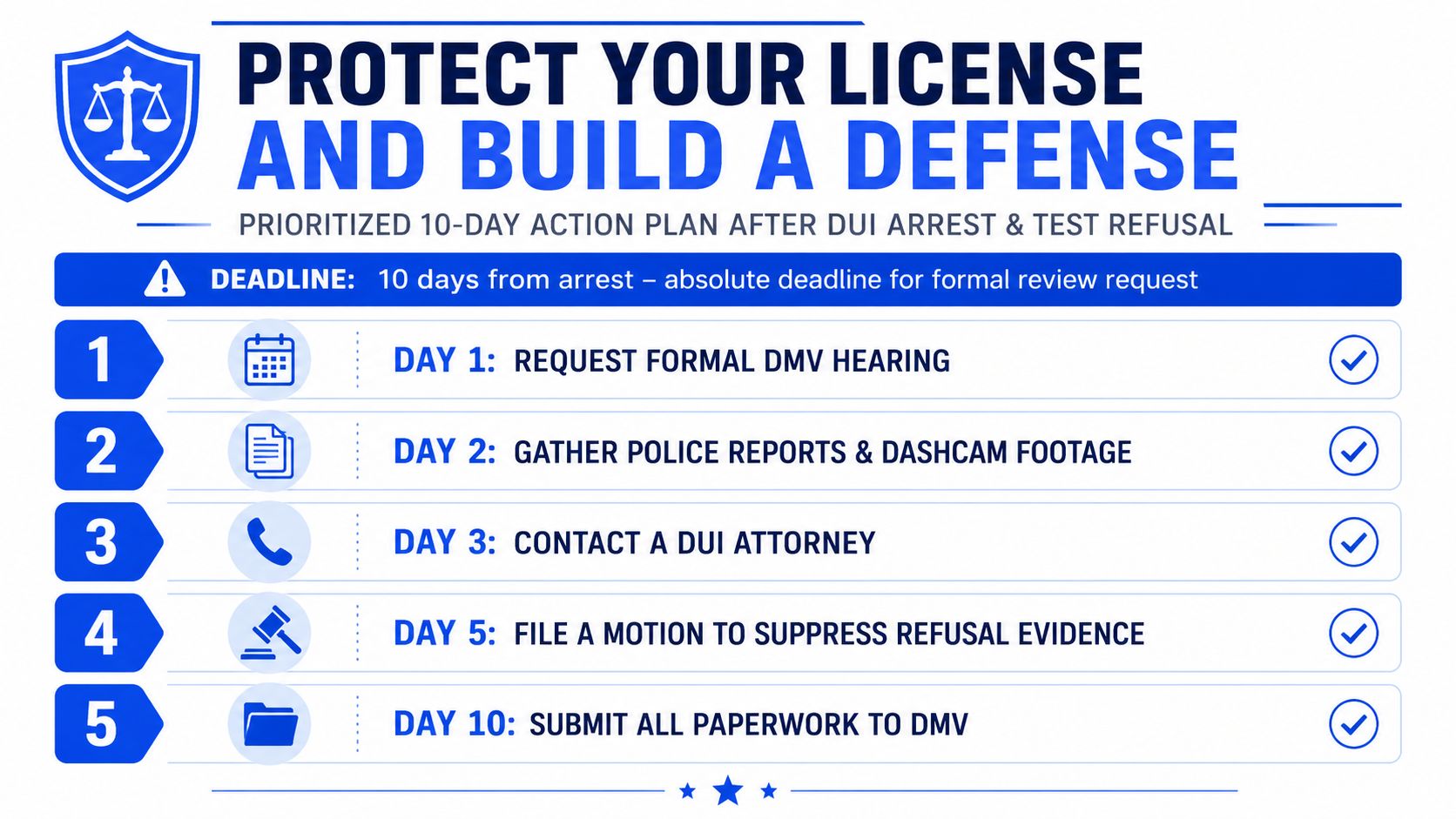
Your first 10 days after arrest should be organized around preservation, not speculation. Florida gives drivers only that period to request a formal hearing challenging the administrative suspension. If no timely request is made, the suspension becomes automatic, as discussed in this Florida breathalyzer testing guide.
Use the deadline first
Request the formal review immediately. Don't wait for the first criminal court date. The request must reach the appropriate agency within the 10-day period calculated from the arrest date.
Keep every document. Save the suspension notice, temporary driving paperwork, arrest affidavit, property receipts, and any document the officer gave you. Take clear photographs and record when each document was received.
Contact counsel promptly. A Florida DUI lawyer can coordinate the administrative hearing with the criminal defense rather than treating them as unrelated files. If you're searching for a Fort Lauderdale DUI lawyer, choose someone prepared to address both proceedings.
Preserve the evidence before it disappears
Ask counsel to obtain the arrest report, body-camera footage, dash-camera footage, dispatch logs, 911 records, witness information, and available breath-machine maintenance and certification records. Write down where you were, what you consumed, who was present, what the officer said, and how the request was made while the memory remains fresh.
Medical conditions and prescription medications may affect balance, speech, coordination, anxiety, or the ability to provide a breath sample. Give that information to your attorney privately. Don't call the police station to offer an explanation, and don't post about the arrest online.
For a practical overview of the hearing process, see administrative license suspension hearings in Florida. A timely request preserves an opportunity to challenge the paperwork and testimony. It does not guarantee a particular ruling, but failing to request review eliminates that opportunity.
Possible Defenses After a Breath Test Refusal
A refusal case isn't defended by repeating that the driver had a right to say no. The relevant question is whether the State can prove each legal condition that makes the refusal punishable and whether the evidence was lawfully obtained.
The stop and arrest
Start with the traffic stop. Did the officer have reasonable suspicion to detain you? A vague hunch isn't enough. The defense should compare the report with video, dispatch information, witness accounts, and the officer's stated reason for initiating the stop.
Then examine probable cause for the arrest. The officer may rely on driving, speech, odor, physical appearance, field sobriety performance, statements, and other circumstances. A weakness in the arrest can affect whether implied consent was triggered at all.
The demand and the test procedure
The next question is authority. Was the request made after a lawful DUI arrest? Was the requested test the type covered by Florida's implied-consent law? If a sample was attempted rather than refused, counsel should review the instrument, operator qualifications, observation requirements, maintenance records, and the handling of the result.
A failed attempt isn't always the same as a deliberate refusal. Asthma, respiratory limitations, panic, injury, or misunderstanding may matter, but the defense needs evidence supporting the explanation.
The warning and evidentiary record
The officer must give the required refusal warning before requesting the sample. Review the exact words, the sequence, the driver's condition, and whether the recording contradicts the report.
A defense may also involve suppression motions, independent-test rights, and limits on how refusal evidence is used. Refusal can still be presented as evidence in a DUI case, so counsel must decide whether to challenge admissibility, reliability, relevance, or the circumstances surrounding the alleged refusal. None of these defenses applies automatically. The arrest file controls.
How Refusal Cases Can Unfold
Consider a first-offense driver who refuses the official breath test after arrest. The officer provides temporary paperwork, but the driver doesn't request a formal review within the required period. The administrative suspension then proceeds automatically, while the criminal case includes the misdemeanor refusal charge and the separate DUI allegation.
A driver with a prior refusal faces a different path. The later refusal can produce the longer 18-month suspension and a first-degree misdemeanor charge, so the attorney must verify the prior refusal record, the dates, the warning, and the officer's paperwork. A prior administrative event can affect the present case even when the driver believes the older matter was unrelated.
A third driver acts quickly. That person requests a formal review within the deadline, obtains the arrest materials, and works with counsel to challenge the stop, arrest, warning, or refusal classification. A restricted or business-purpose driving arrangement may become part of the broader strategy where legally available, but eligibility and conditions depend on the facts and applicable Florida procedures.
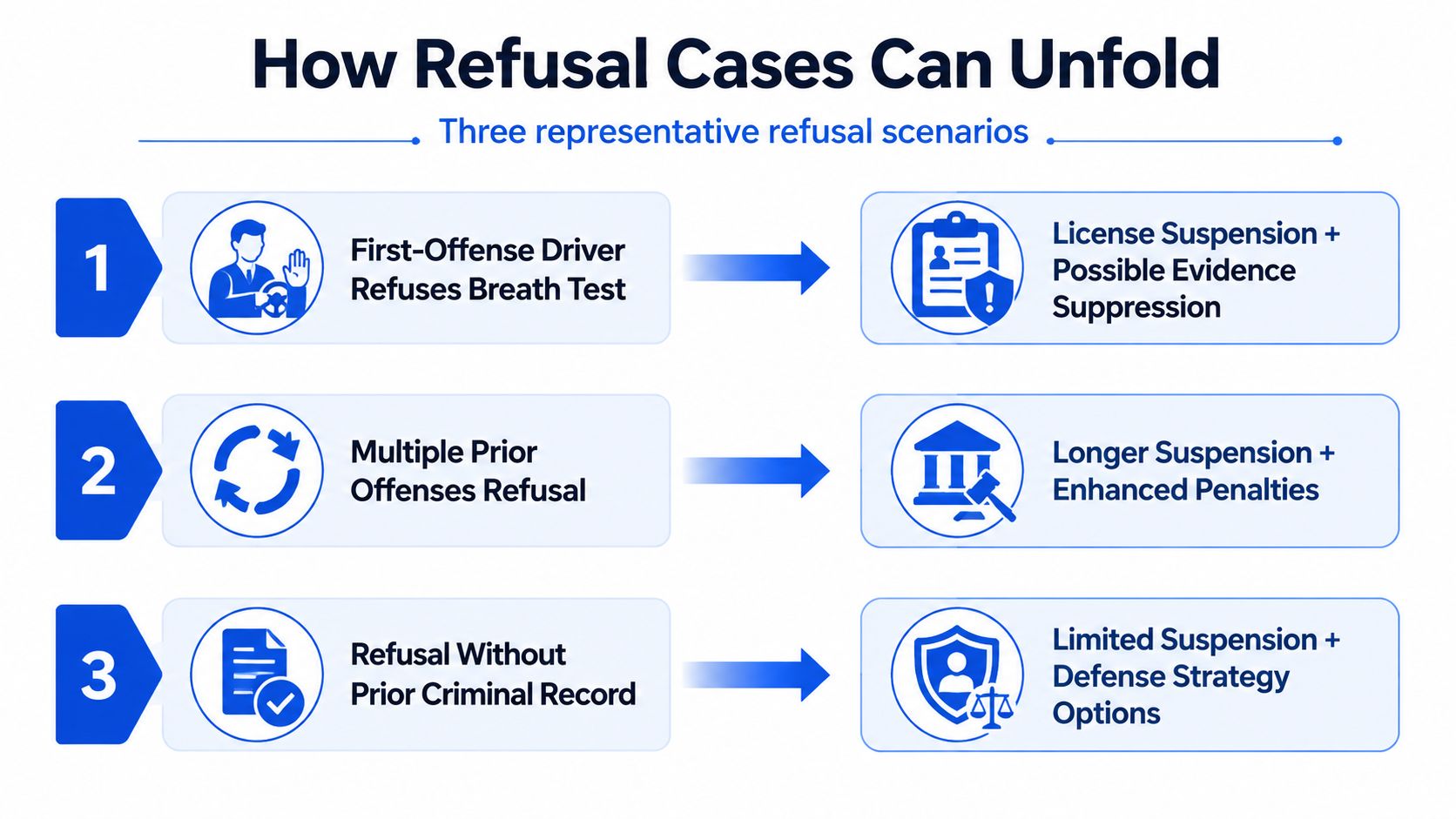
The same decision can produce very different procedural consequences because timing and records matter. A missed hearing request may damage driving privileges before the criminal court meaningfully addresses the DUI. A timely request gives counsel a chance to examine the administrative case while preparing the criminal defense.
This video offers another visual explanation of how refusal cases may develop:
Take the Next Step With Your Florida Case
A breath-test refusal should be handled as one coordinated case with multiple consequences. The administrative suspension, the criminal refusal charge, and the underlying DUI evidence must be reviewed together because a decision in one proceeding can affect the record in another.
Early counsel can request the DUI file through public-records procedures, preserve body-camera and testing evidence, evaluate the warning given before the refusal, and request the formal review hearing within 10 days of arrest. Your lawyer should also coordinate statements and arguments so an explanation offered in the administrative record doesn't unnecessarily harm the criminal defense.
This approach matters across South Florida. Whether your arrest occurred in Fort Lauderdale, elsewhere in Broward County, Miami-Dade, Palm Beach, or another Florida jurisdiction, the first questions remain concrete:
Was the stop lawful?
Did probable cause support the arrest?
Was the implied-consent warning accurate and timely?
Was the refusal clear, or could a medical or communication issue explain it?
Was the hearing requested before the deadline?
What evidence remains apart from the breath test?
You can begin by using Ticket Shield's confidential case submission page. Bring the arrest paperwork, suspension notice, refusal warning, and any information about prior refusals or DUI cases to the consultation. No attorney can promise a result without reviewing the evidence, but delaying the first decision can cost you an important opportunity.
Ticket Shield, PLLC offers confidential Florida criminal defense consultations for DUI arrests and breath-test refusals, including review of the suspension deadline, refusal warning, and underlying arrest evidence. Visit Ticket Shield, PLLC to contact the firm and discuss a practical defense plan before the administrative deadline passes.