
Florida Second DUI Penalties and Defense Options
Jason Goldsmith, Esq
You're leaving a Fort Lauderdale restaurant, merge onto I-95, and get stopped after a lane change. The officer says he smells beer. Your child is in the back seat. A Breathalyzer follows, and the officer already sees a prior DUI conviction in your record. Within hours, you're facing what people commonly call a Florida second DUI.
The prior conviction doesn't make the new case unbeatable. It does make timing critical. Florida's five-year lookback determines whether the court must impose the harshest repeat-offender penalties, so the first job is to identify the exact conviction date, examine how the traffic stop began, and protect your driver's license before the administrative deadline expires. If you're in Broward County, Fort Lauderdale, Miami-Dade, Palm Beach, or elsewhere in South Florida, speak with a defense lawyer before treating the charge as a routine misdemeanor. Your criminal case and your license case are separate problems.
Table of Contents
What a Second DUI Charge Really Means in Florida
Florida Statute 316.193 treats a new DUI as a second offense when the driver has one prior DUI conviction. The State must prove the new DUI, and it must establish the prior conviction when seeking repeat-offender penalties. An arrest alone is not a conviction, and the date of the prior conviction matters greatly.
The charge itself generally remains a misdemeanor unless other facts change the classification. A third DUI within the statutory felony circumstances or a DUI involving serious injury or death can create different exposure, but a second DUI conviction is still a serious county-court case. The consequences can include incarceration, substantial fines, license revocation, vehicle restrictions, DUI school, and ignition interlock monitoring.
The practical point: A prior DUI raises the consequences, but it doesn't eliminate the State's burden to prove the current stop, impairment, and chemical evidence.
For a prior conviction within the five-year enhancement period, Florida requires at least 10 days in jail, a five-year driver-license revocation, and at least one year of ignition-interlock use, according to Florida's official DUI administrative suspension guidance. The jail exposure can reach nine months, or 12 months when aggravating circumstances such as a BAC of 0.15 or higher or a minor in the vehicle are present. The statutory framework also includes 50 hours of community service, 30 days of vehicle impoundment, and a DUI school and evaluation requirement.
That doesn't mean you should assume conviction is inevitable. Police reports often leave important questions unanswered. Was the lane change a lawful basis for the stop? Did the officer extend the detention without adequate justification? Were field sobriety instructions and observations recorded accurately? Did the breath-test process comply with Florida requirements?
A former Florida prosecutor knows how the State builds these cases. A defense attorney should also know where that construction can fail. Review Florida DUI defense options before entering a plea or allowing the prosecutor to define the case for you.
The 5-Year Window That Changes Everything
The five-year lookback is the hinge between a repeat DUI with hard mandatory punishment and a repeat DUI with more sentencing discretion. Florida counts the period from the prior conviction to the new offense for purposes of the enhanced track. The exact dates should be verified through certified court records, not guessed from memory or from a driver's-license printout.
Two penalty tracks
If the new DUI occurs within five years of the prior conviction, the court must impose the enhanced package described in Florida Statute 316.193. That package includes mandatory jail, a five-year revocation, vehicle impoundment, and ignition interlock requirements. Florida's statute also identifies a separate track for a second conviction when the prior conviction falls outside that five-year period. The charge remains serious, but the mandatory consequences differ.
Factor | Prior Within 5 Years | Prior Outside 5 Years |
|---|---|---|
Repeat-offense status | Second DUI with the statutory enhancement | Second DUI, but outside the enhancement window |
Mandatory jail | At least 10 days under the enhanced track | The exact sentencing consequences must be reviewed under the applicable statutory provision |
License consequence | Five-year revocation | Different court-imposed license consequences may apply |
Ignition interlock | At least one continuous year | A second DUI still carries a mandatory interlock requirement under Florida law |
Vehicle restriction | 30 days of impoundment under the enhanced framework | Confirm the applicable requirement from the charging and conviction circumstances |
The date of the prior conviction, not merely the date of arrest, is central. A case dismissed in another state, an unresolved charge, or an arrest that never resulted in conviction shouldn't automatically be treated as a prior DUI conviction. Your lawyer should obtain the underlying disposition rather than rely on a database label.
Out-of-state convictions can create confusion. Florida may recognize a qualifying out-of-state DUI conviction, so the argument that an old case “doesn't count because it happened elsewhere” is not a safe strategy. Counsel should compare the out-of-state judgment, the Florida charging language, and the dates before advising you about the enhancement.
Why the timing affects negotiation
In Broward and Miami-Dade courts, the same current allegation can produce very different negotiation positions depending on whether the prior conviction falls inside the five-year window. A prosecutor evaluating a mandatory-minimum case has less freedom to offer a sentence that avoids the statutory floor. If the enhancement doesn't apply, the defense may have more room to negotiate treatment, licensing consequences, and sentencing structure.
Do not let the State use an unverified prior to force you into an unnecessary concession. Have the records reviewed before arraignment whenever possible.
Mandatory Minimums, Fines, and Ignition Interlock Rules
The statutory penalties should be separated into categories because they affect different parts of your life. Jail concerns immediate liberty. A revocation affects employment and family transportation. An ignition interlock controls how you drive after eligibility is restored. A negotiated outcome must account for all of them, not just the fine.
For a second DUI within five years, Florida law requires at least 10 days in jail, a five-year license revocation, 30 days of vehicle impoundment, and at least one continuous year of ignition interlock use. These requirements appear in the official Florida statute and driver-services materials, including Florida Statute 316.193.
The fine for a second DUI conviction is $1,000 to $2,000, according to Florida DUI penalty guidance from the National College for DUI Defense. If a minor was in the vehicle or the BAC was 0.15 or higher, the ignition-interlock period can increase to two years. Those aggravated facts also require close review because they affect both negotiation and sentencing exposure.

What the interlock requirement means
Florida Statute 322.2715 makes ignition interlock mandatory for a second DUI for at least one continuous year, whether the new offense falls inside or outside the five-year enhancement window, as explained by the Florida Senate's ignition-interlock statute. The device requires a breath sample before the vehicle starts and generates compliance records that can become important during reinstatement or supervision.
The court can also impose DUI school, substance-abuse evaluation, community service, and vehicle restrictions. Each condition creates a separate compliance obligation. Missing treatment, failing to maintain the device, or violating driving restrictions can damage an otherwise favorable resolution.
Read a broader explanation of Florida DUI penalties, but don't stop at the headline penalty. The defense must identify which conditions are legally mandatory, which are negotiable, and which can be challenged through the evidence.
License Revocation and the Separate Administrative Case
Your DUI arrest can create two proceedings at once. The criminal prosecution proceeds in county court. The administrative license case proceeds through the Florida Department of Highway Safety and Motor Vehicles. The criminal judge doesn't control the administrative case, and winning an issue in one proceeding doesn't automatically resolve the other.
The administrative process has a short deadline. In many cases, you have 10 days after the arrest to request a formal or informal review of the suspension, as described in Florida's administrative license suspension process. Miss that deadline, and you may lose an important opportunity to challenge the suspension through an administrative hearing.
Separate tracks, separate decisions
Suspension Length | BPO Eligibility | Hardship Waiting Period | Reinstatement Requirements |
|---|---|---|---|
Depends on the administrative suspension basis and driving history | Must be evaluated through DHSMV rules and the specific record | A second DUI revocation may permit hardship consideration after one year if requirements are met | DUI school, supervision, ignition interlock compliance, and other DHSMV conditions may apply |
Florida's official driver-services guidance states that hardship reinstatement may become available after one year, but only after DUI school and supervision requirements are satisfied. That opportunity isn't automatic. The applicant must meet the applicable requirements and present the documentation the agency demands.
A second DUI can also create restrictions on every vehicle you routinely operate. The interlock requirement is not a one-time installation. You must use an approved device, complete required service appointments, and preserve calibration and compliance records.
Do this first: Tell your lawyer about the arrest immediately, because the administrative deadline can arrive before the first meaningful criminal court hearing.
The criminal court cannot reinstate your driving privilege directly. Your defense plan should therefore include the Bureau of Administrative Reviews, the DHSMV record, hardship eligibility, and the criminal charge from the beginning. Treating the license case as an afterthought is a costly mistake.
Defense Strategies That Move a Second DUI Case
A prior conviction increases the sentencing risk, especially when it falls within the five-year lookback period. It does not prove that the officer lawfully stopped you, that you were impaired, or that the breath result was collected and interpreted correctly. The State still must prove the current charge with admissible evidence.
Challenge the stop and detention
A lane change, speeding allegation, equipment issue, or anonymous complaint can support a traffic stop only when the documented facts provide a lawful basis. If the stop was unlawful, your lawyer can seek to exclude evidence through a motion to suppress evidence. If the officer extended the stop beyond its traffic purpose without adequate legal grounds, Rodriguez v. United States supplies an important constitutional framework.
The timeline often exposes weak police work. Defense counsel should compare dispatch records, body-camera and dash-camera footage, citation times, and the written narrative. A short gap between the traffic investigation and the DUI inquiry may matter if the officer cannot explain why the detention continued.
Test the chemical evidence
A breath printout is not self-proving. Counsel should examine the observation period, operator qualifications, machine records, maintenance history, source-code issues, and compliance with the applicable testing protocol. Florida litigation involving the Intoxilyzer 8000, including issues addressed after the Florida Supreme Court's State v. Birge ruling, may affect how the defense evaluates the machine evidence.
A claimed 20-minute deprivation period before a breath sample deserves close review. If the officer failed to observe you properly or the observation was interrupted, the reliability and admissibility of the result become disputed issues.
Reconstruct impairment from the evidence
Field sobriety tests can be affected by poor lighting, uneven pavement, footwear, injury, balance disorders, fatigue, medication, or neurological conditions. Your lawyer should compare the officer's scoring with the video instead of accepting the report's conclusions.
A rising BAC defense may matter when drinking occurred relatively close to driving. Expert analysis can examine whether the alleged alcohol level while driving necessarily matched the later test result. Refusal cases carry separate consequences, yet they may leave the State with a more difficult proof problem when the impairment evidence is weak.
The five-year lookback should guide the defense from the first review. If the State cannot prove the prior qualifying conviction, its repeat-offense sentencing position may change. If it can, attack the current stop, detention, impairment proof, and chemical evidence before treating the mandatory minimum as unavoidable.
Preservation letters should be sent early for body-camera footage, dispatch material, breath-machine records, and other evidence vulnerable to routine deletion. The strongest defenses are built before the first court date, not improvised after a plea offer arrives.
Mitigation, Plea Negotiation, and Diversion Options
Negotiation begins before the prosecutor has formed a fixed view of the case. Your lawyer should build a mitigation package that answers practical questions: Are you addressing alcohol or substance-use concerns? Are you complying with testing and supervision? Can the State trust that you'll complete every condition?
Build the package early
Before arraignment, gather the certified driving history, the prior case disposition, employment information, character letters, treatment records, and proof of voluntary enrollment in a licensed DUI school or substance-abuse evaluation. Don't submit random documents. Present a focused package that explains why the current case should be resolved with structured accountability rather than unnecessary punishment.
A defense attorney should then:
Enter a protective plea: Preserve the ability to investigate the case rather than rushing into an admission.
Review discovery: Examine the affidavit, video, breath records, witness accounts, and prior conviction documents.
Identify legal defects: File suppression or evidentiary motions where the facts support them.
Propose measurable compliance: Use treatment, monitoring, community service, and interlock compliance as part of the negotiation.
Protect the record: Consider whether a withhold, dismissal, reduction, or trial is legally and practically available.
A withhold of adjudication can matter because it may affect the long-term consequences of the disposition, but eligibility and statutory restrictions must be reviewed carefully. Do not assume a prosecutor will offer one because you enrolled in treatment.
Diversion and the realistic outcome
Broward County and Miami-Dade County may have county-specific diversion or pretrial options for qualifying defendants, including programs described locally as Broward Bridges or PTI-style alternatives. Availability depends on the current charge, prior record, prosecutor policy, compliance history, and the exact facts. A lawyer should confirm current eligibility instead of promising admission.
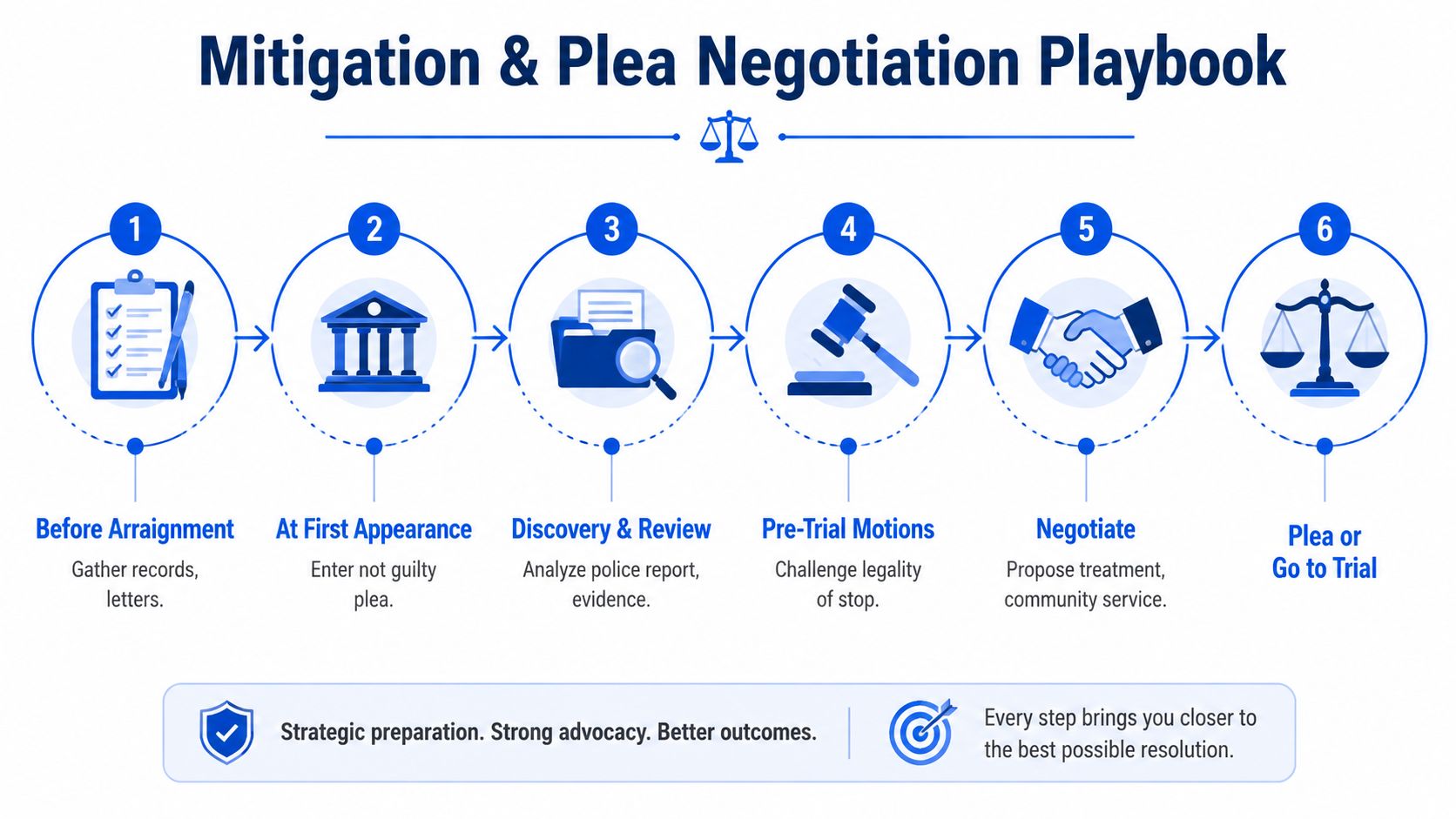
Sometimes a straight plea with strong mitigation is more sensible than pursuing a weak diversion request. The decision should account for mandatory jail, interlock duration, license consequences, treatment demands, and the strength of the suppression issues. The aim is not to chase the maximum possible concession. It's to secure the safest lawful resolution and complete every condition without creating a new violation.
Here's a short video resource that can help you understand the general negotiation process:
Practical Steps to Take After a Second DUI Arrest in South Florida
The first days after arrest should be organized around deadlines and evidence. Don't wait for the criminal arraignment to begin protecting your license or preserving records.
Act during the first 72 hours
Protect the administrative deadline: Have counsel submit the request for a formal review hearing to the Bureau of Administrative Reviews within 10 days, as required by the applicable administrative process.
Obtain the core records: Get the charging affidavit, citation, breath-test ticket, implied-consent paperwork, and any notice affecting your license.
Preserve video: Send public-records requests for body-camera, dash-camera, dispatch, and jail video before routine retention practices affect availability.
Start qualified evaluation: Enroll in a state-licensed DUI education program or substance-abuse evaluation when counsel advises that early compliance will strengthen your position.
Confirm transportation needs: Identify work, school, childcare, and medical obligations so the license strategy addresses real hardship rather than vague inconvenience.
The administrative hearing and criminal defense should inform each other, but they remain separate. A lawyer should track the hearing request, temporary driving authority, criminal discovery, and motion deadlines on one coordinated calendar. For a broader overview of the early criminal process, see what happens after a DUI arrest.
Prepare for compliance before it becomes urgent
If reinstatement or restricted driving becomes available, you may need an SR-22 filing, an approved ignition-interlock vendor, installation records, calibration receipts, and proof of treatment or supervision. Keep every document. A missed appointment or unexplained device violation can become an avoidable problem.
Ask counsel whether prior interlock use can receive credit toward the 12-month minimum when the law and the record support that request. If your job requires you to operate an employer-owned vehicle, discuss whether an interlock exemption request is available and what documentation the agency requires. Never assume an employer vehicle is automatically exempt.
Finally, retain a private defense attorney before the first court date when possible. Early counsel can review the five-year enhancement, challenge the stop, preserve evidence, request the administrative hearing, and present treatment and compliance records before the prosecutor commits to the mandatory-minimum position. Ticket Shield, PLLC handles Florida DUI defense and related criminal matters, including cases involving license suspension, repeat-offender allegations, and evidence challenges. Contact Ticket Shield, PLLC for a confidential consultation about your Broward County or South Florida second DUI case.