Second Degree Felony Florida: Penalties, Examples & Defense
Jason Goldsmith, Esq
A second-degree felony in Florida carries up to 15 years in prison, 15 years of probation, and a $10,000 fine. That's the ceiling, not the automatic outcome, because the point-based sentencing system, your prior record, and the defense strategy can change the result fast.
If you just got arrested in Broward County, Miami-Dade, Palm Beach, or anywhere else in South Florida, that number is probably what's keeping you up at night. It should. But the smarter move is to focus on what the State can prove, how your case scores, and whether your attorney can push the charge, the points, or the sentencing exposure down before the case hardens.
Table of Contents
What a Second Degree Felony Means Under Florida Law
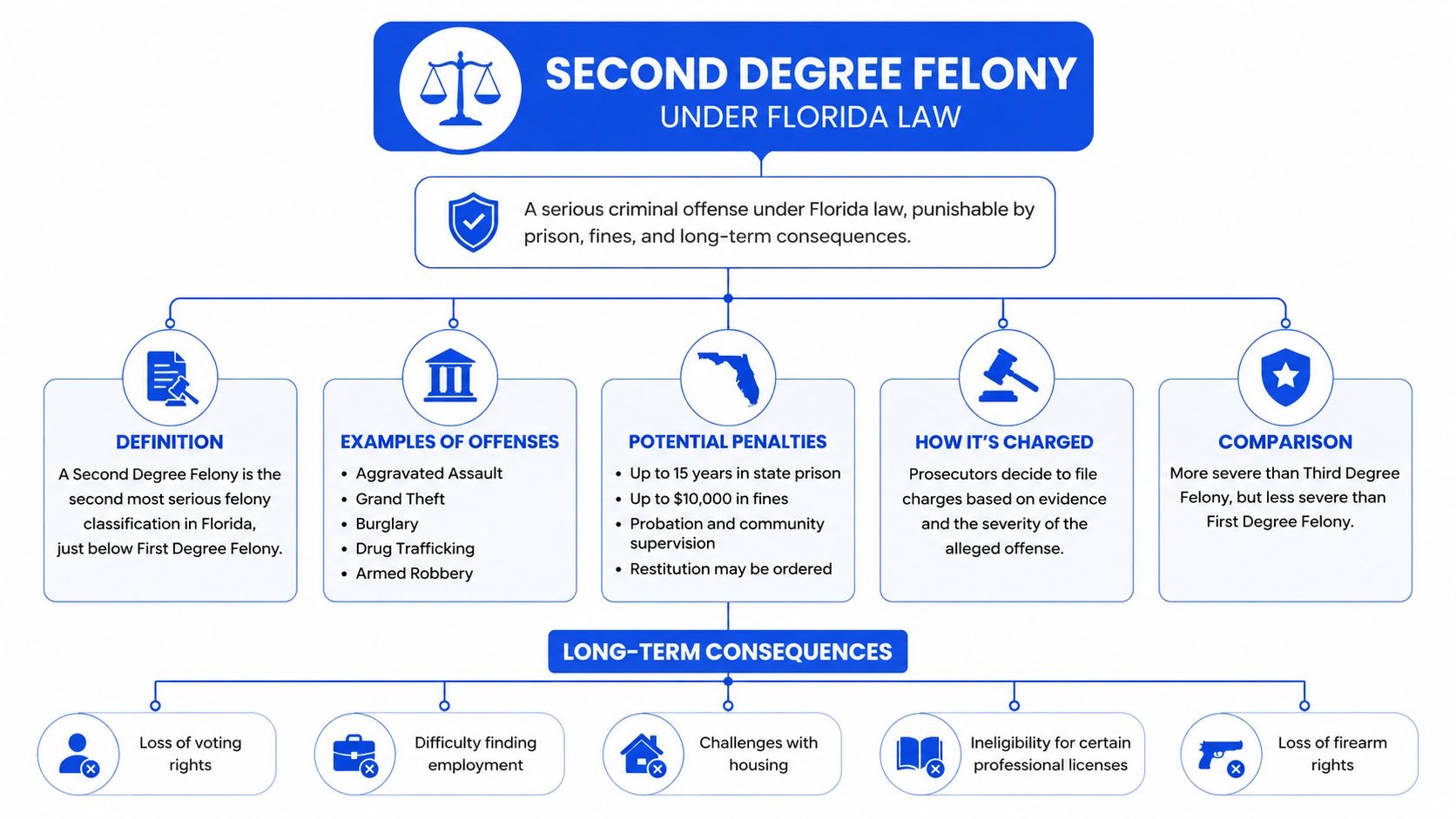
You can hear the words “second degree felony” and still not know what they really mean for your life. In Florida, it's a serious felony tier, not a minor offense, and it sits in the middle of the state's five-level felony structure, below capital, life, and first-degree felonies, but above third-degree felonies.[^1]
Why this charge deserves immediate attention
A second-degree felony is not the kind of case you wait out and hope goes away. The statutory ceiling is 15 years in prison, 15 years of probation, and a $10,000 fine, which is why early decisions matter so much in Florida criminal court.[^1] The same charging level can cover conduct that ranges from violent allegations to property and drug offenses, so the label alone doesn't tell you everything. The facts, the evidence, and the exact statute do.
Practical rule: The charge name matters, but the State still has to prove every element. If one key piece fails, the case can fall apart or drop to a lower level.
That's where people get trapped. They see the word “felony” and assume conviction is inevitable. It isn't. Florida defense work starts with reading the charging document closely, checking the alleged facts, and forcing the State to prove the exact offense it chose to file.
For a basic contrast with lower-level charges, see this explanation of misdemeanor meaning. That comparison helps put the seriousness of a second-degree felony in perspective without minimizing it.
The bottom line is simple. A second-degree felony is a high-stakes criminal charge with real prison exposure. You need to treat it like one from day one, because the first few moves often shape everything that follows.
[^1]: Florida felony penalties under section 775.082
Statutory Penalties and How Florida Sentencing Points Work
A second-degree felony in Florida can look very different on paper than it does at sentencing. Judges do not start with the maximum and work down. They look at the score sheet, the facts, the prior record, and any enhancement issues, then decide whether the case calls for prison, probation, or something in between.
The ceiling is fixed, the outcome is not
For a second-degree felony, the legal ceiling is still 15 years in prison, 15 years of probation, and a $10,000 fine.[^3] That does not mean every case gets anywhere near that number. Florida uses a point-based sentencing system, and the score sheet often drives the actual outcome before the judge ever hears about mitigation or family support.
The point structure matters because certain scores push the case into a prison result even when the charge itself sounds negotiable. Under Florida's sentencing formulas, once the total score reaches the prison threshold, the judge has far less room to impose a straight probationary sentence. In practical terms, defense counsel has to attack the score sheet early, because prior convictions, victim injury, weapon allegations, and other scoring items can change the entire posture of the case.
The formula cited in Florida sentencing practice is (Total Points - 28) × 0.75 = Minimum Prison Months.[^2] That is why lawyers focus on the score sheet so aggressively. A small change in points can move a case from a probation discussion to a prison discussion, and that difference usually shapes the plea offer long before trial.
Florida Felony Sentencing Overview
Felony Level | Max Prison Time | Max Probation | Max Fine |
|---|---|---|---|
Second-degree felony | 15 years | 15 years | $10,000 |
Third-degree felony | lower than second-degree | lower than second-degree | lower than second-degree |
Firearm allegations can make the case worse fast. Florida's firearm enhancement law can reclassify a second-degree felony to a first-degree felony in qualifying circumstances.[^4] In a gun case, prosecutors often press that point hard because it gives them more advantage in plea negotiations and more pressure at sentencing.
For the broader firearm framework, review Florida's 10-20-Life law. It shows how a weapons allegation can change sentencing exposure beyond the base offense and why gun-related charges demand immediate attention.
If your score is near the prison line, the plea offer matters more than the headline charge. That is how Florida sentencing works in real courtrooms, and judges know it.
Do not treat the statutory maximum as the expected sentence. The primary question is how the score sheet, the charge, and the facts interact in your case.
[^1]: Florida court-data summary on charges and pleas
[^2]: Florida Supreme Court Criminal Punishment Code scoresheet and sentencing guidelines
[^3]: Florida felony sentencing statute 775.082
[^4]: Florida firearm enhancement statute
How Second Degree Felonies Compare to Other Felony Levels
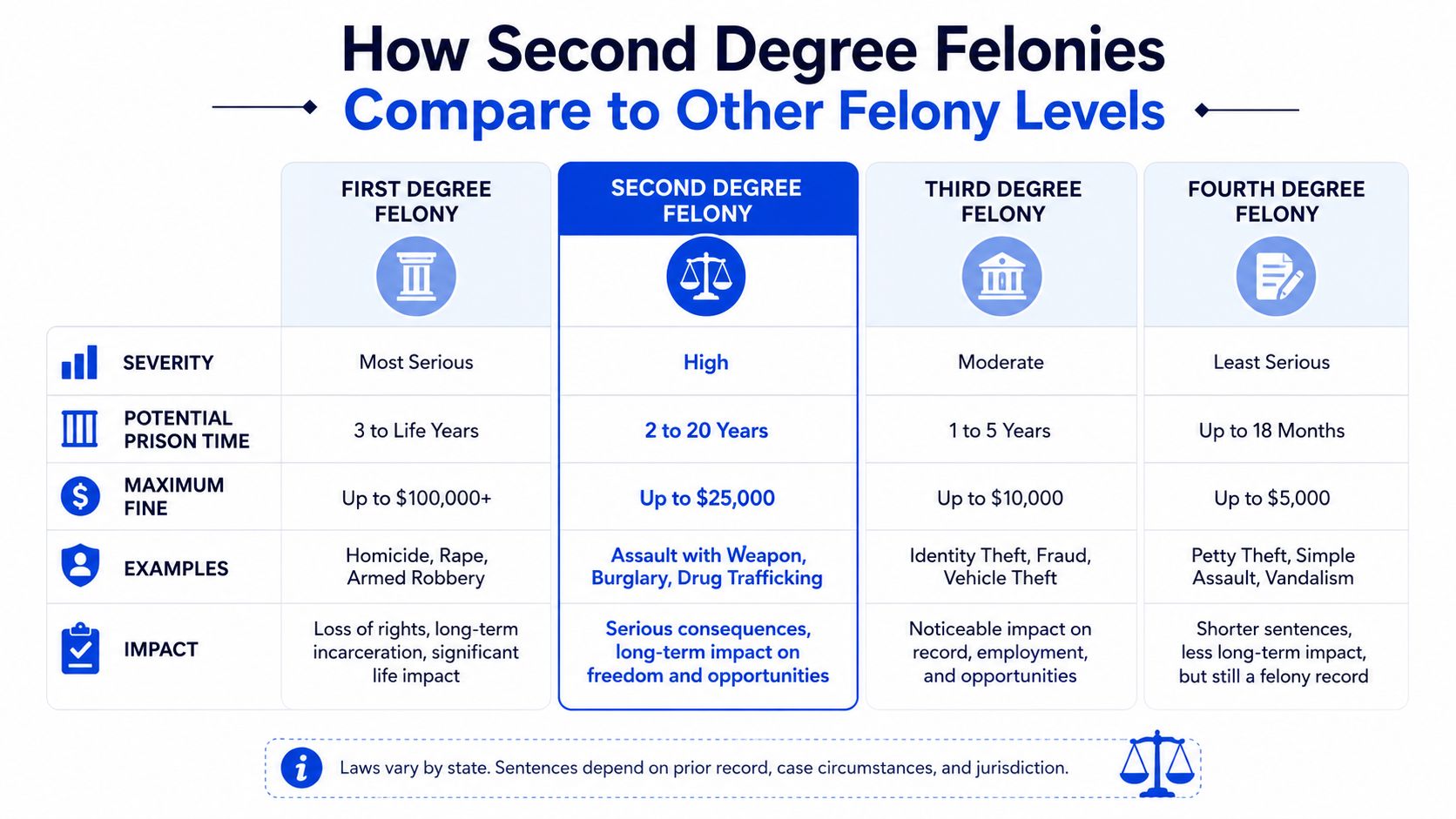
A second-degree felony in Florida sits in the middle of the felony ladder, but that middle position still carries serious consequences. Prosecutors, defense lawyers, and judges do not treat every felony level the same, and the classification shapes how hard each side pushes on plea offers, score sheet issues, and sentencing risk. Florida's felony structure separates capital, life, first-degree, second-degree, and third-degree felonies, and second-degree offenses fall below the most severe levels but well above the lowest felony tier.[^5]
Where the charge sits in the hierarchy
That placement matters in practice. A second-degree felony may not be the top charge in the case, yet it still gives the State meaningful sentencing exposure to use during negotiation. Prosecutors know that the label alone can pressure people, especially when the possible prison range starts sounding real.
A third-degree felony usually leaves more room to fight for probation, court-ordered treatment, or another non-prison result. A first-degree felony brings a higher ceiling and often different enhancement problems, which changes the defense strategy immediately. Second-degree felonies sit between those two, so the case has to be measured by the facts, the score sheet, and the realistic disposition options, not by the title on the arrest paperwork.
Severity comparison at a glance
Felony level | Position in Florida system | Typical defense posture |
|---|---|---|
First-degree felony | Above second-degree | Attack elements, enhancements, and score aggressively |
Second-degree felony | Middle of the severe felony range | Focus on reduction, suppression, and sentencing exposure |
Third-degree felony | Below second-degree | Push hard for reduction or non-prison disposition |
The sentence a client faces is not driven by the felony label alone. Judges look at the score sheet, prior record, victim input, and whether the case offers any basis for a lower-level resolution. Prosecutors do the same thing, which is why a second-degree felony can be a plea case in one courtroom and a prison case in another.
Florida's punishment code also matters here. The court does not just read the degree of the charge and stop. It uses the sentencing framework, which is why the score can matter more than the headline charge when the case is close to the prison line.[^5]
A second-degree felony can still be defended down, reduced, or resolved with a negotiated outcome that avoids the worst result. The practical question is whether the State can prove the charge as filed, whether any enhancement or aggravating fact really applies, and whether the defense can create room for a better offer. For a charge-specific example, see felony battery in Florida, where the label may sound severe but the facts still control the outcome.
[^5]: Florida sentencing framework overview
Common Second Degree Felony Charges in Florida
Second-degree felonies show up across very different types of cases. Some are violent, some are property-related, and some involve drugs or firearms. That's why a charging title alone doesn't tell the whole story.
Violent and property offenses
Florida second-degree felonies can include offenses such as aggravated battery, burglary of an unoccupied dwelling, certain drug offenses, and grand theft involving property valued between $20,000 and $100,000.[^6] Those are the kinds of charges that can turn on one detail, like whether the alleged injury was serious, whether the dwelling was occupied, or whether the State can prove ownership and value.
A violent charge often creates immediate bond and detention pressure. A property case may look less dramatic, but it can still carry a felony record, probation exposure, and restitution consequences. In either setting, the defense has to challenge the elements instead of assuming the State can prove them just because an arrest happened.
Weapon allegations and upgraded conduct
Some cases become second-degree felonies because of aggravating facts, especially firearm involvement. Others start lower and get enhanced because the State claims the conduct crossed a legal threshold. That's why the exact wording in the information or indictment matters so much.
For a battery-specific example, review felony battery in Florida. Battery cases often show how a charge moves from a simple allegation to a serious felony once injury, prior history, or weapon facts enter the picture.
Read the charging document line by line. The statute number, injury allegation, and enhancement language tell you more than the arrest report does.
What the State must prove
The prosecutor still has to prove the elements of the offense beyond a reasonable doubt. That means identity, intent, conduct, and any aggravating circumstance that raises the charge. If the State can't prove one of those pieces, the defense has a path to reduction, dismissal, or trial acquittal.
Don't treat a second-degree felony as a single category with one standard defense. The right strategy depends on whether the case is about force, value, possession, drug allegations, or a weapon enhancement. That's where the true fight lies.
[^6]: Florida second-degree felony examples
Collateral Consequences That Extend Beyond the Courtroom
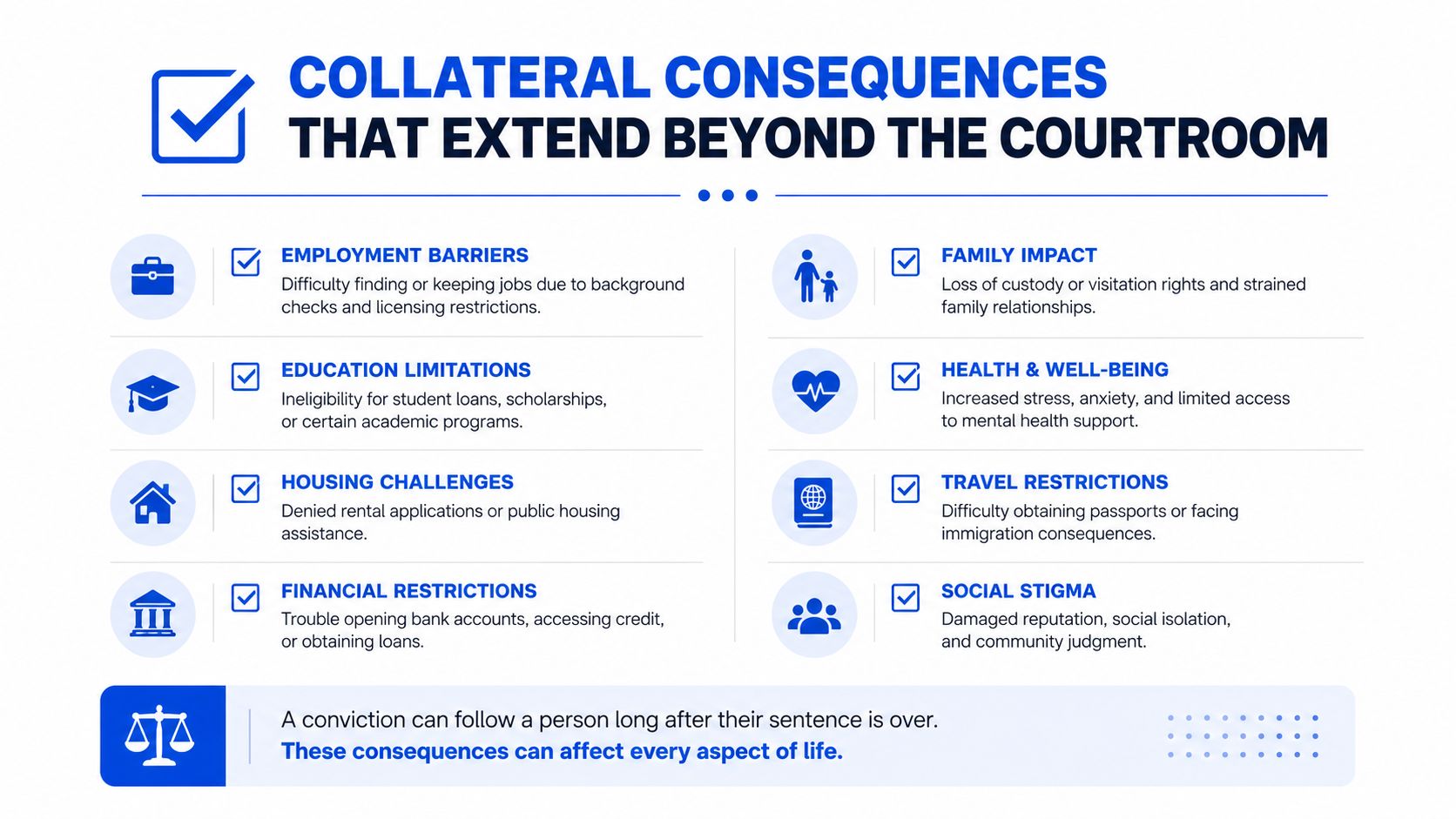
A felony conviction changes life in ways that many do not anticipate until it is too late. The prison term, probation, and fine are only the direct penalties. The bigger damage often appears later, affecting employment, licensing, housing, and personal rights.
Rights and practical losses
A second-degree felony conviction can affect civil rights, firearm ownership, and your record status in ways that follow you long after the case ends. If you're not a U.S. citizen, immigration consequences can also become part of the picture. Employers, landlords, licensing boards, and schools all react differently, but none of them treat a felony as a small issue.
That's why a plea deal that avoids prison still may not solve the core issue. A conviction can keep creating friction every time you apply for a job, renew a license, or try to move forward with a clean slate. If you're trying to protect future options, record sealing in Florida becomes part of the long game, but only if your case resolves in a way that leaves sealing or expungement on the table.
Why the result matters even more for families
Parents also need to think about custody, visitation, and the practical stress a felony case puts on the household. Even when the court doesn't take a family issue directly, the conviction can still shape how other systems view you. That's real, and it's often more disruptive than the sentence itself.
The smart move is to fight the case before the conviction becomes the problem. That means looking for dismissal, reduction, diversion where available, or a plea structure that protects as much of your future as possible.
A felony conviction can follow you longer than the sentence does. If the defense can stop the conviction, that's usually the better win.
Defense Strategies and Immediate Steps After an Arrest
The strongest defense in a second-degree felony case starts before the first court date. Prosecutors often expect a plea resolution, and judges want to see whether the defense has a real plan for suppression issues, score sheet exposure, and a workable outcome. That means the early stage is not paperwork. It is the part of the case where advantage is built or lost.
The first moves matter most
Do not talk to investigators without counsel. Do not post your side of the story online. Do not assume a quick explanation will fix the charge. Once you give the State a statement, it becomes part of the case file and can be used against you later.
Use this checklist immediately:
Stay silent with police: You do not help yourself by filling in the gaps for them.
Preserve evidence: Save texts, screenshots, receipts, call logs, and witness names.
Avoid posts and messages: Anything written online can come back in court.
Write down the facts: Dates, times, locations, and exact statements matter.
Call a defense lawyer fast: Early involvement keeps more options open.
What a strong defense targets
Search and seizure issues are often the first place to attack. If officers searched without a valid basis, stopped you unlawfully, or took a statement without proper warnings, key evidence may be vulnerable. The same is true if the State depends on shaky witness identification, incomplete video, bad chain of custody, or a weak enhancement allegation. Defense counsel should also look at suppression motions, because a clean arrest does not matter much if the evidence was collected the wrong way.
That is why a firm like Ticket Shield, PLLC can fit into the process, especially if you need a Florida criminal defense attorney who handles felony, DUI, drug, violent crime, and probation matters across the state. The point is plain. You need someone who will examine the evidence and the sentencing exposure before the case hardens into a bad plea offer.
Bottom line: Do not focus on the arrest charge alone. Focus on what gets suppressed, what gets reduced, and what the score sheet really says.
If the facts support it, defense counsel can push for diversion, treatment-based outcomes, or a negotiated reduction. If the case has trial weaknesses, the defense should prepare to use them. The goal is the same in either path. Reduce the damage before the State locks in its position.
Local Court Considerations and When to Contact Ticket Shield
South Florida courts don't all move the same way. Broward County, Miami-Dade, and Palm Beach each have their own practices, prosecutors, judges, and courtroom rhythms, and those differences affect how a second-degree felony gets handled. Local knowledge matters because the same facts can land differently depending on where the case is filed.
Why county-level experience matters
Some judges lean hard on probation structures. Others are more open to treatment-based outcomes when the facts support them. Prosecutors also vary in how they evaluate reductions, diversion, and enhancements, especially in drug, DUI, theft, and weapons cases. If your charge overlaps with a probation violation, a gun allegation, or a traffic-related felony, the details matter even more.
Alternative dispositions can sometimes include probation, treatment-oriented supervision, or problem-solving court options, depending on the case and the defendant's history. The right path depends on the actual charge, not hope. That's why the earlier sections on scoring, enhancements, and plea negotiation strategies matter so much in real cases.
When to get defense counsel involved
Contact defense counsel as soon as the arrest happens, not after the first court date has passed. That's especially true if the case involves a firearm, alleged violence, drugs, or any prior record that can increase exposure. Early action gives the defense a better shot at preserving evidence, shaping negotiations, and avoiding mistakes that can't be undone.
If you want a straight answer about what's realistic in your case, don't wait for the system to decide for you. Get the charge reviewed, get the score evaluated, and get a plan in place.
A CTA for Ticket Shield, PLLC. If you're facing a second-degree felony in Florida, call now for a confidential consultation and get a defense plan that focuses on the evidence, the sentencing exposure, and the fastest path to limiting damage.