
DUI Penalties Florida: A Complete 2026 Guide
Jason Goldsmith, Esq
You're in the worst part of the DUI process right now, the part where the flashing lights are gone but the consequences are just starting. Maybe you were taken to jail after a stop on I-95, Federal Highway, or I-595. Maybe you blew, maybe you refused, maybe you still don't know what the officer wrote in the report. Either way, Florida DUI penalties start moving fast, and the case is already splitting into two tracks, one in court and one with the DHSMV.
That's the part many overlook. A DUI arrest in Florida is not just a criminal charge. It can also mean an immediate driver license action that begins before the judge ever hears the case. If you wait, you can lose an important opportunity you'll never get back.
Table of Contents
What Happens After a Florida DUI Arrest
The arrest usually feels messy and rushed for a reason. An officer is watching your driving, your speech, your balance, and your reactions, then deciding whether to request field sobriety exercises and a chemical test. Once the handcuffs go on, the clock starts on two separate cases, the criminal prosecution and the administrative license action. That's why the first call matters so much. If you need a plain-English overview of how the process unfolds, start with this guide to new Florida DUI laws.
From roadside stop to booking room
At the scene, don't assume the officer's version is automatically right. Officers often look for signs they can turn into probable cause, but those signs can come from fatigue, nerves, medication, a bad road surface, or a simple misunderstanding. Once you're arrested, you'll be taken to jail, booked, and asked again about testing.
That booking-room moment is where people make mistakes. They argue, volunteer explanations, or sign paperwork without understanding the license consequences. You do not need to help the State build its case.
Practical rule: the first few hours after arrest are about preserving options, not telling your whole side of the story.
The next 24 hours matter more than people think
The immediate fallout can include release conditions, a future court date, and a license problem that starts without warning. Florida's DUI system is built so the arrest can trigger punishment before guilt is proven in court. That's why a defense lawyer should move fast on both tracks, the courtroom case and the DHSMV hearing.
If you're sitting in booking or just got home, your job is simple. Save every paper you were given, don't delete texts or call logs, and write down the stop, the test request, and anything the officer said about refusal or suspension. The facts fade quickly, and those first details often drive the defense.
Florida DUI Penalties by Offense Number
Florida splits DUI punishment by offense number, and the difference is real. A first arrest can still bring jail exposure, license revocation, mandatory school, and court supervision. A repeat case raises the stakes fast, and the prosecutor will treat prior history as a pressure point from day one.
Offense | Fine Range | Maximum Jail/Prison | License Revocation | Aggravated Triggers |
|---|---|---|---|---|
First DUI | $500 to $1,000 | Up to 6 months in jail | 180 days of revocation | BAC 0.15 or higher, or a minor in the car can raise the fine to $1,000 to $2,000 and jail exposure to 9 months |
Second DUI | $1,000 to $2,000 | Mandatory minimum jail on repeat conduct, with stronger sentencing exposure | Longer revocation, plus ignition-interlock consequences | Repeat offense structure makes the case much harder to contain |
Third DUI within 10 years of the second | Not more than $5,000 | Up to 5 years in prison | Severe revocation consequences | This becomes a third-degree felony |
First DUI penalties exceed what most drivers expect
A first conviction in Florida can still mean a $500 to $1,000 fine, up to 6 months in jail, 180 days of license revocation, 50 hours of community service, and mandatory DUI school, according to the Florida Highway Safety and Motor Vehicles DUI penalties page. If the driver's BAC is 0.15 or higher or a minor was in the vehicle, the fine increases to $1,000 to $2,000 and jail exposure can rise to 9 months (FLHSMV DUI administrative suspension and penalty summary).
Repeat DUIs get ugly quickly
Florida escalates sharply for repeat conduct. A second conviction carries a $1,000 to $2,000 fine, and a third conviction within 10 years of the second is a third-degree felony punishable by up to 5 years in prison and a $5,000 fine. Florida law and the FLHSMV penalty summary both reflect how fast the case becomes harder to contain once there is a prior DUI on the record.
A lot of people focus on the word “first” and relax too early. Don't. The State looks at the charge, the driving facts, the BAC evidence, and any prior history. Your defense has to be built around the exact tier you're facing, not on wishful thinking.
Fines, Jail Time, Probation, and Ignition Interlock
The sticker shock is never just the fine. A Florida DUI can turn into court costs, probation fees, DUI school, testing, vehicle-related expenses, and missed work. The judge's sentence is only one part of what you will pay.
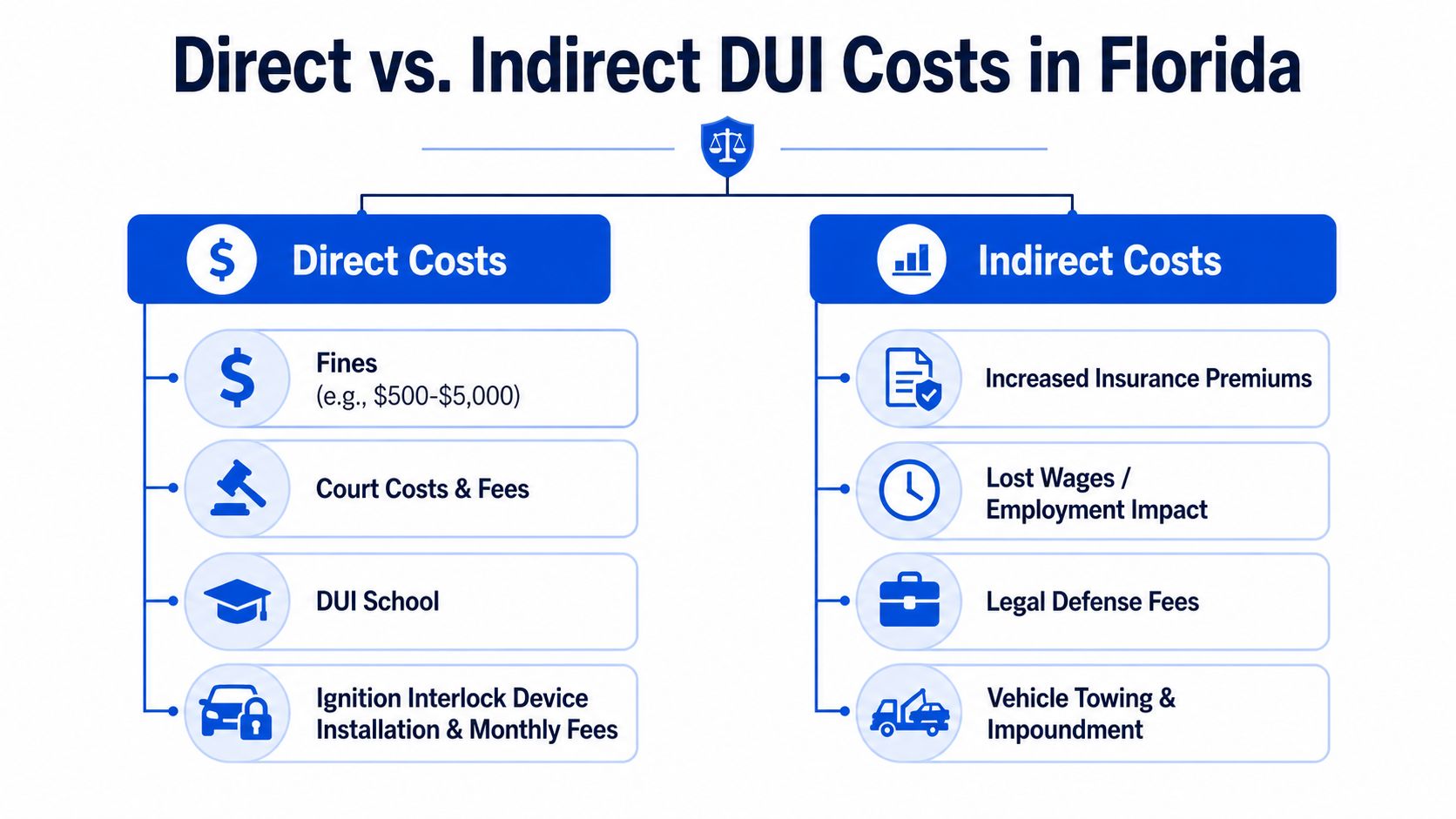
Direct punishment is only one layer
A lot of defendants fixate on the maximum penalties and miss the more common outcome. Statewide case data from Florida shows that convicted DUI defendants usually receive sentences well below the ceiling, with outcomes that vary by county and case facts. The point is simple. The court is not just looking at guilt, it is deciding how much supervision, treatment, and money to impose on top of the criminal conviction (Florida DUI case dataset).
That is why the fine alone tells you almost nothing. The true cost often comes from probation conditions, mandatory classes, license-related restrictions, and the practical expense of missing work or rearranging your life around court dates and program requirements.
The fine is rarely the part people remember. Probation, mandatory programs, and driving restrictions are what make the case disruptive.
Jail exposure changes fast once there is a prior
Repeat DUI is where the floor rises. A second conviction within 5 years carries a mandatory minimum jail term, and Florida also layers in longer revocation and ignition-interlock requirements (Florida DUI administrative suspension and penalty summary). That is not a sentencing technicality. It is the difference between a case that can be negotiated carefully and one that starts with mandatory custody pressure.
The cost side of the case also grows. Interlock means installation, monthly monitoring, service visits, and the daily burden of blowing into a device before you can drive. For a working person, that is not a small inconvenience. It affects commuting, childcare, and any job that depends on a vehicle.
If your case involves a prior DUI, the defense needs to focus on the charge tier, the alleged blood alcohol evidence, and the court conditions that will follow a conviction. The goal is not to hope the sentence stays light. The goal is to stop the case from reaching the point where the court can stack jail, supervision, and interlock on top of the conviction.
Driver License Suspensions and Hardship Options
Florida's license penalty is a separate track, and it starts immediately. If you wait for the criminal case to tell you whether you can drive, you are already behind. The DHSMV action can begin before arraignment, so the first 10 days after arrest are the window that matters if you want to protect your ability to drive.
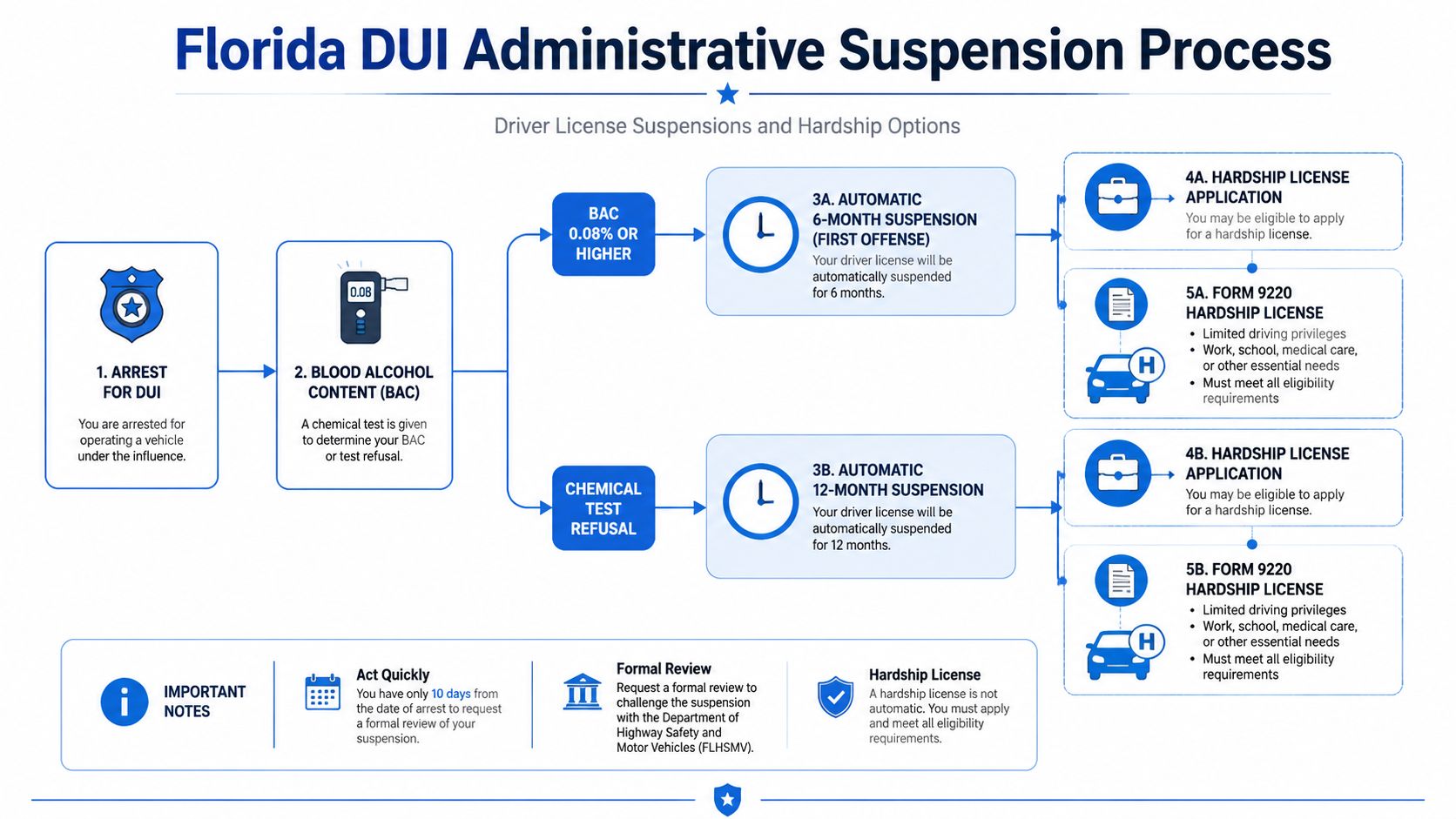
The DHSMV punishment is not the same as the court case
A first DUI usually brings two different license consequences depending on what happened at the stop. If you submitted to breath or blood testing, the administrative suspension is generally 6 months. If you refused, the suspension is generally 12 months, and refusal cases also include a 90-day hard suspension period (Florida DUI administrative suspension rules). You can lose driving privileges before a judge ever rules on guilt.
Deadlines control this part of the case. You have to request the administrative review hearing within the statutory deadline, and if you miss it, you often hand the State a suspension without a real challenge. If you need a practical next step on getting back on the road after the arrest, review the firm's guide to license reinstatement after DUI.
Hardship is not automatic, and it is not generous
A hardship license can help, but it does not restore full driving privileges. It usually allows limited, condition-based driving, not unrestricted use of your license. Eligibility depends on the offense history, whether there was a refusal, and how the paperwork is handled.
For many people, the core issue is not whether a hardship option exists. It is whether they can qualify for one fast enough to keep working, handle family obligations, and avoid turning a DUI arrest into a total transportation problem.
Bottom line: treat the DHSMV deadline like a court deadline. If you want to keep driving, you have to act immediately.
Implied Consent and Refusal Penalties in Florida
Florida's implied consent law works hard against you after a DUI arrest. If you drive on Florida roads, the State treats that as advance agreement to lawful chemical testing. Refusal gives prosecutors another issue to use, and it gives the DHSMV a separate basis to suspend your license.
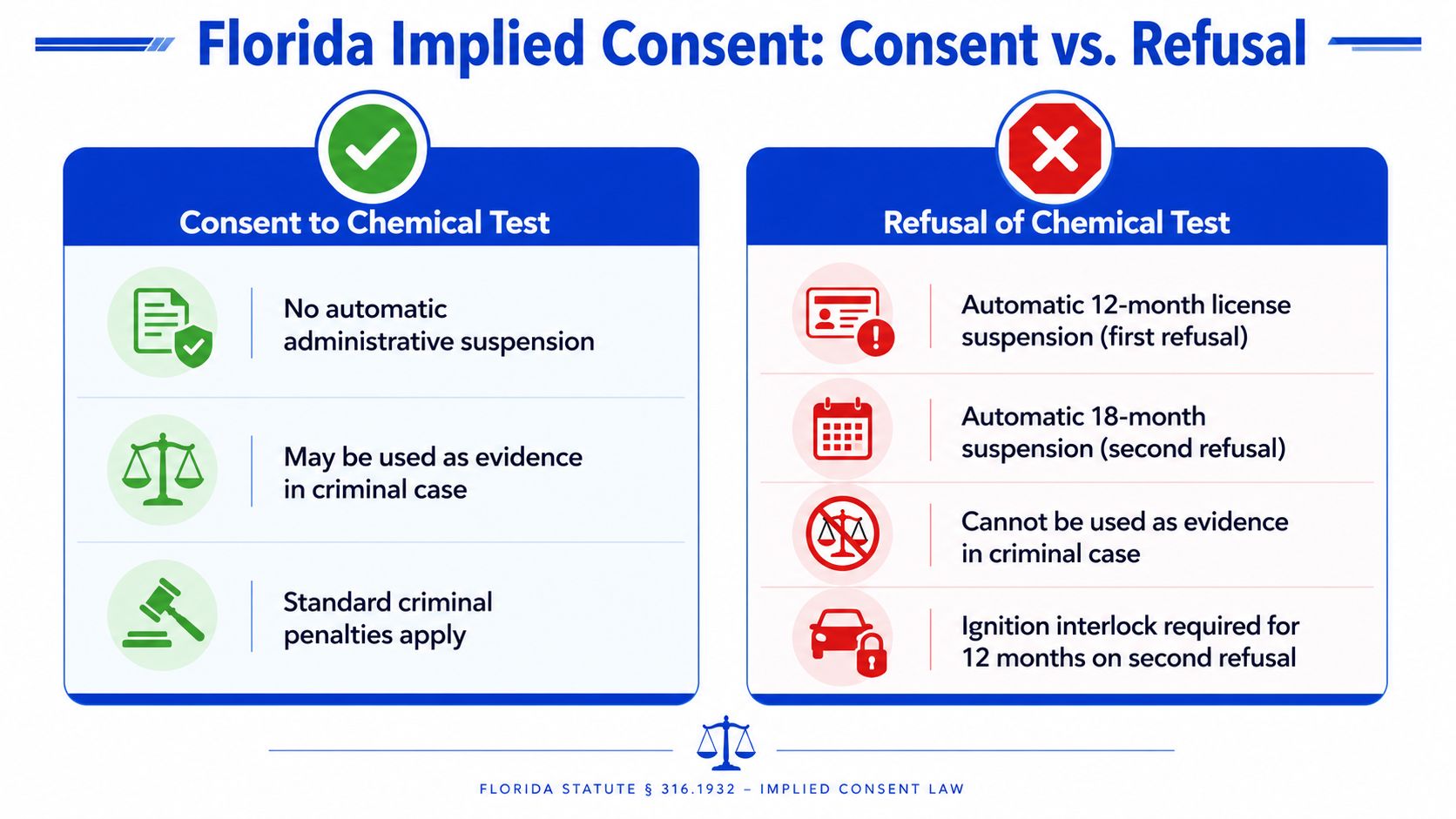
Consent and refusal are not the same risk
If you consent, the State gets a test result, and that number can be used in the criminal case. If you refuse, you may block the cleanest scientific proof, but you trigger refusal penalties and give the State another argument for court. The right move turns on the stop, the warning, the officer's conduct, and the facts leading up to the request.
A first refusal can mean a 12-month suspension. A second refusal can mean an 18-month suspension and ignition-interlock consequences for 12 months on the second refusal (Florida implied consent and refusal penalty summary). That is why refusal is never a simple win or loss. It is a tactical choice, and the details decide whether it helps or hurts.
The defense angle is built around timing and legality
If the stop was unlawful, the refusal fight changes fast. If the implied-consent warning was defective, the State's case can weaken. If the officer lacked a lawful basis for the arrest, that can matter in both the criminal case and the DHSMV action.
The defense has to attack both tracks at once. In a refusal case, the lawyer should challenge the stop, the warning, the sequence of events, and the hearing deadline. If you need a focused explanation of that process, the firm's page on refusal to submit to breath test in Florida lays out the approach that often gets missed.
What DUI Case Outcomes Look Like in Florida
A DUI arrest in Florida does two things at once. The criminal case moves through court, and the license case moves through the DHSMV. If you miss that split, you will misread the stakes.
Online, DUI stories sound like total disaster or an easy win. Real Florida data sits in the middle, and it should shape your decisions. In a statewide sample of 69,311 DUI cases from 2023–2025, the guilty rate was 91.9% and the dismissal rate was 1.2% across 65 Florida counties. Those numbers come from the public Florida DUI case dataset.

The usual result is a plea, not a courtroom victory
That same dataset reported an average sentence of 3.9 months for convicted defendants and an average fine of $1,047. That is the typical middle of Florida DUI work. Most cases do not disappear, but most also do not end at the harshest point of the statute. Prosecutors use the charge to push for a plea, and defense lawyers use the weak spots in the arrest, testing, and paperwork to cut the deal down.
The bigger point is simple. Florida agencies make DUI arrests constantly, and judges see these files every day. That routine cuts both ways. It means the State knows the playbook, and it means your lawyer has to attack the stop, the testing, the warnings, and the DHSMV deadline with precision. If your lawyer talks as if every case ends in dismissal, you are getting fantasy. If someone says a DUI always ends at the maximum, you are getting panic, not advice.
Read the numbers the right way
The statewide outcome data gives you a reality check, not a prediction. A case can still be beaten, narrowed, or negotiated into a better result when the stop was weak, the breath test was flawed, or the refusal warning was handled badly. If the officer's observations were shaky, the defense should examine horizontal gaze nystagmus closely, because that test is often treated as more reliable than it really is.
Use the data to stay grounded. Then use the facts of your own arrest to fight both tracks at once, the criminal case in court and the license action at DHSMV.
Common Florida DUI Defenses Worth Knowing
A DUI case is a chain. Break one link, and the State's case gets weaker. That's why the defense starts with the stop, not the courtroom drama.
The strongest defenses usually attack the foundation
Unlawful stop: If the officer lacked a lawful basis for the stop, the case can weaken before the State ever gets to testing.
Field sobriety problems: Balance issues, nerves, weather, shoes, medical conditions, and poor instructions can make roadside exercises unreliable.
Breath test problems: Maintenance records, calibration issues, and operator certification all matter.
Refusal challenges: The warning, the timing, and the officer's conduct can create defense angles in refusal cases.
Drug DUI issues: The State still has to prove actual impairment, not just point to a substance in the system.
The horizontal-gaze-nystagmus test gets overused by officers and misunderstood by drivers. If that test played a role in your arrest, read the firm's explanation of horizontal gaze nystagmus. It helps you see why an officer's observations are not the same thing as proof beyond a reasonable doubt.
Defense rule: the earlier a lawyer finds the weak link, the more likely the case can be reduced, narrowed, or challenged outright.
Don't wait for trial to start thinking about defense. The most useful work often happens before formal charges are even filed, when body cam, dash cam, test records, and hearing deadlines can still be used to your advantage. That's where a former prosecutor's perspective helps, because the State's process has pressure points if you know where to look.
Collateral Consequences and Your Next Steps
A DUI conviction reaches past the courtroom. It can affect insurance, work, professional licensing, and, for non-citizens, immigration risk. It can also leave a long record footprint that follows you well beyond the case itself.
The smart move is to act early, before the case hardens. A lawyer can preserve the administrative hearing, request video, review the stop, and look for suppression issues before the State locks in its theory. If the case is handled well from the start, the defense has more room to push for reduction, dismissal, or a better plea structure.
If you were arrested in Broward County, Fort Lauderdale, Miami-Dade, Palm Beach, or anywhere in South Florida, do not wait to see what happens next. Call a Florida DUI defense lawyer now, ask about the criminal case and the DHSMV deadline, and get a plan in place before your options shrink.
A CTA for Ticket Shield, PLLC.