Dui Checkpoints Florida
Jason Goldsmith, Esq
A Florida DUI checkpoint can turn an ordinary drive home into a high-pressure encounter within seconds. You may be asked to stop even though an officer didn't see you commit a traffic violation, and the decisions you make at the roadside can affect both a criminal DUI case and your driver's license. The most important questions are practical ones: Was the checkpoint properly planned? Was your vehicle selected neutrally? Did the officer have a lawful reason to extend the stop?
For drivers in Fort Lauderdale, Broward County, Miami-Dade, Palm Beach, and throughout South Florida, understanding those pressure points matters. Florida permits sobriety checkpoints, but constitutional safeguards limit how agencies may design and operate them. A careful defense begins with the checkpoint plan, the stopping pattern, the length of the detention, the officer's observations, and the testing that followed.
Table of Contents
Your Rights and Practical Steps Before, During, and After the Stop
How Ticket Shield PLLC Can Help After a Florida DUI Checkpoint
A Friday Night on a Florida Highway
The road is still shining from a recent shower when the blue lights appear ahead. You're driving home on a South Florida roadway after stopping at a bar, the radio turned low and both hands resting high on the steering wheel. Cones narrow the lanes, reflective signs glow in the headlights, and a uniformed officer waves traffic into a single line.
You notice details you hadn't expected. Marked patrol cars sit along the shoulder. An advance warning sign stands near the first set of cones. Wet asphalt, warm exhaust, and the faint smell of rain fill the car each time you breathe in. Your windows are rolled down, the dome light is off, and your mind starts replaying the evening.
The instinct is immediate. Maybe you should turn around. Maybe a side street is safer. Then you see another officer watching the approaching traffic, and the idea of making a sudden move feels worse than continuing forward.
The car ahead stops. Its driver hands over documents. A flashlight passes across the windshield and the front seats. You inch forward until the officer points directly at your vehicle.
You stop at the marked line. The officer bends toward the window.
“License and registration.”
That moment feels like a traffic stop, but legally it begins differently. You weren't necessarily pulled over because of something the officer observed. You were included in a planned screening operation. What happens next depends on whether the checkpoint follows Florida's constitutional rules and whether the officer develops an independent reason to investigate you further.

What Florida DUI Checkpoints Are and Why They Exist
A Florida DUI checkpoint, also called a sobriety checkpoint or sobriety roadblock, is a planned operation in which officers briefly stop vehicles to screen for impaired drivers. The initial stop generally doesn't require individualized suspicion because the checkpoint itself is based on a highway-safety purpose rather than a particular driver's conduct.
That authority has limits. The Florida Supreme Court approved checkpoint stops in State v. Jones in 1986, and the U.S. Supreme Court later upheld sobriety checkpoints nationally in Michigan Department of State Police v. Sitz in 1990. Florida practice is built around safeguards intended to prevent officers from choosing vehicles based on personal or arbitrary judgment. A Florida DUI checkpoint legality overview provides additional context on those constitutional boundaries.
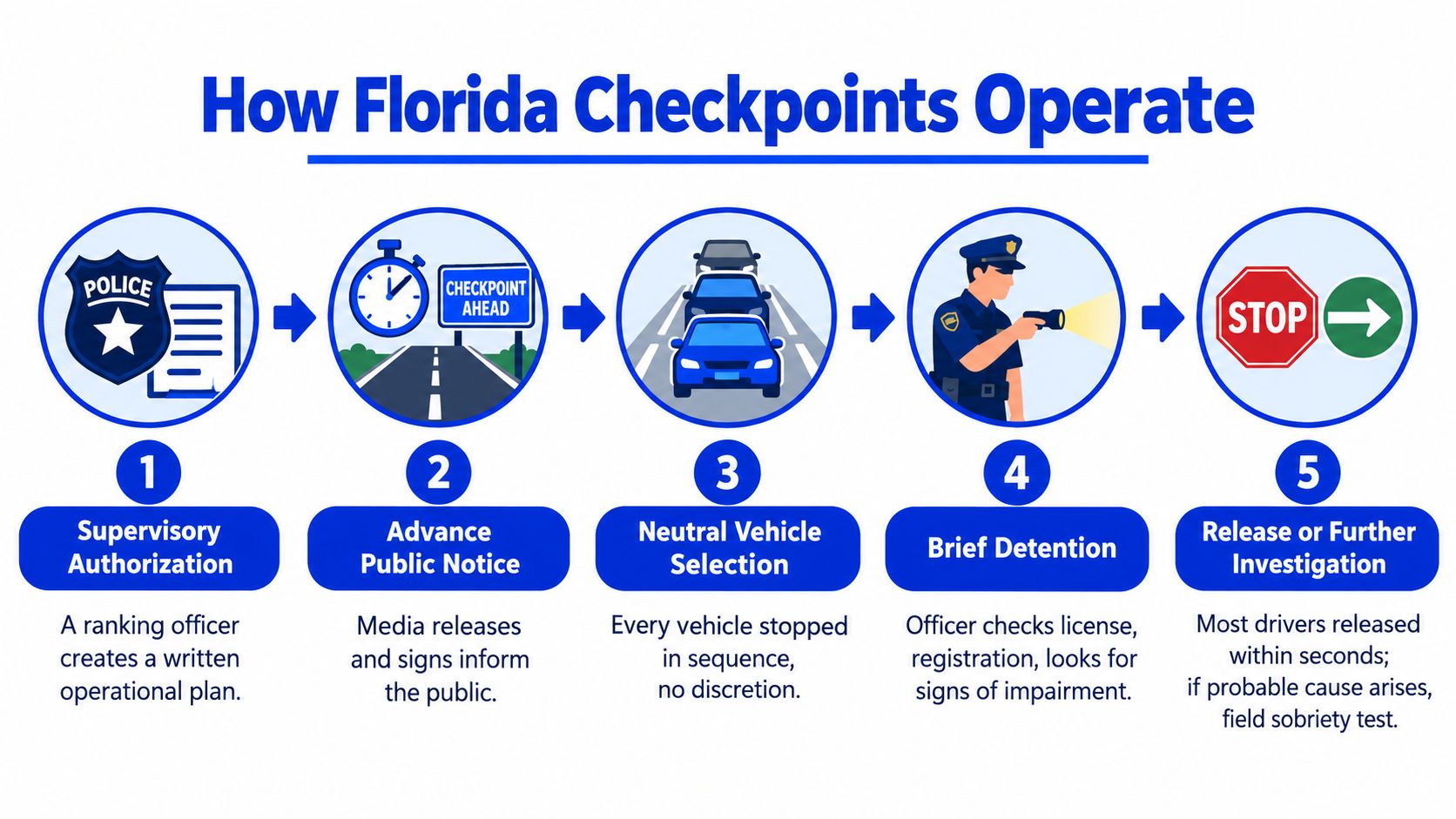
The operational foundation is a written plan approved in advance by supervisory personnel. The plan should establish how vehicles will be selected, how officers will work, how motorists will be warned, and how the agency will protect traffic safety. A neutral formula, such as stopping every vehicle or a predetermined sequence, matters because it limits discretion at the exact point where a seizure occurs.
Florida has used checkpoints as an organized enforcement strategy for decades. A 2005 Florida and NHTSA annual report recorded almost 400 DUI checkpoints during fiscal year 2005, with almost 38,500 vehicles passing through 155 checkpoints. The report also described other periods involving at least 175 checkpoints and consecutive years in which more than 400 checkpoints were held. Those figures come from the Florida 2005 annual report, and they show that checkpoints have been deployed at meaningful statewide scale rather than as isolated roadside events.
The public-safety purpose doesn't give officers unlimited authority. If the agency didn't create a written plan, used an unclear stopping method, or ignored its own procedures, the checkpoint may be vulnerable. The same is true if a brief screening turns into a detention based only on an officer's hunch.
How Florida Checkpoints Are Supposed to Operate
A lawful checkpoint should look more like a controlled procedure than an improvised traffic trap. The details matter because every stage limits the government's discretion.
The written plan comes first
Before officers place cones or stop traffic, a supervisor should approve a written operational plan. That plan should identify the location, timing, staffing, traffic-control methods, and neutral vehicle-selection formula. Florida checkpoint guidance emphasizes that a pre-approved written plan, neutral stopping formula, and visible safety procedures help prevent arbitrary seizures. The Florida sobriety checkpoint operational document reflects those procedural concerns.
The plan isn't a formality for the file. It becomes important evidence later. Defense counsel can compare what the plan required with what officers did, including which vehicles they stopped and how they handled delays.
Drivers should see the operation ahead
Warning signs, lighting, cones, and marked police vehicles should make the checkpoint visible before a driver reaches the stopping point. Advance public notice is also commonly treated as part of the legitimacy analysis. The purpose is to reduce surprise and create a safe, orderly flow, not to hide the operation until the last possible moment.
Visibility also protects motorists. A driver who can see the lane closure has time to slow down safely instead of making a panic maneuver.
Selection must be neutral
Officers shouldn't decide that one vehicle looks interesting and another doesn't unless the written plan permits that selection. A neutral sequence might require every vehicle to stop or identify a predetermined interval. The formula must be established in advance and applied consistently.
Practical rule: A checkpoint can begin lawfully and still become vulnerable if officers abandon the neutral formula in the roadway.
The first detention should remain brief
The screening officer may request driving documents, give basic directions, and observe signs such as odor, speech, coordination, or confusion. The initial encounter isn't supposed to become an open-ended interrogation. Florida sources describe a three-minute rule, under which broad vehicle diversion should be adjusted if average processing time exceeds that threshold. Officers are expected to suspend broad diversion and selectively stop vehicles until delays fall below the limit, as discussed in this explanation of the Florida checkpoint three-minute limit.
If specific facts suggest impairment, the encounter changes. The officer may direct the driver to a separate area for a DUI investigation, but that expansion should rest on observable facts rather than mere inclusion in the checkpoint line. The legal distinction between an initial seizure and a more intrusive detention is discussed in reasonable suspicion versus probable cause.
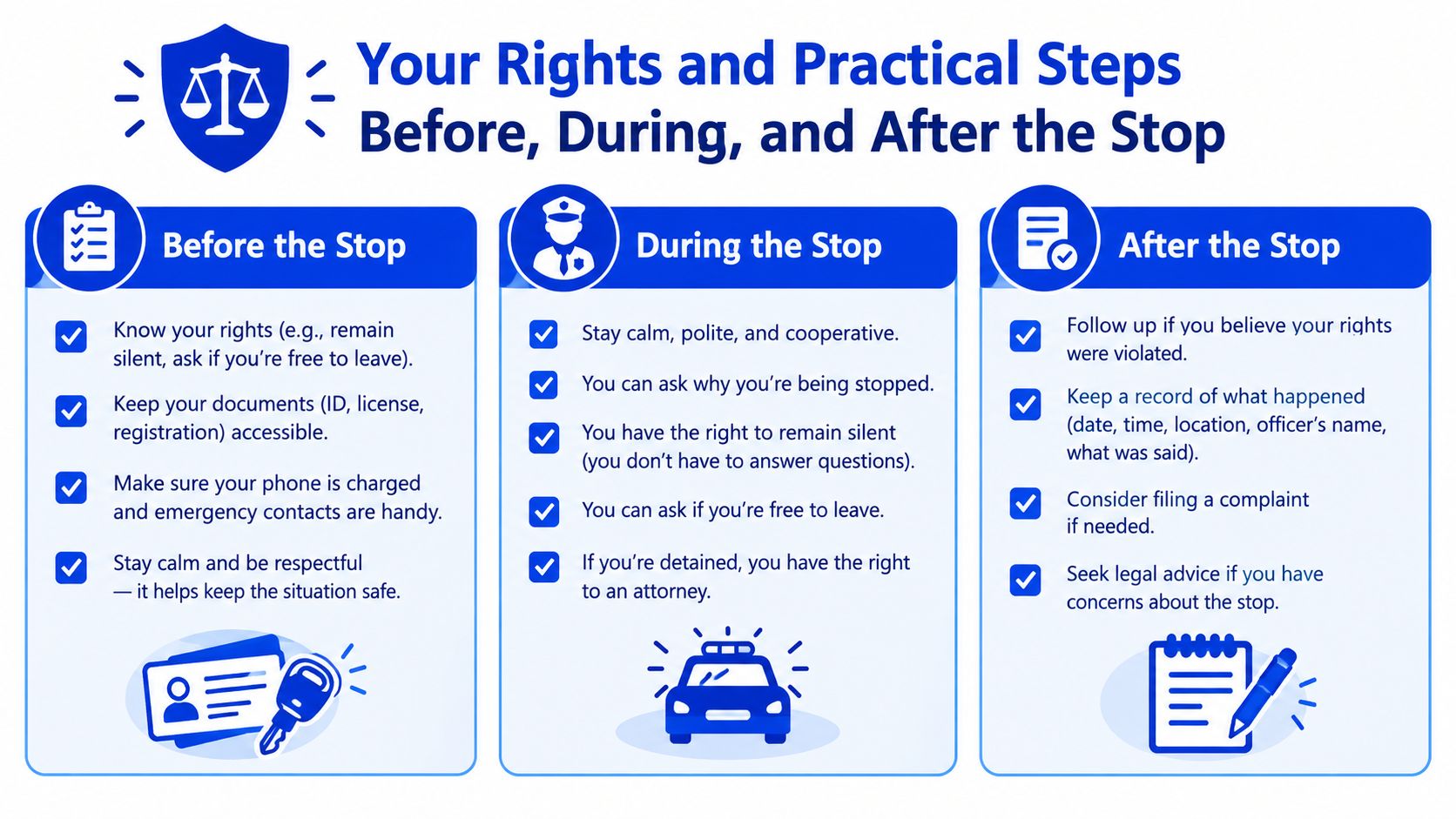
Your Rights and Practical Steps Before, During, and After the Stop
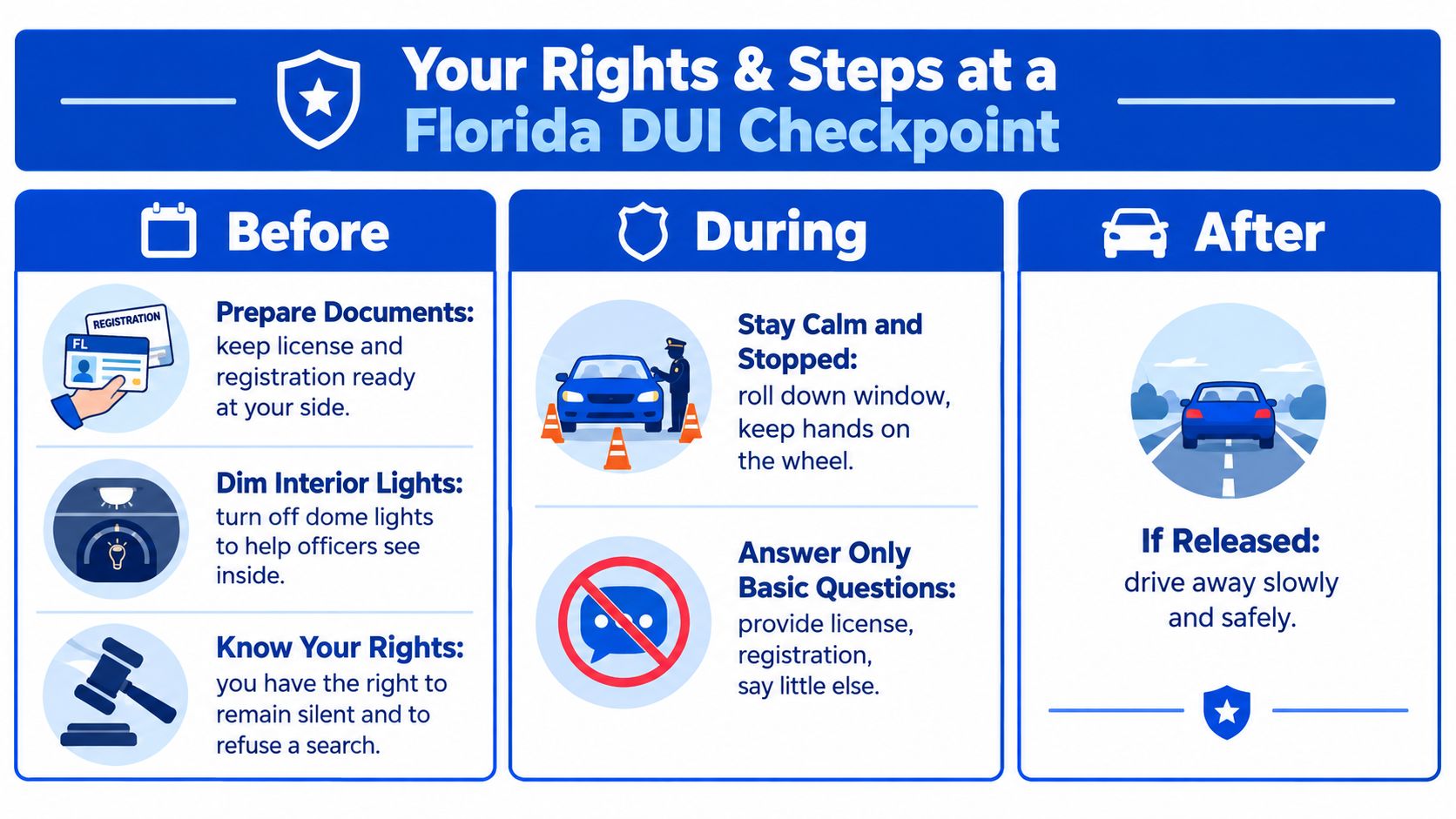
The safest roadside strategy is calm, limited, and deliberate. You can't control whether an officer chooses your car, but you can avoid turning a brief encounter into a larger problem.
Before you reach the checkpoint
Slow down and follow the traffic pattern. Keep your driver's license, registration, and proof of insurance accessible without reaching around the cabin. Turning around isn't automatically unlawful, but the maneuver must comply with traffic laws and safety requirements. A sudden U-turn, crossing a restricted line, driving onto a shoulder, or striking a curb can create an independent reason for a stop.
Dim the interior light if practical and keep your hands visible. That isn't an admission of anything. It makes the encounter easier for the officer to monitor and reduces the chance that ordinary movements will be misunderstood.
During the initial contact
Provide the documents the officer requests. You don't have to volunteer a narrative about where you've been, what you've consumed, or when you last drank. A short, respectful answer is usually better than trying to persuade an officer that you're sober.
You can decline consent to a vehicle search. Don't physically resist if an officer claims legal authority to search, and don't argue the constitutional issue beside the cones. State your lack of consent clearly and calmly, then remember what happened.
If the officer asks you to step out or perform field sobriety exercises, ask whether you're required to comply and avoid guessing about your rights in the moment. Refusing an exercise won't guarantee that you won't be arrested, but participating can create evidence the State may later use. The practical issues surrounding chemical-test decisions are addressed in whether you can refuse a breathalyzer in Florida.
After release or arrest
If the officer waves you through, leave slowly and safely. Don't stop nearby to confront officers or record the operation while driving away. Once you're in a safe place, write down what you remember:
Location and layout: Record the roadway, cones, signs, lighting, lane configuration, and nearby businesses.
Officer conduct: Note names, badge numbers, statements, requests, and whether officers followed a consistent pattern.
Timing: Estimate when you entered the queue, reached the officer, were moved aside, and were released or arrested.
Evidence preservation: Save dash-camera footage, passenger observations, receipts, and location records before they disappear.
If you're arrested, request a lawyer before answering substantive questions. Don't post the details online or discuss them with friends who may later become witnesses. A contemporaneous account can help counsel compare your memory with reports, body-camera footage, and the checkpoint records.
Field Sobriety Exercises and Chemical Tests in Florida
Field sobriety exercises are not interchangeable with chemical testing. Each produces a different type of evidence, and each has conditions that can affect how much weight a judge or jury should give it.
The commonly used standardized exercises include Horizontal Gaze Nystagmus, the Walk-and-Turn, and the One-Leg Stand. The first involves observed eye movement. The latter exercises require balance, divided attention, and the ability to follow instructions. They can be affected by poor lighting, uneven pavement, footwear, fatigue, age, injury, neurological conditions, and the officer's instructions or demonstrations.
A defense lawyer examines the recording and the administration, not just the officer's conclusion. Did the officer explain and demonstrate the exercise? Was the surface level? Did traffic, rain, flashing lights, or nearby vehicles distract the driver? Did the officer count correctly and document clues accurately? These questions can expose weaknesses without requiring the defense to claim that every officer acted in bad faith.
Test | What It Measures | Legal Standard | Common Defense Challenge |
|---|---|---|---|
Horizontal Gaze Nystagmus | Eye movement observed during a controlled gaze | Proper administration and admissible observations are required | Lighting, distance, medical conditions, glasses, poor instructions, or incomplete documentation |
Walk-and-Turn | Balance, divided attention, and following directions | The State must connect the performance to impairment evidence | Uneven ground, footwear, weather, confusion, physical limitations, or officer cueing |
One-Leg Stand | Balance and divided attention | The performance must be interpreted with the surrounding facts | Leg, back, inner-ear, or neurological issues, fatigue, surface conditions, or timing errors |
Breath, blood, or urine testing | Chemical evidence of alcohol or substances | Testing must comply with Florida law and applicable procedures | Collection, observation, machine reliability, operator qualifications, timing, or chain of custody |
Florida's implied-consent framework applies when a driver is in actual physical control of a motor vehicle and a breath or blood-alcohol level reaches 0.08 or higher. The same framework addresses refusal to submit to breath, blood, or urine testing, creating a separate immediate licensing consequence. The governing administrative-suspension statute is Florida Statute 322.2615.
The testing decision is therefore not only about the criminal case. Counsel may examine whether the request was lawful, whether the collection complied with procedure, whether the result is reliable, and whether independent evidence contradicts the State's interpretation. A detailed review of the Florida field sobriety test can help explain why roadside performance must be evaluated in context.
Challenging an Unlawful Checkpoint Stop
A valid checkpoint isn't immune from challenge. The defense question is whether the agency followed the constitutional design before and during your particular stop.
A motion to suppress may rely on the Fourth Amendment and Article I, Section 12 of the Florida Constitution. The argument may focus on a missing written plan, a supervisor who didn't authorize the operation, an unexplained departure from the stopping formula, poor visibility, or a detention that lasted beyond the brief screening purpose without specific facts supporting further investigation.
The three-minute benchmark is especially useful as an operational warning sign, not a magic stopwatch that decides every case. A delay may have an innocent explanation, while a shorter detention may still be unlawful if officers selected your vehicle arbitrarily or extended the encounter without objective observations. The court examines the total circumstances and the agency's records.
What defense counsel requests
The State's evidence often includes more than the arrest affidavit. Counsel may seek:
The original checkpoint plan: This shows the authorized formula, location, staffing, and supervisory approval.
Officer reports and recordings: Body-camera, dash-camera, and dispatch material can test the written narrative.
Operational logs: These may show vehicle counts, delays, staffing changes, and whether officers adjusted the procedure.
Officer testimony: Depositions and hearings can reveal inconsistencies between the plan and roadside practice.
The State must establish the legality of the seizure and the admissibility of evidence obtained during the encounter. If a judge suppresses critical observations, statements, field-test performance, or chemical evidence, the prosecution may lose the foundation needed to prove the DUI charge.
That doesn't guarantee dismissal. The State might still possess independent evidence, and a court may suppress some evidence while allowing other evidence. The defense must connect each defect to the evidence the prosecution wants to use. A practical explanation of that process appears in this guide to motions to suppress evidence.
Charges, License Suspension, and Long-Term Consequences
A checkpoint arrest creates two separate legal tracks. The criminal case determines whether the State can prove DUI. The administrative case concerns your driving privilege and may proceed even if the criminal prosecution later weakens.
Under Florida's DUI statute, a person may face a charge if they drove or had actual physical control of a vehicle while impaired, or if a chemical result meets the statutory threshold. Florida law treats 0.08 or higher as prima facie evidence of impairment, meaning the result may be used as evidence that the driver's normal faculties were impaired. The applicable rule appears in Florida Statute 316.1934.
A refusal is not the same as a not-guilty result. Florida's implied-consent system can impose an administrative suspension for refusal, while a breath-alcohol result at or above the threshold can trigger a different suspension process. For drivers over 21, the Florida Department of Highway Safety and Motor Vehicles identifies a six-month suspension for a first administrative suspension based on a qualifying result and one year for a second or subsequent suspension, as explained by Florida's DUI administrative suspension laws.
The deadline requires immediate attention
The administrative review process has a short deadline. A driver generally has ten days to request a formal review hearing after the qualifying DUI suspension event. Missing that deadline can eliminate an important opportunity to contest the suspension, so counsel should address the license issue immediately rather than waiting for the criminal case to develop.
Potential consequences can also include ignition-interlock requirements, an ignition-interlock license, employment complications, insurance consequences, and restrictions on driving. A reduced charge, dismissal, or successful suppression ruling may change the practical exposure, but no lawyer can promise a particular result. The right strategy depends on the checkpoint records, test evidence, prior history, and the facts supporting the arrest.
How Ticket Shield PLLC Can Help After a Florida DUI Checkpoint
A driver doesn't need to wait for a formal DUI charge before seeking advice. Whether you were arrested, cited, released, or given a warning, early review can preserve evidence and clarify the administrative deadline.
Ticket Shield, PLLC, led by former prosecutor Jason S. Goldsmith, represents clients in Broward County, Fort Lauderdale, Miami-Dade, Palm Beach, and other Florida jurisdictions. The firm can examine the written checkpoint plan, request public records, review body-camera and dash-camera material, compare officer accounts, evaluate field sobriety evidence, and assess chemical-test procedures. Counsel may also determine whether a suppression motion or administrative review request is appropriate.
The firm's former-prosecutor perspective can help identify how the State Attorney's Office may evaluate checkpoint documentation and whether a procedural defect affects the evidence. A consultation should give you a realistic assessment of exposure, possible defenses, and next steps without promising an outcome.
If your license is at risk, contact a South Florida defense lawyer immediately. Ticket Shield is available 24/7, and acting before the ten-day administrative deadline can preserve an important avenue for challenging the suspension.
Ticket Shield, PLLC reviews Florida DUI checkpoint stops, written plans, detention timelines, field sobriety evidence, chemical tests, and license-suspension deadlines. Visit Ticket Shield, PLLC for a confidential consultation serving Fort Lauderdale, Broward County, Miami-Dade, Palm Beach, and surrounding South Florida communities.